
Premium Wedding Rings Melbourne: The 2026 Definitive Buyer’s Guide

What if the metal purity you chose for its prestige is actually the primary reason your wedding band loses its structural integrity over time? Selecting wedding rings is a task that demands more than just an eye for style; it requires a technical understanding of how specific materials perform under decades of daily friction and pressure. Most couples prioritise the initial sparkle, yet the true value of a ring lies in its engineering and its ability to withstand the rigors of a lifetime without compromising its form.
It's natural to feel uncertain about the long term durability of different gold alloys versus platinum, or how to ensure a new band sits perfectly flush against a unique engagement ring. You want a piece that functions as a precise extension of your existing jewellery rather than a poorly fitted afterthought. This 2026 guide provides the technical framework you need to master the nuances of ring selection, ensuring lifelong durability and aesthetic harmony. We will examine the performance metrics of premium alloys, the value proposition of natural versus lab grown accents, and the bespoke CAD processes that guarantee a seamless, professional fit.
Key Takeaways
- Understand the specific physical properties of Platinum and 18K gold alloys to select a material that balances aesthetic appeal with the structural integrity required for daily wear.
- Discover how a bespoke CAD design process ensures your wedding rings in Melbourne achieve millimetre-perfect alignment and eliminate the risk of mechanical wear between bands.
- Evaluate the technical merits of different setting styles, such as channel and grain, to ensure diamond-set bands remain secure under long-term environmental stress.
- Learn to identify 'Wed-Fit' and contoured ring designs to solve the common issue of non-flush pairings and achieve a seamless, professional aesthetic.
Understanding the Foundation: Wedding Ring Styles and Materials
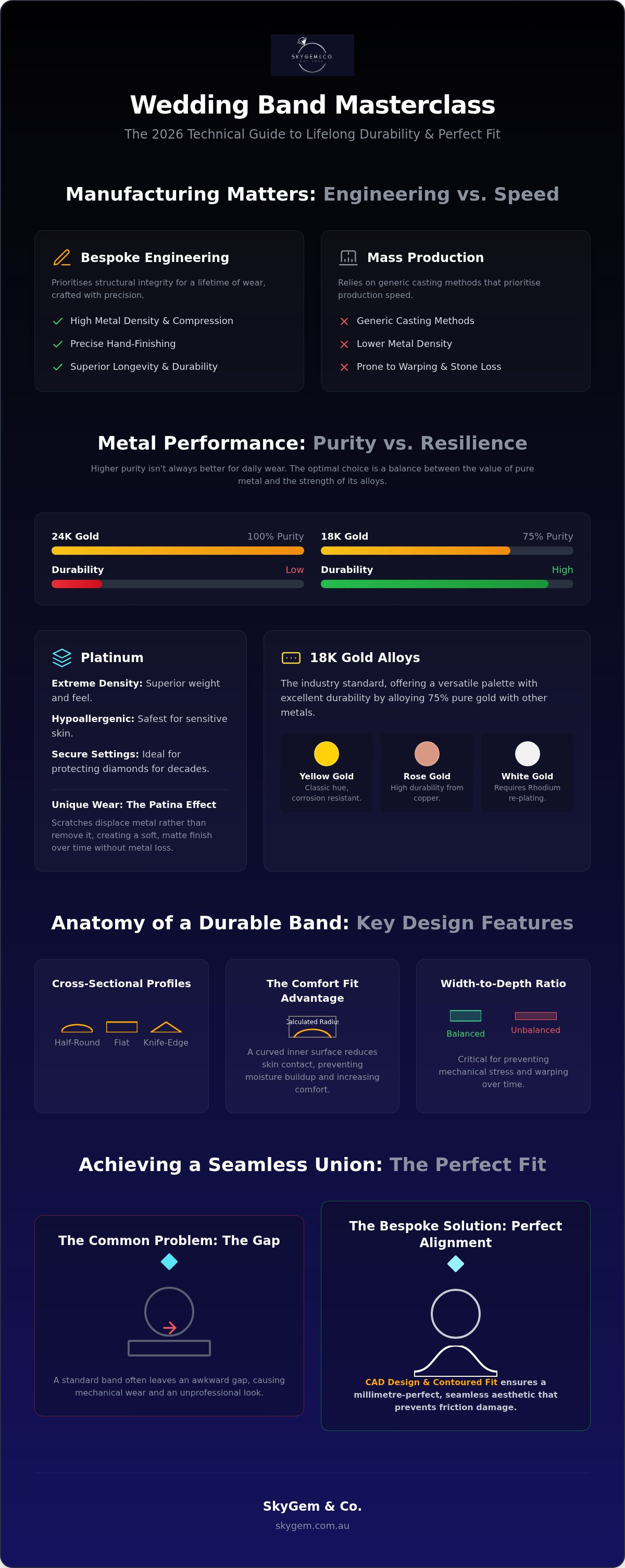
A wedding ring is more than a simple adornment; it's a permanent mechanical asset designed to endure decades of daily friction and environmental exposure. When you evaluate wedding rings melbourne, it's vital to distinguish between 'Ready-to-Wear' manufacturing and bespoke engineering. Mass-produced rings often rely on generic casting methods that prioritise production speed over metal density. In contrast, bespoke standards involve precise metal compression and hand-finishing, ensuring the piece maintains its structural integrity despite constant contact with hard surfaces. Current 2026 trends reflect a significant shift back to substantial metal weights, moving away from the fragile, ultra-thin bands of previous years that were prone to warping and stone loss. This return to durability ensures that the ring remains a stable foundation for a lifetime of wear.
The Technical Anatomy of a Wedding Band
The performance of a band is dictated by its cross-sectional profile and internal geometry. Profiles like the Half-Round offer a traditional domed aesthetic, while Flat or Knife-Edge silhouettes provide modern light reflection patterns and sharper geometric lines. However, the most critical technical feature is the internal comfort fit. This involves a calculated radius on the inner edge of the shank, reducing the surface area in contact with the skin. This design prevents moisture buildup and ensures the ring remains comfortable during temperature-induced finger swelling. Achieving the correct width-to-depth ratio is also essential for longevity; a band that is too thin relative to its width will eventually succumb to mechanical stress and lose its circular form over time.
Classic vs. Contemporary Silhouettes
While the plain polished band remains the gold standard for its ease of maintenance and timeless appeal, modern silhouettes frequently incorporate varied textures. Matte, brushed, and hammered finishes offer a sophisticated, non-reflective alternative, though it's important to understand these are surface treatments. Over several years, daily wear will naturally burnish these textures, requiring professional re-finishing to restore the original look. For those seeking specific wedding rings melbourne for style inspiration, the focus should remain on how the silhouette complements the engagement ring's proportions. A well-designed band acts as a structural partner, providing a stable foundation that enhances the overall aesthetic of the bridal set without compromising on comfort or durability.
Selecting the Optimal Metal for Longevity and Performance
Achieving a balance between chemical purity and mechanical resilience is the primary challenge when selecting the metal for your wedding band. A common misconception suggests that a higher gold karat always equates to a superior ring. However, in the context of wedding rings melbourne, 18K gold (75% purity) is the industrial standard for a reason. While 24K gold represents absolute purity, its inherent softness makes it unsuitable for the high-friction environment of a ring worn daily. By alloying gold with metals like palladium, copper, or silver, we create a material that retains its investment value while gaining the hardness necessary to protect gemstone settings and resist warping.
Platinum: The Industrial Standard for Durability
Platinum is favoured for its extreme density and unique wear characteristics. Unlike gold, which loses microscopic amounts of metal when scratched, platinum undergoes a process known as displacement. The metal is merely pushed aside rather than removed. This results in the 'patina' effect, a soft matte finish that many collectors value as a mark of the ring's history. Because no metal is lost over time, platinum is the technically superior choice for diamond-set bands, as the claws remain structurally sound for decades. It's also naturally hypoallergenic, making it the safest option for individuals with sensitive skin or metal allergies.
18K Gold Alloys: Yellow, White, and Rose
Gold alloys provide a versatile palette, but each carries specific maintenance requirements. 18K Yellow Gold is prized for its classic hue and excellent corrosion resistance. Rose Gold, created by increasing the copper content, offers high durability and colour stability. White gold, however, requires a different management cycle. Most white gold is naturally slightly warm in tone and is finished with a Rhodium plating to achieve a crisp, reflective white. This plating will eventually wear, requiring a professional re-rhodium service every 12 to 24 months to maintain its brilliance. For a more technical deep dive into metal properties, you can explore our Definitive Guide to Gold Jewellery.
When selecting your metal, consider how it interacts with your existing jewellery. Choosing a metal that matches the hardness of your engagement ring prevents one band from wearing down the other through constant contact. If you're unsure which alloy aligns with your lifestyle, a bespoke technical consultation can help clarify the best path forward for your specific design requirements.
Incorporating Diamonds and Gemstones into Your Wedding Band
While traditional plain bands offer simplicity, many couples looking for wedding rings melbourne are transitioning toward diamond-set 'eternity' styles. This shift introduces complex engineering requirements. A stone-set band must balance brilliance with structural integrity. Unlike a solitaire ring where one stone is the focus, a wedding band features multiple small accents. These require precise alignment. Professional consultation ensures these wedding rings melbourne remain structurally sound over decades of wear.
Setting Styles and Stone Security
Choosing the right setting depends on your daily activity level. Channel settings provide the highest security for active wearers. In this configuration, stones sit between two continuous walls of metal. A flush surface prevents snagging. Pave and grain settings use minute beads of metal to hold stones. Brilliance is maximised by exposing more facets. However, they require superior craftsmanship. We always advocate for hand-setting stones rather than using cast-in-place methods. Hand-setting allows the jeweller to tension each claw individually. Precision here reduces the risk of stone loss.
Australian Sapphires and Rubies offer exceptional durability for those seeking a departure from diamonds. Sapphires rank 9 on the Mohs scale. They are the most resilient coloured gemstones for a wedding band. Their chemical stability ensures they won't fade. Incorporating these stones into a low-profile setting ensures the band remains practical. It provides a distinct, personalised aesthetic without compromising performance.
Natural vs. Lab-Grown Diamond Accents
The choice between natural and lab-grown diamonds depends on your priorities regarding rarity and budget. Lab-grown diamonds provide a cost-efficient solution for high-carat eternity bands. Larger or more numerous stones become accessible without increasing the price point. Conversely, natural GIA-certified diamond accents maintain long-term rarity. Hardness and refractive indices are identical. Both options offer the same performance metrics. You can explore the specific nuances of these stones in our guide to lab grown diamonds melbourne. Selecting GIA-certified accents ensures every stone meets strict quality standards. Quality control is vital for achieving a uniform sparkle.
The Bespoke Design Journey: Crafting Your Unique Symbol
Bespoke manufacturing represents the pinnacle of jewellery engineering. It moves the selection of wedding rings melbourne away from speculative retail browsing toward a structured technical partnership. At SkyGem & Co., we treat every project as a unique design challenge, focusing on how the ring will perform over a fifty-year horizon. This process typically spans four to six weeks. This timeframe allows for exhaustive quality checks at every stage, ensuring the final product meets our rigorous internal benchmarks for durability and finish.
From Concept to CAD: The Precision Phase
The journey begins with a technical consultation where we align your aesthetic preferences with the physical performance of your chosen materials. We then move into Computer-Aided Design (CAD). This technology allows for millimetre-perfect accuracy. It's especially vital when designing a band to sit flush against a custom-made engagement ring melbourne. 3D rendering provides a digital prototype. You can visualise the interaction between the two bands from every angle before any metal is cast. We use this phase to apply structural reinforcement to high-wear areas, such as increasing the depth of the shank or adjusting stone counts. This ensures the final piece achieves a perfect visual balance without sacrificing strength.
The Hand-Finishing Standard
Digital precision provides the framework, but the final performance of the ring depends on the hand-finishing stage. Once the raw casting is complete, our master jewellers begin the laborious process of refining the metal. This involves multiple stages of polishing and tension-setting every diamond or gemstone. This 'human touch' ensures that the surface is free of microscopic casting pits that can lead to structural failure over time. Each piece undergoes rigorous quality control checkpoints to ensure compliance with national regulatory standards for metal purity and stone grading. This methodical approach guarantees that your ring isn't just a beautiful object; it's a durable asset built to withstand the physical demands of daily life.
If you're ready to begin your design journey, start your bespoke consultation to discuss your requirements with our technical specialists.
Achieving Aesthetic Harmony: Pairing Bands with Engagement Rings
Selecting wedding rings melbourne often leads to a common technical frustration: the presence of an unsightly gap between the engagement ring and the wedding band. This aesthetic misalignment usually occurs when the engagement ring setting sits low on the finger, preventing a straight band from sliding underneath the basket or halo. To resolve this, we categorise solutions into 'Wed-Fit' architecture or custom contoured engineering. A 'Wed-Fit' design is an engagement ring specifically engineered with a raised setting to allow a standard straight wedding band to sit flush. If your engagement ring wasn't built with this foresight, bespoke intervention is required to achieve a seamless pairing.
Solving the Flush-Fit Dilemma
Contoured bands are engineered specifically to follow the unique arc of a halo or trilogy ring. These pieces use precise CAD measurements to wrap around the central setting, creating a unified silhouette. Alternatively, notched bands provide a technical solution for low-set gemstone settings by removing a small section of the band to accommodate the engagement ring's basket. For some, a straight band remains an intentional design choice. This 'intentional gap' can highlight the individual character of each ring, though it requires careful consideration of the rings' relative heights to prevent mechanical wear where the two pieces of jewellery meet.
Balancing Carat Weights and Widths
Achieving a cohesive set requires more than just a flush fit; it demands a balance of visual weight. A wedding band that is too wide or features excessively large diamonds can easily overpower the centre stone of the engagement ring. Proportional harmony is maintained when the band complements rather than competes with the primary diamond. Matching metal profiles is another essential step in technical pairing. If your engagement ring features a knife-edge shank, pairing it with a half-round wedding band can create a disjointed aesthetic. Consistency in the shank profile ensures the rings feel like a singular, intentional unit.
The modern stacking trend has introduced more flexibility, allowing for a curated look that mixes metals, such as pairing a rose gold band with a platinum engagement ring. While this allows for personal expression, the underlying structural profiles must still harmonise to ensure long-term comfort and stability. For a deeper analysis of how to design a set from the ground up, our guide on bespoke engagement rings melbourne offers comprehensive pairing advice to ensure your final bridal set is technically and aesthetically perfect.
Securing Your Lifelong Investment
Selecting a wedding ring is a technical decision that dictates the structural integrity of your bridal set for decades. We've explored how specific material properties, such as the density of platinum or the alloy composition of 18K gold, influence long-term performance. You now understand that achieving a seamless aesthetic harmony requires more than just visual matching; it demands the precision of bespoke CAD design to eliminate mechanical wear and ensure a perfect flush fit.
By prioritising engineering over retail trends, you're investing in a permanent asset that remains as resilient as it is beautiful. Our expert GIA-trained consultants act as technical partners, specialising in everything from GIA-certified diamonds to rare Australian Sapphires. Whether you're seeking a classic band or a complex contoured design, we provide the expertise necessary to secure your legacy. If you're ready to finalise your search for wedding rings melbourne, we invite you to take the next step. Book a Bespoke Wedding Ring Consultation with SkyGem & Co. today to ensure a guaranteed flush fit and expert material validation. We look forward to engineering a piece that stands the test of time.
Frequently Asked Questions
How much should I spend on a wedding ring in Australia in 2026?
Expenditure on wedding rings in Australia is dictated by material volume, metal purity, and gemstone specifications rather than arbitrary percentage rules. Instead of following outdated trends, focus on the cost of technical inputs like metal weight and diamond quality. Investing in a substantial band ensures the piece won't warp or thin over decades. Prioritise structural integrity and material purity to ensure the ring remains a durable, long term asset.
Is Platinum better than 18K White Gold for a wedding band?
Platinum is technically superior for stone security because it displaces rather than wears away over time. While 18K white gold is harder and offers higher resistance to surface scratching, it requires regular rhodium plating to maintain its crisp finish. For those seeking wedding rings melbourne that require minimal maintenance and permanent colour stability, platinum is the industrial standard. Your choice should align with your specific maintenance preferences.
Can I design a wedding band to fit my unique engagement ring perfectly?
Yes, a bespoke CAD design process allows for millimetre-perfect alignment with any engagement ring silhouette. We use 3D rendering to ensure the wedding band follows the exact arc of your central setting, whether it's a halo, trilogy, or low-set solitaire. This technical approach eliminates the unsightly gap found with mass-produced rings. It also prevents mechanical friction between the two pieces, preserving the structural integrity of both bands.
What is the most durable setting for a diamond wedding ring?
Channel settings are the most durable option for active lifestyles. By securing diamonds between two continuous walls of precious metal, the stones are protected from side impacts and snagging. This 'flush' surface is ideal for daily wear. While grain and claw settings offer higher brilliance, they expose more of the stone's surface. For maximum longevity, ensure your stones are hand-set into a substantial metal foundation rather than using cast-in-place methods.
How long does it take to create a bespoke wedding ring?
The creation of a bespoke wedding ring typically requires four to six weeks from the initial consultation to final polishing. This period includes the technical design phase, 3D CAD rendering, casting, and the meticulous hand-setting of any gemstones. Rushing this process can compromise the quality of the metal finishing or the security of the settings. Planning ahead ensures every quality control checkpoint is met according to national regulatory standards.
Do men's wedding bands come with diamonds or are they usually plain?
Men's wedding bands are increasingly incorporating diamond accents, though plain polished or brushed styles remain classic choices. Technical preferences often lean toward flush-set diamonds or subtle grain settings that don't compromise the ring's rugged profile. Whether you choose a plain band or one with lab-grown diamonds, the focus should remain on the width and depth ratios. A well-engineered band feels substantial and resists deformation during physical activity.
Should my wedding ring match my partner's ring exactly?
There is no technical requirement for wedding rings to match; instead, many couples opt for complementary design elements. You might choose the same metal alloy, such as 18K rose gold, while selecting different profiles or finishes. This approach allows each individual to choose a band that suits their personal hand proportions and lifestyle. Shared design markers create a sense of cohesion without forcing a compromise on comfort or technical performance.
How do I find my ring size without visiting a store?
You can determine your ring size accurately by using a physical multi-sizer tool or measuring the internal diameter of an existing ring with digital calipers. Avoid using paper or string methods, as these lack the precision required for a professional fit. When measuring for wedding rings melbourne, consider that finger size fluctuates with temperature. A technical consultant can provide a professional sizing kit to ensure the band is engineered for a secure fit.
Disclaimer
This article is for general informational purposes only and may include AI-assisted content. Pricing, specifications, and availability are subject to change. For accurate advice and current information, please contact SkyGem & Co. directly. Nothing in this content constitutes professional or financial advice.