
The Definitive Guide to Gold Jewellery: Purity, Craftsmanship, and Investment Value

Would you intentionally pay a 300% markup for a 9ct gold piece that lacks the structural density to survive daily wear for more than five years? Many Australian collectors find the price discrepancies between 18ct and 9ct options confusing, often leading to purchases that cause skin irritation or tarnish prematurely. You're right to expect more transparency from a sector where the technical specifications of gold jewellery are frequently obscured by marketing jargon.
By mastering the metallurgical nuances of karats, alloy compositions, and local manufacturing standards, you can secure pieces that retain both their aesthetic brilliance and tangible value. This guide provides a rigorous analysis of gold purity and craftsmanship to ensure your next acquisition is a high-performing asset. We'll detail the engineering of durable settings, the impact of Australian hallmarking compliance, and the specific factors that influence long-term resale potential in the current A$ market.
Key Takeaways
- Understand the technical breakdown of the karat system to determine the precise balance between pure gold content and structural durability.
- Learn how metallurgical engineering uses specific alloys like palladium and copper to achieve distinct colour profiles while maintaining material integrity.
- Evaluate the long-term "cost per wear" of solid gold jewellery versus plated alternatives to ensure your acquisition remains a high-value asset over decades.
- Master a professional checklist for inspecting weight and finish, allowing you to identify superior craftsmanship and avoid common manufacturing defects.
- Discover why bespoke manufacturing processes result in higher metal density and a more resilient piece than mass-produced casting methods.
The Anatomy of Gold: Understanding Purity and Karats
Gold jewellery is rarely composed of the pure element alone. In its 24ct form, gold is exceptionally soft, making it unsuitable for the rigors of daily wear or the complex architecture of modern settings. To achieve the necessary structural integrity, pure gold is fused with various gold alloys. These additions, which often include silver, copper, and palladium, provide the hardness required to retain fine detail and secure precious gemstones safely.
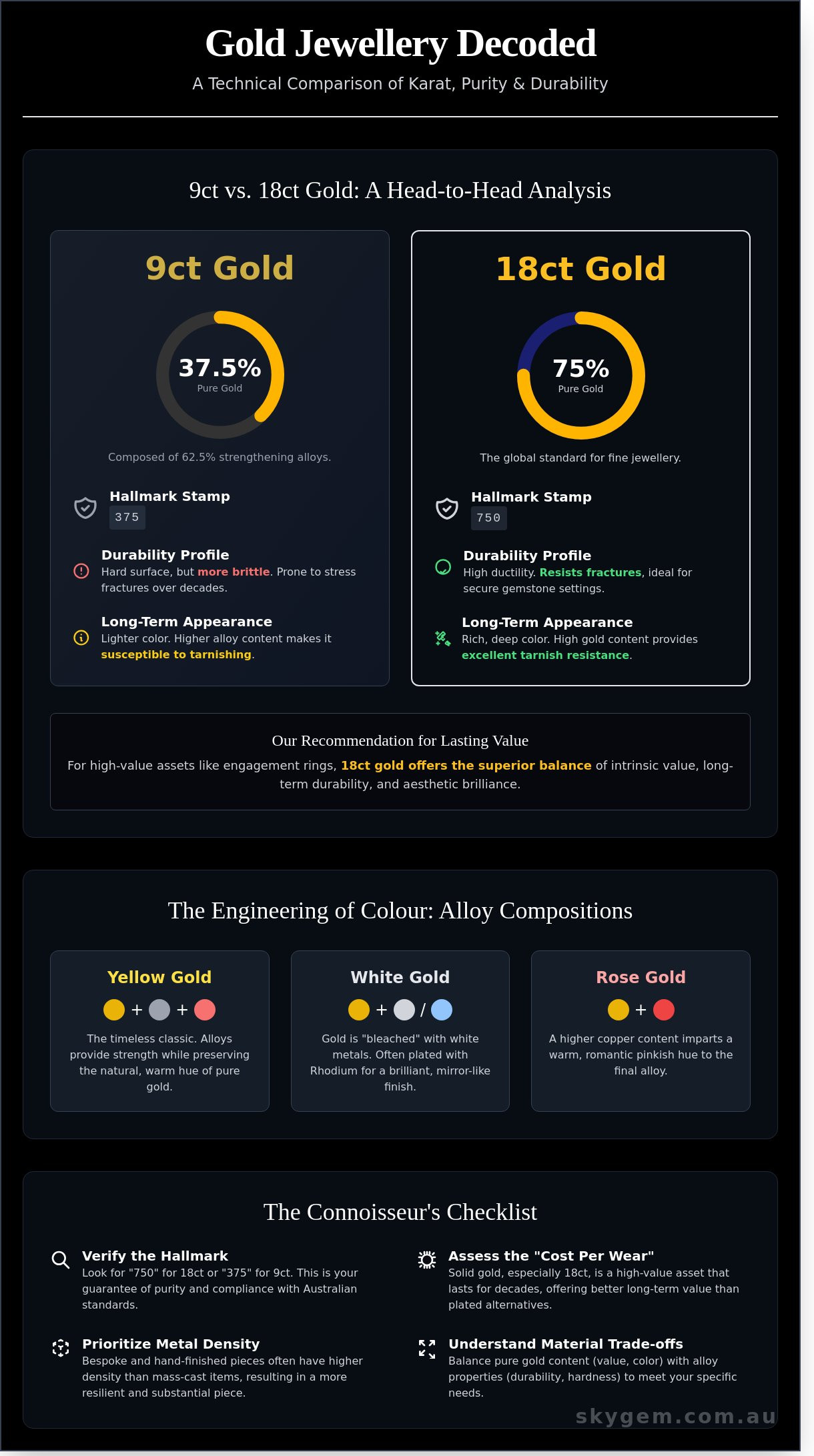
The Karat system serves as the technical baseline for measuring this purity, based on a scale of 24 parts. While 24ct represents 100% pure gold, it lacks the mechanical strength for functional design. Most high-end boutique jewellery utilizes 18ct gold, which contains 75% pure gold and 25% strengthening alloys. This 18ct standard is preferred globally because it offers the ideal equilibrium between high intrinsic value and the durability needed for a lifetime of use. It's the benchmark for those seeking a balance of luxury and performance.
The 9ct vs 18ct Debate: Which is Right for You?
The choice between 9ct and 18ct gold involves a technical trade-off between metal composition and long-term resilience. 9ct gold consists of only 37.5% pure gold, with the remainder being base metals. While this makes the material surface-hard, it also makes it more brittle and prone to stress-related metal fatigue over several decades. In contrast, 18ct gold is the superior choice for engagement rings due to its high ductility. This property allows the metal to be formed into secure, intricate claws that can withstand everyday knocks without fracturing. 18ct gold also possesses a greater density and a richer, deeper colour that won't tarnish or dull as easily as lower-purity options.
Gold Hallmarking and Compliance in Australia
In the Australian market, transparency and consumer protection are managed through strict hallmarking standards. A hallmark is a small stamp usually found on the inside of a ring or the clasp of a necklace that verifies the metal's purity. For 18ct gold jewellery, you'll typically see the "750" stamp, signifying 750 parts gold per 1000. For 9ct, the stamp is "375".
Verifying authenticity is a straightforward process for the professional jeweller. We use precise methods like X-ray Fluorescence (XRF) scanning to confirm the exact elemental breakdown of a piece without damaging it. In Australia, the JAA (Jewellery Association of Australia) sets the code of conduct that ensures these markings are accurate. Ensuring your piece carries the correct hallmark is the most reliable way to guarantee that your investment meets regulatory standards and retains its resale and insurance value over time.
The Engineering of Colour: Yellow, White, and Rose Gold Alloys
Pure gold is distinctively yellow, yet the technical requirements of modern gold jewellery necessitate the introduction of specific alloy metals. This metallurgical engineering serves a dual purpose: it increases the material's Vickers hardness and creates a diverse palette of colours. By manipulating the ratios of silver, copper, and palladium, we achieve structural integrity that pure 24-carat gold lacks. Precise thermal management is critical during the casting process, as different alloys exhibit unique cooling rates and shrinkage profiles. For instance, high-palladium white gold alloys require casting temperatures exceeding 1,100 degrees Celsius to ensure a dense, porosity-free finish.
The choice of alloy also dictates the visual harmony of a piece. Selecting the right metal involves assessing how it interacts with specific gemstones to enhance their natural saturation. The karat mark on a piece of jewellery identifies the precise ratio of pure gold to these engineering alloys, which directly impacts both the item's durability and its final aesthetic.
Yellow Gold: The Timeless Classic
Standard yellow gold alloys typically combine pure gold with silver and copper. This combination preserves the metal's natural warmth while providing the rigidity needed for secure stone setting. An 18K yellow gold alloy, containing 75% pure gold, produces a deep, regal hue that is more saturated than 9K alternatives. It remains the most forgiving choice for daily wear. Because it doesn't rely on surface treatments, it maintains its colour even if the surface is scratched or worn over time.
White Gold and the Role of Rhodium Plating
White gold is achieved by "bleaching" the yellow base with white metals. While nickel was common in previous decades, premium Australian manufacturing now utilised palladium for its superior hypoallergenic properties and weight. Because the resulting alloy retains a faint yellowish tint, a final layer of rhodium plating is applied to create a high-lustre, mirror-like finish. This plating typically requires refreshing every 12 to 24 months to maintain its brilliance. 18K White Gold engagement rings remain a leading choice for those seeking a contemporary, crisp aesthetic that complements high-grade diamonds.
Rose Gold: The Romantic Alloy
The distinctive pink blush of rose gold is the result of an increased copper content in the alloy mix. Beyond its aesthetic appeal, this alloy offers significant structural benefits; copper is a potent hardening agent, making rose gold one of the most durable gold variants available for fine jewellery. In bespoke design, rose gold has seen a 40% increase in demand over the last five years, often used to provide a soft contrast against lighter skin tones. If you're considering a unique piece, our team can help you explore custom design options tailored to your specific style and gemstone selection.
Solid Gold vs. Gold Plated: A Durability and Value Analysis
Understanding the metallurgical composition of gold jewellery requires a technical assessment of metal longevity and intrinsic value. While solid gold consists of a consistent alloy throughout the piece, gold-filled and gold vermeil options rely on surface applications over a core of different material. Gold-filled items use a mechanical bonding process to attach a layer of gold to a base metal, whereas gold vermeil involves electroplating at least 2.5 microns of gold over sterling silver. To maintain transparency in the Australian market, we reference standards similar to the U.S. Federal Trade Commission's Guides for the Jewelry Industry, which provide precise definitions for these classifications and help consumers avoid mislabelled products.
The "cost per wear" metric reveals the true economic profile of these materials. A solid 18k gold ring priced at A$2,400 that remains wearable for 60 years costs just A$40 annually. In contrast, a plated alternative costing A$150 may only maintain its aesthetic integrity for 18 months before the base metal emerges, resulting in a higher long-term expenditure. Solid gold also retains a recycling safety net; it can be liquidated for its weight value at any time based on current spot prices, whereas plated items hold zero secondary market value because the gold content is too negligible to extract profitably.
The Structural Failures of Plated Jewellery
Plated items fail because the thin outer layer, often measuring only 0.5 to 2.0 microns, cannot withstand daily abrasion. Once this barrier vanishes, the wearer's skin contacts base metals like brass or nickel, which frequently triggers allergic reactions and skin discolouration. Most plated gold jewellery cannot be resized or repaired. The high heat required for soldering destroys the surface finish, making these pieces effectively disposable once they are damaged or no longer fit the wearer.
Solid Gold as a Generational Asset
Solid gold provides a stable foundation for high-value settings. It allows for the secure mounting of a loose gemstone, as the prongs can be retipped or adjusted without compromising the metal's finish. Professional polishing can restore a 50-year-old piece to its original lustre by removing surface scratches without revealing a different metal underneath. Investment-grade jewellery is defined as pieces that retain structural integrity for over 50 years. This durability ensures that the asset transitions from a personal purchase to a generational heirloom that maintains both its form and its financial worth.
The Connoisseur’s Checklist for Selecting Gold Jewellery
Selecting high-quality gold jewellery requires a technical eye that looks beyond the initial lustre. A piece's weight is your first indicator of structural integrity. Solid gold feels substantial and resists deformation, whereas hollow pieces feel surprisingly light for their volume. While hollow designs offer a lower price point, they lack the tensile strength required for daily wear and are often impossible to repair if crushed. You should also inspect the surface for porosity. These tiny pinholes occur during the cooling phase of the casting process; a piece with visible porosity is structurally compromised and may crack under stress.
Security features are equally vital. Ensure that all jump rings are soldered shut rather than just looped together. For heavier items, a lobster clasp provides a more robust mechanical connection than a standard spring ring. Ethical sourcing has also become a benchmark for quality in the Australian market. By 2025, approximately 85% of premium local jewellers are expected to use only recycled or conflict-free gold, ensuring your investment aligns with modern sustainability standards and local compliance regulations.
Assessing Craftsmanship in Gold Chains and Pendants
The difference between hollow and solid links in gold necklaces determines the piece's lifespan. You can check for smooth articulation by running the chain through your fingers; it should move fluidly without kinking or catching. A high weight-to-thickness ratio is a hallmark of durability. For instance, a 50cm solid gold curb chain should typically weigh at least 10 to 15 grams to withstand the tension of daily movement without stretching. If it's too light, the links will likely wear thin and snap within a few years.
Setting Integrity: Gold Prongs and Bezels
Gold hardness directly impacts the safety of your diamonds. While 24ct is too soft for secure settings, 18ct gold provides the ideal balance of ductility for precise claw work and hardness for long-term retention. This alloy ensures that prongs remain firm against the stone's girdle, even under the rigours of Australian lifestyle activities. If you're looking for a custom solution, our natural white diamond ring builder allows you to select settings engineered for maximum stone security and light performance.
The Future of Your Collection: Bespoke Design and Maintenance
Investing in bespoke manufacturing ensures your gold jewellery possesses a structural integrity that mass-produced items often lack. Standard casting methods used in high-volume production can result in microscopic porosity, which creates internal weak points within the metal. By contrast, a specialist boutique utilizes advanced techniques like high-pressure rolling or cold-working. These processes increase the metal's density by approximately 15% to 20% compared to traditional centrifugal casting. At Skygem, the journey toward custom-made jewellery begins with a technical consultation. We analyze specific alloy ratios to ensure the metal meets your lifestyle requirements, whether you need the high-tensile strength of 18ct white gold or the classic ductility of yellow gold.
The Bespoke Advantage
Computer-Aided Design (CAD) allows for a level of precision that eliminates the structural vulnerabilities found in hand-carved waxes. Every claw, bridge, and shank is engineered for maximum durability, ensuring the piece survives decades of wear. You aren't just choosing a design; you're selecting a technical specification that serves as a canvas for your personal story. This approach future-proofs the piece against the stresses of daily life. It also allows for complete personalisation of the alloy itself. You can specify a higher palladium content in white gold to ensure the piece remains bright without frequent rhodium plating, a common requirement for lower-quality commercial pieces.
Caring for Your Gold Investment
Maintaining the value of your asset requires a disciplined approach to storage and cleaning. Gold sits at roughly 2.5 to 3 on the Mohs scale of hardness. This means a diamond, which is a 10, will easily gouge the surface of your gold jewellery if they're stored in the same pouch. Use individual fabric-lined compartments to prevent surface abrasion and keep your collection's lustre intact. 18ct gold is best cleaned with mild soap and a soft-bristled brush to maintain its finish.
While home care is effective for surface oils, professional intervention is necessary for deeper restoration and safety. An ultrasonic cleaner uses high-frequency sound waves to dislodge compacted debris from intricate settings that a brush can't reach. We recommend a professional 12-month check-up to inspect the security of your settings. Over a year of constant wear, gold prongs can thin or shift due to accidental impact. Identifying these issues during an annual service prevents the loss of valuable gemstones and preserves the piece's long-term investment value. It's a simple step that ensures your collection remains a permanent and evolving asset.
Investing in Lasting Engineering and Value
Selecting high-performance gold jewellery requires a technical appreciation for 18ct gold compositions and the structural integrity of bespoke alloys. By prioritising the 75% purity standard alongside GIA-certified diamond specifications, you ensure your acquisition remains a durable, long-term asset. Our approach integrates rigorous metallurgical standards with architectural design principles to future-proof every piece against daily wear. This methodology guarantees that your collection maintains its aesthetic and fiscal value through precise craftsmanship and material compliance.
As specialists in unheated natural gemstones and premium 18ct gold, we provide the expert consultation necessary for complex bespoke projects. Our team focuses on the intersection of engineering excellence and individual expression, delivering pieces that meet the highest Australian standards of quality. Whether you're seeking a specific investment-grade diamond or a custom-engineered setting, our technical expertise ensures a reliable outcome. Explore our curated collection of bespoke gold jewellery and discover how our commitment to precision can elevate your personal portfolio. It's time to secure a piece that reflects both your standards and your story.
Frequently Asked Questions
Is 9ct or 18ct gold better for everyday wear?
18ct gold is the optimal choice for high-end everyday wear because it strikes a balance between 75% gold purity and structural durability. While 9ct gold is technically harder due to its 62.5% alloy content, it's more susceptible to stress corrosion over 10 or 20 years. 18ct gold offers superior resistance to perspiration and household chemicals. This ensures the piece retains its aesthetic and physical properties throughout a lifetime of use.
Does white gold jewellery turn yellow over time?
White gold pieces will show a slight yellowish hue over time as the rhodium plating naturally thins. Most owners notice this shift after 18 months of regular wear. Since white gold consists of a yellow gold base mixed with white alloys, it requires a fresh application of rhodium every 2 years to restore its mirror-like finish. This maintenance ensures the piece remains compliant with premium aesthetic standards and maintains its silver-toned appearance.
Can I wear gold jewellery in the shower or pool?
You should avoid wearing gold jewellery in pools due to high chlorine concentrations, which cause stress corrosion cracking in gold alloys. While fresh water in a shower won't immediately damage the metal, soap scum buildup reduces the brilliance of the piece over time. Chemical exposure from swimming pools can specifically weaken 9ct and 14ct alloys. This leads to structural failure in prongs or joins if exposed for more than 30 minutes.
How can I tell if my jewellery is real solid gold?
Verification of solid gold begins with identifying the laser or struck hallmark. For example, the "750" stamp for 18ct gold is required under Australian trade descriptions. A secondary check involves measuring the item's displacement; 18ct gold has a density of 15.2 to 15.9 grams per cubic centimetre. If a piece shows green skin discolouration or responds to a neodymium magnet, it's typically a plated base metal rather than solid bullion.
What is the difference between yellow gold and rose gold durability?
Rose gold is slightly more durable than yellow gold. It contains a higher percentage of copper, which is a harder metal. A standard 18ct rose gold alloy uses 25% copper and silver, whereas yellow gold uses a different ratio to maintain its classic hue. This increased copper content provides better resistance to scratches and surface deformation. It's a practical solution for those seeking a resilient yet premium metal for rings.
Why is 18ct gold more expensive than 14ct gold?
The price difference exists because 18ct gold contains 75% pure gold, while 14ct gold only contains 58.5%. When purchasing gold jewellery in Australia, you're paying for the higher fine gold content based on global market rates. For a 15-gram chain, the 18ct version holds 2.47 more grams of pure gold than the 14ct alternative. This equates to an approximate A$250 difference in material value based on current spot prices.
Does gold jewellery tarnish like silver?
Pure gold doesn't tarnish. However, the base metals used in gold alloys can react with oxygen and skin oils to cause slight discolouration. Silver-heavy alloys in 9ct gold may show more darkening than 18ct pieces over a 5-year period. This reaction is less aggressive than the rapid oxidation seen in sterling silver. Regular maintenance prevents these alloys from reacting with atmospheric pollutants and skin acidity over time.
How often should I have my gold jewellery professionally cleaned?
You should schedule a professional cleaning and inspection every 6 to 12 months. This ensures the structural integrity of your settings. Professional jewellers use ultrasonic cleaners and steam at specific pressures to remove compacted debris that home cleaning cannot reach. These biannual checks allow for the early detection of worn claws or thinning bands. This prevents the loss of valuable gemstones and protects your long-term investment.
Disclaimer
This article is for general informational purposes only and may include AI-assisted content. Pricing, specifications, and availability are subject to change. For accurate advice and current information, please contact SkyGem & Co. directly. Nothing in this content constitutes professional or financial advice.