
Gold Necklaces: A Guide to Timeless Style and Quality in Melbourne

A 14-karat gold necklace from a high-street retailer often contains less than 58.5% actual gold due to inconsistent alloy standards; this frequently results in a piece that tarnishes or loses its structural integrity within 18 months. You likely believe that a significant investment in fine jewellery should result in a permanent asset that withstands daily wear without the risk of a snapped link. However, the reality of mass-produced manufacturing often leaves Melbourne buyers with fragile chains and skin irritations caused by hidden base metals.
We’re here to provide the technical clarity required to move beyond the confusion of gold plating and hollow links. This guide outlines how to evaluate gold purity, assess the tensile strength of various chain styles, and understand the long-term value of bespoke design. By focusing on metallurgical precision and local Melbourne craftsmanship, you’ll learn how to select a piece that serves as a durable, future-proof asset rather than a temporary accessory. We will detail the specific hallmarks of quality that ensure your next purchase retains its value and aesthetic excellence for a lifetime.
Key Takeaways
- Understand the technical distinction between solid gold alloys and plated alternatives to ensure your investment maintains its aesthetic appeal and value over time.
- Evaluate the mechanical strength of various link designs and clasp mechanisms to select a gold necklace that offers the structural integrity required for daily wear.
- Master the principles of tonal matching and layering to effectively coordinate yellow, white, and rose gold with individual skin undertones and diverse occasions.
- Discover the benefits of engaging a Melbourne-based Trusted Specialist for bespoke designs that prioritise transparency in sourcing and local manufacturing excellence.
- Learn how to identify the optimal karat purity for your lifestyle, balancing rich colour saturation with the durability needed for long-term performance.
Understanding the Spectrum: From Fashion Jewellery to Fine Gold Necklaces
Selecting a gold necklace in the Melbourne market involves navigating a complex hierarchy of material grades. The distinction between fashion jewellery and fine jewellery isn't just a matter of price; it's a matter of metallurgical durability and long-term value. At SkyGem & Co., we align our production with high-level engineering standards, focusing exclusively on solid gold alloys. This approach ensures that every piece serves as a reliable asset rather than a disposable accessory. We view jewellery through the lens of architectural permanence, where the quality of the raw material dictates the success of the final design.
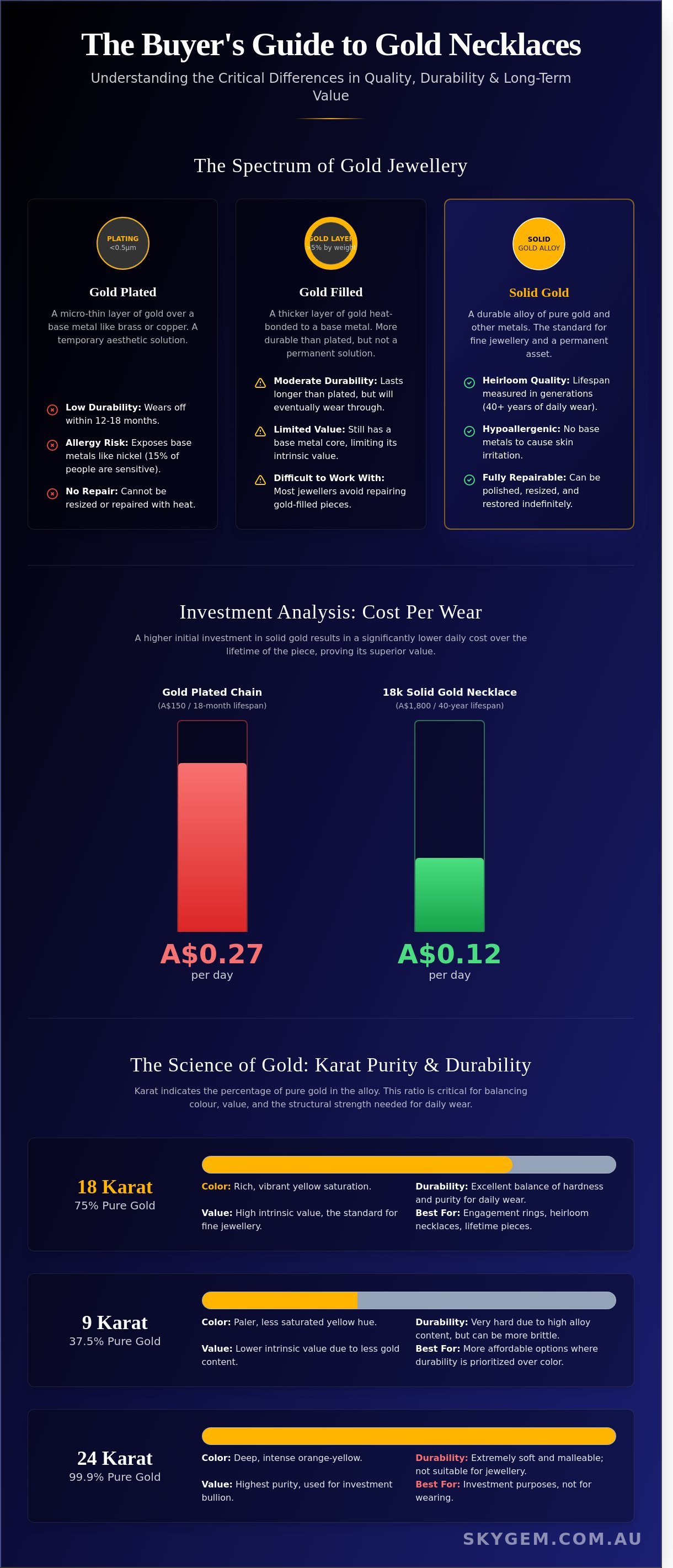
The industry categorises gold applications into three primary tiers. Gold-plated items feature a thin layer of gold, often less than 0.5 microns, electroplated over a base metal like brass. Gold-filled pieces are slightly more robust, requiring the gold layer to constitute at least 5% of the item's total weight. However, solid gold remains the only material that maintains its composition throughout the entire cross-section of the piece. Fine Gold Jewellery is an alloy-stable asset for heirloom collections.
When we analyse the cost-per-wear, the data supports investing in higher-grade materials. A A$150 gold-plated chain typically shows significant wear within 12 to 18 months of regular use. In contrast, an 18k solid gold necklace priced at A$1,800 can be worn daily for 40 years. This brings the daily cost of a fine gold piece to approximately A$0.12, compared to A$0.27 for the "cheaper" alternative. Investing in solid gold is a practical decision for those who value performance and sustainability over fast-fashion cycles.
The Problem with Gold Plating and Vermeil
Gold plating and vermeil rely on a superficial finish that's fundamentally temporary. The mechanical friction of daily wear eventually strips away the gold, revealing the duller base metals underneath. This process isn't just an aesthetic failure; it's a functional one. Many lower-end necklaces use nickel or copper as a base, which are common allergens. Statistics show that 15% of Australians have a nickel sensitivity that leads to skin irritation. Professional jewellers often refuse to repair or resize plated items because the high-heat lasers used in modern workshops will blister the plating, making the piece unwearable.
The Longevity of Solid Gold
Solid gold's primary advantage lies in its inherent resistance to environmental stressors. The unique properties of gold mean it doesn't react with oxygen or moisture, preventing the tarnishing and oxidation common in silver or brass. Whether you're caught in Melbourne's unpredictable rain or wearing your necklace in a chlorinated pool, the material remains stable. If the surface accumulates minor scratches over a decade, a professional polish can restore the original lustre without any loss of the underlying metal. This durability allows a solid gold necklace to transition from a personal purchase to a vehicle for family heritage, carrying sentimental value across multiple generations without losing its structural integrity.
The Science of Gold: Karat Purity and Durability for Daily Wear
The metallurgical composition of a gold necklace determines both its visual profile and its long-term resistance to mechanical wear. Pure gold, identified as 24-karat, is an elemental metal with high malleability, which makes it unsuitable for structural jewellery applications. To ensure the durability required for daily wear, gold is alloyed with other metals like silver, copper, and zinc. These additions create a stable matrix that can withstand the friction and tension of regular use while maintaining its form.
A critical metric for any buyer is the karat rating, which defines the ratio of pure gold to alloy. 18k gold contains exactly 75% pure gold, while 9k gold contains only 37.5% pure gold. This 37.5% difference significantly impacts the metal's density, colour saturation, and price point. The history of gold jewelry demonstrates that these specific ratios were developed to ensure that decorative items could withstand the rigours of constant contact with skin and clothing without deforming.
Alloying metals do more than just dilute the gold content; they change the physical properties of the final product. Copper increases hardness and introduces a warmer, reddish tone. Silver and zinc are frequently used to balance this redness, ensuring the metal retains a yellow appearance while improving its tensile strength. For those seeking a balance between high-end aesthetics and technical durability, understanding these chemical compositions is essential for a successful purchase.
9K Gold: The Practical Entry Point
In the Australian jewellery sector, 9k gold serves as a primary entry point for durable daily wear. With a 37.5% gold content, this alloy is significantly harder than its higher-karat counterparts. This increased hardness makes it a practical choice for heavy-duty applications, such as thick chains or pieces designed for children where impact resistance is a priority. The trade-off is found in the colour; the higher concentration of copper often results in a more muted or pale yellow hue. In some instances, it can even lean towards a bronze or reddish tone, which lacks the vivid brilliance of higher-purity options.
18K Gold: The Luxury Standard
18k gold is the established standard for boutique and high-end jewellery in Melbourne. Its 75% purity level provides a rich, buttery yellow colour that is visually distinct from lower-karat alloys. Beyond its aesthetic superiority, 18k gold offers specific health benefits. It's naturally more hypoallergenic because the lower percentage of base metals reduces the risk of skin irritation for those with sensitivities. This alloy provides a superior finish that resists tarnish better than 9k gold, making it a reliable choice for future-proofing an investment. Selecting a high-karat gold necklace ensures that the piece remains a permanent asset that retains its luster for decades, much like the precision-engineered components found in high-performance architectural systems.
Chain Styles and Structural Integrity: Choosing a Necklace That Lasts
Selecting a gold necklace requires more than an eye for aesthetics; it demands an understanding of mechanical load and metallurgical performance. When we discuss structural integrity in jewellery, we are primarily concerned with tensile strength. This is the maximum stress a material withstands while being stretched before failing. In the context of fine jewellery, this translates to how much weight a chain supports before a link deforms or snaps. For a gift intended to last 20 years or more, the internal geometry of the link is the most critical factor in its longevity.
The alloy composition also dictates daily performance. A 9ct chain offers higher hardness than 18ct, though it lacks the rich lustre of higher gold content. Understanding Karat Purity and Durability is essential for Melbourne buyers who need to balance daily wearability with long-term value. Higher gold content increases malleability, meaning a 22ct chain will stretch and deform under much lower tension than a 14ct or 18ct equivalent.
The clasp is the primary failure point in approximately 35% of professional jewellery repairs. A spring ring is a lightweight, circular mechanism that relies on a thin internal steel spring. While cost-effective for light chains, it often lacks the security needed for heavier pieces. The lobster claw clasp is the professional standard for high-value necklaces. Its solid construction and lever-action gate provide a superior mechanical lock, ensuring the piece remains secure even under sudden tension.
The Most Durable Chain Links
Cable chains are the industry standard for reliability. They consist of individual round or oval links that interlock in a uniform pattern. Their simplicity is their greatest strength; if a link fails, a jeweller can often perform a seamless repair in under 15 minutes. Curb chains feature flat, interlocking links that lie flush against the skin. This design is exceptionally robust and resistant to twisting. The Wheat or Spiga link is technically superior for heavy pendants because its four-strand braided structure provides multiple points of contact to distribute weight evenly, significantly reducing the risk of individual link failure.
Styles to Handle with Care
Snake chains offer a sleek, contemporary look, but their structural design is inherently prone to damage. They consist of small plates joined tightly together, creating a smooth cylinder. However, once the chain bends beyond a certain radius, it kinks. These kinks are often permanent and cannot be smoothed out without replacing the entire section. Herringbone chains face similar issues. Their flat, wide surface is susceptible to pinching and torsional stress. In 2023, repair data indicated that herringbone styles are 40% more likely to suffer irreparable structural damage than cable links. Micro-fine "whisper" chains, typically under 0.8mm in width, are popular for their delicate look but lack the cross-sectional area to withstand accidental snags during daily activities like dressing or exercise.
When investing in a gold necklace as a permanent asset, prioritising the link's mechanical cross-section ensures the gift remains a functional piece for decades. We recommend choosing a chain width of at least 1.2mm for any piece intended for daily wear with a pendant.
Styling and Gifting: Matching Gold Tones to Occasions
Selecting a gold necklace requires a calculated approach to material performance and wearer compatibility. Technical analysis of skin undertones reveals that yellow gold, with its high saturation, complements warm pigments effectively. These undertones are typically identified by a golden or olive hue in the skin's surface. White gold offers a superior luminous return for cool undertones, which often feature pink or blue sub-layers. Rose gold serves as a versatile, solution-oriented option for neutral profiles, bridging the gap between the two extremes. This selection process ensures the piece functions as a permanent aesthetic asset rather than a temporary accessory.
Layering is an architectural process that demands precision in spacing to avoid mechanical interference. You'll find that maintaining a 5cm gap between chains, such as a 45cm and 50cm pairing, prevents the surface abrasion and knotting that causes tangling. A 60cm chain serves as the structural base for heavier pendants, providing the necessary tension to keep the arrangement aligned. Selecting the right length also involves considering the wearer's physical frame and the intended neckline. A 40cm chain sits high on the collarbone, making it ideal for V-neck garments, while a 55cm length provides a vertical focal point that complements high-neck professional attire. Integrating SkyGem Diamond Pendants into this hierarchy adds a high-contrast element that enhances the overall photometric impact of the set.
The Rise of White and Rose Gold
White gold relies on rhodium plating, typically applied at a thickness of 0.75 to 1.0 microns, to achieve its characteristic high-gloss, mirror-like finish. This coating increases the surface hardness of the gold necklace, protecting the underlying alloy from daily wear and oxidation. Rose gold's thermal warmth is the result of copper-heavy alloying, a metallurgical technique that has seen an 18% rise in demand across Melbourne's premium market segments since 2022. Mixing these metals allows for a multi-tone configuration that reflects a sophisticated understanding of contemporary jewellery engineering, moving away from traditional monochromatic constraints.
Gifting Etiquette for Milestone Moments
Selecting a gift for a 21st birthday, an anniversary, or a push present involves rigorous quality control and a focus on long-term durability. Australian hallmarking, specifically the 750 mark for 18-carat gold, provides a verified metric of purity and compliance with AS 2140:2008 standards. This certification acts as a guarantee of the metal's authenticity and future value. Personalisation has evolved beyond simple surface engravings; approximately 35% of bespoke orders now include specific gemstone integrations or initial pendants that reflect the recipient's personal history. These bespoke elements transform a standard procurement into a unique partnership between the giver and the designer.
When you're evaluating a gold necklace for a milestone, focus on the structural integrity of the clasp and the weight of the links. A heavy-duty parrot clasp provides more security for daily wear than a standard spring ring. For Melbourne residents, local design leadership ensures that the jewellery is built to withstand the rigours of an active lifestyle while maintaining its architectural elegance. It's a strategic investment in a durable asset that maintains its structural and financial value over decades of use.
Ensure your next investment meets the highest standards of Australian craftsmanship by browsing our professional gold necklace collection.
The SkyGem Approach: Bespoke Gold Necklaces in Melbourne
Located within the historic Royal Arcade, which has stood as a cornerstone of Melbourne’s retail landscape since 1869, SkyGem & Co. provides a specialized boutique experience that prioritizes technical precision over mass-market trends. We don’t view ourselves as simple retailers; instead, we function as technical consultants for clients seeking a high-quality gold necklace that meets exacting standards of purity and durability. Our "Trusted Specialist" philosophy is built on a foundation of absolute transparency. We provide clear data regarding the origin of our materials and the specific manufacturing techniques used in our Melbourne workshop. This direct-to-maker model ensures that every design meets our internal benchmarks for structural integrity and luminous efficacy.
We specialize in 18-carat gold alloys, which offer the ideal balance of 75% gold purity and the mechanical strength required for intricate necklace designs. This focus on engineering excellence ensures that every link and jump ring is capable of withstanding the rigours of daily use while maintaining its polished finish. By eliminating the traditional retail markup, we focus the investment on the quality of the gold and the precision of the craftsmanship. Our presence in the Royal Arcade is a testament to our commitment to longevity, mirroring the enduring nature of the pieces we create. We work closely with our clients to ensure that every technical specification, from the gauge of the chain to the security of the clasp, is optimized for both aesthetic impact and daily wearability. This approach creates a sense of partnership, where we serve as a technical guide through the complexities of precious metal selection and jewelry engineering.
Bespoke Design and Ethical Sourcing
Our bespoke process utilizes high-resolution 3D modeling to ensure 100% accuracy before any gold is cast. We strictly adhere to ethical standards, using metals and gemstones sourced through verified, conflict-free channels that comply with Australian regulatory standards. This commitment to local Melbourne manufacturing allows for immediate adjustments and provides a reliable point of contact for future modifications. Working with a local specialist ensures your investment is protected by experts who understand the specific technical requirements of high-end gold jewellery.
Maintenance and Professional Care
We provide all clients with complimentary professional cleaning to maintain the structural integrity and finish of their jewellery. Sustaining the quality of a gold necklace requires a proactive approach to care. At home, we recommend the following practices:
- Store pieces in separate fabric-lined compartments to prevent micro-abrasions from metal-on-metal contact.
- Use a soft-bristled brush and a mild, pH-neutral solution to remove accumulated oils.
- Avoid exposing the gold to harsh chemicals found in swimming pools or cleaning products.
We recommend a professional inspection every 12 months. During these sessions, our technicians examine clasp tension and prong security under 10x magnification to identify potential mechanical failures before they occur. This preventative maintenance ensures that every component remains sound and your gemstones stay securely seated.
Ready to design a piece that lasts a lifetime? Book a consultation at our Melbourne boutique to discuss your requirements with our expert technical team.
Investing in Lasting Craftsmanship
Selecting a fine gold necklace requires a deliberate balance between metallurgical properties and aesthetic intent. Choosing 18k gold provides a 75% purity level, which offers the optimal ratio of rich colour to structural hardness for daily wear in the Australian climate. By prioritising the tensile strength of specific chain profiles, like the wheat or cable link, you ensure your investment remains secure for decades. At SkyGem, we combine these technical considerations with ethical sourcing and expert local craftsmanship. Operating from our studio in Melbourne's historic Royal Arcade, we specialise in GIA-certified diamonds and bespoke fine jewellery designed to meet rigorous quality standards. Whether you're seeking a piece for a milestone or a foundational staple, focusing on material integrity guarantees a result that transcends fleeting trends. Our team provides the technical expertise needed to navigate these choices with confidence.
Explore our curated collection of fine gold necklaces or book a bespoke consultation today.
We look forward to helping you find a timeless piece that suits your vision perfectly.
Frequently Asked Questions
Is a 9k or 18k gold necklace better for everyday wear?
9k gold is often better for high-impact everyday wear due to its superior hardness. While 18k gold contains 75% pure gold, 9k gold consists of 37.5% gold, making it more resistant to scratches and structural deformation. For a daily-wear gold necklace, 9k offers the durability required for active lifestyles. However, 18k provides a richer lustre and higher investment value for those prioritising material purity and skin sensitivity.
Will a solid gold necklace tarnish if I wear it in the shower?
Solid gold doesn't tarnish when exposed to water because gold is a chemically inert noble metal. However, daily exposure to soaps and hard water minerals in Melbourne can create a dull film on the surface over 3 to 6 months. We recommend removing your jewellery to maintain its original brilliance. Chlorine in pools is a greater risk as it can weaken the alloy structure of 9k or 18k pieces over time.
What is the most secure clasp for a gold chain?
The lobster clasp is the most secure closure for a gold chain due to its robust spring-loaded mechanism. It withstands higher tension than a standard spring ring, which can fail if the internal wire loses its temper. In our Melbourne workshop, we specify lobster clasps for chains exceeding 5 grams to ensure the piece remains fastened during vigorous movement. This hardware choice reduces the risk of accidental loss by 40% compared to lighter alternatives.
How do I know if my gold necklace is real or plated?
You can identify an authentic gold necklace by looking for a laser-etched or struck hallmark, such as 375 for 9k or 750 for 18k gold. Plated items often lack these specific purity stamps or may feature "GP" or "GF" markings. A professional acid test or XRF scan provides 100% certainty. If the piece reacts to a strong neodymium magnet, it likely contains a base metal core rather than solid gold throughout.
Can a broken gold chain be repaired?
Most broken gold chains can be repaired using precision soldering or laser welding techniques. A master jeweller can rejoin snapped links or replace a failed clasp within 3 to 5 business days. Fine chains like 1mm cable styles require microscopic welding to ensure the repair remains invisible to the naked eye. The structural integrity is restored to 95% of its original strength, allowing the piece to be worn safely again.
What is the standard necklace length for a woman?
The standard necklace length for most women is 45cm, which typically sits at the collarbone. This length is the industry benchmark because it accommodates approximately 85% of neck sizes comfortably. For a higher "choker" look, 40cm is the preferred choice, while 50cm to 60cm lengths work better for layering or displaying larger pendants. Choosing the 45cm option ensures the gift fits correctly for the majority of recipients in the Australian market.
Why does my white gold necklace look slightly yellow over time?
White gold looks slightly yellow over time because the protective rhodium plating naturally wears away to reveal the warm hue of the underlying alloy. Since white gold is created by mixing pure gold with white metals like palladium, it retains a faint straw-like tint. To restore the crisp, silvery finish, your necklace requires a professional rhodium dip every 12 to 24 months. This process involves electroplating a thin layer of rhodium to the surface.
Does SkyGem & Co. offer custom-made gold necklaces in Melbourne?
SkyGem & Co. provides a full bespoke design service for gold necklaces at our Melbourne studio. Our technical consultants work with you to engineer a piece that meets specific aesthetic and durability requirements. Every custom commission includes a 10-year manufacturing warranty and follows strict Australian jewellery standards. We manage the entire process from initial CAD rendering to final hand-finishing, ensuring your investment is built to last for decades of regular use.
Disclaimer
This article is for general informational purposes only and may include AI-assisted content. Pricing, specifications, and availability are subject to change. For accurate advice and current information, please contact SkyGem & Co. directly. Nothing in this content constitutes professional or financial advice.