
Lab Grown Diamonds: The 2026 Comprehensive Australian Buying Guide

If you believe that a lab-grown diamond is merely a cost-saving alternative, you're overlooking the most significant advancement in gemstone engineering of the last 70 years. While the market for lab grown diamonds Melbourne offers in 2026 is vast, the distinction between a mass-produced stone and a specimen of high optical performance often comes down to a 0.05mm variance in facet alignment. You likely recognise that choosing a stone requires more than just an appreciation for aesthetic beauty; it demands a technical understanding of how carbon is structured under extreme physical conditions.
We understand that the conflicting data surrounding CVD and HPHT methods can make the selection process feel more like a complex procurement task than a personal milestone. This guide provides you with the expert-led technical assurance needed to master these nuances, ensuring your bespoke piece balances engineering excellence with a refined architectural finish. We'll examine the specific crystal growth patterns of high-carat stones, the physics of light return, and the rigorous hand-finishing standards that guarantee the long-term structural integrity of your investment.
Key Takeaways
- Understand how controlled environment growth produces stones that are chemically and physically identical to mined counterparts, establishing a foundation of engineering excellence.
- Distinguish between CVD and HPHT synthesis methods to ensure your selection aligns with the precision required for high-end bespoke jewellery.
- Learn to evaluate technical purity beyond the traditional Four Cs, focusing on Type IIa classification when sourcing premium lab grown diamonds melbourne.
- Explore the structural engineering required for integrating larger carat weights into intricate settings designed for multi-generational durability and performance.
The Science of Brilliance: Understanding Lab-Grown Diamond Technology
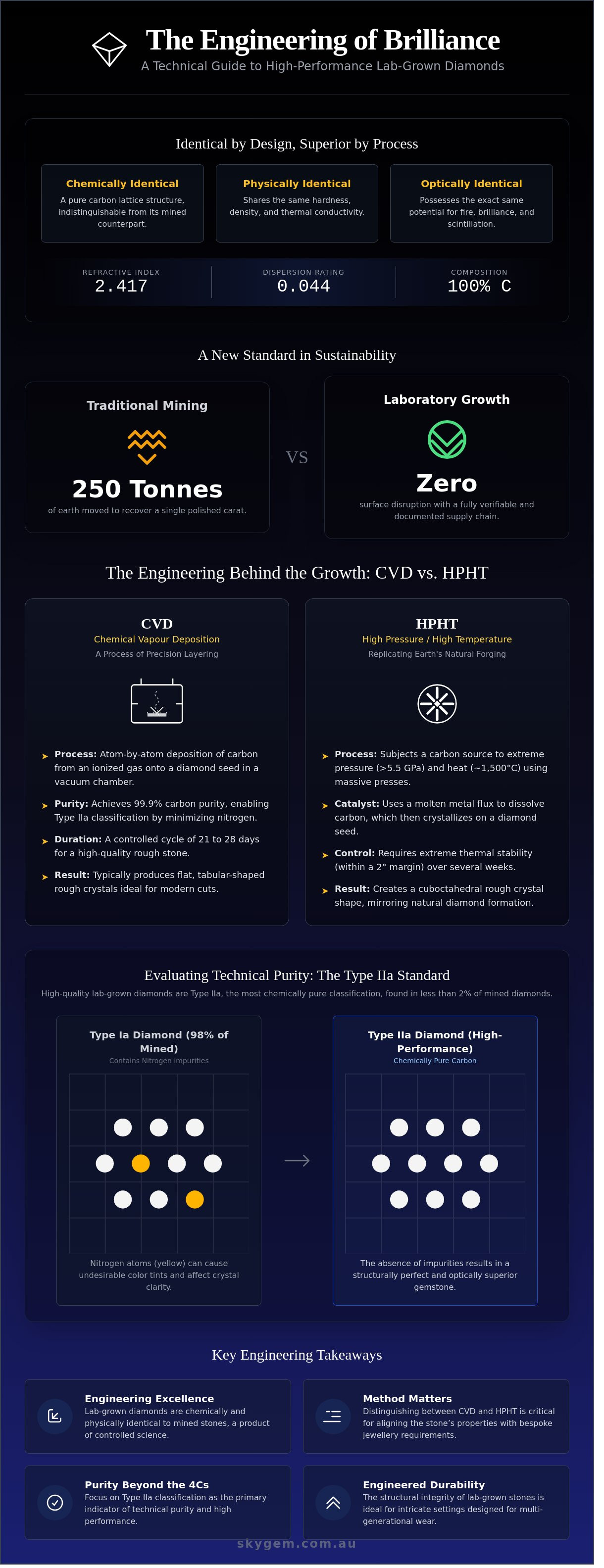
Lab-grown diamonds represent a significant shift in gemstone engineering. These stones are chemically, physically, and optically identical to diamonds extracted from the earth. By replicating the extreme heat and pressure of the earth's mantle within a controlled laboratory, technicians produce a 100% pure carbon lattice. This technical achievement ensures that every stone meets the rigorous 2026 quality standards expected by discerning buyers. Modern lab grown diamonds melbourne clients now demand this level of precision and consistency. Laboratory growth eliminates the unpredictable geological impurities often found in mined stones. This results in a cleaner, more predictable crystal growth that serves as a future-proof asset for contemporary Australian jewellery design.
The Molecular Reality of Lab-Grown Carbon
Every genuine diamond shares a specific cubic crystal structure. Lab-grown variants maintain a refractive index of 2.417 and a dispersion rating of 0.044. These specific figures dictate the "fire" and brilliance of the stone. Unlike simulants such as moissanite or cubic zirconia, which possess different chemical compositions and light-bending properties, lab diamonds are carbon-based. They aren't imitations. They are the same material, just grown with technical intent and extreme precision.
Ethical and Environmental Compliance in Australia
Australian consumers prioritize transparency in their supply chains. Traditional mining requires moving approximately 250 tonnes of earth to recover a single polished carat. Laboratory environments reduce this surface disruption to zero. This shift supports a reliable supply chain where every stone's origin is documented and verifiable. Skygem applies the same rigorous standards to diamond selection as we do to high-level engineering projects. This commitment to technical expertise ensures that your selection is both a sustainable choice and a high-performance asset. We treat each gemstone as a technical specification, ensuring it meets the highest benchmarks for local design and long-term durability.
Choosing a lab-grown stone is a decision rooted in both logic and aesthetics. It represents an investment in a product that utilizes 21st-century innovation to deliver a traditional result. For those seeking lab grown diamonds melbourne, the focus remains on the intersection of engineering excellence and visual performance. These stones offer a solution-oriented approach to luxury, providing a premium product that aligns with modern ethical standards without compromising on the physical properties that define a diamond.
CVD vs. HPHT: The Engineering Behind the Growth
Selecting lab grown diamonds in Melbourne requires an understanding of the rigorous engineering processes that define their final performance. Two primary methods dominate the high-end jewellery sector: Chemical Vapour Deposition (CVD) and High Pressure High Temperature (HPHT). While both create chemically identical diamonds, the technical paths they follow influence the stone's internal architecture and visual properties.
Chemical Vapour Deposition (CVD) Mechanics
CVD is a precision-layered growth process that occurs inside a vacuum chamber. A thin slice of diamond, known as a seed, serves as the foundation for the entire cycle. Technicians introduce a carbon-rich gas mixture, which is then ionised into plasma using microwave energy. This plasma breaks down the molecular bonds of the gas, allowing pure carbon atoms to settle onto the seed in a methodical, atom-by-atom sequence.
- Nitrogen Control: Maintaining nitrogen levels below 1 part per million is essential to prevent brown tinting.
- Carbon Purity: The vacuum environment allows for 99.9% carbon purity, resulting in Type IIa diamonds.
- Growth Duration: A typical CVD cycle lasts between 21 to 28 days for a high-quality rough stone.
HPHT: Replicating Earth’s Natural Forging
The HPHT method simulates the extreme geological conditions found 150 kilometres below the Earth's surface. Using massive hydraulic presses, this process subjects a carbon source to pressures exceeding 5.5 GPa and temperatures near 1,500 degrees Celsius. A molten metal flux, often containing iron and nickel, dissolves the carbon before it crystallises onto a diamond seed. It's a volatile environment that requires extreme thermal management.
Technical specialists must maintain thermal stability within a 2-degree margin over several weeks to avoid structural inclusions. HPHT is particularly effective for achieving D, E, and F colour grades, as the high-pressure environment can effectively remove existing colour distortions in the crystal lattice. This process often yields stones with a cuboctahedron shape, which is highly efficient for round brilliant cuts.
Engineering choices dictate the final geometry and suitability for specific designs. While CVD is often favoured for fancy shapes like emerald or radiant cuts due to its plate-like growth, HPHT provides the structural density often preferred for large round stones. Discerning buyers can explore these technical differences by viewing a curated range of lab grown diamonds in Melbourne to see how engineering translates into brilliance.
Evaluating Technical Quality: Beyond the Traditional Four Cs
While the 4Cs provide a foundational framework for assessment, the unique growth environments of lab-created stones necessitate a more rigorous technical audit to ensure long-term value. When sourcing lab grown diamonds melbourne, buyers must look past the surface metrics of Carat, Colour, Clarity, and Cut. The most critical technical benchmark is the Type IIa classification. This designation confirms the stone is almost entirely devoid of nitrogen or boron impurities. While only 2% of mined diamonds achieve this level of chemical purity, it's the baseline for premium lab-grown specimens. Stones lacking this purity often exhibit a "brownish" tint or reduced transparency that grading reports might not fully capture.
Technical excellence also requires identifying structural anomalies like growth strain or blue nuance. Growth strain occurs when the diamond's lattice structure is disrupted during the rapid crystallization process, leading to a blurry or "oily" appearance. Blue nuance is a distinct metallic tint caused by excess boron in the growth chamber. These defects aren't always listed as primary inclusions, making expert consultation vital. A technical specialist can identify these issues using cross-polarized filters, ensuring the stone's performance matches its paper specifications.
Certification Standards for Lab-Grown Specimens
The International Gemological Institute (IGI) and the Gemological Institute of America (GIA) are the primary authorities for certification. IGI has been the industry leader in lab-grown reporting for over a decade, providing granular data on growth methods. Since 2020, GIA has also provided full digital grading reports for lab-grown stones, applying the same rigorous standards used for natural diamonds. Every certified stone must feature a microscopic laser inscription on the girdle. This isn't just for identification; it's a mandatory compliance feature under ISO 18323 standards that ensures transparency throughout the supply chain. When reading a report, always look for the "As Grown" comment, which confirms the stone hasn't undergone post-growth treatments to artificially enhance its colour.
The Impact of Growth Morphology on Light Performance
A diamond's growth method, either Chemical Vapor Deposition (CVD) or High Pressure High Temperature (HPHT), dictates its internal morphology. HPHT stones grow in a cuboctahedron shape, while CVD stones grow in a tabular format. These patterns influence the stone's final lustre and how it interacts with light. To counteract potential graining in CVD stones, a "Triple Excellent" cut grade is essential. This ensures the facets are aligned to maximize light return and hide any internal structural variations. For those looking to compare technical data across thousands of stones, using online diamond selection tools allows you to filter by specific depth percentages and table widths. This level of precision is the only way to guarantee your lab grown diamonds melbourne purchase delivers the architectural brilliance required for high-end jewellery design.
Bespoke Integration: Designing Settings for Lab-Grown Stones
The shift toward lab diamonds has fundamentally altered the financial allocation of a jewellery budget. By reducing the primary stone cost by approximately 60% to 80% compared to mined equivalents, clients can invest more heavily in the architectural integrity of the setting. Choosing high-quality lab grown diamonds Melbourne allows for a transition from standard commercial mounts to bespoke, hand-finished pieces that offer superior durability.
When a diamond exceeds the 2.0ct threshold, structural engineering becomes the priority. Larger stones exert greater leverage on prongs and require a reinforced gallery rail to prevent the stone from loosening. A custom approach ensures that the metal volume is calculated based on the specific dimensions of the diamond, rather than using a generic "one size fits all" head that might compromise the security of the gem.
Selecting the Right Metal for Your Diamond
The choice between 18K White Gold and Platinum is a technical decision based on wear-resistance and maintenance cycles. Platinum is a dense, "sticky" metal that doesn't lose volume when scratched; it merely displaces it. This makes it ideal for the fine prongs required in modern minimalist designs. 18K White Gold is harder due to its alloy composition, but it requires rhodium plating every 18 to 24 months to maintain its bright finish. Metal choice also impacts the stone's perceived colour. A D-grade lab diamond is best paired with Platinum or White Gold to maintain its crisp, icy profile, whereas a slightly warmer stone might benefit from the contrast of 18K Yellow Gold.
The Custom Manufacturing Workflow
Bespoke manufacturing is a multi-stage engineering process that far exceeds the quality of mass-produced rings. It begins with a 3D CAD model tailored to the stone’s exact micron measurements, ensuring a perfect seat. Unlike off-the-shelf rings that are often hollowed out to save metal weight, a bespoke piece maintains a solid internal structure.
The custom-made engagement ring process concludes with hand-setting and high-pressure polishing. This step is vital because it compresses the metal, removing the microscopic porosity found in standard casting. The result is a ring that feels substantial and resists the rigors of daily wear over a 50-year lifespan.
Start your design journey today by using our online lab-grown diamond ring builder.
The SkyGem & Co. Philosophy: Technical Excellence and Partnership
sky gem and co functions as a technical consultancy rather than a traditional retail outlet. We prioritize the long-term structural integrity of every piece, ensuring your investment serves as a multi-generational asset. By focusing on the intersection of engineering and aesthetics, we provide a level of precision that standard jewellers rarely match. We view the procurement of lab grown diamonds melbourne as a collaborative partnership rooted in data, transparency, and technical merit. Our approach removes the guesswork, replacing sales pressure with expert-led education.
Expert Consultations and Transparent Sourcing
Our 60-minute one-on-one sessions allow clients to engage directly with a jewellery specialist. We don't rely solely on standard grading reports; we perform our own rigorous vetting. This includes analyzing the diamond's growth morphology and internal strain patterns that often escape basic lab analysis. Our heritage in the Australian landscape spans over 15 years, giving us the local expertise to navigate global supply chains effectively. We reject approximately 98% of the stones we inspect, selecting only the top tier for our permanent collection. This selective approach ensures that every gemstone meets our benchmarks for luminous efficacy and structural purity. We provide full disclosure on the origin and growth method of every stone, empowering you with the data needed for an informed decision.
Creating Your Legacy Piece
The journey from a technical education to the final engagement ring is a methodical one. We apply architectural design principles to every setting, focusing on metal fatigue resistance and precise stone orientation. This commitment to "future-proofing" means your piece is built for daily durability, not just initial impact. Our designs comply with strict Australian manufacturing standards, ensuring every lab grown diamonds melbourne purchase is backed by engineering excellence and aesthetic balance. We bridge the gap between scientific precision and artistic expression. Every component, from the prong thickness to the alloy composition, is selected to withstand the rigours of a lifetime. Contact our team today to schedule a bespoke consultation and begin creating a legacy piece that reflects your high standards.
Securing Your Investment in 2026 Diamond Technology
Selecting a diamond in 2026 requires a shift from traditional retail metrics toward high-level engineering data. By prioritizing GIA and IGI certified stones, you ensure your investment meets the rigorous 0.01mm precision standards required for peak light performance. Whether you choose the 99.9% carbon purity of CVD or the Type IIa structural integrity of HPHT, technical transparency is the foundation of a lasting purchase.
Our specialists provide expert technical consultations that bridge the gap between complex material science and 100% bespoke Australian design. When sourcing lab grown diamonds melbourne clients demand, we focus on future-proofed settings that protect the stone's 50-year structural durability. SkyGem & Co. acts as your technical consultant to ensure every facet aligns with 2026's strictest quality benchmarks. We don't just provide stones; we engineer permanent assets.
Begin your bespoke journey with our Lab-Grown Diamond Ring Builder
We're ready to help you design a piece that reflects your commitment to excellence.
Frequently Asked Questions
Are lab-grown diamonds real diamonds or stimulants?
Lab-grown diamonds are chemically, physically, and optically identical to mined diamonds, making them real diamonds rather than stimulants. Unlike Cubic Zirconia or Moissanite, which possess different refractive indices and hardness levels, lab-grown stones consist of pure carbon arranged in a cubic crystal structure. The Federal Trade Commission updated its diamond definition in 2018 to include laboratory-grown stones, acknowledging that their 10 on the Mohs scale of hardness matches their geological counterparts exactly.
How do lab-grown diamonds differ from natural diamonds under technical inspection?
Technical inspection reveals that lab-grown diamonds differ from natural stones only through microscopic growth patterns and trace element concentrations. While a standard 10x loupe cannot distinguish between the two, specialized laboratory equipment like the GIA iD100 can detect the specific UV fluorescence and crystal growth morphology unique to Chemical Vapour Deposition or High Pressure High Temperature processes. These internal markers act as a digital fingerprint that confirms the diamond's technological origin without affecting its performance.
Will a lab-grown diamond pass a standard diamond tester?
A lab-grown diamond will pass a standard diamond tester because it possesses the exact thermal and electrical conductivity of a mined stone. Basic handheld testers measure how heat or electricity moves through the crystal; since both types are 100% carbon, the reading remains identical. For those seeking lab grown diamonds melbourne retailers use advanced spectroscopic devices to ensure 100% accuracy in origin identification, as simple thermal probes cannot differentiate between laboratory and geological carbon structures.
Do lab-grown diamonds lose their brilliance or change colour over time?
Lab-grown diamonds are chemically stable and won't lose their brilliance, cloud over, or change colour over time. Because they share the same atomic structure as mined stones, they're immune to UV exposure and environmental degradation. A 2.0-carat laboratory stone purchased in 2026 will maintain its 2.417 refractive index and dispersion levels for centuries. Their durability ensures that the optical performance remains permanent, requiring only standard cleaning to remove surface oils and maintain peak light return.
Is it possible to get a GIA certificate for a lab-grown diamond in Australia?
You can obtain a full GIA Laboratory-Grown Diamond Report for stones sold in Australia. Since Q4 2020, the GIA has provided comprehensive grading for colour, clarity, and cut, replacing the previous descriptive ranges with specific grades like VS1 or F. Each certified stone features a laser inscription on the girdle, typically measuring less than 5 microns, which matches the digital record and ensures full transparency for the consumer throughout the purchasing process.
Why are lab-grown diamonds significantly more cost-effective than mined stones?
Lab-grown diamonds cost 60% to 85% less than mined stones because the supply chain is shorter and avoids the high overheads of geological exploration. Traditional mining requires shifting 250 tonnes of earth to find a single carat of diamond, whereas laboratory production utilizes efficient reactors. By removing the costs associated with heavy machinery, land permits, and complex global distribution networks, producers deliver a premium product at a price point that allows for larger carat weights within the same budget.
Can lab-grown diamonds be insured just like natural diamonds?
Insurance companies in Australia provide full coverage for lab-grown diamonds against loss, theft, and damage, applying the same underwriting standards as natural stones. When sourcing lab grown diamonds melbourne clients should provide a current independent valuation and a grading report from a laboratory like IGI or GIA. Premiums are calculated based on the 100% replacement value stated in the appraisal. This ensures that your financial protection is commensurate with the stone's market price and technical specifications.
How does the resale value of lab-grown diamonds compare to natural ones?
The resale value of lab-grown diamonds is currently lower than natural stones, typically retaining 10% to 20% of their initial purchase price on the secondary market. While natural diamonds are often viewed as a commodity, lab-grown stones are priced as a high-performance consumer luxury. This price trajectory mirrors other technology-driven sectors where production efficiencies lower costs over time. Buyers should view these diamonds as a permanent lifestyle asset rather than a liquid financial investment meant for future liquidation.
Disclaimer
This article is for general informational purposes only and may include AI-assisted content. Pricing, specifications, and availability are subject to change. For accurate advice and current information, please contact SkyGem & Co. directly. Nothing in this content constitutes professional or financial advice.