
Wedding Rings Melbourne: The Definitive Buyer’s Guide for 2026

Why would a specialist jeweller recommend a specific metal alloy that costs A$480 less than its premium counterpart for a client with a high-activity lifestyle? Selecting wedding rings melbourne couples can depend on for half a century requires a focus on metallurgical performance rather than just aesthetic trends. You likely recognize that a wedding band is a permanent structural asset, yet the conflicting data regarding metal Vickers hardness and the 2026 market value of lab-grown diamonds often creates unnecessary friction during the selection process.
This guide provides a technical and aesthetic masterclass in high-performance band selection, bridging the gap between engineering precision and local Australian design. You'll gain a clear understanding of the technical specifications that define structural integrity and ethical provenance. We examine the durability of Platinum versus 18ct White Gold based on recent stress-test data and provide a precise framework for matching unique engagement settings with bands engineered for long-term comfort and security.
Key Takeaways
- Understand the structural principles behind wedding ring engineering to ensure your band functions as a high-performance, lifelong asset.
- Evaluate the physical properties of precious metals to identify why 18K gold remains the industry standard for durability and aesthetic longevity in the Australian market.
- Learn how to navigate the technical landscape of wedding rings melbourne by leveraging GIA certification and precise optical performance data for gemstones.
- Discover a systematic approach to bespoke design, moving from a lifestyle-based brief to a precise technical drawing using modern CAD technology.
- Gain insight into the intersection of traditional craftsmanship and precision manufacturing to ensure your investment meets rigorous Australian quality standards.
The Architecture of a Lifetime: Understanding Wedding Ring Engineering
A wedding ring isn't just a symbol; it's a high-performance daily asset designed to withstand 50 years of mechanical stress. While the history and symbolism of wedding rings often focus on sentiment, Skygem prioritises structural integrity through Australian-led engineering. Selecting wedding rings melbourne couples can wear with confidence requires looking past the surface to the physics of the metal and the precision of the build.
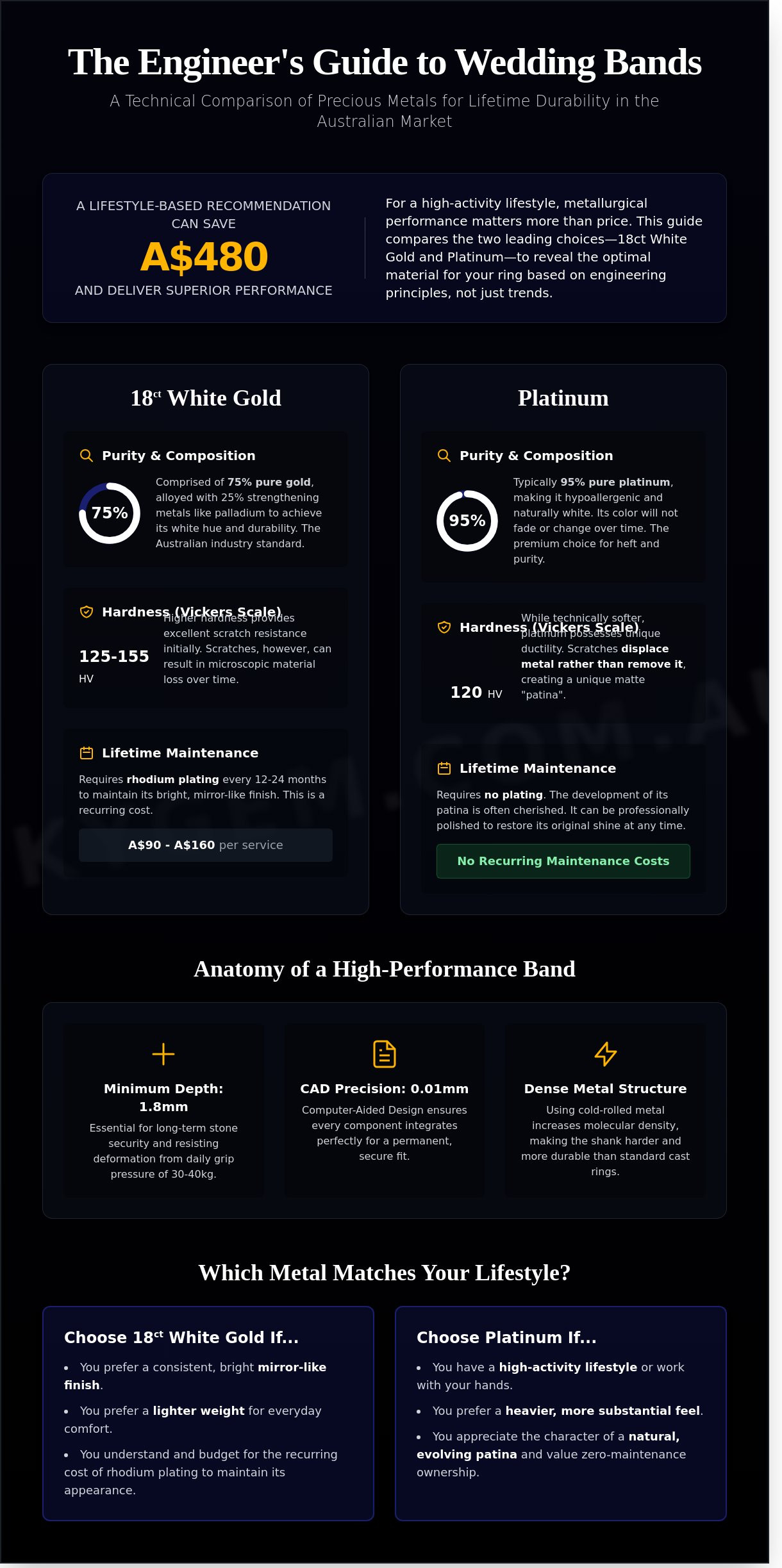
The "profile" or cross-sectional shape of the band dictates its resistance to deformation. A thin, 1.5mm wire-thin band might meet a minimalist aesthetic, but it often fails under the 30kg to 40kg of grip pressure humans exert during routine activities. We recommend a minimum depth of 1.8mm for long-term stone security. This ensures the ring maintains its circular form, preventing the "pinching" effect that causes stones to loosen over time.
Anatomy of a High-End Wedding Band
- The Shank: This is the functional body of the ring. High-end bands use cold-rolled metal to increase molecular density, making it harder than standard cast rings.
- The Gallery: The area beneath the centre stone. It provides the architectural bracing needed for lateral stability.
- The Prongs: These are the mechanical fasteners. Hand-finished settings outperform mass-produced moulds because they lack the microscopic porosity inherent in rapid casting.
Precision is non-negotiable. We utilise Computer-Aided Design (CAD) to achieve 0.01mm accuracy, ensuring every component integrates perfectly. When sourcing wedding rings melbourne clients should look for this intersection of technology and craftsmanship to ensure a permanent fit.
Matching the Wedding Band to Your Engagement Ring
Technical compatibility is vital for long-term wear. A "flush-fit" design requires the engagement ring's head to be elevated, allowing the wedding band to sit directly against the shank without obstruction. If you prefer a "gap" setting, you must manage metal-on-metal friction. Different alloys have different hardness ratings; pairing a soft 18K gold band with a harder platinum engagement ring can cause the platinum to "saw" through the gold over a decade. Explore our engagement rings to find the perfect technical match for your lifestyle and ensure your suite functions as a single, cohesive unit.
Material Performance: Selecting Metals for Lifetime Durability
Selecting the right alloy for wedding rings Melbourne couples will wear for decades requires a technical understanding of metallurgy. In the Australian luxury market, 18K gold remains the definitive benchmark for high-end commissions. This alloy consists of 75% pure gold and 25% strengthening metals, a ratio that perfectly balances intrinsic value with structural integrity. While 24K gold is too malleable for daily wear, 18K provides the necessary hardness to secure stones while resisting significant deformation. Understanding precious metal properties is essential for predicting how a ring will perform over a 50 year lifespan.
The technical variation between gold colours is driven by the specific composition of the 25% alloy. White gold achieves its hue through palladium or nickel, while rose gold relies on a higher copper content to create its signature warmth. Yellow gold utilizes a balanced mix of silver and copper to maintain a traditional glow. Platinum stands apart as a naturally white, dense metal. It's approximately 40% heavier than 14K gold, providing a substantial feel that many clients prefer for its "heft" and hypoallergenic qualities. Because platinum is 95% pure, it doesn't require the chemical whitening processes used for gold alloys.
Gold Alloys vs. Platinum: A Technical Comparison
On the Vickers scale, 18K white gold typically measures between 125 and 155 HV. Platinum sits slightly lower at 120 HV but possesses a unique property known as displacement. When scratched, platinum molecules shift rather than flake away. This creates a "patina" over time, a matte finish that many appreciate as a record of the ring's history. Conversely, white gold requires rhodium plating every 12 to 24 months to maintain its mirror-like finish. This maintenance cycle typically costs between A$90 and A$160 per service, a factor to consider in the long-term cost of ownership.
Sustainability and Ethical Sourcing Standards
Modern consumers prioritize transparency in their supply chains. Data from 2024 indicates that approximately 68% of Australian luxury jewellers have transitioned toward certified recycled gold to mitigate environmental impact. Recycled gold offers the exact same atomic structure as newly mined metal but requires 99% less water during the refining process. Choosing metals refined under Australian-led compliance ensures that your investment supports ethical labour practices. For those seeking a bespoke solution, selecting a custom-made engagement ring allows for direct oversight of material provenance and engineering quality.
Optical Performance and Certification: Navigating Gemstone Specifications
Optical performance is not merely a subjective measure of "sparkle." It represents the quantifiable interaction between light and the internal facets of a stone. For couples selecting wedding rings melbourne, understanding light return, fire, and scintillation is essential for a high-value purchase. These metrics determine how effectively a diamond reflects and refracts light back to the eye. A GIA (Gemological Institute of America) report provides the technical verification required for these assessments. It ensures that the cut grade, symmetry, and polish meet strict laboratory standards. Both natural and lab-grown diamonds share a refractive index of 2.417, meaning they interact with light in an identical manner. You can view our natural and lab-grown diamonds online to compare these specifications directly.
The Technical Reality of Lab-Grown Diamonds
Lab-grown diamonds are chemically and physically identical to natural stones. Both consist of carbon atoms arranged in a precise cubic crystal structure. The primary difference lies in the growth environment, not the resulting material. This technical parity allows buyers to maximise their price-to-performance ratio. You can often secure a 2.00-carat lab diamond for the same A$5,000 to A$7,000 budget that might only afford a 0.70-carat natural stone of equal clarity. While lab diamonds offer exceptional immediate aesthetic impact, natural stones maintain a different long-term value profile due to their geological rarity. Modern buyers usually balance this immediate visual scale against traditional asset considerations.
Coloured Gemstones: Sapphires, Rubies, and Emeralds
Durability is the primary technical consideration for daily-wear wedding rings melbourne. We utilise the Mohs scale of mineral hardness to guide these selections. Sapphires and rubies score a 9.0 out of 10, making them highly resistant to the abrasions of daily life. Emeralds sit between 7.5 and 8.0, which necessitates a more protective setting design. Thermal management and maintenance are also vital factors. Certain stones are sensitive to rapid temperature shifts or ultrasonic cleaning. For instance, emeralds often contain natural oils that can be damaged by high-heat steam. You should browse our curated collection of loose gemstones to see how different mineral structures affect long-term durability and maintenance requirements.
- Refractive Index: 2.417 for diamonds, ensuring maximum light return.
- Hardness: Sapphire (9.0) vs. Emerald (7.5-8.0) on the Mohs scale.
- Certification: GIA remains the industry benchmark for technical accuracy in 2026.
A Systematic Approach to Custom Ring Design and Selection
Selecting wedding rings melbourne couples can rely on for a lifetime requires a shift from purely aesthetic thinking to a technical design brief. At Skygem, we view the wedding band as a precision-engineered component. While "off-the-shelf" rings often suffer from high-volume casting issues like metal porosity or insufficient wall thickness, a custom-engineered piece ensures structural integrity. Every design begins with a consultation that translates your lifestyle requirements into a technical drawing, balancing the tactile nature of the jewellery with the rigours of daily wear.
The 5-Step Selection Framework
- Step 1: Metal Specification. We determine the optimal alloy based on your existing jewellery and skin sensitivity. For instance, 950 Platinum offers superior durability for high-impact lifestyles, while 18K gold provides a classic metallurgical profile.
- Step 2: Ergonomic Profile. You'll select a band width and internal profile (such as a comfort-fit curve) designed to accommodate natural finger swelling and daily movement.
- Step 3: Gemstone Integration. If incorporating stones, we evaluate setting styles. Channel settings offer maximum protection for active users, while pavé settings provide high-level brilliance with specific maintenance requirements.
- Step 4: Architectural Approval. We provide high-resolution CAD renders. This allows you to inspect the ring's proportions and "visual weight" before we move to the workshop.
- Step 5: Final Calibration. The physical piece is finished to exact tolerances, ensuring the transition from digital design to tangible asset is flawless.
Future-Proofing Your Purchase
A ring is a dynamic asset that must adapt over decades. We focus on designs that allow for future sizing adjustments, as some full-eternity bands or complex patterns can be difficult to resize by more than one full size. Maintenance is a critical component of our partnership. We recommend a professional inspection every 12 to 18 months to check prong tension and metal wear. Every piece we manufacture includes a lifetime manufacturing warranty, providing a technical guarantee that your investment is protected against structural defects. This systematic approach ensures your ring remains as functional in 2076 as it is on your wedding day.
Ready to begin your technical design brief? Book a design consultation with our Melbourne specialists today.
The SkyGem & Co. Standard: Precision Manufacturing and Bespoke Artistry
SkyGem & Co. operates at the intersection of structural engineering and fine art. Our commitment to technical excellence ensures that every piece of jewellery meets rigorous Australian standards for durability and aesthetics. By integrating traditional hand-finishing with advanced CAD technology, we produce wedding rings melbourne couples rely on for lifelong performance. We maintain absolute transparency in our procurement of GIA-certified stones, providing full photometric data and origin reports for every diamond. Many clients choose to begin their journey with a custom-made engagement ring consultation to ensure the wedding band integrates seamlessly with their existing hardware.
The Bespoke Manufacturing Process
Our manufacturing workflow prioritises material integrity and geometric accuracy above all else. Specialists utilize 3D rendering to calculate stone seats with mathematical precision, ensuring that every GIA-certified diamond is secured within tolerances measured in fractions of a millimetre. This technical approach eliminates the structural vulnerabilities often found in mass-produced pieces from global franchises. By maintaining a boutique workshop, we offer superior value, typically providing a 35% higher gold weight and better stone clarity than high-street retailers for the same investment. Our quality control protocols involve a multi-stage inspection process, covering everything from thermal stress testing of the metal to the security of individual pavé settings.
- Precision CAD Prototyping: We create digital models to verify ergonomic fit and structural balance before casting.
- High-End Finishing: Every ring undergoes a 12-point quality check to ensure the polish and symmetry meet 2026 industry benchmarks.
- Direct Sourcing: By removing middle-layer wholesalers, we invest more of your budget into the actual calibre of the raw materials.
Partnering for the Long Term
We act as technical consultants throughout your jewellery journey, providing professional guidance that extends well beyond the initial purchase. Our relationship with clients is built on a foundation of reliability and expert support. We provide scheduled maintenance, professional cleaning, and structural restoration services to ensure your rings remain a permanent asset. This future-proofing mindset is central to our design philosophy; we build pieces intended to withstand 50 years of daily wear without compromising their architectural integrity. When you're ready to secure your wedding rings melbourne, we invite you to our boutique for an expert consultation where we can review technical specifications and design options tailored to your lifestyle.
Securing Your Engineering Legacy for 2026
Selecting a wedding band is a technical decision that balances metallurgical integrity with aesthetic vision. By 2026, the standard for wedding rings melbourne couples expect has shifted toward high-performance alloys and verified optical precision. You've now seen how structural durability depends on precise manufacturing, from the specific gravity of the metal to the GIA Certified Diamonds that offer documented light performance. At SkyGem & Co., we don't just supply jewelry; we act as technical consultants for your most significant investment.
Our Bespoke CAD Design Specialist team utilizes 3D modeling to ensure 100% dimensional accuracy before production begins. This methodology, combined with Premium Australian Craftsmanship, ensures your ring remains a permanent asset for 50 years or more. It's about moving beyond the retail shelf to a solution-oriented design process that respects your timeline and your budget. We look forward to helping you engineer a piece that stands the test of time and tradition.
Book a Bespoke Consultation at SkyGem & Co.
Frequently Asked Questions
How much should I spend on a wedding ring in Australia?
In Australia, couples typically spend between A$1,500 and A$3,500 on a wedding band according to 2024 market data. This figure fluctuates based on metal weight and gemstone density. For a high-quality wedding rings Melbourne purchase, we recommend allocating 1% to 3% of your total wedding budget. This ensures you invest in a durable piece that withstands daily wear without compromising your broader financial planning.
What is the most durable metal for a wedding band?
Platinum is the most durable precious metal for a wedding band because of its high density and resistance to thinning over time. While 18K gold loses microscopic amounts of metal through friction, platinum merely displaces it; this maintains its structural integrity for decades. If you work in a high-impact manual trade, tungsten carbide offers the highest scratch resistance, though it's important to note it cannot be resized.
Is it better to choose a lab-grown or natural diamond for a wedding ring?
Choosing between lab-grown and natural diamonds depends on whether you prioritise market rarity or cost-efficiency. Lab-grown diamonds provide the same chemical composition as mined stones but typically cost 60% to 80% less. For many Melbourne couples, this allows for a larger carat weight within the same budget. Natural diamonds retain a higher resale value, which currently sits at 30% to 50% of the original purchase price.
Can I customise a wedding band to fit my existing engagement ring?
You can absolutely customise a wedding band to sit flush against an existing engagement ring through a process called bespoke contouring. This involves 3D scanning your engagement ring to ensure the wedding band follows its exact geometry. You'll find this technical approach prevents the two rings from rubbing together; this reduces metal fatigue and extends the lifespan of your jewellery by approximately 15 years compared to non-matching sets.
How long does the bespoke wedding ring process take?
The bespoke wedding ring process typically requires a timeframe of 4 to 6 weeks from the initial design consultation to final delivery. This schedule accounts for 3D CAD modelling, casting, hand-setting stones, and final hallmarking. We recommend starting this process at least 12 weeks before your ceremony date. This allows for final fit adjustments and any specific engraving requirements that often add 5 business days to the production cycle.
Do I need a GIA certificate for a diamond wedding band?
You should require a GIA certificate for any individual diamond over 0.30 carats to verify its technical specifications and origin. While smaller pavé diamonds in a wedding band are rarely certified individually, they should still meet a documented minimum grade, such as F/G colour and VS clarity. It's a critical step in your wedding rings Melbourne acquisition because obtaining a GIA report ensures the stone's value is protected for insurance purposes.
What is the difference between 14K and 18K gold for wedding rings?
The primary difference lies in the gold content; 18K gold contains 75% pure gold, while 14K gold contains 58.5%. In the Australian market, 18K is the standard for high-end jewellery because of its rich colour and hypoallergenic properties. Although 14K is slightly harder due to its higher alloy content, 18K offers superior long-term value and a more prestigious finish that aligns with premium architectural aesthetics.
How often should I have my wedding ring professionally serviced?
You should have your wedding ring professionally serviced every 12 months to ensure its structural integrity remains intact. A standard service includes checking the security of stone settings, ultrasonic cleaning, and rhodium plating for white gold pieces. Regular inspections can identify thinning claws or loose stones before they result in a total loss; this simple maintenance schedule can save you thousands in replacement costs over the lifetime of the ring.
Disclaimer
This article is for general informational purposes only and may include AI-assisted content. Pricing, specifications, and availability are subject to change. For accurate advice and current information, please contact SkyGem & Co. directly. Nothing in this content constitutes professional or financial advice.