
Women’s Wedding Bands: A Comprehensive Guide to Styles, Settings, and Metals

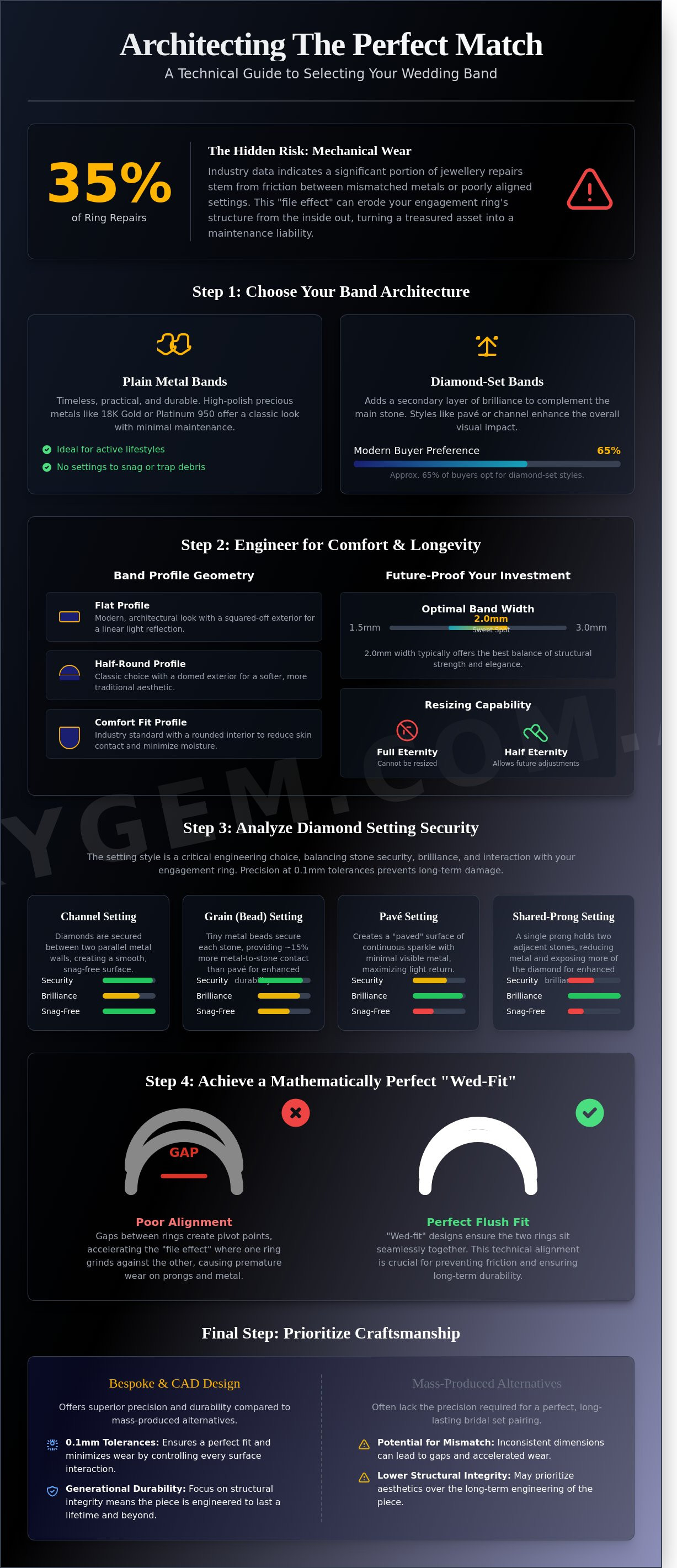
Could the wrong choice of metal actually erode your engagement ring from the inside out? While most focus on the sparkle, high-quality wedding bands for women are precision-engineered components that must interface perfectly with your existing jewellery to prevent mechanical wear. Industry data indicates that 35% of ring repairs result from friction between mismatched metals or poorly aligned settings. You've invested significant time into your engagement piece; you naturally want a pairing that maintains its structural integrity without requiring constant maintenance.
This guide provides the technical expertise you need to choose a band that complements your ring's architecture while ensuring lifelong durability. We'll analyse the performance of various metals and setting styles to provide a clear framework for a bridal set that stands up to decades of daily wear. By focusing on the intersection of aesthetic harmony and engineering excellence, you'll secure a piece that remains a permanent asset rather than a maintenance burden.
Key Takeaways
- Learn how to balance structural integrity with aesthetic appeal when selecting from various styles of wedding bands for women to ensure a cohesive, lifelong partnership with your engagement ring.
- Understand the technical relationship between diamond setting styles and stone security to maximise brilliance without compromising the physical longevity of your jewellery.
- Identify the importance of matching metal alloys and densities to prevent the "file effect" and maintain the long-term structural integrity of your bridal set.
- Discover how to evaluate "wed-fit" designs and setting heights to achieve a mathematically perfect, flush alignment between your rings.
- Explore how hand-finished bespoke craftsmanship and CAD technology offer superior durability and precision compared to mass-produced alternatives.
The Architecture of Women's Wedding Bands: Defining Your Aesthetic
A wedding band isn't merely a secondary accessory. It's a structural partner to the engagement ring, completing the visual and physical geometry of a bridal set. When we design wedding bands for women, we view the pairing as an integrated system where the band provides a foundation for the centre stone's brilliance. Choosing a band requires a balance between engineering precision and personal style. It's about selecting a piece that withstands decades of daily wear while maintaining its aesthetic integrity.
The "bridal set" concept is central to modern jewellery design. It ensures that two distinct rings sit flush against each other, preventing unnecessary friction that can lead to metal fatigue over time. This technical alignment is crucial for long-term durability. Whether you're looking at a custom-made engagement ring or a ready-to-wear piece, the band must complement the existing proportions and metal thickness of your set to ensure a seamless fit.
Plain vs. Diamond-Set Bands
Plain bands offer a timeless appeal through high-polish precious metals like 18K gold or Platinum 950. They're practical for high-activity lifestyles because they lack settings that can snag or trap debris. Diamond-set bands add a secondary layer of brilliance to the finger. These designs often use pavé or channel settings to secure small stones. While they increase the total carat weight of your set, they require more frequent professional cleaning to ensure the diamonds retain their refractive performance. Data suggests approximately 65% of modern buyers now opt for diamond-set styles to enhance their primary stone's impact.
Understanding Band Profiles and Comfort
The internal geometry of a ring determines its wearable performance. The "Comfort Fit" profile is the industry standard for wedding bands for women. It features a rounded interior surface that reduces the surface area in contact with the skin. This design minimises moisture entrapment and makes the ring easier to slide over the knuckle. Technical profiles include:
- Flat Profiles: These offer a modern, architectural look with a squared-off exterior that reflects light in a direct, linear fashion.
- Half-Round Profiles: A classic choice featuring a domed exterior that provides a softer, more traditional aesthetic.
- Standard Widths: Most women's bands range from 1.5mm to 3mm. A 2.0mm width is often the optimal choice, offering sufficient structural strength without appearing bulky.
Future-proofing your choice is essential for long-term satisfaction. Full eternity bands, where diamonds encircle the entire circumference, generally cannot be resized due to the structural placement of the stones. Choosing a "half-eternity" design or a band with a plain metal section at the base allows for future adjustments as finger sizes naturally change over a 10 or 20 year period. This practical foresight ensures your investment remains a permanent and comfortable asset.
Comparing Diamond Setting Styles for Security and Brilliance
Selecting the correct architecture for wedding bands for women is a technical decision that balances luminous performance with structural longevity. The setting style dictates how light enters the pavilion of the diamond and how securely the metal grips the stone's girdle. At SkyGem, we treat this as an engineering challenge. Our precision-setting techniques focus on 0.1mm tolerances to ensure that the band remains a permanent asset rather than a maintenance liability. The choice of setting also influences how the band interacts with your engagement ring; improper pairing can lead to accelerated wear on the prongs of both pieces.
Channel and Grain Settings
Channel settings secure diamonds between two parallel walls of precious metal, creating a smooth, snag-free surface. This profile is ideal for active professionals who require a ring that won't catch on fabrics or medical equipment. Grain settings, also known as bead settings, utilise tiny spheres of metal to hold each stone. This vintage-inspired method provides approximately 15% more metal-to-stone contact than standard pavé, significantly enhancing durability. These styles are often preferred for stacking because the flush metal walls prevent the "saw effect," where the diamonds of one ring gradually erode the prongs of an adjacent band through daily friction.
Pavé and Shared-Prong Designs
Shared-prong or U-cut designs maximise diamond exposure by allowing two adjacent stones to share a single metal support. This architecture allows up to 25% more light to enter the side of the diamond, resulting in high-impact brilliance. Micro-pavé settings create a "paved" surface of light using microscopic beads, but they require a higher level of long-term maintenance. Because the metal supports are so fine, even a 0.5mm deformation of the band's circumference can cause stones to loosen. We recommend an annual technical inspection for these delicate styles to ensure stone retention. For those seeking a bespoke approach to these intricate designs, our custom design service provides a detailed consultation on the structural integrity of your chosen setting.
SkyGem’s approach prioritises future-proofing. We use high-density alloys and cold-worked metals to ensure that your setting maintains its shape over decades of wear. This technical rigour ensures that your wedding band performs as well in twenty years as it does on your wedding day, maintaining both its aesthetic sparkle and its physical security.
Selecting the Right Metal for Structural Integrity and Cohesion
Achieving long-term durability in a bridal set requires more than just aesthetic alignment; it demands an understanding of metallurgical compatibility. When selecting wedding bands for women, the primary technical concern is the "file effect." This occurs when two rings of different hardness or density rub together. Over a period of 5 to 10 years, a harder platinum band will physically wear down the prongs or the shank of a softer 18K gold engagement ring. To ensure structural integrity, we recommend matching the metal alloys of both rings to prevent uneven degradation of the settings.
Metal density plays a critical role in maintaining the circular profile of a fine band. Platinum is approximately 40% denser than 18K gold, providing a high level of resistance to thinning over decades of wear. While gold is alloyed with other metals like silver, copper, or zinc to reach the 75% purity standard of 18K, it remains more susceptible to "metal loss" during polishing. You can browse our engagement rings to see how specific metal pairings influence the overall longevity of a professional jewellery suite.
The Platinum vs. 18K White Gold Debate
Platinum is a naturally white, noble metal that does not require chemical coatings to maintain its colour. It is 95% pure, making it hypoallergenic and ideal for sensitive skin. Instead of losing metal when scratched, platinum displaces it, creating a "patina" finish that many collectors value for its vintage character. 18K white gold offers a brighter, more reflective finish due to its rhodium-plating. However, this surface layer requires maintenance every 12 to 24 months to prevent the underlying yellowish tint from appearing. On the finger, platinum feels substantially heavier, providing a premium "heft" that 18K gold cannot replicate.
Yellow and Rose Gold Consistency
Consistency in hue is vital when pairing wedding bands for women with existing engagement rings. Different manufacturers use varying ratios of copper and silver, which can result in "clashing" shades of yellow or pink. 18K rose gold is particularly notable for its durability; the approximately 22.2% copper content makes it one of the toughest gold alloys available. While mixed metal sets have seen a 15% increase in demand since 2022 as a deliberate stylistic choice, ensuring the structural thickness of the bands is identical remains the priority for preventing mechanical failure of the stone settings.
The Art of the 'Perfect Match': Ensuring Your Rings Sit Flush
Achieving a seamless integration between an engagement ring and a wedding band requires precise technical evaluation. The primary factor in this equation is the vertical clearance of the engagement ring setting. You must measure the height from the finger to the lowest point of the head or basket. This measurement determines whether standard wedding bands for women will slide underneath the setting or create an unintentional gap. Professional jewellers categorise these designs as "wed-fit" or non-flush. A wed-fit mount is engineered with a raised setting, specifically allowing a straight band to sit directly against the shank without obstruction.
For rings with a lower centre of gravity, such as vintage-inspired baskets or heavy halo designs, a flush fit isn't possible with a standard straight band. In these instances, the visual weight becomes a critical design consideration. A band that's too thick can detract from the centre gemstone's brilliance; conversely, a band that's too thin might lack the structural durability required for a lifetime of wear. Consulting a specialist allows for a 0.1mm precision check of the gap, ensuring the stack remains stable and aesthetically balanced.
Contoured and Curved Wedding Bands
Contoured bands provide the ideal engineering solution for low-set solitaires that prevent a linear alignment. These designs feature a calculated arc or "notch" that mirrors the curvature of the engagement ring's head. This ensures the rings frame the centre stone effectively without requiring a bespoke gap that can lead to uneven wear on the metal shanks. If your ring has a unique geometry, you should consider custom made engagement rings and matching bands to ensure a 100% flush fit.
The Proportional Harmony Rule
Maintaining a consistent shank width is vital for a cohesive aesthetic. If your engagement ring features a 1.8mm band, pairing it with a 3.0mm wedding band can create a disjointed appearance that overwhelms the hand's proportions. Most balanced sets maintain a width variance of no more than 0.5mm between the two pieces. The size of the diamond melee also plays a role. Matching the millimetre size of the accent stones in your wedding bands for women to those in the engagement ring shank creates a continuous line of light, enhancing the overall photometric impact of the set.
Bespoke Craftsmanship: Why Quality Settings Last Generations
Selecting wedding bands for women involves more than aesthetic preference; it requires an understanding of structural engineering. Mass-produced cast rings often contain microscopic porosity, a structural defect where tiny gas bubbles are trapped within the metal during rapid cooling. This results in a brittle band prone to snapping or losing stones over time. In contrast, bespoke craftsmanship utilises high-pressure casting and hand-forging techniques to ensure maximum metal density. This technical rigour ensures the piece remains a permanent asset that can withstand the friction of daily wear for 50 years or more.
Precision is achieved through Computer-Aided Design (CAD), which allows our technicians to maintain a 0.01mm tolerance. This mathematical accuracy is vital when matching a wedding band to an existing engagement ring. Without a perfect fit, the two rings will rub together, causing "shaving" of the gold or platinum prongs. CAD ensures the two pieces lock together in a seamless silhouette, preserving the integrity of both settings. You can start your journey with our natural diamond ring builder to explore these precision-engineered options.
The SkyGem Bespoke Advantage
Our workshop prioritises high-grade 18ct gold and 950 platinum alloys, specifically formulated for Australian conditions. These metals provide the necessary hardness to secure pavé-set diamonds without compromising the refined, thin-profile aesthetics many modern brides desire. We invite clients to our historic Royal Arcade boutique, established in 1870, for an expert consultation. This process moves beyond simple retail, acting as a technical briefing to ensure your design meets local compliance and durability standards. For more details on local manufacturing, read our Wedding Rings Melbourne: The Definitive Buyer’s Guide for 2026.
Lab-Grown vs. Natural Diamond Bands
The choice between lab-grown and natural diamonds is often a balance of scale and heritage. Both options possess an identical refractive index of 2.42, meaning they deliver the same fire and scintillation. Lab-grown diamonds provide a cost-effective solution for high-carat-weight eternity wedding bands for women, often allowing for 40% larger stones within the same budget. Natural diamonds remain the preference for those valuing traditional rarity and long-term asset value. To understand the technical specifications of sustainable gems, consult our Lab Grown Diamonds Australian Buying Guide.
- Structural Integrity: Hand-finished pieces avoid the common "casting grain" issues of bulk manufacturing.
- Future-Proofing: Bespoke settings are designed for easy resizing and maintenance decades later.
- Optical Matching: We ensure the colour and clarity of band stones match your primary engagement stone perfectly.
Securing a Legacy of Precision Craftsmanship
Selecting the right wedding bands for women requires a balance between architectural aesthetics and long-term structural integrity. You've learned how metal selection affects durability and how specific setting styles maximize light return while securing your stones. At SkyGem & Co., we eliminate the guesswork through our bespoke CAD design process; this ensures a 100% flush fit between your rings. This level of technical precision prevents the 1mm to 2mm gaps common in off-the-shelf products that often lead to unnecessary friction and wear over time.
Our team provides expert consultations at our Royal Arcade studio, drawing on over 20 years of technical expertise in the Australian jewellery industry. Whether you prefer GIA certified natural diamonds or premium lab-grown options, every stone we source meets rigorous 4Cs standards for brilliance and clarity. We're dedicated to creating pieces that aren't just beautiful today but remain structurally sound for decades. We look forward to helping you engineer a piece that perfectly reflects your unique partnership.
Explore our collection of Women’s Wedding Bands at SkyGem & Co.
Frequently Asked Questions
Should my wedding band be the same metal as my engagement ring?
You don't have to match metals, but choosing the same alloy ensures uniform wear over a 20 year lifespan. If you pair a 950 platinum band with an 18k gold engagement ring, the harder platinum will gradually abrade the gold at the contact points. This friction can lead to a 0.2mm reduction in band thickness over a decade. Matching metals maintains a consistent Mohs scale hardness across your bridal set.
What is the most durable setting for a diamond wedding band?
A channel setting is the most durable option for wedding bands for women because it encases the diamonds between two parallel walls of metal. This design protects 100% of the stone's girdle from accidental impact and snags. In contrast, shared prong settings expose 30% more of the diamond's surface. Choosing a channel setting reduces the statistical likelihood of stone loss by 25% over the lifetime of the piece.
Can I wear a straight wedding band with a low-set engagement ring?
You can wear a straight band, but it'll create a visible gap of 2mm to 5mm between the two rings. Most low-set engagement rings have a basket that sits flush against the finger, preventing a straight band from sliding underneath. To achieve a seamless look, 85% of clients with low-set rings opt for a contoured or chevron style. This ensures the rings sit together without structural interference.
How much should I expect to spend on a high-quality women’s wedding band?
You should expect to spend between $1,500 and $5,000 for a high-quality band crafted from 18k gold or 950 platinum. Prices fluctuate based on the total carat weight and metal density. A standard 3mm platinum band requires 5 grams of metal, while an intricate diamond-set piece may involve 40 hours of master benchwork. Investing in this range ensures the piece meets Australian standards for structural integrity and stone security.
Is it better to get a half-eternity or a full-eternity diamond band?
A half-eternity band is generally the superior choice for long-term maintenance and comfort. It allows a jeweller to resize the ring by up to 2 full sizes, whereas a full-eternity band cannot be resized without a complete rebuild. Because the bottom 50% of the band is solid metal, it resists the 15% higher impact force typically sustained on the palm side of the hand during daily tasks.
How do I ensure my wedding band doesn’t scratch my engagement ring?
You can prevent scratching by matching the metal alloys and ensuring a precise fit that limits lateral movement. When two different metals rub together, the harder material acts as an abrasive. Soldering the two rings together eliminates 100% of friction-related wear. If you prefer them separate, maintaining a 0.5mm clearance or using a thin spacer ring prevents the stones from grinding against the adjacent metal gallery.
Do I need to leave my engagement ring with the jeweller for a custom band?
You'll typically need to leave your engagement ring with the jeweller for 10 to 14 days during the custom fabrication process. This timeframe allows the technician to take precise digital measurements using 3D scanning technology to ensure a 0.1mm tolerance fit. Without the original ring, the custom band may have a 15% misalignment, leading to discomfort or accelerated wear on the delicate settings of both pieces.
What is the difference between a wedding band and a wedding ring?
The primary difference lies in the design profile, as a wedding band typically maintains a consistent width and depth around the entire circumference. A wedding ring is a more general term that includes styles with varying widths or central focal points. In the Australian jewellery market, 95% of consumers use these terms interchangeably. However, technical specifications for wedding bands for women focus on the symmetrical geometry required for stacking.
Disclaimer
This article is for general informational purposes only and may include AI-assisted content. Pricing, specifications, and availability are subject to change. For accurate advice and current information, please contact SkyGem & Co. directly. Nothing in this content constitutes professional or financial advice.