
What to Do with an Heirloom Diamond: A Professional Guide to Repurposing Legacy Stones

What if the true value of your inheritance lies not in its dated setting, but in the structural potential of the stone itself? For many, the question of what to do with an heirloom diamond is complicated by a tension between sentimental preservation and practical wearability. You likely value the history of the piece, yet you're hesitant to proceed due to concerns about stone security, technical durability, or whether an antique cut can truly thrive in a contemporary mount.
We understand that a legacy diamond is more than a gem; it's a technical asset with a unique provenance. This guide provides a professional framework to help you navigate the transition from a drawer-bound relic to a functional masterpiece. You'll learn how to conduct a rigorous health audit of your diamond, identify the performance metrics of older cuts like the Old European or Mine cut, and modernise the piece without compromising its integrity.
By following a structured design process, you can transform a family artifact into a bespoke piece of fine jewellery that meets modern standards of precision and aesthetics. We'll explore the essential steps of the repurposing journey, ensuring your diamond remains a secure and radiant centerpiece for the next generation.
Key Takeaways
- Establish a baseline for stone health through a professional technical audit, including deep cleaning and careful unsetting to identify microscopic structural risks.
- Determine exactly what to do with an heirloom diamond by balancing its historical provenance with modern design paths, such as a Solitaire Refresh or a Trilogy Expansion.
- Leverage advanced CAD (Computer-Aided Design) to ensure a high-precision fit for antique cuts, which often feature irregular dimensions compared to modern calibrated stones.
- Evaluate the performance metrics of specific metals, such as 18K Yellow Gold or Platinum, to provide long-term structural security for legacy gems.
- Gain insight into the bespoke consultation process, ensuring full transparency and security as your stone moves from initial inspection to final digital render.
Understanding the Potential of Your Heirloom Diamond
An heirloom diamond represents a technical bridge between generations, carrying both historical provenance and significant sentimental weight. When you are considering what to do with an heirloom diamond, it's vital to view the stone as a raw material with untapped potential. Unlike modern retail purchases, these legacy stones often come with a narrative that adds a layer of value far beyond a standard financial appraisal. While an appraisal provides a snapshot of replacement cost based on current market data, the sentimental legacy is what typically drives the decision to modernise a piece.
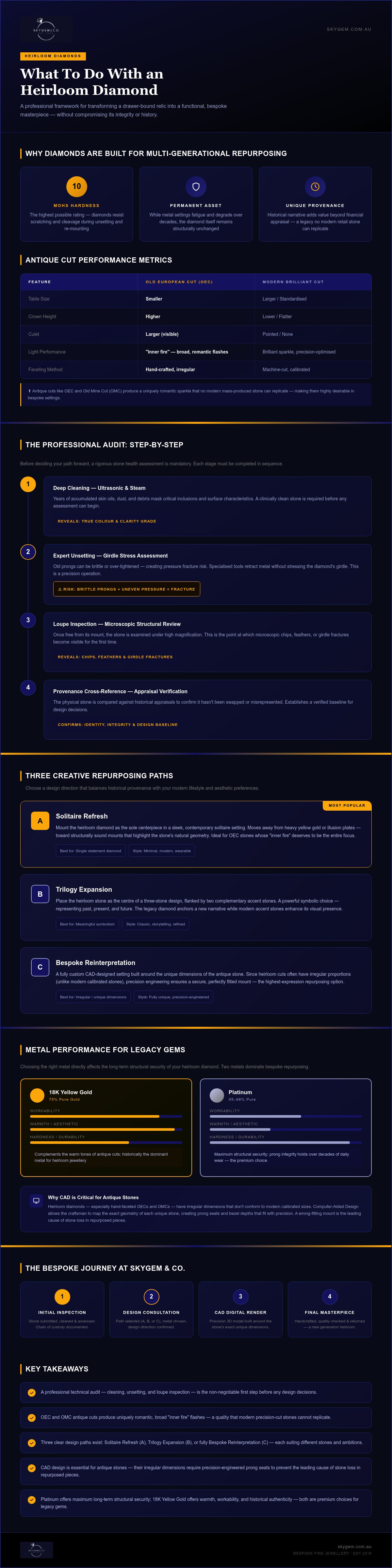
Diamonds are uniquely suited for multi-generational repurposing because they possess a 10/10 rating on the Mohs hardness scale. This physical property ensures the stone can withstand the rigorous process of unsetting and re-mounting without the high risk of scratching or cleavage that softer gemstones might face. While the original metal setting may fatigue or degrade over decades, the diamond remains a permanent asset. This durability allows for a seamless transition from a forgotten keepsake to a high-performance bespoke engagement ring that can be worn daily with confidence.
Understanding the history of jewellery helps clarify why these stones were set the way they were. Historically, settings were often designed to protect the stone or enhance its size using the technology available at the time. Modern consumers increasingly prioritise the connection to this history, seeking to honour the past while ensuring the piece aligns with current engineering standards and aesthetic preferences. It's a process of technical refinement that preserves the soul of the diamond while updating its physical environment.
The Shift from Antique to Contemporary Aesthetic
Older settings frequently rely on heavy yellow gold or illusion plates designed to make smaller stones appear larger. While these were innovative in their era, they often feel dated and bulky by modern standards. Upcycling has become a dominant trend in 2026, as clients look for sustainable ways to create fine jewellery without the environmental impact of new mining. The goal is to balance the preservation of history with the ergonomics of a modern lifestyle. This often involves moving toward sleeker, more structurally sound mounts that highlight the stone's natural geometry rather than obscuring it with excessive metal.
Identifying Common Heirloom Diamond Cuts
Most heirloom stones feature antique cuts, such as the Old Mine Cut (OMC) or the Old European Cut (OEC). These stones were fashioned by hand before the advent of modern precision technology. Consequently, they exhibit different light performance metrics than contemporary Brilliant cuts. OECs typically feature a smaller table, a higher crown, and a larger culet, resulting in a distinct "inner fire" and broader flashes of light. These unique facet patterns are highly desirable in custom settings. They offer a character and romantic sparkle that modern, mass-produced stones cannot replicate. Deciding what to do with an heirloom diamond often starts with appreciating these technical nuances and deciding how to best showcase them in a new design.
The Essential Professional Audit: Assessing Diamond Integrity
Before you can decide what to do with an heirloom diamond, a professional ultrasonic and steam cleaning is mandatory. Years of accumulated skin oils, dust, and debris can mask critical surface characteristics and inclusions. Only when the gem is clinically clean can a specialist accurately assess the materials, and gemstones under high magnification. This baseline clarity is essential for identifying the stone's true colour and clarity grade before any design work begins.
The unsetting phase is a delicate technical operation that requires expert handling to prevent stone damage. Older prongs may be brittle or have been tightened multiple times, creating uneven pressure points that could lead to fractures. We use specialized tools to retract the metal without stressing the diamond's girdle. When determining what to do with an heirloom diamond, cross-referencing the physical stone with historical appraisals ensures that the gem hasn't been swapped or misrepresented in the past. Once the stone is free from its mount, a technical loupe inspection allows us to map hidden inclusions or microscopic fractures that were previously obscured by the metalwork.
Checking for Structural Vulnerabilities
Antique diamonds often exhibit girdle chips because older settings frequently left the stone's edge exposed to impact. While these chips don't always compromise the stone's beauty, they represent structural weak points that may fail under the pressure of modern setting techniques. Internal fractures, known as feathers, also require careful evaluation. If a feather reaches the surface, the pressure of a new mount could cause it to expand and damage the stone. In some cases, we might recommend a professional re-cut or a minor polish. This process can remove surface abrasions and restore the stone's original light performance without significantly reducing its carat weight.
Certification and Grading in the Modern Era
Submitting an heirloom to the GIA provides a definitive baseline for modern insurance valuations and future-proofs the piece. Many older diamonds fall into the warm colour range, typically within the K through M grades. These tones significantly influence your choice of metal; an 18K yellow gold mount can harmonise with these warmer hues, whereas platinum might highlight the tint. Professional GIA grading provides a technical guarantee that your stone is a natural diamond rather than a historical simulant like paste or white sapphire. If you're unsure about the integrity of your inherited gem, our team can provide a detailed technical inspection to guide your next steps.
Three Creative Paths for Repurposing Heirloom Jewellery
The transition from a technical audit to creative design marks the most innovative phase of the repurposing journey. Determining what to do with an heirloom diamond requires a strategic approach that respects the stone’s original cut while optimising it for a modern wardrobe. You aren't limited to recreating a ring; you can also consider a "New Life" alternative by converting the gem into a singular pendant or a standout earring. If you choose to expand the design, selecting complementary side stones from natural and lab-grown diamonds allows for precise colour and clarity matching to suit the centre stone's specific grade.
When selecting a design path, consider the stone's physical dimensions and light performance. An antique stone with a high crown might require a different setting depth than a modern round brilliant. By choosing a path that aligns with the stone's geometry, you ensure the final piece is both aesthetically balanced and structurally sound. The goal is to create a functional asset that honours its history through superior craftsmanship.
The Modern Solitaire Transformation
Older rings often feature high-profile cathedral settings that are prone to catching on fabrics and sustaining impact damage. A modern refresh typically involves moving the diamond into a low-profile setting, such as a secure bezel or a refined four-claw mount. If your antique diamond has a slight yellow tint, setting it in 18K White Gold or Platinum can neutralise the warmth and provide a crisp, industrial aesthetic. This path is ideal for creating a bespoke engagement ring designed with a straight-edged shank, allowing a wedding band to sit perfectly flush against it without a gap. This configuration improves the ergonomics of the ring for daily wear.
Designing a Legacy Trilogy Ring
The trilogy setting offers a symbolic narrative, using three stones to represent a couple's past, present, and future. This path allows you to pair your heirloom centrepiece with modern precious gemstones, such as Australian Teal Sapphires or vibrant Emeralds. A significant technical challenge here is matching the "fire" of an antique cut with the brilliance of modern side stones. Tapered baguettes or pear-shaped diamonds are excellent choices to frame an older round centre; they provide a geometric transition that highlights the central stone without competing with its unique facet pattern. This creates a cohesive visual flow that bridges different eras of gem-cutting technology.
Technical Design Considerations for Modern Settings
Transitioning a legacy stone into a contemporary mount requires a focus on metallurgical properties and precision engineering. When you are determining what to do with an heirloom diamond, the physical interaction between the stone and its new environment is a primary concern. Unlike modern stones, heirloom diamonds rarely adhere to standard calibrated measurements. This makes Computer-Aided Design (CAD) an essential tool in the modern workshop. By creating a digital model of your specific stone, we can engineer a bespoke seat that accommodates every unique facet and depth variation, ensuring the stone is held with zero movement.
Prong selection is another technical lever used to mitigate risks identified during the audit phase. For stones with minor edge damage, eagle claw or tab prongs are superior choices. These styles provide a larger surface area of contact, which can effectively conceal minor girdle chips while providing a secure, industrial strength grip. Many clients also ask about melting down their original gold to create the new ring. While sentimentally appealing, the technical reality often involves metallurgical risks. Old gold frequently contains solder and unknown alloys that can cause porosity or structural brittle points in a new cast. We typically recommend using refined, fresh metal for the new setting to ensure long-term structural integrity.
Metal Choice and Structural Longevity
The choice of metal significantly impacts both the security and the aesthetic of the diamond. Platinum is often considered the gold standard for high-value centres because of its density and displacement properties; unlike gold, it does not wear away over time. However, the aesthetic impact of gold jewellery cannot be overlooked. A yellow gold setting can mask slight tints in an older stone, whereas a white metal might highlight them. The goal is to balance a "dainty" modern look with a metal thickness that guarantees the stone's safety for decades of daily wear.
Integrating Modern Lab-Grown Diamonds
A growing trend in 2026 is the "hybrid" bespoke piece, which addresses the gap between heritage and modern value. By using lab grown diamonds as halos or side stones, you can achieve a high-impact design while keeping the focus on your heirloom centre. This approach is highly cost-effective and allows for a perfect match in colour and clarity grades. A hybrid design offers the ethical and financial benefits of modern technology while honouring the natural history of your inherited gem. If you are ready to begin the technical design phase, you can consult with our design team to create a digital render of your concept.
Navigating the Bespoke Journey with SkyGem & Co.
Determining what to do with an heirloom diamond is a significant decision that requires a partner who acts as a technical consultant rather than just a retailer. Our engagement begins with a comprehensive consultation where we transition from the initial technical audit into a collaborative design phase. This process is engineered to respect the stone's history while aligning it with your modern aesthetic requirements. We don't just sell settings; we design a structural environment that ensures the long-term viability of your legacy gem.
Transparency in the workshop is a cornerstone of our professional practice. We maintain a rigorous chain of custody for your family stone, documenting every stage of the transformation from the moment it's unset to the final polish. This methodical approach addresses the common concern regarding stone security, providing you with absolute confidence that your original diamond is the one being placed into the new mount. Every design session is an opportunity to review technical specifications and ensure the final piece is a precise reflection of your vision.
From Concept to Craftsmanship
The design journey leverages high-fidelity 3D modelling to help you visualise your heirloom diamond in its new setting before any metal is cast. This CAD phase allows us to fine-tune the seating and prong geometry to the micrometre, ensuring a perfect fit for irregularly shaped antique cuts. Once the digital design is approved, our boutique workshop takes over. We prioritise hand-finishing for every piece, a step that provides a level of refinement and durability that mass-produced jewellery cannot match. A typical custom-made legacy transformation requires several weeks to complete, reflecting the precision required for high-end results.
Securing Your Legacy
The completion of your jewellery is not the end of our partnership. Post-transformation maintenance is essential for preserving the structural integrity of your new piece. We recommend regular professional cleanings and annual prong checks to ensure the diamond remains secure in its mount. To conclude the process, we provide a modern valuation certificate aligned with GIA standards. This document is vital for insurance purposes, reflecting the updated market value of the transformed piece. If you're ready to honour your history with a modern masterpiece, you can book a consultation to begin your custom design journey today.
Engineering the Next Chapter of Your Legacy
Repurposing an inherited gem is a technical process that bridges the gap between historical sentiment and modern durability. By prioritising a professional audit and leveraging advanced CAD technology, you ensure that your stone isn't just preserved, but structurally optimised for daily wear. Whether you choose a minimalist solitaire refresh or a complex trilogy expansion, the focus remains on the precision of the setting and the long-term security of the diamond.
Understanding what to do with an heirloom diamond allows you to transform a static asset into a functional piece of fine jewellery. At SkyGem & Co., our expert GIA-trained consultants and specialised bespoke design workshop provide a transparent environment for this transformation. Through our detailed 3D CAD design process, we eliminate uncertainty by allowing you to verify the fit and aesthetic before any metal is cast.
Transform your heirloom diamond into a bespoke masterpiece with SkyGem & Co.
We look forward to partnering with you as a technical consultant to create a piece that honours your family's history with uncompromising craftsmanship and reliability.
Frequently Asked Questions
Is it worth resetting a low-quality heirloom diamond?
The decision to reset a lower-grade stone depends entirely on the balance between its sentimental provenance and its structural integrity. While a diamond might have lower colour or clarity metrics, it remains a permanent link to your family history. If a technical audit confirms the stone is free from critical surface-reaching fractures, modernising the setting can significantly improve its visual performance and daily wearability.
Can a diamond break during the resetting process?
While diamonds are the hardest natural substance, they can cleave or fracture if they possess pre-existing structural vulnerabilities like deep feathers. Professional unsetting involves using specialised tools to retract metal without applying direct pressure to these weak points. We mitigate this risk by performing a high-magnification loupe inspection before the work begins, identifying any microscopic risks that might be aggravated by new metalwork.
How much does it cost to put an heirloom diamond in a new setting?
The investment required for a new mount is determined by the design complexity, your choice of metal, and the labour involved in the custom casting process. When considering what to do with an heirloom diamond, you should account for the cost of the professional audit, CAD modelling, and hand-finishing. Because every heirloom stone has unique dimensions, a bespoke approach is necessary to ensure a secure and permanent fit.
Can I use the gold from the original heirloom ring in the new design?
We typically advise against melting down old gold for a new cast because it often contains solder and impurities that compromise metallurgical stability. These contaminants can lead to porosity or brittle points in the new setting, potentially risking the security of your diamond. A more reliable approach involves refining the old metal for credit and using fresh, high-purity 18K gold or platinum for the transformation.
Will resetting an antique diamond decrease its value?
Resetting an antique diamond generally increases its practical and financial value by transforming it into a wearable, modern asset. While the original mount might have historical charm, it often lacks the structural security required for contemporary lifestyles. By placing the stone in a high-precision setting and obtaining a modern grading report, you establish a clear baseline for insurance and future-proof the piece for the next generation.
How do I know the jeweller won’t swap my diamond for another one?
Transparency is maintained through a documented chain of custody and the verification of unique identifying markers or laser inscriptions. Many modern diamonds feature a microscopic GIA serial number on the girdle, which we verify under a microscope both before and after the setting process. For older stones without inscriptions, we map internal inclusions that act as a "fingerprint," ensuring the exact stone you provided is the one returned.
Can I add lab-grown diamonds to a natural heirloom diamond setting?
Integrating lab-grown diamonds as side stones or halo accents is a highly effective way to expand a design while managing project costs. This hybrid approach allows you to match the colour and clarity of your natural heirloom centre with high-precision lab stones. It's a popular strategy for those deciding what to do with an heirloom diamond who want a larger visual impact without the premium cost of natural secondary gems.
Do I need a new GIA certificate if I already have an old appraisal?
A modern GIA certificate is essential because older appraisals often lack the technical precision and standardised grading metrics used today. An outdated report might not accurately reflect the stone's current condition or identify it as a natural diamond with modern certainty. Obtaining a new laboratory report provides a definitive technical baseline, which is critical for accurate insurance coverage and establishing the stone's current market position.
Disclaimer
This article is for general informational purposes only and may include AI-assisted content. Pricing, specifications, and availability are subject to change. For accurate advice and current information, please contact SkyGem & Co. directly. Nothing in this content constitutes professional or financial advice.