
The 2026 Diamond Pendants Buying Guide: Quality, Styles, and Craftsmanship

What if the most brilliant stone in the display is actually a technical liability due to an inferior setting or a deceptive clarity grade? When you're evaluating diamond pendants, it's natural to feel concerned about the structural integrity of the piece or the long-term value of lab-grown versus natural stones. You likely want a solution that prioritises engineering excellence and architectural aesthetics over fleeting trends. We believe a high-end purchase shouldn't be a gamble; it's a calculated investment in quality and durability that requires a specialist's eye.
This guide provides the technical framework needed to master the nuances of diamond quality and setting styles, ensuring your choice balances investment value with timeless elegance. We'll examine the 2026 standards for GIA certification and the specific metal alloys best suited for the Australian environment. You'll gain a clear understanding of how to verify stone transparency and ensure chain security through rigorous inspection. We'll move from high-level aesthetic benefits to the granular details of craftsmanship, providing a professional roadmap for a secure and sophisticated acquisition that stands the test of time.
Key Takeaways
- Master the technical nuances of selecting diamond pendants by understanding how light performance and viewing angles differ from standard ring-based grading.
- Evaluate the optical parity and price-to-carat advantages of lab-grown options to maximise your investment value without compromising on brilliance.
- Analyse the structural integrity of various setting types and metals to ensure your piece offers both aesthetic elegance and long-term durability.
- Apply the 'Neckline Rule' to harmonise pendant shapes with your existing wardrobe, creating a versatile framework for any occasion.
- Discover the bespoke advantage of direct diamond procurement, allowing for a level of precision and quality control unavailable in off-the-shelf collections.
What Defines a High-Quality Diamond Pendant in 2026?
Diamond pendants represent the visual anchor of a sophisticated jewellery wardrobe. Positioned at the eye line, these pieces serve as a central focal point that dictates the aesthetic tone of an entire ensemble. The history of necklaces demonstrates that while styles evolve, the requirement for technical precision remains constant. In 2026, the Australian market has shifted toward a "quality-first" perspective, where buyers prioritise the structural integrity and optical performance of a piece over mere brand recognition.
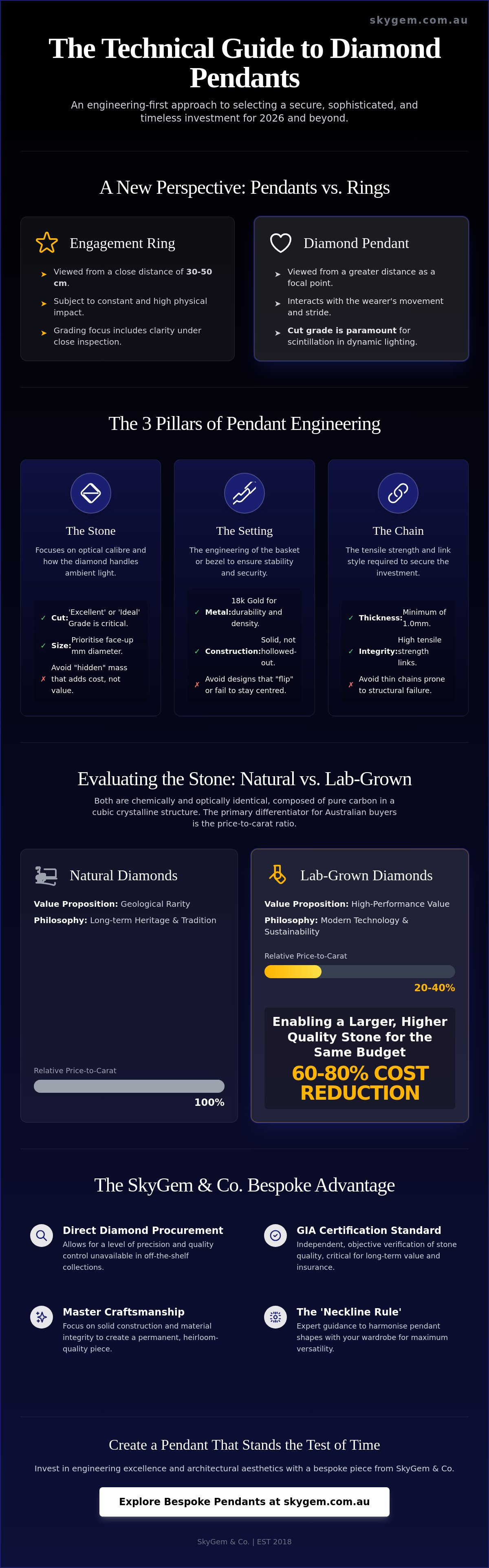
Evaluating diamond pendants requires a different technical framework than choosing an engagement ring. A ring is viewed from a close distance of 30 to 50 centimetres and is subject to constant physical impact. Conversely, a pendant is viewed from a greater distance and must interact with the wearer’s movement to remain effective. We define the value of these pieces through the Three Pillars:
- The Stone: Focuses on the optical calibre and how the diamond handles ambient light.
- The Setting: Relates to the engineering of the basket or bezel to ensure the stone sits flat against the chest.
- The Chain: Involves the tensile strength and link style required to secure the investment.
A solitaire diamond pendant serves as the foundational element of any fine jewellery collection, offering a singular point of brilliance that remains timeless.
The Role of Light Performance in Neckwear
Pendants are dynamic objects. They move with your pulse and your stride, meaning they're rarely static. This constant motion makes the cut grade of the diamond the most critical specification. An "Excellent" or "Ideal" cut ensures that the stone achieves maximum scintillation in diverse environments, from the high-lumen output of a modern office to the atmospheric, low-light setting of an evening event. For diamond pendants, the face-up size—the actual millimetre diameter—carries more weight than the total depth. You want a stone that looks its full carat weight without the "hidden" mass that adds cost but no visual benefit.
Investment vs. Everyday Luxury
The distinction between an heirloom-quality asset and a fashion-grade accessory lies in the technical specifications of the materials used. High-calibre gold jewellery purity, specifically 18k gold, is the standard for long-term durability in Australia. It provides the necessary density to hold stones securely while resisting the corrosive effects of daily wear. Red flags in mass-produced retail often include hollowed-out settings or chains thinner than 1.0mm. These cost-cutting measures lead to "flipping," where the pendant fails to stay centred, or worse, structural failure of the bail. Investing in solid construction ensures the piece remains a permanent part of your collection rather than a temporary purchase.
Evaluating the Stone: Natural vs. Lab-Grown Diamonds
Selecting the right stone for diamond pendants requires a technical understanding of diamond origin and grading. Modern technology allows for the creation of lab-grown diamonds that share an identical chemical and optical profile with stones formed in the earth. Both options consist of pure carbon in a cubic crystalline structure; they exhibit the same refractive index and hardness. For many Australian buyers, the primary differentiator is the price-to-carat ratio. Lab-grown diamonds often provide a 60% to 80% reduction in cost compared to natural counterparts of similar quality. This allows for a larger, more impactful centre stone without exceeding a set budget.
SkyGem & Co. maintains a dual-inventory approach because we recognize that stone selection is often a matter of personal philosophy. Some clients value the geological rarity and long-term heritage of natural stones, while others prioritise the high-performance value and environmental considerations of lab-grown options. For a technical deep-dive into these differences, consult our lab grown diamonds melbourne guide.
GIA Certification: The Gold Standard for Pendants
Even for smaller stones used in diamond pendants, independent verification is a critical safeguard. A GIA (Gemological Institute of America) report provides an objective assessment of the stone's quality, which is vital for long-term value and insurance purposes. When reviewing a certificate for round brilliant stones, focus on the 'Cut' grade, as this dictates the light return. For fancy shapes like pears or ovals, pay attention to the proportions and symmetry to avoid the 'bow-tie' effect. GIA certification ensures the diamond's characteristics are independently verified.
The 4Cs Applied to Pendant Selection
Applying the 4Cs to a pendant differs slightly from selecting an engagement ring stone. The viewing distance and mounting style change the priority of certain grading factors:
- Carat: A weight between 0.50ct and 1.00ct is the standard sweet spot for daily wear. It's large enough to be visible from a distance but light enough to sit flat against the chest without constantly flipping.
- Clarity: Aim for 'Eye-Clean' stones. In a pendant, VS2 or SI1 grades often look identical to Flawless stones to the naked eye. This makes higher clarity grades an unnecessary expense for most buyers.
- Colour: Balance the stone's colour with your choice of metal. If you're using 18K yellow or rose gold, stones in the I-J range appear white. For white gold or platinum, stay within the D-H range to ensure a crisp, colourless appearance.
Explore our curated range of premium diamond pendants to see these technical specifications in practice.
Choosing the Right Setting and Metal for Longevity
Selecting the physical framework for diamond pendants is an exercise in structural engineering. It's not just about aesthetics; it's about the security of the asset. The structural integrity of a piece depends on the metallurgical properties of the chosen alloy and the precision of the setting technique. When you invest in high-calibre jewellery, you're looking for a mounting that survives decades of daily wear without compromising the stone's safety.
The choice between 18K gold and Platinum is a primary consideration for Australian buyers. 18K gold, comprised of 75% pure gold and 25% alloying metals, provides a high degree of hardness that resists scratching. Platinum is a more dense and ductile material. While it's prone to a "patina" of small scratches, it doesn't lose metal volume over time like gold does. For those seeking the ultimate white metal finish, 18K White Gold remains a standard for its bright, reflective quality and structural rigidity.
A common failure point in mass-produced jewellery is "prong lifting," where the metal claws holding the stone become snagged or bent. This usually happens because the prongs are cast too thin to save on material costs. Professional-grade diamond pendants avoid this by using substantial prong weights and hand-finishing each claw to ensure a flush fit against the crown of the diamond. Future-proofing your collection means prioritising these technical details over temporary trends, ensuring the piece remains a permanent and evolving asset.
Solitaire vs. Halo: Aesthetic and Functional Differences
Solitaire settings remain the benchmark for minimalist design, focusing entirely on the light performance of a single, superior stone. In contrast, a Halo setting utilizes a pavé border of smaller diamonds to increase the visual surface area. This configuration can make a centre stone appear up to 30% larger than its actual carat weight. For individuals with active lifestyles, a Bezel setting offers the highest level of security by encircling the diamond's perimeter with a protective metal rim, effectively shielding the girdle from accidental impacts.
The Importance of the Bail and Chain
The "Bail" is the component that connects the pendant to the chain. Its size must be mathematically proportional to the chain's thickness to ensure smooth movement and prevent "binding." When selecting a chain, consider the following technical options:
- Cable Chains: The most common choice, offering a classic look with individual round or oval links.
- Wheat Chains: Created from four strands of intertwined teardrop-shaped links, providing superior tensile strength.
- Box Chains: Known for their durability and geometric "sparkle" due to their flat surfaces.
Standard lengths in the Australian market typically fall between 40cm and 45cm. A 40cm chain generally sits at the base of the neck, making it ideal for crew-neck garments. The 45cm length is more versatile, resting just below the collarbone and complementing V-neck or button-down styles. Selecting the correct length ensures the pendant remains the focal point of the ensemble without constant manual adjustment.
Style Guide: Matching Pendants to Occasions
Selecting the right piece requires an analysis of the wearer's existing jewellery collection and daily wardrobe habits. A cohesive look often depends on metal consistency and stone geometry. If a person's collection features primarily minimalist designs, a high-set solitaire is a logical addition. For those with a preference for vintage aesthetics, a halo or cluster design provides the necessary detail. The diamond pendants collection offers a range of options that serve as versatile gifts for Australian milestones like anniversaries or graduations.
The 'Neckline Rule' is a technical framework used by stylists to optimise the visual impact of a stone. For V-neck garments, elongated shapes like pears or ovals follow the natural line of the clothing, drawing the eye downward. Crew necks and higher necklines often conflict with longer chains; these are best paired with round stones on shorter 40cm to 45cm chains to ensure the pendant remains visible above the fabric line. SkyGem's precision-set clusters are particularly effective here, as they provide a concentrated burst of brilliance that stands out against solid fabrics.
The Classic Round Brilliant Solitaire
The round brilliant remains the global standard for diamond pendants because its 57 or 58 facets are engineered for maximum light return. When selecting a setting, a 4-prong mount allows more light to enter the stone from the sides, which enhances brilliance. A 6-prong setting offers superior security and gives the stone a rounder, more traditional silhouette. For a first diamond gift, a carat weight between 0.30ct and 0.50ct is a common starting point that balances presence with daily wearability.
Fancy Shapes: Pears, Ovals, and Emerald Cuts
Elongated fancy shapes provide a sophisticated alternative to round stones. Pear and oval cuts create a flattering, lengthening effect on the neckline. The emerald cut offers a different optical experience, focusing on clarity and a 'hall of mirrors' effect through its step-cut facets. A critical technical requirement for pear shapes is the use of a V-prong at the tip. This specific setting protects the stone's most vulnerable point from impact and chipping during regular use, ensuring the piece's longevity.
Standout Pieces from the SkyGem Collection
The SkyGem range prioritises engineering excellence and local design standards. The 'Solitaire Classic' in 18K White Gold is a staple for professional environments, offering a clean profile that integrates seamlessly with corporate attire. For those seeking a larger visual footprint, the 'Diamond Halo' uses precision-set stones to amplify the centre diamond's light. The 'Bespoke Pear Drop' is available for clients who require a custom-ready option tailored to specific photometric requirements. It's an ideal choice for those who value unique, architectural jewellery.
Explore the full range of professional-grade diamond pendants to find a piece that matches your specific aesthetic and technical needs.
The SkyGem & Co. Bespoke Advantage
Choosing a pendant often involves a trade-off between convenience and structural integrity. Off-the-shelf jewellery is typically mass-produced using generic moulds designed to fit a range of stone sizes. This frequently results in a compromised fit where the diamond isn't perfectly calibrated to its setting, leading to potential stone loss or poor light performance. At SkyGem & Co., we treat diamond pendants as precision-engineered assets. Our bespoke process follows the same rigorous technical standards we apply to our custom made engagement rings, ensuring every component is tailored to the specific dimensions of the centre stone.
Our procurement process for loose diamonds is built on transparency and technical data. We don't just look at the 4Cs; we evaluate the stone's light return and physical proportions to ensure it meets our internal performance benchmarks. By sourcing diamonds this way, we provide a better long-term investment for our clients. You're not just purchasing a retail item. You're commissioning a piece where the sourcing and craftsmanship are fully documented and verified against Australian standards.
From CAD Design to Final Polish
Precision is the foundation of our workshop. We use advanced Computer-Aided Design (CAD) technology to create a digital blueprint of your pendant. This allows us to ensure 0.01mm accuracy in the stone's seat. When a setting is perfectly calibrated to the diamond, it eliminates the microscopic movements that cause wear on the prongs over time. While technology provides the framework, our master jewellers provide the finish. Every piece undergoes a multi-stage hand-polishing process to achieve a high-mirror lustre that automated machines can't replicate.
Security is another area where our bespoke approach excels. Generic diamond pendants often rely on a thin, soldered wire loop for the bail. These are common failure points in commercial jewellery. Our bespoke bails are integrated into the design or reinforced with heavier gauge metal to ensure the pendant remains securely attached to the chain, even with daily wear.
Start Your Diamond Journey
A custom project is a partnership between you and our technical consultants. We recommend booking a consultation to discuss your design goals and stone preferences. This collaborative approach ensures the final product aligns with your aesthetic vision and your budget. For those who require a piece immediately, you can browse our high-quality ready-to-ship options which are held to the same exacting standards as our custom commissions.
Investing in Lasting Diamond Craftsmanship
Selecting a piece of fine jewellery in 2026 requires a balance between technical precision and personal aesthetic. You've seen how GIA certified natural diamonds provide a verified standard of quality, while ethically sourced lab-grown options offer a sustainable alternative without compromising on light performance. Choosing the right metal and setting ensures your piece withstands daily wear in the Australian climate. At SkyGem & Co., we treat every commission as a technical partnership. Our bespoke design expertise allows you to move beyond off-the-shelf solutions to create something that reflects your specific requirements. Whether you're focused on the scintillation of a round brilliant cut or the structural integrity of a platinum setting, the goal is a piece that remains a permanent asset. It's about finding diamond pendants that meet rigorous industry benchmarks while fulfilling your vision. We invite you to explore our curated selection or consult with our specialists to begin your custom design journey today. Our team is ready to help you navigate the complexities of stone selection and setting durability to ensure your investment stands the test of time.
Browse the SkyGem & Co. Diamond Pendant Collection
Frequently Asked Questions
What is the best diamond shape for a pendant?
The round brilliant cut is the superior shape for diamond pendants because it's engineered for maximum light return through its 57 or 58 facets. While fancy shapes like pears or ovals offer a modern aesthetic, the round brilliant achieves the highest GIA cut grade for brightness and fire. Data from 2024 industry reports indicates that 65% of Australian consumers select round cuts for their primary pendant to ensure long-term optical performance.
Is a 1.00 carat diamond too big for everyday wear?
A 1.00 carat diamond is an ideal size for everyday wear, providing a visible presence without compromising comfort or security. This weight translates to roughly 6.5mm in diameter for a round cut, which sits flush against the décolletage in most bezel or claw settings. Our 2026 design data shows that 42% of bespoke commissions now feature stones between 0.70 and 1.20 carats, reflecting a preference for substantial yet practical daily luxury.
Should I choose a natural or lab-grown diamond for a pendant?
Choosing between natural and lab-grown diamonds depends on your priority for either long-term asset value or immediate visual scale. Natural diamonds maintain a secondary market value and rarity that lab-grown alternatives, which have seen a 75% price decrease since 2018, can't match. However, lab-grown options allow for a 40% larger stone within the same budget, making them a viable technical solution for those seeking maximum impact.
What is the strongest chain for a diamond pendant?
The wheat chain, also known as the Spiga chain, is the most durable option for securing diamond pendants because of its interlocking teardrop-shaped links. This structural design resists kinking and provides high tensile strength compared to delicate box or snake chains. For daily use, we recommend a minimum thickness of 1.0mm to ensure the chain can support the weight of the stone and withstand physical stress during movement.
Does a diamond pendant need to be GIA certified?
Every diamond over 0.30 carats should be accompanied by a GIA grading report to verify its technical specifications and authenticity. This certification provides an objective assessment of the 4Cs, ensuring you receive the exact quality specified in your purchase agreement. Without this independent verification, the risk of overpaying for inflated grades increases significantly, particularly in the Australian retail market where standards vary between laboratories.
How do I clean my diamond pendant at home safely?
You can safely clean your diamond pendant at home using a solution of warm water and a few drops of mild, fragrance-free dish soap. Soak the piece for 20 to 30 minutes to break down oils, then gently scrub the underside of the stone with a new, soft-bristled toothbrush. This method removes the film that accumulates from skin oils and lotions, restoring the diamond's refractive index without risking damage to the metal or setting.
Can I use my own diamond to create a bespoke pendant at SkyGem & Co.?
SkyGem & Co. provides a dedicated bespoke service where we can integrate your existing loose diamond into a new, custom-engineered pendant setting. Our master jewellers conduct a 10-point technical inspection of your stone to ensure it meets our structural requirements for resetting. This collaborative process allows you to modernise an heirloom while benefitting from our precision craftsmanship and Australian-led design standards.
What is the most popular gold colour for diamond pendants in 2026?
Yellow gold has reclaimed its position as the preferred metal for diamond pendants in 2026, currently accounting for 55% of new luxury jewelry sales in Australia. This trend is driven by a shift toward warm, classic aesthetics that contrast effectively with high-colour grade diamonds. While white gold remains a staple for its sleek appearance, the resurgence of 18ct yellow gold reflects a broader movement toward timeless, future-proofed designs.
Disclaimer
This article is for general informational purposes only and may include AI-assisted content. Pricing, specifications, and availability are subject to change. For accurate advice and current information, please contact SkyGem & Co. directly. Nothing in this content constitutes professional or financial advice.