
Solitaire Engagement Rings Melbourne: The 2026 Guide to Timeless Design

A minimalist setting is the ultimate test of a jeweler's technical precision, where there's no room for structural error. You likely appreciate the clean lines of a classic solitaire but worry that a thinner band might compromise the security of your stone. It's a valid concern; as the design landscape shifts toward larger center stones and more delicate profiles in 2026, the physics of the setting become more critical. When selecting solitaire engagement rings Melbourne, the primary challenge is balancing a refined aesthetic with the mechanical requirements of a lifelong heirloom.
We'll provide the technical clarity you need to navigate this investment with confidence. You'll learn how to balance diamond size with structural integrity, ensuring your ring remains secure through decades of daily wear. This guide covers the critical 2026 GIA grading updates for lab-grown diamonds, the impact of rising gold costs on setting thickness, and the bespoke CAD methods that eliminate the risks of a fragile mount. We'll move beyond the 4Cs to explain how precision engineering transforms a simple design into a permanent asset that performs as well as it looks.
Key Takeaways
- Understand the mechanical requirements of a secure setting and why the precision of a hand-finished seat is essential for preventing stone loss.
- Evaluate the 2026 GIA reporting standards to navigate the value differences between natural and lab-grown solitaire engagement rings Melbourne.
- Learn how custom-engineered CAD design provides a level of durability and precision that mass-produced casts cannot replicate.
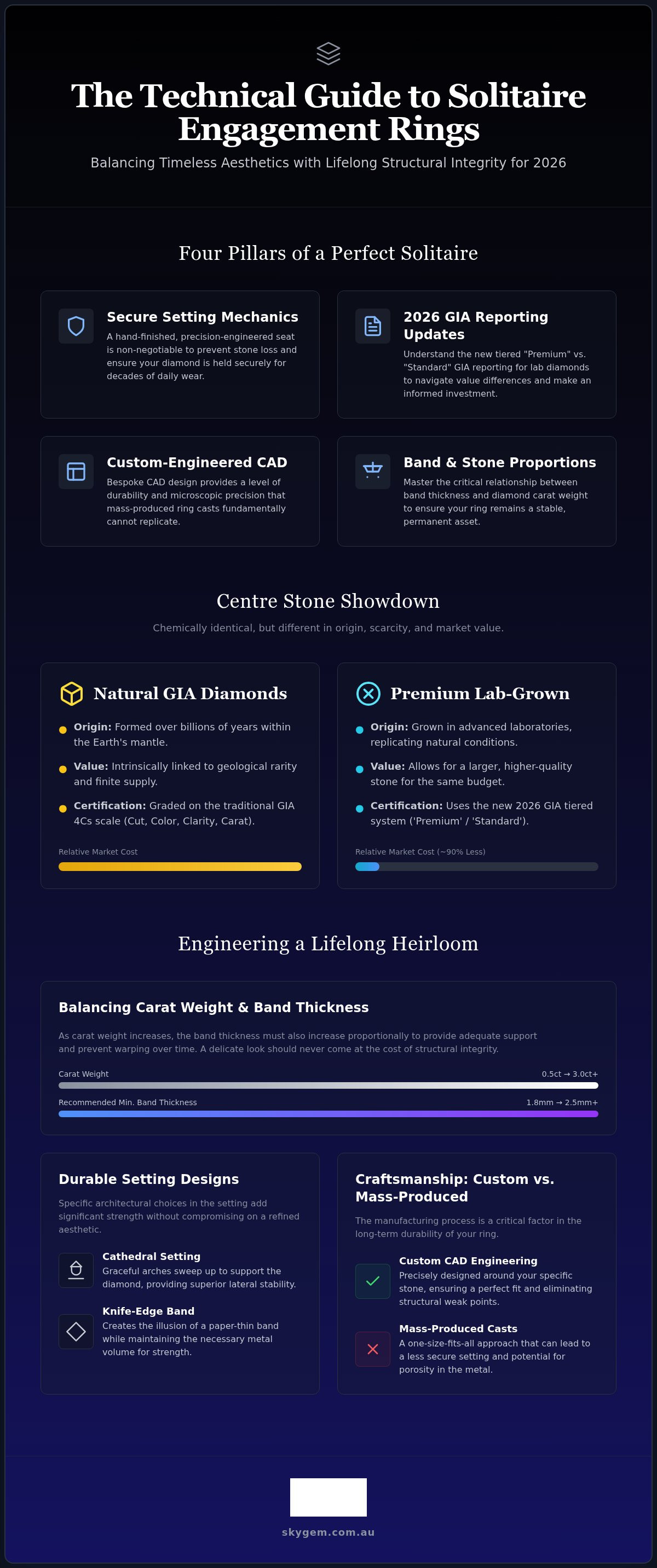
- Master the relationship between band proportions and diamond carat weight to ensure your ring remains a stable and permanent asset for daily wear.
The Enduring Appeal of Solitaire Engagement Rings in Melbourne
The solitaire design remains the definitive choice for those seeking a balance of understated elegance and technical superiority. By stripping away peripheral distractions, this setting acts as the ultimate benchmark for a diamond's performance. Every facet is exposed to light, allowing for maximum brilliance and scintillation. For those researching solitaire engagement rings melbourne, the appeal lies in this transparency; there is nowhere for an inferior stone to hide. This architectural purity is why the style has dominated the history of engagement rings, evolving from ancient symbols to the sophisticated, precision-engineered pieces we see today.
In the local landscape, the 'Melbourne standard' refers to a specific intersection of high-durability alloys and refined, hand-finished aesthetics. It isn't just about the stone; it's about the structural integrity of the mount. A premium solitaire must withstand the rigors of daily wear while maintaining a profile that feels weightless on the finger. This focus on long-term viability over temporary fashion is what separates a high-end technical design from a mass-produced alternative.
The Definition of a Classic Solitaire
At its core, a classic solitaire consists of a single centre stone mounted on a plain precious metal band. The architecture typically involves a 'seat' where the diamond rests and a series of prongs, usually four or six, that secure the crown. While the concept is simple, the execution varies significantly based on the wearer's lifestyle. A custom-made engagement ring allows for specific structural choices like a cathedral setting, which uses arches to support the stone, or a knife-edge band that creates a visual illusion of extreme thinness while maintaining the metal volume required for strength.
Why Solitaires Remain the Top Choice for 2026
The minimalist aesthetic continues to lead the market in 2026 because it offers unparalleled versatility. Modern couples often view their engagement ring as the first piece in a broader collection. A solitaire provides a clean foundation that pairs seamlessly with various wedding band styles, from plain gold to intricate diamond-set pavé bands. It allows for future growth, such as adding anniversary stacks, without creating a cluttered look.
This style also maximises the visual impact of your investment. Without a halo or side stones to compete with, the centre diamond appears larger and more prominent. For those choosing elongated shapes like ovals or marquise cuts, which are trending heavily this year, the solitaire setting emphasizes the stone's length and creates a flattering, elongated line on the hand. It's a pragmatic choice that values optical performance over passing fads.
Selecting the Centre Stone: Natural vs. Lab-Grown Diamonds
The technical selection of a centre stone is the most significant variable in the design of solitaire engagement rings melbourne. From a chemical perspective, natural and lab-grown diamonds are identical; both consist of carbon atoms arranged in a cubic crystal structure. They possess the same refractive index, dispersion, and hardness. The decision between them isn't one of quality, but of project priorities regarding rarity, budget allocation, and long-term value retention.
Certification remains the only safeguard for your investment. As of October 2025, the GIA updated its reporting for lab-grown diamonds, moving to a tiered system of "Premium" and "Standard" classifications. This differs from the traditional 4Cs scale still used for natural stones. Understanding these technical nuances is vital. While lab-grown diamonds are approximately 90% less expensive than natural equivalents in 2026, natural stones retain a distinct market position due to their finite geological supply. Each stone type serves a different purpose in the portfolio of a modern couple.
Natural GIA Certified Diamonds
Natural diamonds represent a geological timeline spanning billions of years. Their value is intrinsically linked to their scarcity and the rigorous standards of the Gemological Institute of America. For a solitaire setting, where the stone is the sole focus, we recommend prioritizing an "Excellent" cut grade to ensure light return is maximized. You can explore GIA certified natural diamonds to see how specific clarity and colour grades impact the stone's physical appearance in a minimalist mount.
The Rise of Premium Lab-Grown Diamonds
Lab-grown diamonds have transitioned from a budget alternative to a primary choice for those seeking solitaire engagement rings melbourne. Utilizing Chemical Vapour Deposition (CVD) or High Pressure High Temperature (HPHT) methods, these stones allow for significantly larger carat weights without the price premiums of natural rarity. In 2026, the average lab-grown centre stone ranges between 1.8 and 2.5 carats. This scale provides a dramatic visual presence that was previously inaccessible for most projects. You may browse lab-grown diamond options to compare how different shapes perform at these larger scales.
When the diamond stands alone, "Cut" is the most critical of the 4Cs. It acts as the engine of the stone's brilliance. Since there are no surrounding diamonds to mask inclusions, "Clarity" also requires closer inspection. We suggest a minimum of VS2 for a solitaire to ensure the stone is eye-clean. If you're unsure which origin aligns with your goals, our consultants can provide a technical comparison of available stones to help you make an informed decision.
Structural Integrity: The Technical Art of the Solitaire Setting
The engineering of solitaire engagement rings melbourne requires a precise balance between minimalist aesthetics and mechanical durability. While the visual goal is often to make the diamond appear as though it's floating, the structural reality must be one of absolute security. A stone is only as secure as the 'seat' it rests in. This is the notch precisely carved into the metal claws where the diamond's girdle is positioned. If the seat is too shallow, the stone may tilt or rotate. If it's too deep, the metal wall becomes thin and prone to failure under stress.
Addressing the primary concern of daily wear requires a move away from mass-produced casts toward hand-finished settings. In a bespoke environment, the volume of metal in the prongs is calculated based on the specific dimensions of your chosen stone. This ensures that the ring remains a permanent asset, capable of withstanding the rigors of an active lifestyle without compromising its refined profile.
Claw Count and Stone Security
The choice between a 4-claw and 6-claw setting is a technical decision that impacts both light performance and safety. A 4-claw setting exposes more of the diamond's pavilion, which can enhance light entry but offers less redundancy if a prong is damaged. A 6-claw setting provides a higher safety margin, as the stone is supported at more points around its circumference. For larger carat weights or elongated shapes, this extra security is often the recommended path.
A gallery rail is a horizontal metal band that connects the prongs below the diamond's girdle, acting as a structural brace that prevents the claws from pulling apart and ensures the stone cannot slide out sideways.
Metal Selection: Platinum vs. 18K Gold
Metal choice isn't merely a colour preference; it's a decision based on performance metrics. Platinum is a dense, naturally white metal that is highly malleable. It doesn't snap under impact; instead, it displaces, making it the technical gold standard for fine solitaire claws. While 18K white gold is harder and more scratch-resistant, it's also more brittle. Over years of wear, gold claws may require more frequent maintenance to ensure they haven't thinned significantly.
The metal also influences the diamond's perceived colour. A platinum setting will highlight any yellow tints in a stone, necessitating a higher colour grade for a crisp look. Conversely, yellow gold can mask slight warmth, allowing for a broader selection of stones. You can view our 18K White Gold solitaire collection to understand how different alloys interact with various diamond grades to achieve a specific aesthetic outcome.
Designing Your Bespoke Solitaire: A Framework for Quality
Designing a solitaire is an exercise in precision engineering. When you move beyond the limitations of ready-to-wear inventory, you gain control over the technical specifications that define longevity. For solitaire engagement rings melbourne, this bespoke approach ensures the band width is mathematically proportional to the diamond's carat weight. A band that is too narrow for a large centre stone creates a top-heavy structure prone to spinning and metal fatigue over time. We focus on achieving a balance where the metal volume supports the stone without overwhelming its visual presence.
Modern design relies on Computer-Aided Design (CAD) to simulate the ring's geometry before it enters production. This allows for adjustments to metal density at high-stress points, such as the junction between the band and the setting. Every hand-finished ring undergoes a rigorous quality control protocol to verify the symmetry of the claws and the depth of the stone's seat. It's a methodical process that treats your jewellery as a structural project rather than a simple retail transaction.
Custom Design vs. Ready-to-Wear
Off-the-shelf settings are often manufactured as mass-produced casts designed to fit a range of diamond sizes. This "one-size-fits-many" approach usually results in a compromise where the prongs may be unnecessarily long or the seat doesn't match the diamond's unique pavilion angle. By choosing the bespoke engagement ring process, you ensure the setting is tailored to the exact dimensions of your diamond. This maximizes light performance and provides a flush fit that prevents the stone from shifting or coming loose during daily activities.
Budgeting for a High-Quality Solitaire
Budget allocation in 2026 requires a strategic look at both the stone and the mounting. With gold prices rising by approximately 65% through 2025, the cost of a high-density setting is a larger factor than in previous years. However, investing in a structurally sound band is more critical for long-term wear than chasing a marginally higher clarity grade that isn't visible to the naked eye. You can find more detail on regional design trends and material selection in our Engagement Rings Melbourne: The Definitive 2026 Guide.
Balanced design ensures your ring remains a permanent asset that performs as well as it looks. If you're ready to begin your technical consultation, you can start your custom design journey with our specialists to review your stone and setting requirements.
SkyGem & Co.: Expert Craftsmanship for Your Solitaire Ring
SkyGem & Co. operates at the intersection of technical precision and aesthetic design. We view the creation of solitaire engagement rings melbourne as a collaborative engineering project. Our role is to act as your technical consultant, providing the data and expertise required to navigate a complex global market. This approach ensures that every design choice, from the alloy composition to the prong profile, is grounded in practical application and long-term performance. We prioritize a solution-oriented partnership, moving away from aggressive sales tactics toward a methodical, expert-led experience.
We bridge the gap between digital precision and traditional craftsmanship. Once the CAD phase is finalized, our master jewellers transition to the hand-finishing stage, where the metal is polished and the stone is set with microscopic accuracy. This dual-layered process eliminates the common defects found in mass-produced jewellery, such as porous metal or uneven claws. By maintaining this high level of control over the manufacturing pipeline, we guarantee that your ring meets the 'Melbourne standard' for premium quality and structural stability.
Our Technical Consultation Process
Transparency is the foundation of our boutique experience. During a consultation, we move beyond the basic 4Cs to examine the physical properties that affect a diamond's light return and structural fit. We prioritize education, explaining how specific 2026 GIA standards impact the value of both natural and lab-grown stones. By focusing on regional design origins and strict regulatory adherence, we provide a level of reliability that larger, global corporations often lack. Our clients value this quiet confidence, knowing their investment is backed by documented expertise and a commitment to the long-term success of their project.
Lifetime Maintenance and Care
A high-quality solitaire is an evolving asset that requires ongoing professional attention to maintain its integrity. To ensure the structural safety discussed in previous sections remains intact, we provide comprehensive maintenance services, including professional cleaning and rigorous prong inspections. These check-ups are essential for identifying metal fatigue or displacement before they lead to stone loss. This commitment to longevity reflects our focus on environmental responsibility and the long-term viability of your heirloom piece.
For those specifically interested in the evolving market for man-made stones, our Lab Grown Diamonds: The 2026 Australian Buying Guide offers further technical insights into selecting a permanent centrepiece for your setting. We treat every ring as a permanent asset, ensuring it remains as secure and brilliant as the day it was first commissioned.
Securing the Future of Your Bespoke Design
Selecting a solitaire is a decision that requires both aesthetic vision and technical foresight. By prioritizing structural integrity through hand-finished settings and bespoke CAD design, you ensure that your minimalist aesthetic doesn't come at the cost of long-term security. Whether you select a natural stone for its geological rarity or a lab-grown diamond for its impressive scale, understanding the 2026 GIA reporting standards is essential for a transparent investment. When searching for solitaire engagement rings melbourne, your focus should remain on the intersection of high-durability alloys and precision-cut diamonds that perform under the rigors of daily wear.
SkyGem & Co. acts as your technical consultant throughout this process, providing GIA certified diamonds and expert technical consultations to help you navigate every complex design variable. We treat each project as a permanent asset, ensuring it remains a structurally sound and brilliant centerpiece for decades to come. Our commitment to ongoing maintenance and regional design origins provides the quiet confidence you need for such a significant project.
Explore our Bespoke Solitaire Engagement Ring Collection and begin a partnership grounded in reliable expertise and regional design pride.
Frequently Asked Questions
Are solitaire engagement rings more expensive than other styles?
Solitaire settings are typically more cost-effective than halo or trilogy designs because they require less metal and fewer secondary stones. The majority of your budget is allocated to the centre diamond rather than the complexity of the mount. This allows for a higher focus on stone quality. When choosing solitaire engagement rings melbourne, the total cost is primarily determined by the carat weight and certification of the single diamond rather than the setting architecture.
Which diamond shape looks the largest in a solitaire setting?
Elongated diamond shapes like oval, pear, and marquise cuts provide a larger surface area relative to their carat weight compared to round brilliant diamonds. These shapes create a visual illusion of greater size and an elegant, elongated line on the finger. For instance, an oval-cut diamond can appear up to 15% larger than a round stone of the same weight, making it a pragmatic choice for maximising visual impact within a minimalist setting.
Is a 4-claw or 6-claw setting better for a round diamond?
A 6-claw setting is technically superior for stone security because it provides more points of contact and redundancy if a single prong is damaged. While a 4-claw setting exposes more of the diamond's facets and can make a stone appear more square, it offers less protection against impact. For a round diamond intended for daily wear, the 6-claw configuration is the reliable expert recommendation to ensure the stone remains permanently seated.
Can I use a lab-grown diamond in a bespoke solitaire ring?
You can certainly integrate a lab-grown diamond into a custom-engineered setting. This is an increasingly common choice in 2026 for those seeking larger centre stones, often ranging from 1.8 to 2.5 carats, without the scarcity premium of natural stones. Our bespoke CAD design process ensures that the setting is mathematically tailored to the exact proportions of your lab diamond, maintaining structural integrity regardless of the stone's origin or scale.
What is the best metal for a solitaire engagement ring in Australia?
Platinum is the technical gold standard for solitaire claws due to its density and malleability, which prevents the metal from snapping under stress. However, 18K yellow gold has seen a strong revival in Melbourne for its warmth and vintage aesthetic. Given that gold prices rose by approximately 65% through 2025, the choice often depends on balancing the specific performance metrics of the metal with your project's budgetary allocation for solitaire engagement rings melbourne.
How do I care for my solitaire ring to ensure the stone stays secure?
Professional inspections every six to twelve months are essential for identifying prong displacement or metal thinning before they lead to stone loss. You should also perform a tap test at home by gently tapping the ring near your ear; any clicking sound indicates a loose stone that requires immediate technical attention. Regular cleaning with a soft brush and mild solution prevents debris from building up and putting pressure on the setting's seat.
What is the typical timeframe for a custom solitaire ring design?
The bespoke design and manufacturing process generally requires four to six weeks from the initial consultation to final delivery. This timeframe includes the stone sourcing phase, CAD modelling, and the meticulous hand-finishing of the setting. Rushing this process can compromise the precision of the stone's seat or the symmetry of the claws. We prioritise a methodical approach to ensure the final piece meets our rigorous quality control standards for long-term durability.
Does a solitaire ring require a specific type of wedding band?
Solitaire rings are the most versatile foundation for a bridal stack and don't require a specific band type. They pair seamlessly with plain metal bands, diamond-set pavé styles, or even contoured bands designed to sit flush against the engagement ring's gallery. This flexibility allows you to evolve your collection over time, adding anniversary bands or gemstone accents without conflicting with the clean, technical lines of the original solitaire setting.