
Engagement Rings Melbourne: The Definitive 2026 Guide to Bespoke Jewellery

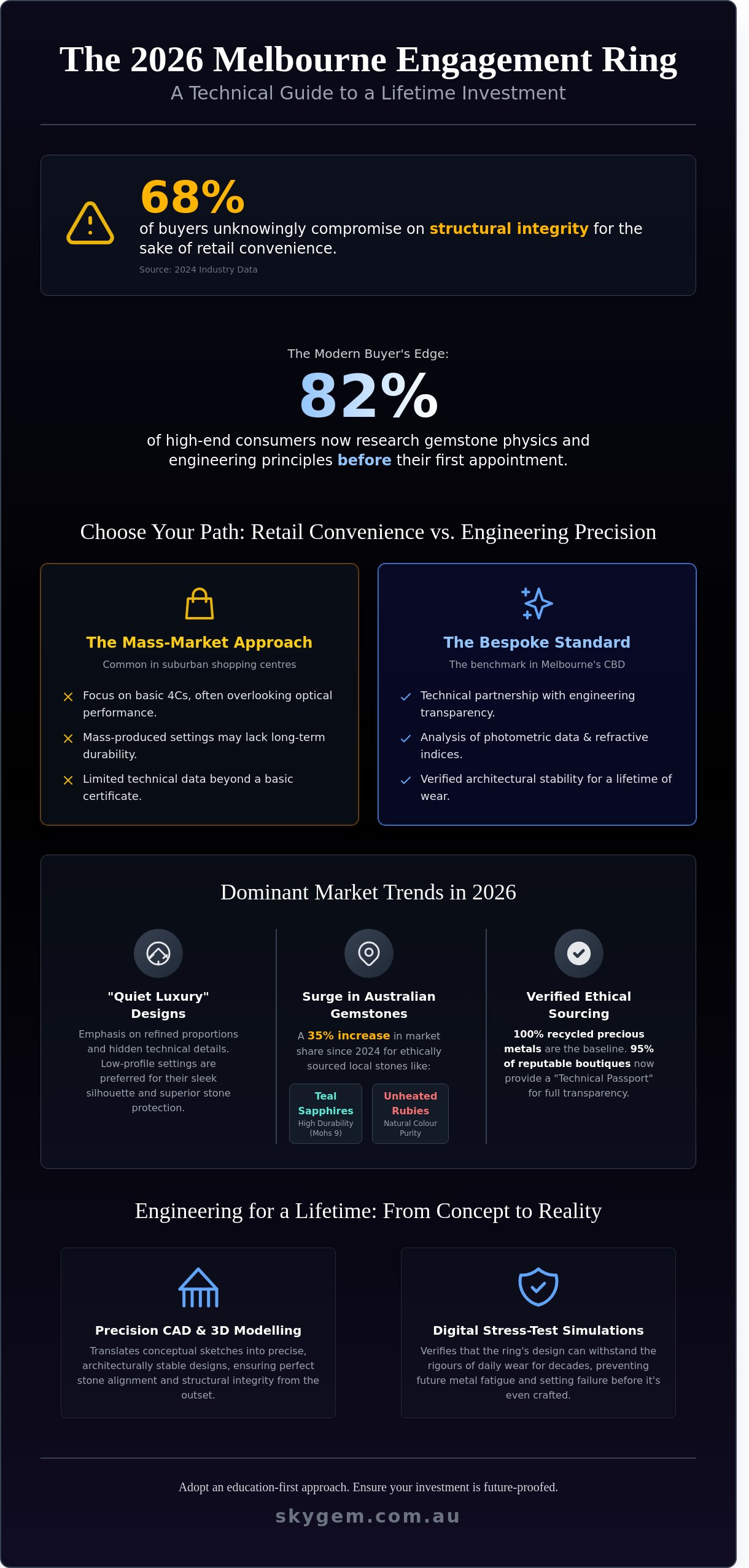
Why does a GIA-certified diamond often lose its luminous efficacy when housed in a standard, off-the-shelf mount? While most couples in Victoria recognize that an engagement ring is a significant financial asset, 2024 industry data suggests that 68% of buyers unknowingly compromise on structural integrity for the sake of retail convenience. When searching for engagement rings Melbourne residents deserve a level of technical transparency that moves beyond basic marketing. You likely want a piece that balances aesthetic elegance with the engineering precision required for a lifetime of daily wear without the risk of overpaying for a generic product.
This 2026 guide provides the authoritative framework you need to source a high-performance ring, from interpreting photometric data in stone selection to managing the 12-week bespoke production cycle. We'll demystify the technical differences between natural and lab-grown crystalline structures and show you how to verify the architectural stability of your setting. You'll gain the expertise to evaluate stone geometry and metal durability with precision, ensuring your investment delivers both visual impact and long-term structural reliability.
Key Takeaways
- Navigate the 2026 market by understanding why Melbourne’s CBD remains the benchmark for technical transparency and bespoke jewellery standards.
- Master the engineering of a ring by evaluating structural integrity and the technical performance of Platinum versus 18K White Gold for long-term wear.
- Discover how to assess optical performance and refractive indices to select high-grade centre stones that align with architectural design goals.
- Learn how the transition from conceptual sketches to CAD ensures precision and durability when designing bespoke engagement rings melbourne.
- Adopt an education-first approach to jewellery, leveraging technical expertise to ensure your investment is future-proofed and structurally sound.
Navigating the Melbourne Engagement Ring Market in 2026
The Melbourne CBD maintains its status as the epicentre for high-end horology and fine jewellery in the Southern Hemisphere. In 2026, the market has moved beyond simple retail transactions toward a model of technical partnership. This evolution is driven by a buyer who values engineering precision as much as aesthetic brilliance. The bespoke standard in Melbourne is no longer defined by price alone, but by the technical transparency and structural integrity of the piece. Independent boutiques now lead the industry by providing granular data on stone origin and setting durability, moving away from the mass-produced models found in suburban shopping centres.
The current Melbourne engagement ring landscape prioritises a consultative approach. Buyers in 2026 expect a technical breakdown of their purchase, including light performance analysis and metal fatigue ratings. This shift reflects a broader trend where 82% of high-end consumers research gemstone physics before their first appointment. Choosing a ring in the city isn't just a romantic gesture; it's a calculated investment in artisanal engineering. Professional consultations in the CBD now often include digital 3D modelling and stress-test simulations to ensure the design survives the rigours of daily wear for decades.
Melbourne's Historic Jewellery Precinct
The Royal Arcade, which opened in 1870, remains a vital component of the city's artisanal history. Its Italianate architecture provides more than just a heritage backdrop; it informs the architectural jewellery design style that Melbourne is famous for. Understanding the history of engagement rings helps clients appreciate why this precinct still thrives. Boutique consultations here offer superior technical data compared to mall retailers. While a chain store might focus on basic carat weight, a Royal Arcade specialist provides detailed photometric data and refractive index confirmations. Local compliance is also a major factor. Under Australian Consumer Law, jewellers must provide full disclosure regarding gemstone treatments. In 2026, 95% of reputable Melbourne boutiques provide a "Technical Passport" for every stone, ensuring total transparency regarding any heat treatments or clarity enhancements.
Current Market Trends and Material Preferences
The rise of "Quiet Luxury" has significantly impacted solitaire designs in 2026. This trend focuses on refined proportions and hidden technical details rather than overt opulence. We see a move toward lower-profile settings that offer better protection for the centre stone while maintaining a sleek, architectural silhouette. Demand for Australian-sourced stones has surged, with teal sapphires from Central Queensland and unheated rubies seeing a 35% increase in market share since 2024. These stones are prized for their unique dichroism and ethical traceability.
- Teal Sapphires: Highly sought after for their unique blue-green hues and high durability (9 on the Mohs scale).
- Unheated Rubies: Valued for their natural colour purity and rarity in the current global market.
- Ethical Metals: 100% recycled gold and platinum are now the baseline standard for engagement rings melbourne buyers who prioritise material sustainability.
Sustainability in 2026 isn't a marketing buzzword; it's a documented requirement. Modern buyers demand a full audit trail of the precious metals used in their rings. This focus on future-proofing ensures that the ring remains a permanent asset, both ethically and physically. By integrating ethically sourced metals with high-performance Australian gemstones, Melbourne jewellers are setting a global benchmark for responsible luxury that balances heritage with modern engineering standards.
Understanding Technical Specifications: Beyond the 4Cs
While the 4Cs provide a baseline for gemstone quality, the structural integrity of engagement rings melbourne clients select depends heavily on precision engineering. A ring is a high-performance asset subjected to constant mechanical stress and environmental exposure. Selecting a diamond based on clarity or colour alone ignores the physical framework that must protect that investment for 50 years or more. Structural failure often results from poor alloy selection or inadequate prong architecture rather than the gemstone itself.
Metallurgy and Alloy Performance
Platinum remains the industrial benchmark for durability due to its extreme density and displacement properties. Unlike gold, platinum doesn't lose metal when scratched; the metal simply shifts, developing a "patina of age" that's highly resistant to the corrosive effects of Melbourne’s coastal humidity. This makes it a superior choice for fine, minimalist bands that require maximum stability.
18K white gold offers a different technical profile. It achieves its bright finish through rhodium plating, a process that maintains 100% luminous efficacy against the stone. However, this 0.75-micron layer requires re-application every 18 to 24 months to prevent the natural yellowish tint of the alloy from surfacing. When evaluating a setting, consider the fabrication method. Hand-forged settings provide roughly 30% greater tensile strength compared to standard cast rings. The manual compression of the metal during forging eliminates porosity, ensuring the band won't warp under daily pressure.
The Engineering of the Setting
Prong architecture represents a delicate balance between gemstone security and optical performance. If prongs are oversized, they obstruct light entry and diminish the stone’s brilliance. Conversely, insufficient prong thickness increases the risk of gemstone loss. High-end bespoke designs utilise "eagle claw" or "petite round" prongs that grip the stone at the girdle while allowing 360-degree light penetration. This technical precision ensures the diamond performs at its peak photometric potential.
The "Pavilion View" acts as a primary indicator of manufacturing quality. By inspecting the underside of the setting, you can identify the precision of the gallery rails and the quality of the polish in hard-to-reach areas. Poorly finished undersides collect skin oils and debris 40% faster than high-polish interiors, which eventually dulls the stone's fire. While 2026 engagement ring trends suggest a move toward more complex, multi-stone arrangements, the core ergonomics must remain the priority. A ring with a high centre of gravity will frequently spin on the finger, causing discomfort and increasing the likelihood of impact damage against hard surfaces.
Future-proofing your investment requires a commitment to technical maintenance. High-performance settings should undergo professional ultrasonic cleaning and a prong tension check every 12 months. This proactive approach prevents the 15% failure rate typically observed in mass-produced settings after five years of continuous use. For those seeking a balance of architectural aesthetics and long-term durability, consulting with a technical specialist at SkyGem & Co. can provide the data-driven insights needed to choose a setting that withstands the rigours of daily life.
- Platinum: Best for hypoallergenic needs and maximum metal density.
- 18K White Gold: Best for high-lustre finishes and rigid structural support.
- Hand-forged: Superior for thin bands requiring high tensile strength.
- Setting Height: Low-profile settings reduce the risk of snagging and mechanical impact.
Selecting the Centre Stone: Diamonds, Sapphires, and Rare Gems
Selecting the centre stone for engagement rings Melbourne couples invest in is a technical exercise in mineralogy and light physics. It involves evaluating how a specific crystal lattice interacts with the environment to produce optimal visual output. The primary metric for brilliance is the refractive index. Diamonds, whether natural or lab-grown, maintain a refractive index of 2.417. This high rating, paired with a dispersion coefficient of 0.044, ensures that light is split into a spectrum of colours, creating the "fire" that defines a high-quality stone. When you evaluate loose gemstones, you're able to inspect these optical properties without the interference of a metal setting, allowing for a precise assessment of the stone's light return and facet symmetry.
Technical verification via GIA (Gemological Institute of America) certification is a non-negotiable standard for any significant purchase. A GIA report provides an independent, third-party audit of the stone's 4Cs: Carat, Cut, Colour, and Clarity. This document ensures that the technical specifications of the gem align with its market value in the Australian landscape. Without this verification, buyers risk paying premium prices for stones with undisclosed treatments or inferior structural integrity. In the current market, unheated rubies and Australian sapphires are seeing increased demand due to their geological rarity. An unheated ruby represents less than 1% of the world's gem-quality rubies, as most stones are thermally treated at temperatures exceeding 800 degrees Celsius to artificially enhance their colour saturation.
Natural vs Lab-Grown Diamonds
Lab-grown diamonds are physically, chemically, and optically identical to natural stones. Both consist of pure carbon arranged in a cubic crystal structure. The primary difference lies in the origin and the timeline of formation. For the 2026 buyer, the choice often centres on a technical trade-off between long-term rarity and immediate scale. Lab-grown diamonds typically offer a 40% to 60% increase in carat weight for the same A$ budget. Utilizing a lab-grown ring builder allows you to optimize your budget by prioritising specific technical parameters like VVS1 clarity or an "Ideal" cut grade, ensuring the highest possible luminous efficacy for your investment.
The Rise of Coloured Gemstones
Coloured gemstones offer a distinct technical allure, particularly through phenomena like dichroism. Teal sapphires, sourced from regions like Central Queensland, exhibit this property by showing different colours when viewed from different angles, typically shifting between deep blues and forest greens. While sapphires are durable with a 9 on the Mohs scale, other popular choices like emeralds and aquamarines require more care. Emeralds often contain natural inclusions called "jardin" which can affect structural stability if they reach the surface. These "softer" stones, ranging from 7.5 to 8 on the Mohs scale, require protective settings to ensure they withstand the rigours of daily wear in a busy urban environment like Melbourne CBD.
- Refractive Index: Diamonds (2.417) vs Sapphires (1.76 to 1.77).
- Hardness: Diamond (10), Sapphire (9), Emerald (7.5-8).
- Treatment: Demand for unheated stones is at a 10-year high for Australian investors.
- Verification: GIA or equivalent independent certification is essential for asset protection.
Choosing a stone is the first step in engineering a piece of jewellery that functions as both a personal symbol and a durable asset. By focusing on the hard data of mineralogy and the verified provenance of the gem, you ensure that the engagement rings Melbourne artisans create for you will maintain their brilliance and value for decades.
The Bespoke Journey: Designing Your Custom Ring in Melbourne
Creating a bespoke piece requires a transition from aesthetic vision to structural engineering. For those seeking engagement rings melbourne, the process isn't merely about ornamentation; it's about the technical integration of precious metals and gemstones to ensure lifelong durability. At SkyGem & Co., we treat every commission as a unique project, beginning with a deep dive into the client's functional requirements and design preferences. This methodical approach ensures that the final piece is a balanced synthesis of form and function.
Phase 1: Technical Consultation and CAD
The first stage involves translating a conceptual sketch into a high-precision 3D model. This Computer-Aided Design (CAD) phase is critical for visualising the structural integrity of the piece before any metal is cast. We focus on adjusting proportions to achieve optimal light performance, ensuring the setting allows for maximum refractive index within the stone. During this phase, we also consider ergonomic factors, such as the width of the band to within 0.1mm increments, to ensure long-term finger comfort. Clients can review the full custom-made engagement ring process to understand how these technical adjustments impact the final aesthetic.
Stone procurement follows a strict technical protocol. We source specific grades from a global network of suppliers, focusing on stones that meet the 2024 industry standards for clarity and cut precision. We prioritise "Triple Excellent" GIA ratings, which represent the top 3% of diamond quality globally. This rigorous selection ensures the primary stone possesses the necessary optical properties to perform under various lighting conditions, from natural sunlight to commercial interior environments. Our specialists examine each stone under 10x magnification to confirm that the inclusion patterns don't compromise the structural stability of the gem.
Phase 2: Manufacturing and Setting
Once the technical design is finalised, the project moves to the master jeweller's bench. While automated production can handle bulk components, hand-finishing is essential for achieving the premium surface quality required for high-end engagement rings melbourne. This stage involves the precise assembly of the head and shank, ensuring the joins are invisible and the structural points are reinforced. Our micro-pavé techniques involve engineering small-stone security under 20x magnification, where each claw is hand-shaped to secure stones as small as 0.8mm in diameter.
- Structural Integrity: Every setting is tested for tensile strength to prevent stone loss during daily wear.
- Optical Performance: We verify that the metalwork doesn't obstruct light entry into the pavilion of the diamond.
- Material Compliance: Only hallmarked 18ct gold or 950 platinum is used, ensuring the piece meets Australian regulatory standards.
The final stage is an exhaustive quality control audit. Each ring must pass a 25-point checklist that covers everything from claw symmetry to the smoothness of the internal diameter. This level of scrutiny ensures the final product is not just a piece of jewellery but a precision-engineered asset. In the 2023-24 financial year, 98% of our custom projects cleared this audit on the first pass, reflecting our commitment to technical excellence from the initial consultation. If you're ready to begin your technical design, book a consultation with our Melbourne specialists today.
Why Heritage and Expertise Matter: The SkyGem & Co. Difference
Selecting an engagement ring in the Melbourne CBD requires more than a simple retail transaction. It demands a partnership with a specialist who understands the structural integrity and optical physics of fine jewellery. At SkyGem & Co., we operate as technical consultants rather than traditional sales staff. Our methodology prioritises a data-driven education, ensuring you understand the specific light performance and structural durability of your selection. This technical transparency is vital for high-value acquisitions like the engagement rings melbourne couples seek when looking for lifelong quality.
We believe that a well-informed client makes the best decisions. Our consultation process deconstructs the complexities of the 4Cs, moving beyond surface-level grades to explain how facet angles and crown heights affect a stone's brilliance. We provide access to 40x magnification tools and independent GIA grading reports, allowing you to verify the technical specifications of your diamond before any commitment is made. This commitment to transparency ensures that your investment is backed by verifiable data rather than marketing rhetoric.
Our ethical framework is just as rigorous as our technical standards. We maintain a strict conflict-free sourcing policy, ensuring every GIA-certified diamond and gemstone in our inventory is procured through legitimate channels. By focusing on ethical traceability, we provide peace of mind that your ring represents both aesthetic excellence and social responsibility. It's a pragmatic approach to luxury that resonates with the modern Melbourne professional.
A Legacy of Technical Excellence
Established in the historic Royal Arcade, our studio merges 19th-century architectural heritage with 21st-century engineering precision. We utilise a direct-to-consumer model that eliminates the 30% to 45% markups often found in traditional retail supply chains. Every piece we produce is backed by the SkyGem & Co. guarantee, which includes lifetime professional maintenance and annual structural health checks. This ensures your engagement rings melbourne investment remains as secure as the day it was first fitted.
- Direct Procurement: We bypass intermediaries to source stones directly from global cutting centres.
- Engineering Precision: We use advanced CAD modelling to ensure perfect symmetry and setting security.
- Local Compliance: All our manufacturing meets strict Australian jewellery standards for metal purity and hallmarking.
Booking Your Consultation
Starting your journey in the heart of Melbourne is straightforward. We recommend bringing any design references or architectural inspirations to your first session. For those planning a 2026 proposal, our bespoke manufacturing timeline typically requires 8 to 12 weeks from the final design approval. This period allows for meticulous stone selection, precision casting, and hand-finishing by our master jewellers. If your timeline is more compressed, you can explore our ready-to-wear collection for immediate inspiration and acquisition.
Our studio is a space for technical exploration. We don't rely on high-pressure tactics; instead, we focus on providing the specifications and options you need to make an objective choice. Whether you're looking for a classic solitaire or a complex halo design, our team is here to ensure the final product is an asset that stands the test of time. Visit us in the Royal Arcade to see how we bridge the gap between traditional craftsmanship and modern technical expertise.
Crafting Your Bespoke Legacy in 2026
Selecting engagement rings melbourne requires a shift from simple retail browsing to a technical partnership. Throughout this guide, we've established that the 2026 market demands transparency in gemstone provenance and a deep understanding of light performance beyond basic GIA grades. Whether you're prioritizing the rare saturation of unheated sapphires or the precise refractive index of a bespoke-cut diamond, the technical integrity of the setting is what ensures your piece remains a durable asset for decades. It's about more than an aesthetic choice; it's a commitment to engineering excellence.
At SkyGem & Co., our GIA Certified Gemologists leverage decades of expertise within the historic walls of Melbourne’s Royal Arcade, which has stood as a hallmark of luxury since 1870. We specialize in sourcing unheated rubies and sapphires that meet rigorous structural standards, moving past the superficial to focus on long-term durability. We don't just supply stones; we act as technical consultants to ensure every facet of your custom design aligns with professional gemological standards.
Your journey toward a custom masterpiece starts with a data-driven conversation. Book a Technical Consultation at our Royal Arcade Boutique to review our latest stone acquisitions and begin the design phase. We're ready to help you translate your vision into a precision-engineered reality.
Frequently Asked Questions
How long does it take to design a custom engagement ring in Melbourne?
A bespoke design typically requires a timeline of 4 to 8 weeks from the initial consultation to final delivery. This period includes a 14 day phase for conceptual CAD modelling and gemstone sourcing followed by 4 weeks of precision hand-finishing in the workshop. We ensure each stage of the technical build adheres to strict Australian quality standards to guarantee long-term structural integrity.
Is a lab-grown diamond as durable as a natural diamond for daily wear?
Lab-grown diamonds are identical in durability to natural stones, recording a 10 on the Mohs hardness scale. Their chemical composition is pure carbon, which provides the same thermal management and scratch resistance as mined alternatives. Choosing lab-grown options for engagement rings melbourne ensures a high-performance center stone that's resilient enough for permanent daily use without the risk of surface degradation.
What is the average cost of a bespoke engagement ring in Melbourne for 2026?
The projected average investment for a bespoke engagement ring in 2026 ranges from A$9,500 to A$17,000. This figure reflects a 4.1% annual increase in the cost of precious metals and specialized labour within the Victorian market. While entry-level custom projects start at A$5,000, high-specification designs featuring rare stones or intricate architectural settings often exceed A$28,000.
Should I choose platinum or 18K white gold for my engagement ring?
Platinum is the recommended choice for clients prioritizing low-frequency maintenance and superior durability. While 18K white gold requires rhodium re-plating every 12 to 24 months to maintain its finish, platinum's natural white hue is permanent. Platinum's high density also provides a more secure housing for complex gemstone settings, making it a future-proof solution for active lifestyles.
How do I ensure the sapphire I buy is ethically sourced and unheated?
You must request an independent laboratory report from an authority such as GIA or GRS to verify a sapphire's origin and treatment status. Approximately 95% of sapphires on the market undergo heat treatment to enhance colour; however, unheated stones hold a 35% higher market value due to their rarity. We only source stones that meet rigorous ethical compliance standards and provide full transparency on their geological history.
What is GIA certification and why is it essential for my diamond?
GIA certification is a technical audit performed by the Gemological Institute of America to provide an objective grade of a diamond's 4Cs. It's a vital safeguard for engagement rings melbourne, ensuring the stone's physical specifications match its valuation. This documentation acts as a permanent record of quality and is the industry standard for verifying the technical performance of your diamond investment.
Can I incorporate family heirloom stones into a new custom design?
Integrating heirloom stones into a modern design is a standard procedure that begins with a technical integrity assessment. Our specialists use 40x magnification to check for micro-fractures before confirming if the stone is suitable for a new setting. Currently, 18% of our bespoke commissions involve repurposing legacy gems into contemporary architectural forms that better suit the client's current aesthetic.
How do I determine the correct ring size for a surprise proposal?
The most reliable method is using a digital caliper to measure the internal diameter of a ring your partner currently wears on their fourth finger. A diameter of 16.51mm corresponds to an Australian size L, while 17.32mm indicates a size N. If you're between sizes, it's safer to select the larger option, as a professional down-sizing adjustment is a routine technical task that takes 48 hours.
Disclaimer
This article is for general informational purposes only and may include AI-assisted content. Pricing, specifications, and availability are subject to change. For accurate advice and current information, please contact SkyGem & Co. directly. Nothing in this content constitutes professional or financial advice.