
Solitaire Engagement Rings Melbourne: The 2026 Guide to Timeless Design

The most striking solitaire engagement rings Melbourne has to offer are often those that appear the most effortless, yet this simplicity relies entirely on hidden technical precision. You likely want a ring that highlights a diamond's brilliance without the constant fear of a stone becoming loose or falling out of a delicate setting. It's a common concern, especially when you're trying to decode the complexities of the 4Cs or deciding between the long term value of natural GIA certified diamonds and the accessible scale of lab grown options.
We believe that choosing a high quality solitaire is a technical consultation as much as a creative one. This guide will help you master the essentials of selecting a structurally sound ring that doesn't compromise on design. You'll learn how to balance diamond quality against carat weight, understand the 2026 market shifts for both natural and lab diamonds, and see how a bespoke design process ensures your ring remains a durable, permanent asset.
Key Takeaways
- Understand why solitaire engagement rings melbourne remain the definitive benchmark for diamond brilliance and how the 2026 minimalist trend influences modern design.
- Evaluate the value retention and physical properties of GIA-certified natural diamonds versus lab-grown alternatives to make an informed investment.
- Learn the engineering principles behind a secure diamond seat and how prong design balances aesthetic minimalism with structural safety for daily wear.
- Identify the advantages of custom-engineered bands over mass-produced casts to ensure proportional harmony between your centre stone and the ring's architecture.
- Discover how a technical consultation approach transforms the bespoke design process into the creation of a durable, generational asset.
The Enduring Appeal of Solitaire Engagement Rings in Melbourne
Solitaire engagement rings melbourne serve as the definitive benchmark for diamond brilliance. This design removes all distractions, forcing the viewer to focus on the technical precision of the centre stone's cut and clarity. The "Melbourne standard" for 2026 isn't just about size; it's about the structural harmony between the stone and its setting. Choosing solitaire engagement rings melbourne in 2026 means opting for a design that values long term performance over temporary trends.
Examining the history and cultural significance of engagement rings reveals that the single stone setting has endured because it's fundamentally honest. It doesn't hide flaws behind side stones or halos. From a technical perspective, a solitaire is often superior for light performance. Without surrounding stones to obstruct light paths, a well cut diamond achieves its full potential for fire and scintillation. Light enters the crown and reflects off the pavilion facets with zero interference, a feat that's often compromised in busier, mass produced settings.
The Definition of a Classic Solitaire
At its core, the solitaire is an exercise in engineering. The architecture consists of a central "seat" where the diamond is secured, supported by a band that must provide lateral stability. Modern variants include the cathedral setting, which uses arches to lift the stone higher for better light exposure, and the knife edge band. The knife edge uses a sharp outer ridge to create a minimalist profile while maintaining the cross sectional metal required for daily wear. These technical choices ensure the engagement ring remains both elegant and durable.
Why Solitaires Remain the Top Choice for 2026
The shift toward minimalism in 2026 is driven by a desire for versatility and longevity. A clean solitaire profile allows for more creative wedding band stacking, making it a flexible asset as your jewellery collection grows. Solitaires also maximise the visual impact of your diamond's carat weight. By isolating the stone, you create a singular focal point that often appears larger and more luminous than stones of a similar size in crowded settings. For those seeking a custom made engagement ring, the solitaire provides a perfect canvas to focus your investment on the highest possible diamond grade rather than decorative metalwork.
Selecting the Centre Stone: Natural vs. Lab-Grown Diamonds
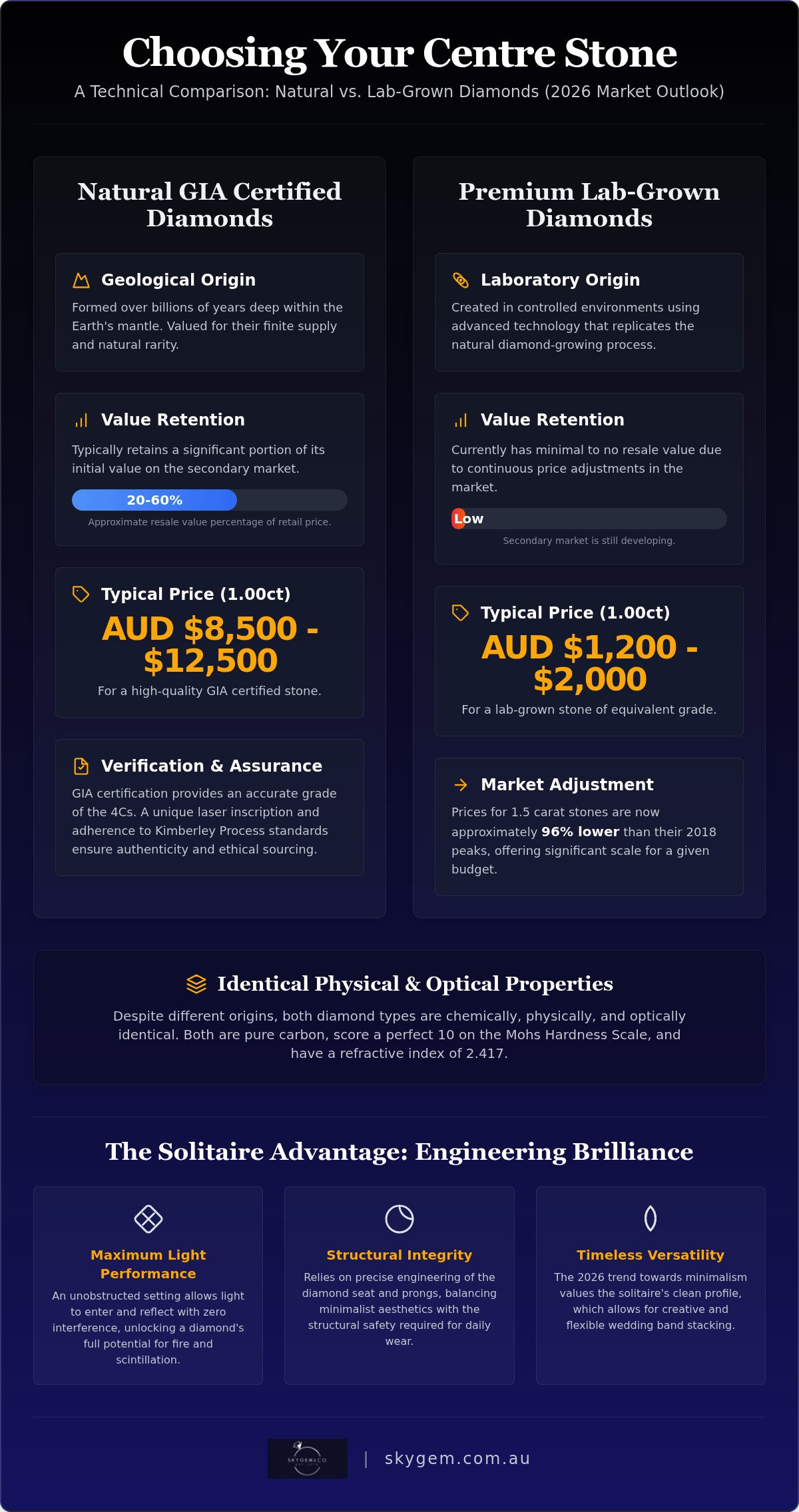
Choosing the centre stone for solitaire engagement rings melbourne requires a neutral, technical framework that balances physical properties against long term value. While both natural and lab grown diamonds are chemically, physically, and optically identical, they represent different value propositions in the 2026 market. Both varieties consist of carbon atoms arranged in a crystal structure, resulting in a refractive index of 2.417 and a hardness of 10 on the Mohs scale. The decision ultimately rests on whether you prioritising geological rarity or the ability to secure a larger carat weight within a specific budget.
Value retention remains a primary differentiator between the two origins. In 2026, natural diamonds typically retain approximately 20 to 60 percent of their retail price on the secondary market. Conversely, lab grown diamonds have seen significant price adjustments, with 1.5 carat stones now priced roughly 96 percent lower than their 2018 peaks. While a 1.00 carat natural diamond of high quality might range between AUD $8,500 and $12,500, a lab grown counterpart of equivalent grade often costs between AUD $1,200 and $2,000. This price gap allows for significant scale, but it's essential to understand the trade off in future resale potential.
Natural GIA Certified Diamonds
Natural diamonds are valued for their finite supply and the billions of years required for their subterranean formation. For a solitaire setting, where the stone is the singular focus, we recommend natural stones with GIA certification to ensure the 4Cs are accurately graded. These reports include a unique laser inscription on the diamond's girdle, providing a permanent link between the physical stone and its technical documentation. This transparency is vital for insurance purposes and verifying that the stone meets the Kimberley Process standards for ethical sourcing. You can explore GIA certified natural diamonds through our technical database to compare specific performance metrics.
The Rise of Premium Lab-Grown Diamonds
Modern lab diamonds are produced using either Chemical Vapour Deposition (CVD) or High Pressure High Temperature (HPHT) methods. These processes replicate the geological conditions of the earth's mantle with extreme precision. The primary benefit for Melbourne couples is the ability to achieve a substantial visual impact; for instance, a 2.00 carat lab grown diamond can often be acquired for less than the cost of a 0.50 carat natural stone. If you prefer a larger aesthetic without compromising on clarity or cut grade, you may browse lab-grown diamond options that meet our rigorous structural standards. If you're unsure which origin aligns with your goals, our consultants can provide a side by side comparison of diamonds online in Melbourne to clarify the technical differences.
Regardless of the diamond's origin, the 4Cs must be balanced specifically for the solitaire setting. Because there are no side stones to mask imperfections, we prioritise "Cut" above all else to ensure maximum light return. A "Very Good" or "Excellent" cut grade is mandatory for a solitaire to prevent the "bow-tie" effect or dull spots in the centre of the stone. Clarity is the second priority, as inclusions are more visible in an isolated setting than they would be in a halo or trilogy design.
Structural Integrity: The Technical Art of the Solitaire Setting
The structural integrity of solitaire engagement rings melbourne depends on the precision of the setting's architecture. It's a complex engineering challenge that requires using the least amount of metal possible to achieve the highest level of security. This minimalist approach ensures the diamond remains the focal point while the underlying structure manages the physical stresses of daily wear. A well-engineered setting doesn't just hold the stone; it protects it from lateral impacts and ensures the prongs don't snag or lift over time.
A common objection to the solitaire design is the fear of the centre stone falling out due to the lack of secondary support. This risk is mitigated through the precision of the 'seat', which is a custom-carved notch in each prong that must match the diamond's girdle profile exactly. If the seat is too shallow, the stone lacks stability. If it's too deep, the prong's structural thickness is compromised. Our technical approach ensures that each seat is calibrated to the specific dimensions of your GIA-certified stone, creating a mechanical lock that keeps the diamond stationary regardless of movement.
Claw Count and Stone Security
Claw count is a functional decision that dictates both the aesthetic profile and the redundancy of the security system. A 4-claw setting offers a modern, square-like appearance that exposes more of the diamond's surface area, whereas a 6-claw setting provides a rounder silhouette and a safety net; if one claw is damaged, the remaining five continue to secure the stone. For larger carats, we often integrate a gallery rail into the design. A gallery rail is a horizontal band of metal that connects the prongs below the girdle of the diamond, providing critical lateral reinforcement to prevent the claws from opening under pressure.
Metal Selection: Platinum vs. 18K Gold
Metal choice significantly impacts the longevity of the setting's prongs. Platinum is often our technical recommendation for solitaire claws because of its extreme density and malleability. Unlike gold, which loses microscopic amounts of metal every time it's scratched, platinum simply displaces, meaning the prongs don't thin out as quickly over decades of use. However, 18K gold remains a premium choice due to its higher Vickers hardness, which offers excellent resistance to bending. You can view 18K White Gold solitaire collection to see how white metals maintain a seamless, "invisible" look against high-colour diamonds. For stones with a lower colour grade, yellow or rose gold can be used to complement the diamond's natural warmth, though white metal claws are often preferred to keep the stone looking its brightest.
Designing Your Bespoke Solitaire: A Framework for Quality
Precision in the design phase is what separates a standard ring from a lifelong asset. While many retailers treat solitaire engagement rings melbourne as stock inventory, we approach them as individual engineering projects. This framework ensures that every millimetre of the band is calculated to support the specific weight and dimensions of your chosen diamond. Moving beyond the limitations of pre-cast settings allows for a level of structural refinement that mass production simply cannot replicate.
Proportional design is a critical factor in the longevity of a ring. A band that is too thin may look elegant in a showroom, but it often lacks the metal density required to resist warping over years of daily wear. When we design a bespoke solitaire, we match the band's width and depth to the diamond's carat size. This creates a stable foundation that prevents the 'head' of the ring from leaning or becoming top-heavy, ensuring the piece remains comfortable and secure.
Custom Design vs. Ready-to-Wear
Ready-to-wear rings are typically produced using generic rubber moulds designed to accommodate a variety of stone sizes. This often results in a poor fit where the diamond sits too high or the prongs are forced into position, creating internal stress in the metal. By contrast, the bespoke engagement ring process utilises Computer-Aided Design (CAD) to build a setting around your exact stone. This sub-millimetre accuracy ensures the 'seat' is perfect, reducing the risk of stone loss and allowing for a more refined, minimalist aesthetic.
Budgeting for a High-Quality Solitaire
A common mistake is allocating the entire budget to the diamond's carat weight while neglecting the setting's quality. We recommend a balanced approach where the durability of the band and the precision of the claws are prioritised. Investing in a hand-finished, custom-engineered setting provides long-term viability that 'extra' clarity grades often don't. For a deeper dive into market trends and technical standards, see our Engagement Rings Melbourne: The Definitive 2026 Guide. Balancing these factors ensures your investment remains secure and visually impactful for decades.
Hand-finishing is the final, critical step in our quality control protocol. Unlike machine-polished rings that can lose sharp edges and structural definition, a hand-finished solitaire maintains its architectural integrity. This process involves multiple stages of abrasive polishing to remove any surface porosity, resulting in a denser metal that resists wear more effectively. If you're ready to begin your project, you can start your bespoke design journey with a technical consultation.
SkyGem & Co.: Expert Craftsmanship for Your Solitaire Ring
SkyGem & Co. operates at the intersection of technical precision and aesthetic design. We act as technical consultants for your project, ensuring that every solitaire engagement ring melbourne we produce meets rigorous engineering standards. Our approach prioritises quiet confidence and reliability, moving away from aggressive sales tactics to focus on the long-term success of your bespoke piece. By treating each ring as a structural asset, we provide a level of expertise that respects the complexity of high-level jewellery manufacturing and the specific rigors of the Melbourne professional landscape. This partnership ensures that your design isn't just visually striking but is built to endure the demands of daily wear.
Our Technical Consultation Process
The journey begins with a transparent evaluation of the diamond market. We assist you in selecting the optimal stone by analysing GIA reports and physical performance metrics rather than relying on marketing jargon. Our process integrates regional design origins with strict regulatory adherence, ensuring that every natural or lab grown diamond complies with the Kimberley Process and modern reporting standards. This methodical approach allows us to bridge the gap between technical specifications and the lived environment where your ring will be worn. We use bespoke CAD design to visualise the architecture of the ring, allowing for granular adjustments to prong thickness and band profile before any metal is cast.
Lifetime Maintenance and Care
A high-quality solitaire is a permanent and evolving asset that requires ongoing maintenance to ensure its structural integrity. We provide professional cleaning and prong inspection services to identify any potential issues before they lead to stone loss. Regular check-ups are essential for verifying the 'seat' of the diamond and the tension of the claws, especially for minimalist designs where the metal-to-stone ratio is low. If you're considering the specific value of modern alternatives, our Lab Grown Diamonds: The 2026 Australian Buying Guide offers further technical insights into stone selection and care.
Our commitment to transparency and education ensures you remain a project stakeholder throughout the design and maintenance phases. We take pride in our regional expertise, offering a boutique experience that values performance over hype. By focusing on hand-finished settings and bespoke CAD design, we ensure your solitaire engagement rings melbourne are built for longevity. Whether you choose a natural GIA certified diamond or a premium lab grown stone, our goal is to provide a solution that reflects your personal aesthetic while meeting the highest engineering benchmarks for safety and brilliance. This partnership extends beyond the initial purchase, focusing on environmental responsibility and the long-term viability of your jewellery as a generational heirloom.
Securing Your Generational Asset
Selecting a solitaire is a commitment to a design that prioritises clarity and structural honesty. We've explored how technical precision in prong engineering and the accuracy of GIA certified diamonds define the quality of high-level jewellery. Whether you opt for the geological rarity of natural stones or the scale of premium lab-grown diamonds, your ring's longevity depends on a foundation of expert technical consultations and bespoke CAD design services.
By focusing on the 'Melbourne standard' of craftsmanship, you ensure that your ring remains a permanent asset rather than a temporary trend. This methodical approach to design transforms a minimalist aesthetic into a robust, generational heirloom. We invite you to explore our Bespoke Solitaire Engagement Ring Collection and begin a partnership focused on the long-term success of your project.
Your journey toward the perfect solitaire engagement rings melbourne should be as precise and rewarding as the final piece itself. We're here to help you navigate this technical landscape with quiet confidence and reliable expertise.
Frequently Asked Questions
Are solitaire engagement rings more expensive than other styles?
When comparing solitaire engagement rings melbourne to halo or trilogy designs, the solitaire is often more cost-effective because it requires less metalwork and fewer side stones. This allows you to allocate a larger portion of your budget toward a high-grade centre diamond. Because the diamond is isolated, any flaws in cut or clarity are more apparent, so we advise prioritising diamond quality over decorative metal features to achieve the best visual result.
Which diamond shape looks the largest in a solitaire setting?
Elongated diamond shapes like the oval, emerald, and marquise cuts offer the largest visual spread per carat weight. These shapes have a greater surface area on the crown than round brilliant diamonds, making them appear larger in a solitaire setting. This is a practical way to maximise the visual impact of your stone without increasing the total carat weight or cost.
Is a 4-claw or 6-claw setting better for a round diamond?
A 6-claw setting offers higher structural redundancy and better protection for the diamond's girdle. If one claw is damaged, the remaining five continue to hold the stone in place. While a 4-claw setting creates a more open, modern look that allows more light to enter the diamond, it provides less protection against lateral impacts during daily wear. The choice often depends on your lifestyle and how active you are with your hands.
Can I use a lab-grown diamond in a bespoke solitaire ring?
Lab-grown diamonds are an excellent choice for bespoke solitaire engagement rings melbourne projects, as they provide identical chemical and physical properties to natural stones. We use the same CAD engineering and hand-finishing techniques for lab diamonds as we do for natural GIA certified stones. This ensures your ring is built to the same high structural standards regardless of the diamond's origin.
What is the best metal for a solitaire engagement ring in Australia?
Platinum is the superior choice for Australian conditions due to its high density and resistance to wear. Unlike gold, which loses microscopic amounts of metal during polishing or scratching, platinum simply shifts, maintaining the thickness of your prongs for decades. 18K white gold is a reliable alternative, though it requires periodic rhodium plating to maintain its bright white finish.
How do I care for my solitaire ring to ensure the stone stays secure?
Proper maintenance involves bi-annual professional inspections and avoiding wearing the ring during high-impact activities like gym workouts or gardening. You can maintain the diamond's brilliance at home using warm water and a soft-bristled brush. Professional check-ups allow us to inspect the tension of the claws and the integrity of the seat to prevent the stone from becoming loose or falling out.
What is the typical timeframe for a custom solitaire ring design?
A custom solitaire ring project typically requires four to six weeks to complete. This period covers the technical consultation, CAD design phase, and the physical manufacturing of the piece. Taking this time ensures that the metal is properly cured and the stone is set with the precision required for a lifelong heirloom, avoiding the compromises found in mass-produced items.
Does a solitaire ring require a specific type of wedding band?
Solitaire rings don't require a specific band, but the setting's height determines how the two rings interact. A wed-fit solitaire is designed with a raised head to allow a straight wedding band to sit flush against the engagement ring. If the solitaire has a lower profile, you might prefer a contoured or shadow band that follows the curve of the centre stone's setting.
Disclaimer
This article is for general informational purposes only and may include AI-assisted content. Pricing, specifications, and availability are subject to change. For accurate advice and current information, please contact SkyGem & Co. directly. Nothing in this content constitutes professional or financial advice.