
Rose Gold Solitaire Engagement Rings: The 2026 Expert Design Guide

Choosing a rose gold solitaire engagement ring is often dismissed as a purely aesthetic decision, yet the true value of this choice lies in the sophisticated metallurgy that dictates both its longevity and its unique interaction with light. While many see the warm, copper-infused glow as a romantic trend, the structural reality is that rose gold offers distinct technical advantages for those seeking a durable, high-performance piece of jewellery. You likely appreciate this distinctive warmth but may harbour concerns about whether the metal will appear dated in a decade or if a lower carat weight offers better resilience for an active lifestyle.
In this 2026 design guide, we move beyond surface-level beauty to explore the engineering precision required for a bespoke solitaire. You will discover how to navigate the differences between 18ct and 9ct alloys and learn the specific diamond grading secrets that allow you to balance stone colour against the metal's rosy hue effectively. We provide a thorough analysis of how modern CAD design and hand-finished craftsmanship ensure your ring remains a permanent asset. This overview transitions from high-level metallurgical benefits to granular diamond-pairing strategies, ensuring your selection is grounded in technical excellence and long-term viability.
Key Takeaways
- Learn why 18ct rose gold is the technical gold standard for durability and rich colour saturation in high-end jewellery.
- Discover the optical "colour hack" that allows a rose gold setting to mask lower diamond colour grades, effectively increasing your budget efficiency.
- Understand how bespoke CAD design and hand-finishing ensure your rose gold solitaire engagement ring achieves the perfect balance of prong tension and aesthetic proportion.
- Explore the 2026 trend towards substantial, architectural band profiles that offer superior structural integrity over mass-produced alternatives.
- Gain professional clarity on the differences between GIA-certified natural and lab-grown diamonds to make an informed, long-term investment.
The Anatomy of a Rose Gold Solitaire Engagement Ring
The solitaire remains the definitive benchmark in high-end jewellery design, prioritising a singular focal point that demands uncompromising quality. A rose gold solitaire engagement ring is a fusion of 19th-century romanticism and modern metallurgical precision. By removing the visual noise of accent stones or complex halos, this "less is more" approach forces the eye to appreciate the unique lustre of the pink-hued gold. The warm, diffused glow of the alloy acts as a soft reflector, enhancing the stone's brilliance without competing for attention.
The Evolution of Rose Gold in Australian Jewellery
Originally termed "Russian Gold" during the 1800s due to its popularity in the Czarist courts, this alloy has transitioned into a 2026 contemporary staple within the Australian market. The solitaire silhouette specifically benefits from this metal because the warm contrast against a white diamond creates a more distinct outline than platinum or white gold. We observe a steady shift toward bespoke solitaires over mass-produced styles. This preference is driven by the need for structural longevity. Bespoke engineering allows for a tailored alloy balance that prevents the common brittleness found in low-quality, mass-market castings.
Solitaire Setting Options: Prongs vs. Bezel
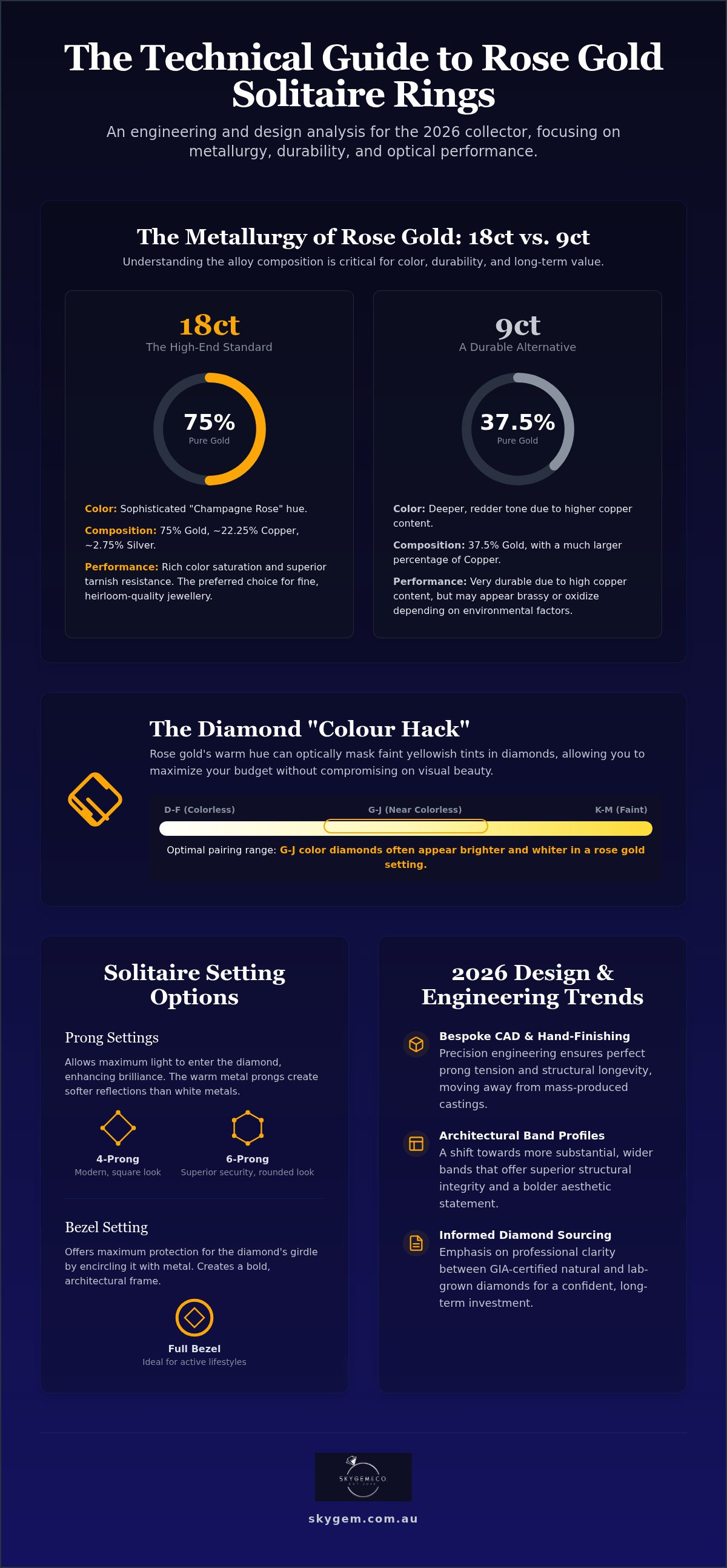
Technical execution in a rose gold setting requires a deep understanding of the metallurgy of colored gold to ensure the setting remains secure over decades of wear. The choice between prongs and bezels is a balance of light performance and security. It's a critical decision for the ring's profile.
- Prong Settings: In a well-engineered rose gold solitaire, the prongs can almost "disappear" into the diamond’s brilliance. The warm metal doesn't create the harsh, dark reflections sometimes seen with cooler metals.
- Bezel Settings: For clients with active lifestyles, a rose gold bezel offers maximum protection for the diamond's girdle. It provides a bold, architectural frame that highlights the metal's unique hue.
- Prong Count: A 4-prong design offers a modern, square-like appearance and maximum light entry. A 6-prong setting provides a more rounded silhouette and superior stone security.
Selecting the right configuration is a matter of both aesthetic preference and practical risk management. Whether you opt for a "whisper" band or a more substantial profile, the integrity of the setting must be the primary technical consideration for your rose gold solitaire engagement ring. Precision in the workshop ensures the prongs are perfectly tensioned to hold the stone without obscuring its natural fire.
The Metallurgy of Rose Gold: 9ct vs 18ct Purity
Selecting a rose gold solitaire engagement ring requires an understanding of how alloy composition dictates both colour and performance. Rose gold is not a naturally occurring element; it is a precision-engineered composite of pure gold, copper, and silver. In an 18ct alloy, the 75% gold purity is balanced with approximately 22.25% copper and 2.75% silver. This specific ratio creates the sophisticated "champagne rose" hue that has become the technical gold standard for high-end jewellery. In contrast, 9ct rose gold contains only 37.5% gold and a much higher copper content. This results in a deeper, redder tone that can sometimes appear brassy or oxidise more quickly when exposed to certain skin pH levels or environmental factors.
The "pink vs. red" debate often comes down to these precise alloy ratios. A higher copper-to-silver ratio results in a deeper red, whereas increasing the silver content softens the tone into a delicate, modern pink. For a high-performance solitaire, 18ct provides the ideal balance of prestige and aesthetic refinement. It remains the preferred choice for those seeking a ring that maintains its lustre without the risk of the "brittle" characteristics sometimes associated with lower-carat alloys. If you're considering a custom build, our specialists can help you select the exact alloy ratio to suit your stone through our bespoke design services.
Technical Durability: Why Rose Gold Outlasts Yellow Gold
Copper serves as a powerful hardening agent, making rose gold inherently more resilient than its yellow or white counterparts. This structural advantage is particularly beneficial for a solitaire setting, where the integrity of the prongs is paramount. 18ct rose gold offers a Vickers hardness rating that exceeds many white gold alloys without needing plating. This means the setting is less prone to deforming or "opening up" over years of daily wear. Because the colour is consistent throughout the metal, there is no rhodium plating to wear away, ensuring a permanent finish that requires significantly less maintenance than white gold.
Skin Tones and Metal Selection
The aesthetic versatility of rose gold is one of its greatest strengths. It complements cool, warm, and neutral skin tones with equal ease, acting as a bridge between traditional yellow gold and modern platinum. This adaptability has fuelled the "mixed metal" trend in Australian wedding stacks, where a rose gold solitaire is often paired with a white gold or platinum wedding band. While the metal's saturation is a primary aesthetic choice, it also plays a role in how we perceive the central stone. The warm reflections of the alloy interact with the diamond's facets, a factor to consider when evaluating stones on the official GIA Color Scale. For a comprehensive breakdown of how these factors influence investment, our Guide to Gold Purity and Craftsmanship offers further technical detail.
Pairing Diamonds with Rose Gold: The "Colour Hack"
The interaction between a diamond and its setting is a matter of optical physics. In a rose gold solitaire engagement ring, the warm reflections of the metal provide a significant advantage for those looking to maximise their investment. While cooler metals like platinum act as a stark contrast that highlights any yellow tint in a diamond, the pink-hued alloy of rose gold effectively masks these undertones. This phenomenon allows you to select a diamond with a lower colour grade on the D-to-Z scale without compromising the visual perception of whiteness.
Choosing a G, H, or even an I-coloured diamond is a strategic move for a bespoke rose gold setting. Because the metal's warmth is already present, the slight "warmth" of a near-colourless diamond blends seamlessly into its environment. This "colour hack" creates a significant opportunity to reallocate your budget. Instead of paying a premium for a D or E colour grade that will be visually indistinguishable in this setting, you can invest those savings into a superior cut grade or a larger carat weight. A better cut ensures the diamond returns more light to the eye, which is the primary driver of brilliance and fire.
The Best Diamond Shapes for Rose Gold Solitaires
Different diamond cuts interact with the composition of rose gold alloys in unique ways. The Round Brilliant remains the benchmark for fire, as its 57 or 58 facets are designed to return maximum light. However, elongated shapes like Oval and Pear are increasingly popular for rose gold solitaires. These shapes provide a modern, flattering effect on the finger, while the warm metal softens the "bow-tie" effect often seen in these cuts. For those seeking a vintage aesthetic, step-cuts like Emerald or Asscher offer a sophisticated, architectural look that pairs perfectly with the romantic history of pink gold.
Natural vs. Lab-Grown Diamonds
From a technical perspective, natural and lab-grown diamonds possess identical chemical and optical properties. Whether you choose a natural GIA-certified diamond or a lab-grown alternative, the "colour hack" remains equally effective. The decision rests on your preference for provenance and sourcing transparency. For a detailed breakdown of these choices, see our Lab-Grown vs Natural Diamonds Comparison. Regardless of the diamond's origin, the key to success is ensuring the stone's proportions are optimised to work with your bespoke rose gold solitaire engagement ring.
Designing Your Bespoke Rose Gold Solitaire
The transition from selecting a diamond to the physical construction of a rose gold solitaire engagement ring requires a shift in focus toward structural engineering. Bespoke manufacturing offers a significant advantage over mass-produced settings because every component is hand-finished to the highest standard. This meticulous process ensures that the prongs are perfectly tensioned for the specific dimensions of your stone. Unlike pre-cast settings that use a "one size fits all" approach, a bespoke build accounts for the unique girdle thickness and pavilion depth of your diamond, ensuring a secure and permanent fit.
Band width selection is a critical aesthetic and functional variable. While ultra-thin "whisper" bands, typically ranging from 1.5mm to 1.8mm, remain popular for their delicate appearance, 2026 design trends favour more substantial, architectural profiles. These thicker bands provide a more stable foundation for the solitaire setting and allow for sophisticated hidden details. You might consider a hidden halo, only visible from the profile, or a custom internal engraving to add a personal layer to the design. We also engineer the setting height to ensure a "flush fit" with a future wedding band, preventing the need for contoured bands that can be difficult to pair later.
The CAD Design Process for Solitaires
Technical precision begins with 3D modelling. This stage allows you to visualise the proportions of the ring from every angle before any metal is cast. We focus specifically on adjusting the "basket" height to balance stone safety with light performance. A lower basket offers better protection for the stone and improved comfort for daily wear, whereas a higher setting can make the diamond appear more prominent. For a deeper look at how we manage these technical variables, consult our Custom Engagement Ring Design Guide.
Maintenance and Long-Term Care
One of the most practical benefits of rose gold is that it doesn't require the periodic rhodium plating mandatory for white gold. The colour is consistent throughout the alloy, ensuring the rosy hue never fades. While the copper content means the metal may slightly deepen in colour over decades, this is often viewed as a desirable "patina" rather than a tarnish. Professional cleaning is recommended annually to maintain the high-polish finish, but simple at-home care with a soft-bristled brush is effective for daily maintenance. If you are ready to begin your design journey, you can begin a bespoke consultation with our technical team today.
The SkyGem & Co. Approach to Rose Gold Excellence
At SkyGem & Co., we operate as technical consultants rather than traditional retailers. Our commitment to transparency ensures you understand the "why" behind every design decision for your rose gold solitaire engagement ring. From the specific copper-to-silver ratio in our 18ct alloys to the light-return metrics of a chosen diamond, we prioritise education to empower your decision-making. This consultant-led approach moves away from aggressive sales tactics, focusing instead on a solution-oriented partnership that respects the technical requirements of your project.
We maintain direct sourcing channels for GIA-certified natural and lab-grown diamonds, ensuring that every stone meets our rigorous standards for structural integrity and optical performance. By removing unnecessary layers in the supply chain, we provide a transparent path from the mine or laboratory to the final setting. As an independent boutique, we offer personalised attention that larger, volume-based showrooms cannot replicate. You aren't just purchasing a piece of jewellery; you're engaging in a bespoke engineering process where every detail is tailored to your specific requirements.
Quality Assurance and GIA Certification
We insist on independent GIA grading for every solitaire diamond to provide an unbiased verification of quality. This ensures that the colour, clarity, and cut grades are accurate and not inflated by in-house assessments. Our metallurgical standards are equally strict. We monitor every batch of 18ct rose gold to guarantee consistent colour saturation and the high Vickers hardness required for a lifetime of wear. You can Browse Our Solitaire Engagement Ring Collection to see how these technical standards translate into finished, high-performance designs.
National Service for Bespoke Jewellery
While our design origins are rooted in Melbourne, our reach extends across Australia through a secure, end-to-end logistics network. We facilitate virtual consultations that allow clients from Sydney to Perth to access our bespoke CAD design process with ease. This ensures that regardless of your location, you receive the same level of technical expertise and design precision. The SkyGem guarantee is a commitment to quality that lasts generations, underpinned by our rigorous quality control protocols and a focus on long-term viability. To begin your own design process, Book a consultation to design your bespoke rose gold solitaire and speak with one of our senior design consultants.
Securing a Legacy of Design and Technical Integrity
Choosing a rose gold solitaire engagement ring represents a sophisticated intersection of metallurgical science and aesthetic refinement. By understanding the technical advantages of 18ct alloys and the optical benefits of the "colour hack," you can secure a piece that offers both long-term durability and exceptional value. A bespoke approach ensures that every component, from prong tension to band profile, is engineered to support your chosen diamond for generations. This methodical focus on structural integrity prevents the common pitfalls of mass-produced jewellery.
Our team provides the transparency and precision required for such a significant project. With access to GIA-certified diamonds and our commitment to bespoke hand-finished craftsmanship, we act as your technical partners throughout the design journey. Expert technical consultations are available to help you navigate the specific requirements of your custom piece. We take pride in regional expertise that prioritises performance over hype. Take the first step toward a legacy of quality and design excellence today.
Design Your Custom Rose Gold Solitaire with SkyGem & Co.
Frequently Asked Questions
Does rose gold solitaire engagement rings tarnish over time?
Rose gold doesn't tarnish in the traditional sense, but the copper content can lead to a slight deepening of colour over several decades. This gradual change is often considered a desirable vintage patina rather than a defect. Unlike silver, it won't turn black or lose its structural integrity. Regular professional cleaning and at-home maintenance help preserve the high-polish finish and ensure the metal continues to reflect light effectively.
Is 18ct rose gold better than 9ct for a solitaire ring?
18ct rose gold is the technical gold standard for engagement rings because it offers superior colour saturation and better skin compatibility. While 9ct gold is technically harder, it's also more brittle and prone to environmental oxidation. The 75% gold purity in 18ct provides a more refined, warm pink hue that perfectly complements a high-quality diamond. It remains the preferred choice for a rose gold solitaire engagement ring intended for lifelong wear.
Can I use a lower colour grade diamond with a rose gold band?
You can effectively use lower colour grade diamonds, such as G, H, or I, because the warm reflections of the metal mask slight yellow undertones. This strategic "colour hack" allows you to reallocate your budget toward a larger carat weight or a superior cut grade without compromising the visual whiteness of the stone. It's an efficient way to maximise the aesthetic impact of your bespoke setting while maintaining high technical standards.
Is rose gold a good choice for someone with sensitive skin?
Rose gold contains copper, which can occasionally cause a reaction in individuals with specific metal sensitivities. If you have a known copper allergy, 18ct is a safer choice than 9ct as it contains a higher percentage of pure gold and significantly less copper. We recommend discussing any sensitivities during your consultation. This allows us to ensure the specific alloy mix used in your bespoke piece is appropriate for your long-term comfort.
How do I clean my rose gold solitaire engagement ring at home?
You can clean your rose gold solitaire engagement ring using a solution of warm water and a few drops of mild dish soap. Soak the ring for twenty minutes to loosen oils, then gently scrub with a soft-bristled toothbrush to remove debris from the basket. Rinse thoroughly under warm running water and dry with a lint-free cloth. This simple routine maintains the diamond's brilliance and the metal's unique pink lustre.
Does rose gold require rhodium plating like white gold?
Rose gold does not require rhodium plating because the pink hue is consistent throughout the entire metal alloy. Unlike white gold, which is naturally yellowish and needs plating to appear bright white, rose gold's colour is a permanent characteristic of the gold and copper mix. This structural advantage makes it a low-maintenance option for clients who want a consistent finish without the need for periodic re-plating services over the ring's lifespan.
What is the best diamond shape for a rose gold solitaire?
The Round Brilliant is the benchmark for maximum fire, but Oval and Pear shapes are increasingly favoured for their modern, elongating effect on the finger. These elongated shapes benefit from the metal's warmth, which can soften the visual impact of the "bow-tie" effect. Step-cuts like Emerald or Asscher also pair beautifully with rose gold, offering a sophisticated architectural look that highlights the metal's unique properties and the stone's internal clarity.
Can a rose gold solitaire ring be resized easily?
A rose gold solitaire can be resized by a skilled jeweller, provided the band is a plain metal profile. However, because rose gold is a harder alloy than yellow gold, it requires precise temperature control during the soldering process to avoid colour mismatching at the join. Our bespoke manufacturing process accounts for future adjustments, ensuring the original structural integrity and alloy consistency are maintained during any necessary resizing.
Disclaimer
This article is for general informational purposes only and may include AI-assisted content. Pricing, specifications, and availability are subject to change. For accurate advice and current information, please contact SkyGem & Co. directly. Nothing in this content constitutes professional or financial advice.