
Peach Sapphire Engagement Rings: The 2026 Definitive Australian Buying Guide

Why invest in a "forever" ring that requires a specialized cleaning kit just to maintain its clarity? Many couples are drawn to the romantic, blush tones of morganite, only to discover the practical frustration of a stone that attracts oils and loses its lustre within days. Choosing peach sapphire engagement rings provides a superior technical solution, offering the same champagne-glow palette with a Mohs hardness of 9. This ensures your gemstone remains resistant to the micro-scratches found in common household dust, maintaining its brilliance without the high-maintenance schedule of softer alternatives.
This 2026 definitive guide provides the technical framework you need to select a durable, high-performance stone that suits your lifestyle. You'll learn how to evaluate unheated peach sapphires for long-term value, select a saturation level that complements your skin tone, and manage a bespoke design process that balances delicate aesthetics with structural precision. From the rise of architectural emerald cuts to the security of modern bezel settings, we'll ensure your selection is a permanent and evolving asset.
Key Takeaways
- Understand the technical advantages of corundum’s Mohs rating of 9. This ensures your gemstone remains resilient against daily abrasions compared to softer alternatives.
- Learn to distinguish between heat-treated and unheated stones to ensure the long-term colour stability and investment value of your selection.
- Discover how specific metal choices and setting styles can be engineered to enhance the natural saturation of peach sapphire engagement rings.
- Master the criteria for "eye-clean" clarity and understand how fine inclusions, or "silk," contribute to the unique aesthetic character of the stone.
- Follow a structured framework for the bespoke design process, moving from initial gemstone consultation to final hand-finished manufacturing.
The Rise of Peach Sapphires: A Sophisticated Alternative to Diamonds
The Australian engagement ring market is witnessing a steady shift toward coloured gemstones that offer a distinct departure from traditional white diamonds. Peach sapphire is a variety of corundum, the same mineral family as rubies and blue sapphires, distinguished by a specific blend of pink and orange hues. While diamonds have long been the standard for durability, these stones provide a technical equivalent in performance with a significantly softer aesthetic profile. Understanding the Sapphire mineral properties is essential for any couple looking to balance physical longevity with a unique visual identity. As technical consultants in the jewellery sector, we've seen peach sapphire engagement rings become a primary choice for those who value unconventional elegance over mass-market trends.
Modern couples are increasingly drawn to these stones because they represent a grounded, modern romance. The warm palette avoids the clinical feel of high-grade white diamonds, offering instead a sense of harmony and individual expression. By selecting a high-quality precious gemstone, you aren't just choosing an alternative; you're investing in a sophisticated asset that reflects a nuanced understanding of colour theory and material science.
Defining the Peach Hue: From Champagne to Salmon
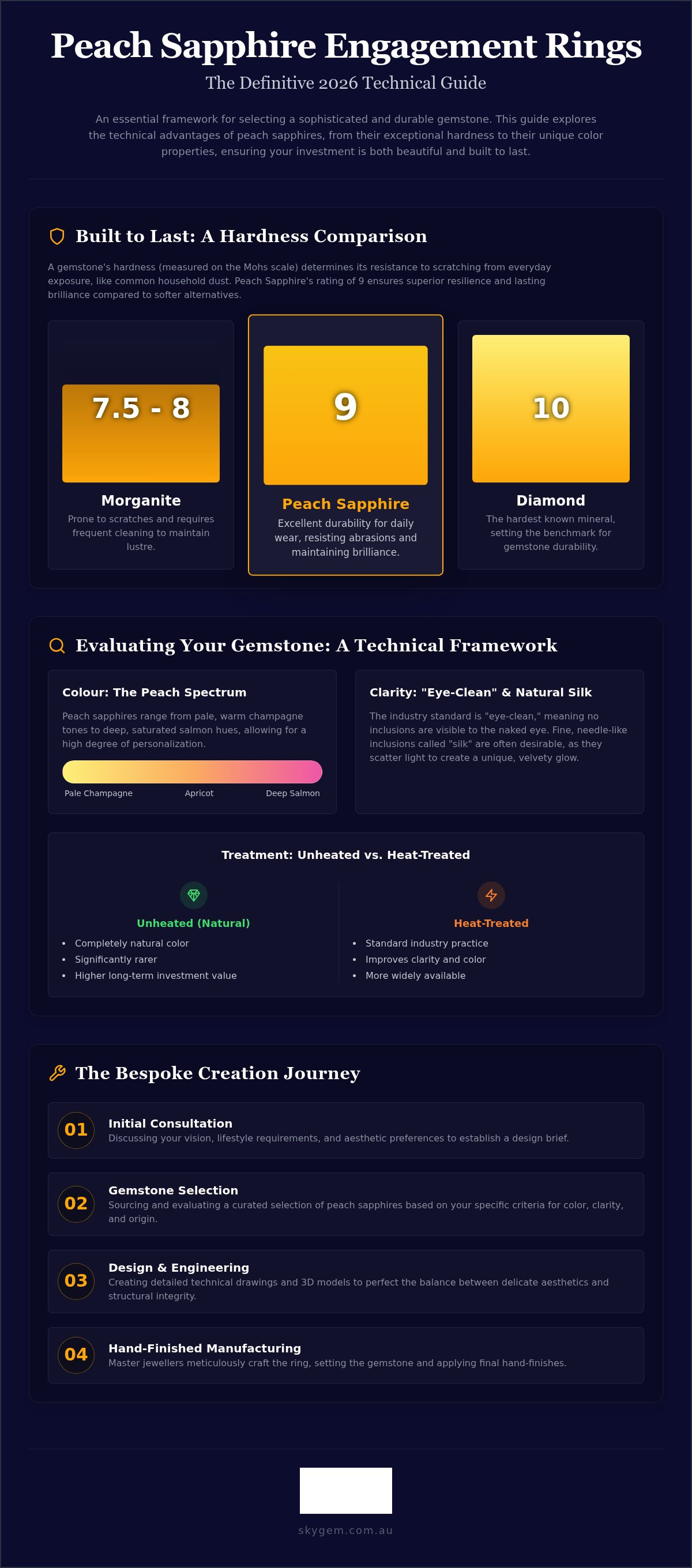
The colour spectrum for peach sapphires is remarkably broad, ranging from pale champagne and apricot to deep, saturated salmon tones. This classification is determined by the precise balance of trace elements within the crystal structure during formation. A stone with a higher concentration of orange will lean toward a warm "champagne" look, while a dominant pink secondary hue creates a softer "blush" effect. The rarest and most prestigious relative in this family is the Padparadscha sapphire, which must exhibit a very specific, delicate marriage of pink and orange. Most peach sapphires used in bespoke designs today fall into the "champagne" or "peach-pink" categories, allowing for a high degree of customisation based on the wearer’s preference.
The Symbolism of Peach Gemstones in 2026
In 2026, peach tones have established themselves as a "new classic" in the Australian professional landscape. This trend is driven by a desire for jewellery that feels personal rather than prescriptive. One of the most practical benefits of the peach palette is its versatility across different skin tones. While stark white diamonds can sometimes appear cold against certain complexions, the warmth of a peach sapphire provides a complementary flush that feels natural and integrated. It's a choice that prioritises the lived experience of the wearer, ensuring the ring remains a timeless staple of their personal style rather than a fleeting fashion statement.
Technical Quality: Understanding Colour, Clarity, and Origin
Evaluating the quality of coloured gemstones requires a different technical framework than the one used for diamonds. While diamond grading relies on 10x magnification, sapphire assessment focuses on what's visible to the naked eye. For peach sapphire engagement rings, the industry standard is "eye-clean" clarity. This means no inclusions are visible when the stone's viewed from a standard distance. High-level gemological reports, such as those detailing GIA Sapphire Quality Factors, help buyers understand how these internal characteristics influence both the stone's durability and its market value.
Internal inclusions known as "silk"—fine, needle-like rutile crystals—often appear in natural sapphires. While heavy inclusions can dull a stone, a light presence of silk can actually be desirable. It scatters light internally, creating a velvety, soft glow that enhances the romantic peach palette. This is distinct from the clinical sparkle of a diamond. Choosing between an unheated and a heat-treated stone is another critical decision. Unheated peach sapphires are significantly rarer and command a value premium because their colour is entirely a product of nature. Heat treatment is a standard industry practice used to improve clarity, but for a bespoke heirloom, the rarity of an unheated stone often aligns better with long-term investment goals.
Colour Saturation and Lighting Performance
One of the most complex aspects of this gemstone is pleochroism. This is the property where a stone displays different colours when viewed from different angles or under varying light sources. A peach sapphire might appear more orange under warm incandescent boutique lighting and shift toward a cooler pink in natural Australian daylight. It's vital to assess your stone in multiple environments before finalising a design. Saturation levels also dictate the aesthetic. Pastel tones offer a subtle, sophisticated look, while vivid, deep peach hues are more striking and typically more expensive. If you're unsure which saturation level suits your design, you can explore our range of precious gemstones to compare different tonal values in person.
Sourcing and Geographic Origins
The origin of a sapphire significantly impacts its technical properties and price. Sri Lanka, historically known as Ceylon, remains the premier source for peach sapphires. Ceylon stones are prized for their exceptional brightness, clarity, and "open" colour that doesn't darken under low light. Madagascar has also emerged as a significant producer of high-quality peach and salmon-toned stones. While Australia is world-renowned for its blue and teal sapphires, peach varieties are less common here. This makes imported Ceylon stones the frequent choice for high-end bespoke projects. Understanding these origins ensures ethical transparency and confidence in the stone's provenance. For those ready to begin their journey, viewing a curated selection of natural sapphires can provide the necessary context for your specific project.
Durability Comparison: Peach Sapphire vs. Morganite and Diamond
When selecting a centre stone for a piece intended for daily, lifelong wear, material hardness is the most critical technical specification to evaluate. While diamonds set the benchmark with a Mohs rating of 10, peach sapphire engagement rings offer a high-performance alternative with a rating of 9. This distinction is vital when comparing sapphires to morganite, which sits significantly lower at 7.5 to 8. Because common household dust contains particles of quartz with a hardness of 7, a morganite stone is susceptible to micro-scratches over time that eventually dull its surface. Sapphire, however, remains resilient against these everyday abrasions, ensuring the stone's structural integrity and surface polish remain intact for decades.
A frequent objection to blush-toned stones is the tendency for them to appear "cloudy" or lose their lustre after only a few days of wear. This is a common issue with morganite, which has a molecular affinity for oils and soaps, requiring cleaning every one to two weeks to maintain its appearance. In contrast, the crystalline structure of a sapphire resists oil buildup much more effectively. A high-quality sapphire typically only requires maintenance every four to six weeks to retain its brilliance. For those prioritizing a low-maintenance, high-durability asset, the technical properties of corundum far outperform beryl-based alternatives.
Hardness and Resilience for Daily Wear
The resilience of a sapphire setting extends beyond mere scratch resistance; it also includes a high level of toughness, which is the stone's ability to resist chipping or breaking under impact. Because engagement rings are frequently exposed to hard surfaces in professional and domestic environments, this durability is non-negotiable. The Mohs scale is the definitive industry standard used to measure the relative scratch resistance of various minerals. By choosing a stone with a rating of 9, you're opting for a material that can only be scratched by a diamond, providing peace of mind for those with active lifestyles who don't want to compromise on a romantic aesthetic.
Brilliance and Light Performance
While diamonds are prized for their "fire" or the dispersion of light into spectral colours, peach sapphires are valued for their internal "glow." This performance is driven by a high refractive index, which determines how efficiently light travels through and reflects out of the gemstone. A precision-cut sapphire maximizes this internal reflection, ensuring the stone doesn't "leak" light or appear flat. You can observe these light-performance variations across our natural sapphire collections, where the cut is engineered to enhance the specific saturation of the peach hue. This technical approach to cutting ensures that even in lower light environments, the stone retains its depth and character without becoming transparent or dull.
Design Guide: Selecting the Perfect Metal and Setting
Designing peach sapphire engagement rings requires a nuanced understanding of colour theory and material compatibility. The metal you choose acts as the structural and visual foundation for the gemstone’s performance, either blending into a monochromatic palette or providing a sharp, architectural contrast. Unlike white diamonds, which are relatively neutral, the pink and orange undertones of a peach sapphire interact dynamically with different precious metals. As technical consultants, we evaluate how the metal’s reflective properties will influence the "face-up" colour of the sapphire once it's seated in the setting.
Metal Pairings and Colour Theory
18K Rose Gold is the most frequent choice for achieving a "seamless" blush look. The copper content in the alloy mirrors the warm apricot and salmon undertones of the sapphire, creating a unified, romantic aesthetic that feels soft against the skin. For those seeking a more modern, high-contrast finish, 18K White Gold or Platinum is the superior technical choice. These cooler metals act as a neutral frame, forcing the peach hue to appear more saturated and vivid. When selecting your metal, it's vital to consider the long-term wear properties and purity levels detailed in our definitive guide to gold jewellery. This ensures your choice balances visual impact with the durability required for a lifelong asset.
Setting Styles for Coloured Gemstones
The choice of setting style should reflect the specific dimensions and saturation of your stone. A Solitaire setting places the focus entirely on the unique colour and cut of the sapphire, making it ideal for high-carat, unheated stones with exceptional clarity. Conversely, Halo and Trilogy designs use natural diamond accents to frame the centre stone. The high-dispersion "fire" of the diamonds provides a brilliant border that elevates the softer, velvety "glow" of the sapphire. This combination is particularly effective for lighter, champagne-toned stones that benefit from the added brilliance of surrounding diamonds.
Beyond the visual style, the structural integrity of the setting is paramount. We advocate for hand-finished settings over mass-produced castings. In a hand-finished piece, the prongs are meticulously calibrated to the specific girdle of your individual sapphire. This technical precision is essential for securing a precious gemstone long-term, preventing the stone from loosening over decades of daily wear. A well-engineered setting doesn't just enhance the aesthetic; it serves as a protective housing that respects the mineral properties of the corundum. If you are ready to begin engineering your own piece, our team can guide you through a custom made engagement ring consultation to match the perfect stone with its ideal setting.
Bespoke Creation: Crafting Your Ring with SkyGem & Co.
The transition from a technical concept to a finished heirloom requires a methodical approach that prioritises material integrity and design precision. At SkyGem & Co., we operate as your technical consultants, guiding you through the complexities of gemstone selection and structural engineering. Creating peach sapphire engagement rings isn't just an artistic endeavour; it's a project management process where every specification is calibrated to the client’s long-term satisfaction. Whether you're based in Melbourne or require our national shipping services across Australia, our commitment to reliability remains the cornerstone of our practice.
The Custom Design Journey
Your journey begins with an expert consultation focused on selecting a loose peach sapphire from our curated inventory. Our team provides the technical data required to compare saturation, clarity, and origin, ensuring the stone meets your specific performance criteria. Once the gemstone is secured, we move to the structural phase. This involves designing a setting that balances your aesthetic preferences with the budget requirements of the project. To facilitate a clear understanding of the final outcome, we utilise advanced CAD technology. This provides a detailed 3D preview, allowing for precise adjustments before we commence the manufacturing of our custom engagement ring services.
Precision in design is matched by our dedication to logistical excellence. Understanding the complex timelines our clients often manage, we prioritise efficiency without sacrificing quality. Insured shipping is provided to all major Australian cities, ensuring your ring arrives with the same level of security as it was crafted. This end-to-end service model is designed to respect your professional time while delivering a result that meets the highest standards of regional craftsmanship.
Transparency and Certification
High-value purchases demand a level of transparency that only independent verification can provide. Every significant gemstone we offer is accompanied by a reputable gemstone report, ensuring you have documented proof of the stone's natural origin. Documenting technical accuracy is a fundamental part of our ethical sourcing commitment. Trust is built through this transparency, forming the basis of a dedicated partnership that looks toward the long-term viability of your asset. For a deeper dive into our manufacturing standards and the regional origins of our designs, you can consult our 2026 guide to bespoke jewellery. Our resource outlines the rigors of our selection process and the regulatory standards we uphold to protect your investment.
Engineering a Timeless Legacy
Selecting a high-performance gemstone is a process of balancing aesthetic preference with material science. As we've explored, the technical superiority of a sapphire's Mohs hardness of 9 provides the structural resilience required for daily wear, ensuring your investment remains a permanent asset. By integrating factors like unheated certification and precision metal pairings, you're ensuring that peach sapphire engagement rings remain as brilliant as the day they were first commissioned. This methodical approach to selection respects both the romantic intent of the piece and the physical properties of the mineral.
SkyGem & Co. acts as your dedicated consultant throughout this design journey. We specialise in unheated natural gemstones and utilise bespoke CAD design to ensure every setting is a precise housing for its centre stone. Whether you require expert consultations in person or national Australian shipping, our commitment to transparency and technical accuracy remains constant. We invite you to begin your project with a focus on quality over hype.
Ready to find your perfect stone? Explore our curated collection of natural peach sapphires and bespoke engagement rings to begin the engineering of your unique heirloom. We look forward to partnering with you on a design that reflects your specific vision and our high standards of craftsmanship.
Frequently Asked Questions
Is a peach sapphire a real sapphire?
Yes, a peach sapphire is a genuine variety of the mineral corundum, which is the same mineral family as rubies and blue sapphires. Its unique colour is a result of specific trace elements, such as iron and chromium, present during the crystal's formation. Because it shares the same chemical and physical properties as all sapphires, it offers the same high levels of durability and brilliance required for a lifelong piece of jewellery.
How does a peach sapphire compare to morganite for an engagement ring?
Sapphire is the superior technical choice for an engagement ring due to its Mohs hardness of 9. Morganite, a variety of beryl, rates significantly lower at 7.5 to 8, making it susceptible to surface abrasions from everyday dust. While morganite attracts oils and requires frequent cleaning to avoid a cloudy appearance, peach sapphire engagement rings resist residue and maintain their lustre with much less maintenance over time.
What is the difference between a peach sapphire and a padparadscha sapphire?
The primary difference lies in the strictness of the colour classification and the resulting market rarity. A Padparadscha sapphire must exhibit a very specific, delicate balance of pink and orange, often compared to the hue of a lotus blossom. Peach sapphires occupy a broader spectrum, including champagne, apricot, and salmon tones. While both are high-performance gemstones, a certified Padparadscha commands a significant price premium due to its extreme scarcity.
Do peach sapphires require special care or cleaning?
Standard jewellery maintenance is sufficient for peach sapphires because they are chemically stable and physically resilient. You can maintain the stone’s brilliance by using warm water, a mild detergent, and a soft-bristled brush to remove any accumulated oils. Unlike softer gemstones that require specialised ultrasonic settings or frequent professional intervention, a sapphire’s hardness allows it to withstand routine cleaning without the risk of surface scratching or structural damage.
Will the colour of my peach sapphire fade over time?
No, natural peach sapphires possess exceptional colour stability and won't fade with exposure to light or heat. The hue is an intrinsic part of the gemstone's crystalline structure. This permanence is a key reason why they're preferred over other blush-toned minerals that may be light-sensitive. When you invest in a high-quality sapphire, you're securing a stone that will maintain its specific saturation and tonal profile for generations.
Are peach sapphires more expensive than blue sapphires?
Typically, peach sapphires offer better value than high-grade blue sapphires of the same carat weight and clarity. While blue remains the most traditional and sought-after colour in the global market, the rising demand for peach tones has closed the price gap. However, unless the stone is a certified Padparadscha, a peach sapphire generally allows you to secure a larger or higher-clarity specimen for the same investment as a premium blue stone.
Can I use a peach sapphire in a custom-designed ring?
Peach sapphires are exceptionally well-suited for custom-designed rings because their hardness allows them to be set in almost any style. Whether you prefer a delicate claw setting or a robust bezel, the stone's structural integrity provides the versatility needed for complex CAD engineering. Their unique palette also allows for highly personalised metal pairings, making them a primary choice for bespoke projects that require a departure from standard diamond designs.
What is the best metal for a peach sapphire engagement ring?
The "best" metal is determined by the specific saturation of the stone and your desired aesthetic outcome. 18K rose gold is ideal for a harmonious, monochromatic look that enhances the stone's warm apricot undertones. Alternatively, 18K white gold or platinum provides a neutral, high-contrast frame that makes the peach hue appear more vivid. Both options provide the necessary structural security, so the choice remains focused on the visual performance of the gemstone.
Disclaimer
This article is for general informational purposes only and may include AI-assisted content. Pricing, specifications, and availability are subject to change. For accurate advice and current information, please contact SkyGem & Co. directly. Nothing in this content constitutes professional or financial advice.