
Overcoming Anxiety About Spending Too Much on an Engagement Ring

What if the secret to a breathtaking engagement ring isn't a larger bank balance, but a more precise engineering strategy? It's natural to feel a sense of anxiety about spending too much on a ring, especially when social media feeds showcase impossible standards and retail markups feel intentionally opaque. You want to provide a piece that symbolizes a lifetime of commitment without compromising your long-term financial stability. Most buyers feel the pressure to choose between quality and cost; they often fear that a lower price point inevitably leads to a less impressive result.
This article introduces a technical framework designed to eliminate that uncertainty through expert value engineering. We'll demonstrate how to balance high-end aesthetics with financial peace of mind by focusing on the specific diamond specifications that actually impact visual performance. You'll discover where to allocate your budget for maximum impact, why bespoke design serves as a cost-control tool, and how lab-grown or carefully selected natural stones can deliver a premium aesthetic on your own terms. We're moving away from high-pressure sales tactics toward a structured, data-driven approach to fine jewellery that prioritizes performance over hype.
Key Takeaways
- Deconstruct the three-month salary myth to alleviate anxiety about spending too much on a ring, allowing you to align your budget with personal financial values.
- Identify which of the 4Cs drive price most aggressively and which are virtually invisible to the eye, ensuring you don't pay for quality you can't see.
- Evaluate the pragmatic benefits of lab-grown diamonds and Australian sapphires as high-performance alternatives for maximizing aesthetic scale.
- Leverage the bespoke CAD design process to eliminate hidden retail markups and maintain complete control over technical specifications.
- Prioritize independent GIA grading and hand-finished durability to protect the long-term viability and financial security of your purchase.
Navigating the Financial Pressure and Anxiety of Ring Buying
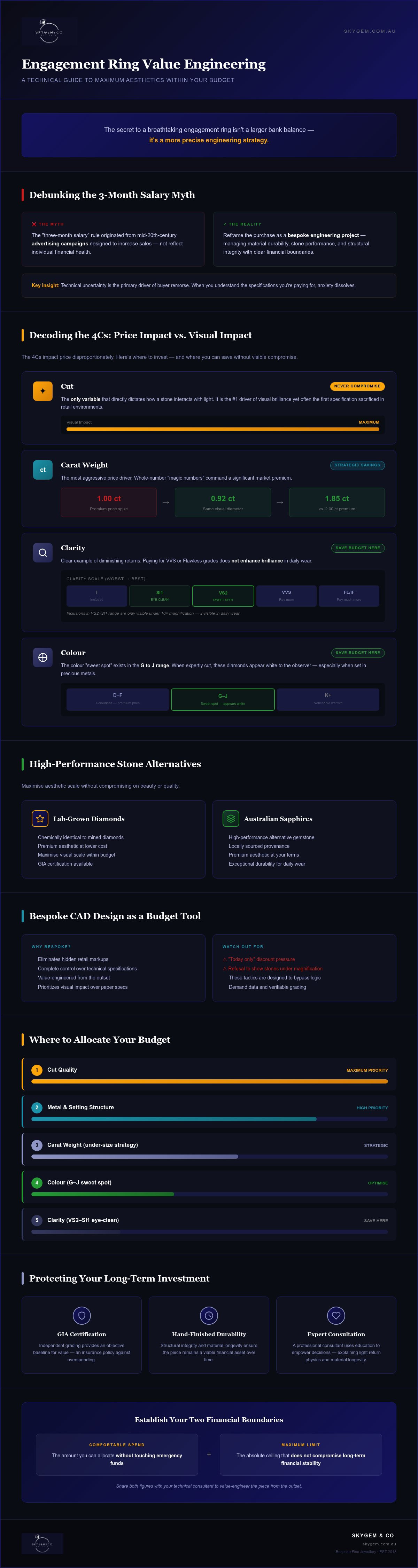
The "three-month salary" guideline is perhaps the most pervasive marketing myth in the jewellery industry. Originating from mid-20th-century advertising campaigns, this arbitrary benchmark was designed to increase sales rather than reflect individual financial health. When you examine the history and cultural traditions of engagement rings, it becomes clear that these "rules" are commercially motivated constructs. Adhering to them often triggers a significant level of anxiety about spending too much on a ring, as it forces a disconnect between your actual savings and an artificial social standard.
Breaking free from this pressure requires shifting your perspective. Instead of viewing the purchase as a test of your affection or status, reframe it as a bespoke engineering project. Like any high-level industrial project, it involves managing fixed variables such as material durability, stone performance, and structural integrity. Technical uncertainty is the primary driver of buyer remorse; when you don't understand the specifications you're paying for, you naturally fear being overcharged. This lack of clarity is what transforms a celebratory milestone into a source of psychological stress.
Identifying Your Core Budgetary Boundaries
Establishing a clear financial framework is the first step toward a stress-free experience. You should differentiate between your "comfortable spend," which is the amount you can allocate without touching emergency funds, and your "maximum limit." Sharing these boundaries with a technical consultant allows them to value-engineer the piece from the outset. Instead of pushing for technical perfection, such as an Internally Flawless clarity grade that's invisible to the naked eye, a consultant can help you prioritize visual impact. This ensures your investment is focused on what actually contributes to the ring's aesthetic performance rather than paying for paper-only specifications.
The Role of Transparency in Reducing Stress
Transparency acts as a safeguard against financial regret. Utilizing natural diamonds with GIA certification provides an objective baseline for value, acting as an insurance policy against overspending. A professional consultant uses education to empower your decision, explaining the physics of light return and material longevity. You should remain vigilant for red flags in high-pressure retail environments. "Today only" discounts or a refusal to show stones under magnification are tactics designed to bypass logic. By focusing on data and verifiable grading, you can resolve the anxiety about spending too much on a ring and move forward with quiet confidence.
Decoding the Technical Drivers of Engagement Ring Pricing
Understanding the technical levers of pricing is the most effective way to resolve anxiety about spending too much on a ring. While the 4Cs provide a standard grading language, their impact on the final invoice is disproportionate. Cut quality is the only variable that directly dictates how a stone interacts with light, yet it is often the first specification sacrificed in retail environments. By focusing on light performance over paper-based rarity, you can achieve a high-performance aesthetic without paying for technical specifications that remain invisible to the naked eye.
Carat weight acts as the most aggressive price driver due to the industry's reliance on "magic numbers." Diamond cutters work to retain weight to hit thresholds like 1.00ct or 2.00ct, as these whole numbers command a significant market premium. Opting for a stone at 0.92ct or 1.85ct can result in a substantial reduction in cost. These "under-size" stones offer the same visual diameter as their whole-number counterparts but bypass the artificial price spikes driven by consumer psychology and supply chain demand.
The Diminishing Returns of Diamond Clarity and Colour
Clarity grades offer a clear example of diminishing returns. An "eye-clean" diamond, typically found in the VS2 or SI1 range, contains inclusions that are only visible under 10x magnification. Paying for VVS or Flawless grades ensures a higher degree of geological purity, but it does not enhance the brilliance of the stone in daily wear. Similarly, the colour "sweet spot" exists in the G to J range. When these diamonds are expertly cut, they appear white to the observer, especially when set in precious metals. Faint or medium fluorescence can occasionally lower the market price of a diamond without negatively impacting its aesthetic beauty in natural lighting.
Metal Purity and Setting Complexity
The choice of metal influences both the initial capital requirement and the long-term maintenance schedule. Gold jewellery purity, specifically 18k, provides an ideal balance of metallurgical durability and rich colour. Platinum is a denser, more expensive material that offers superior resistance to thinning over decades, though it requires a higher upfront investment. Complexity in the setting also scales the price; a minimalist solitaire allows the majority of your budget to be allocated to the centre stone, whereas intricate halo or trilogy designs increase the labour hours and the total diamond count. Refined, hand-finished details like tapered claws can provide a sense of luxury without the cost of high-density pavé work. If you're unsure which technical specifications will yield the best result for your budget, you can book a technical review to compare these variables in detail.
Strategic Value Engineering: Maximising Aesthetics Within a Budget
Value engineering in high-end jewellery is the process of optimizing the visual output of a piece without inflating the technical cost. While round brilliant diamonds are the industry standard for light return, they command the highest price per carat due to the significant raw material loss during the cutting process. You can effectively mitigate anxiety about spending too much on a ring by selecting fancy shapes like ovals, pears, or marquise cuts. These elongated silhouettes often possess a larger surface area than a round diamond of the same carat weight, providing a more substantial visual presence on the hand for a lower capital outlay.
Another strategic approach involves the architectural placement of stones. A trilogy setting or the use of delicate side stones can enhance the perceived scale of a smaller centre diamond. By distributing the total carat weight across multiple stones, you achieve a complex, high-end aesthetic that feels more intentional and bespoke than a single oversized solitaire. This method allows for a balanced allocation of funds, focusing on high-quality smaller stones to frame a centrepiece that fits within your established financial boundaries.
The Lab-Grown Advantage for Budget-Conscious Buyers
The emergence of lab grown diamonds has fundamentally shifted the value proposition for modern buyers. These stones are chemically, physically, and optically identical to their natural counterparts, yet they typically allow for 30-50% larger stones for the same financial investment. For many, the anxiety about spending too much on a ring stems from the fear of compromising on scale to meet a price point. Lab-grown options resolve this by delivering the desired visual impact without the scarcity-driven premium of mined stones. While some cite resale value as a concern, an engagement ring is primarily a sentimental asset and a permanent heirloom rather than a liquid financial instrument; the immediate utility and aesthetic satisfaction often outweigh theoretical future returns.
Alternative Gemstones for Unique Value
If you're seeking a distinctive aesthetic that deviates from traditional diamond norms, precious gemstones offer exceptional value engineering opportunities. Australian sapphires, particularly in trending teal and peach hues, provide a durable and prestigious alternative with a rich regional heritage. These stones often allow for a much larger visual footprint than a diamond of equivalent cost. Rubies and emeralds also offer a sense of timeless luxury, allowing you to create a high-impact bespoke piece that prioritizes character and colour over the rigid technical metrics of the diamond market. This shift toward coloured gems often results in a ring that feels more personal and less tied to the standardized pricing pressures of the global diamond trade.
The Bespoke Design Process as a Budget Management Tool
Many consumers assume that custom manufacturing is more expensive than purchasing a pre-made piece. In reality, "off-the-shelf" rings often carry significant retail markups to cover the costs of physical inventory, prime real estate, and extensive floor staff. By choosing a bespoke path, you eliminate these hidden expenses. A bespoke jeweller acts as a technical consultant, directly sourcing loose diamonds from global networks to find a stone that matches your specific price point. This direct-to-source approach significantly reduces the anxiety about spending too much on a ring because every dollar is allocated to the materials rather than the retailer's overhead.
Using Computer-Aided Design (CAD) provides a level of financial control that retail shopping can't match. Before a single gram of gold is cast, you can visualise the exact proportions of the piece. If the initial design exceeds your budget, you can adjust technical variables like metal volume or stone specifications in the digital model. This iterative process ensures the final product aligns perfectly with your financial boundaries while maintaining the high-end aesthetic you desire.
The Value of a Personal Consultation
A personal consultation shifts the experience from passive shopping to active collaboration. When designing bespoke engagement rings, the setting is engineered specifically around the unique dimensions of your chosen stone. This precision ensures a more secure fit and a more refined profile. You gain the ability to prioritise specific design elements, such as a hidden halo or a specific claw style, without being forced into a "package deal" that includes features you don't value. This targeted allocation of funds is the hallmark of a sophisticated buyer.
Controlling Costs Through Design Tweaks
Professional design allows for granular cost control through structural optimisation. By reducing metal weight in areas that don't compromise structural integrity, you can lower the material cost of the setting. Additionally, strategic prong placement can be used to maximise the visible surface area of the diamond, making it appear larger than its technical carat weight suggests. Choosing a setting that offers superior protection for the stone also reduces the long-term cost of ownership by minimising the need for frequent repairs or claw re-tipping. These technical adjustments provide a premium finish while respecting your budgetary constraints, effectively resolving any lingering anxiety about spending too much on a ring.
Establishing Trust and Longevity in Your Jewellery Investment
The true cost of an engagement ring isn't just the initial transaction price; it's the total cost of ownership over several decades. While mass-market retailers often entice buyers with aggressive discounts, these "deals" frequently involve compromises in metallurgical integrity. A ring that is cast in high volumes often suffers from porosity, which leads to brittle claws and structural failure. This technical reality is why many experience anxiety about spending too much on a ring when they see significant price discrepancies between jewellers. A hand-finished, bespoke piece built to higher engineering standards might require a slightly larger upfront investment, but it eliminates the recurring costs of structural repairs and stone loss.
Trust is built on verifiable data. An independent grading report from the Gemological Institute of America (GIA) acts as a technical audit of your diamond's physical properties. It provides an objective baseline that ensures the price you're paying aligns with the stone's global market value. This transparency is vital for financial security, as it allows for accurate insurance valuations and protects the long-term equity of your asset. Beyond the diamond, evaluating a jeweller's commitment to maintenance and resizing is essential. A ring that can't be serviced or resized due to poor design is a liability rather than a permanent heirloom.
Verification and Certification
Learning to interpret a natural diamond grading report is a crucial skill for any serious buyer. You should focus on more than just the 4Cs; examine the proportions, symmetry, and polish grades, as these dictate the stone's light performance. Ethical sourcing is another non-negotiable metric. Ensure your jeweller adheres to the Kimberley Process and can verify conflict-free origins. Once the piece is completed, a professional appraisal for insurance purposes serves as the final layer of financial protection, documenting the replacement value of both the stone and the bespoke setting.
Final Steps to a Confident Purchase
Before finalizing your commission, ask your jeweller specific questions regarding resizing limits and the frequency of professional cleaning. A robust warranty should cover manufacturing defects, but it doesn't replace the need for comprehensive jewellery insurance. Understanding these operational details transforms the purchase from a stressful event into a confident investment in a piece designed to last generations.
Book a consultation to explore custom engagement rings designed for your budget.
Securing a High-Performance Future for Your Investment
Transitioning from a consumer mindset to a project-focused perspective allows you to replace emotional pressure with technical precision. By deconstructing industry myths and leveraging the bespoke design process, you ensure every dollar is allocated to materials that enhance visual performance rather than retail markups. This structured approach effectively resolves anxiety about spending too much on a ring, as it replaces marketing-driven benchmarks with data-driven decision-making. You've learned that a high-end aesthetic isn't just about a high price point; it's the result of smart engineering.
You now possess the framework to balance premium aesthetics with long-term financial peace of mind. Whether you prioritize the visual scale of lab-grown diamonds or the technical rarity of GIA-certified natural stones, your purchase is a calculated investment in quality. Our transparent process provides direct access to the world's finest gems and hand-finished craftsmanship, ensuring your piece remains a durable asset for generations to come.
Take the next step with confidence, knowing that your choice is supported by technical expertise and a commitment to enduring value.
Frequently Asked Questions
Is it normal to feel anxious about my engagement ring budget?
Feeling anxiety about spending too much on a ring is a standard response to a significant financial and emotional commitment. Most buyers encounter pressure from outdated social norms and aggressive marketing tactics. Shifting your focus to a technical framework helps alleviate this stress. By understanding the specific drivers of cost, you can align your purchase with personal financial values rather than arbitrary industry expectations, ensuring the process remains a positive milestone.
How much should I spend on an engagement ring in Australia in 2026?
There is no fixed amount you must spend, as the "three-month salary" rule is an outdated marketing construct. In Australia, your budget should be determined by your personal financial boundaries and comfort level. A technical consultant can help you prioritize where to allocate funds for the best visual result. Whether you choose a minimalist solitaire or an intricate design, the focus should remain on the durability and performance of the materials within your specific limit.
Does a custom-made ring cost more than a retail ring?
A custom-made ring often provides better value than a retail equivalent because it eliminates the high overheads associated with stock inventory and prime floor space. Bespoke manufacturing allows you to control every technical variable, from metal weight to stone specifications. This transparency ensures your budget is spent on high-quality materials and craftsmanship rather than hidden retail markups. It's a precise way to get exactly what you want without paying for brand-name premiums.
How can I make a diamond look bigger without spending more?
You can maximize the visual impact of a stone by selecting fancy shapes like oval, pear, or marquise cuts, which have a larger surface area than round brilliants of the same weight. Additionally, utilizing a thinner band or a delicate halo can make the centre diamond appear more substantial. Expert prong placement and hand-finished settings also play a critical role in enhancing light return, which increases the perceived scale of the diamond without requiring a larger carat weight.
Are lab-grown diamonds a good investment for those with budget anxiety?
Lab-grown diamonds are an excellent choice for resolving budget anxiety because they allow you to purchase a significantly larger stone for the same price as a natural diamond. They are chemically and physically identical to mined stones, offering the same brilliance and durability. While natural diamonds hold a different scarcity value, lab-grown stones provide immediate aesthetic satisfaction and utility for those who prioritize visual scale and modern manufacturing ethics over geological rarity.
What are the most common hidden costs when buying a ring?
Hidden costs often arise from poor structural design or lack of long-term maintenance planning. Rings with brittle, mass-produced settings may require frequent claw re-tipping or repairs to prevent stone loss. Other overlooked expenses include professional appraisals for insurance and potential resizing fees if the initial design isn't adaptable. Choosing a hand-finished setting and ensuring your diamond is GIA-certified helps mitigate these risks, providing a clearer picture of the total cost of ownership over time.
How do I know if I am being overcharged for a diamond?
Verifying the price against an independent GIA grading report is the most reliable way to ensure you aren't being overcharged. This report provides an objective audit of the diamond's specifications, allowing you to compare it to global market baselines. If a jeweller refuses to provide independent certification or uses high-pressure "today only" discounts, it's a significant red flag. Transparency in the sourcing process is essential for establishing a fair market value for your investment.
Can I upgrade my ring stone later if I have a smaller budget now?
You can certainly upgrade your stone later, provided the original setting is engineered to accommodate a larger diamond. When commissioning your initial piece, tell your consultant that you might consider a larger stone in the future. They can design a setting with a head or basket that is easier to replace or modify. This strategy allows you to start with a high-quality, hand-finished band now while keeping the door open for a future aesthetic expansion.
Disclaimer
This article is for general informational purposes only and may include AI-assisted content. Pricing, specifications, and availability are subject to change. For accurate advice and current information, please contact SkyGem & Co. directly. Nothing in this content constitutes professional or financial advice.