
Lab Grown vs Natural Diamonds: The Definitive 2026 Australian Guide

As of August 2026, lab grown diamonds account for over 50% of new engagement rings sold in Australia, marking a significant shift in how we value luxury. If you're currently weighing the merits of lab grown vs natural diamonds, you've likely encountered a confusing mix of terms like 'synthetic' and 'simulant' that don't quite explain the underlying science. It's natural to feel some anxiety about making a choice that carries both financial weight and emotional significance. You want to ensure your selection holds its meaning, whether you value geological rarity or the ability to secure a larger, higher-quality stone for your specific budget.
Explore More: alexandrite
This guide acts as your technical consultant to help you choose the right stone for a bespoke setting. We'll clarify the chemical identity of these diamonds and address the 2026 market realities regarding resale value and long-term viability. You'll gain a clear framework for balancing your ethical priorities with technical performance metrics. Whether you're designing a classic solitaire or an intricate trilogy ring, this information ensures your selection is based on facts rather than marketing hype.
Key Takeaways
- Understand that when comparing lab grown vs natural diamonds, both share an identical carbon-atom lattice structure that defines them as authentic diamonds rather than simulants.
- Evaluate the 2026 market landscape to understand how the widening price gap impacts your ability to select higher-grade specifications for bespoke jewellery.
- Learn how the 4Cs of diamond grading apply universally across both origins, requiring GIA certification to verify technical quality and provenance.
- Discover how your diamond choice influences the engineering of custom solitaire, halo, or trilogy settings during the technical CAD design process.
- Gain a practical framework for choosing between geological rarity and laboratory precision based on your long-term values and aesthetic goals.
The Chemical Reality: Are Lab Grown and Natural Diamonds Identical?
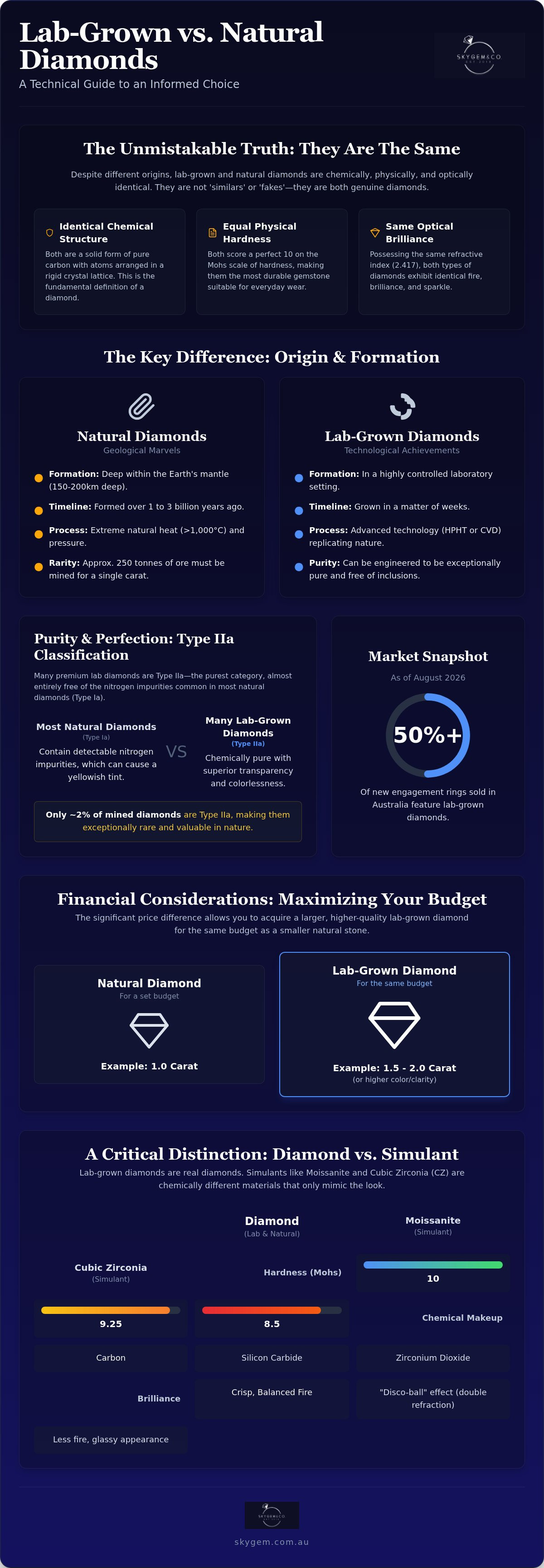
A diamond is a solid form of pure carbon with atoms arranged in a crystal structure. This fundamental definition remains unchanged regardless of the stone's origin. When evaluating lab grown vs natural diamonds, the most critical technical takeaway is that they're both composed of the same isometric-hexoctahedral crystal system. They aren't just similar; they're chemically, physically, and optically identical.
Defining the Diamond Lattice
The structural integrity of a diamond comes from its tight covalent bonds. In this isometric system, carbon atoms are arranged in a specific lattice that provides unparalleled hardness and light dispersion. Because the growth environment in a laboratory replicates the high-pressure conditions found deep within the Earth, the resulting stones possess the same refractive index and thermal conductivity. For a client designing a bespoke engagement ring, this means a lab-grown stone will display the same brilliance and fire as a natural one.
Order Now: black gem
Lab-Grown vs. Simulants: Why It Matters
Understanding the difference between a diamond and a simulant is vital for long-term satisfaction. Materials like moissanite or cubic zirconia (CZ) are often confused with lab diamonds, but they're entirely different chemical species. A Synthetic diamond is a genuine diamond, whereas a simulant only mimics the appearance. When comparing lab grown vs natural diamonds, professional gemological testing is the only way to identify the origin, as simulants can be spotted via basic thermal or optical tests.
The performance metrics highlight this gap clearly:
- Hardness: Both lab and natural diamonds score a 10 on the Mohs scale. Moissanite sits at 9.25, making it more prone to surface abrasions over decades of wear.
- Refractive Index: Diamonds have a refractive index of 2.417. Simulants often have 'double refraction', which can give them a 'fuzzy' or overly colourful appearance that doesn't match the crisp light return of a true diamond.
Trace Elements and Type IIa Classification
While the carbon structure is the same, trace elements provide a technical fingerprint. Most natural diamonds are Type Ia, containing detectable amounts of nitrogen that can impart a yellowish tint. In contrast, many premium lab diamonds are classified as Type IIa. This is the purest category of diamond, containing almost no measurable nitrogen. In nature, Type IIa stones are exceptionally rare, representing only about 2% of all mined diamonds. Choosing a lab-grown stone often allows you to secure a Type IIa diamond with superior transparency and colourlessness that would be significantly harder to source in a natural stone of the same carat weight.
Explore More: what hand does the wedding ring go on
Origin and Formation: Comparing Geological Rarity with Laboratory Precision
The fundamental difference in the debate of lab grown vs natural diamonds lies in the dimension of time and the method of delivery. Natural diamonds are geological artifacts. They formed between 150 and 200 kilometres below the Earth's surface under extreme pressure and temperatures exceeding 1,000 degrees Celsius. This process occurred over one to three billion years, long before the first life appeared on our planet. It's a timeline that modern engineering cannot replicate, making each natural stone a finite piece of Earth's history.
The Geological Story of Natural Diamonds
These stones remained trapped in the mantle until volcanic eruptions transported them to the surface through kimberlite pipes. The rarity of natural white diamonds is quantifiable through the sheer volume of material required for their extraction. Miners typically move approximately 250 tonnes of ore to recover a single carat of gem-quality diamond. This geological scarcity creates a restricted supply, which underpins the traditional value and legacy of natural stones.
The Technological Precision of CVD and HPHT
Laboratory diamonds bypass the geological timeframe through two sophisticated engineering processes. High Pressure High Temperature (HPHT) replicates the Earth's core conditions by placing carbon in a press, while Chemical Vapor Deposition (CVD) grows diamonds atom-by-atom in a plasma chamber using carbon-rich gas. According to the GIA on Lab-Grown Diamonds, these methods result in different growth morphology. For example, CVD diamonds often grow in a tabular shape, whereas natural diamonds grow octahedrally. HPHT often results in stones with high colour grades, while CVD allows for precise control to produce the high-purity Type IIa stones discussed earlier.
While the final products are chemically identical, gemologists look for 'growth remnants' under 10x magnification to distinguish them. HPHT stones may show metallic flux inclusions, while CVD stones might display unique strain patterns. This distinction highlights the shift from geological rarity to technological scalability. Natural rarity is a function of geological luck and massive industrial effort. Technological rarity, however, is being replaced by scalability as production efficiency improves. When choosing between lab grown vs natural diamonds, you're deciding between a finite geological asset and a high-performance engineered material. If you're unsure which origin aligns with your design vision, you can book a technical consultation to view both options side-by-side.
Financial Considerations: Assessing Value, Resale, and Long-Term Viability
The financial landscape for diamond acquisition in 2026 is defined by a clear divergence between asset rarity and design utility. As lab-grown stones now account for a projected 70% of the Australian engagement ring market, the decision-making process has shifted. Choosing between lab grown vs natural diamonds isn't merely a matter of upfront cost. It involves a technical assessment of how your capital is distributed across the stone's geological legacy and its physical specifications.
Market Dynamics and Price Stability
The price gap between these two categories has widened significantly due to massive production efficiencies in the laboratory sector. While natural diamonds remain a finite resource with a supply chain tied to geological extraction, lab-grown stones benefit from technological scalability. This has led to a market where lab-grown diamonds retail for approximately 50 to 80% less than natural equivalents of the same grade. According to GIA's analysis of natural and lab-grown diamonds, the identical chemical properties don't translate to identical market trajectories. Natural diamonds historically retain a higher percentage of their retail value, typically between 20% and 60%, whereas lab-grown stones currently retain an estimated 10% to 40%.
It's vital to view these figures through the lens of a long-term asset rather than a short-term investment. Neither category should be purchased with the expectation of a financial profit upon resale. Instead, the value of a natural diamond lies in its rarity and proven price stability over decades. Conversely, the value of a lab-grown diamond is found in its immediate purchasing power, allowing for a higher technical specification at a lower entry point.
The 'Engagement Ring' Budget Allocation
When designing bespoke jewellery, the price differential creates a significant opportunity cost. Clients exploring lab grown diamonds Australia wide often find they can secure a 2.00-carat stone for the same budget that would only afford a 0.70-carat natural diamond. This allows for a more ambitious aesthetic without compromising on the quality of the setting.
A strategic budget allocation often involves weighing the stone's origin against the metalwork. For a bespoke project, you might choose to invest the savings from a lab-grown stone into premium materials like Platinum or high-density 18k Gold. This ensures the structural integrity of the piece remains high, regardless of the stone's provenance. By prioritising the total design, the diamond becomes a component of a larger engineering project rather than the sole driver of the ring's future value. This approach respects both the technical precision of modern manufacturing and the personal values of the wearer.
The Selection Framework: Prioritising Carat, Quality, and Heritage
Selecting a stone requires a structured framework that balances technical specifications with personal values. Whether you are comparing lab grown vs natural diamonds, the standard for evaluation remains the 4Cs: Cut, Colour, Clarity, and Carat weight. These metrics provide a universal language for quality, though the strategy for optimising them often shifts depending on the stone's origin. Your choice should reflect a balance between the geological legacy of the earth and the precision of modern engineering.
Applying the 4Cs to Lab and Natural Stones
Cut quality is the most critical metric because it dictates the stone's interaction with light. A poorly cut diamond will appear dull. For those using a diamond ring builder, prioritising an 'Excellent' or 'Ideal' cut grade ensures maximum brilliance. Regarding Clarity, the goal is often 'eye-clean' rather than 'flawless'. In a natural stone, achieving an eye-clean VS2 grade offers a significant value advantage over an internally flawless stone that looks identical to the naked eye. With lab-grown stones, the lower price point often allows buyers to reach for higher colour and clarity grades without the same financial friction.
Certification and Transparency
Independent verification is the cornerstone of a secure purchase. The Gemological Institute of America (GIA) remains the gold standard for grading both natural and laboratory-grown specimens. A GIA report doesn't just confirm the 4Cs; it provides a definitive statement on the stone's origin and any post-growth treatments. By 2026, GIA standards have solidified the requirement for lab-grown diamonds to be laser-inscribed on the girdle with a unique report number and a clear statement of their laboratory-grown origin. This ensures transparency and protects the buyer's interests over the long term. Obtaining an independent appraisal alongside this certification is a non-negotiable step to verify that the physical stone matches its digital record.
The 'sweet spot' in diamond selection involves a trade-off between perceived size and technical purity. While heritage and geological rarity drive the appeal of natural stones, the modern preference for sustainability and ethical transparency often leads buyers toward lab-grown options. By focusing on the intersection of a high cut grade and an eye-clean clarity, you can maximise the visual impact of your bespoke setting. This technical approach ensures the stone performs as a high-level asset within the design, regardless of how it was formed. We recommend viewing stones in person to see how these grades translate to real-world performance.
Bespoke Integration: Choosing the Right Diamond for Your Custom Setting
The final stage of the selection process involves integrating your chosen stone into a structural design that ensures both aesthetic impact and long-term durability. Designing a bespoke piece is an engineering exercise where the diamond acts as the primary component. Whether you are comparing lab grown vs natural diamonds, the physical dimensions of the stone dictate the technical parameters of the setting. A precision-engineered ring doesn't just hold a diamond; it protects the stone's integrity while maximising its specific optical properties.
Designing for Solitaire and Trilogy Styles
Solitaire settings require a centre stone with exceptional light performance, as the minimal metalwork leaves the diamond's facets fully exposed. When selecting a high-carat lab-grown stone for a solitaire, the setting must be calibrated to the stone's exact girdle thickness and pavilion depth to prevent 'bow-tie' effects or light leakage. In contrast, custom made engagement rings featuring a trilogy design require a different technical approach. Here, the challenge lies in matching the side stones to the centre diamond. Consistency in colour and clarity is paramount; even a slight variance in the nitrogen-related tint of a natural stone compared to a Type IIa lab stone can disrupt the visual symmetry of the trio. Our consultants ensure that every stone in a trilogy setting shares a unified light-return profile.
The CAD and Manufacturing Process
The transition from a conceptual stone to a finished asset begins with Computer-Aided Design (CAD). This process allows us to create a 3D digital twin of the ring, built specifically around the GIA-certified dimensions of your diamond. Mass-produced settings often rely on generic 'one-size-fits-most' heads that can leave gaps or exert uneven pressure on the stone's crown. This is a critical failure point for high-value gems. You can learn more about these risks in our analysis of The Hidden Costs of Mass-Produced Rings. At SkyGem & Co., each setting is hand-finished after the CAD-driven casting to ensure the prongs are perfectly seated against the diamond's surface.
A technical consultant's role is to bridge the gap between your lifestyle and these engineering requirements. If your daily environment involves high physical activity, a low-profile bezel or a heavy-gauge six-prong setting might be recommended to secure your asset. This solution-oriented approach ensures that the debate between lab grown vs natural diamonds concludes with a piece of jewellery that isn't just beautiful, but is a permanent, viable asset designed for the rigours of daily wear. By focusing on precision at every stage, from stone selection to the final hand-polish, we ensure the centrepiece remains the focus of the design for decades.
Securing Your Legacy with Technical Precision
The choice between lab grown vs natural diamonds is no longer a question of authenticity, but one of personal and financial priority. You've seen that both stones share the same carbon lattice and physical properties, which shifts the decision toward a balance of design utility and geological rarity. Natural stones offer a finite piece of Earth's history, while lab-grown alternatives provide the opportunity for larger, high-purity Type IIa specimens within a specific budget. Both paths lead to a genuine diamond that requires expert evaluation to ensure it performs as the centerpiece of your design.
Success in bespoke jewellery depends on more than just the stone's origin. It requires the technical precision of GIA-certified grading and the structural stability of a CAD-designed setting. As your technical consultants, we help you navigate these specifications to ensure your solitaire or trilogy ring is engineered for long-term viability. We focus on transparent education and expert craftsmanship to bridge the gap between technical performance and your aesthetic vision. Your journey toward a custom-made piece should be defined by confidence in your materials and the reliability of your design partner.
We look forward to assisting you with the selection of your perfect diamond and the creation of your unique setting.
Frequently Asked Questions
Are lab-grown diamonds real diamonds?
Yes, lab-grown diamonds are authentic diamonds. They possess the same carbon-atom lattice structure as stones formed in the earth. Unlike simulants, they're classified as genuine diamonds by global grading authorities. When comparing lab grown vs natural diamonds, it's essential to recognise that the only physical difference is the origin of the carbon crystallisation, occurring either within the earth's mantle or a controlled laboratory environment.
Do lab-grown diamonds pass a diamond tester?
Yes, lab-grown diamonds will pass a standard diamond tester. These devices typically measure thermal or electrical conductivity, and because lab diamonds share the exact physical properties of natural stones, they respond identically. To distinguish between the two, gemologists must use advanced spectroscopic equipment that can detect specific growth patterns or trace elements. This technical distinction is why professional certification is a requirement for any high-value diamond purchase.
Will lab-grown diamonds lose their value over time?
Lab-grown diamonds typically have a lower resale value compared to natural stones. While natural diamonds are a finite geological resource that historically retains 20% to 60% of retail value, lab diamonds are a technologically scalable product. Current 2026 market data suggests lab-grown resale values sit between 10% and 40%. Choosing lab grown vs natural diamonds often involves weighing the immediate benefit of a larger stone against the long-term price stability of a rarer asset.
Can you tell the difference between lab and natural diamonds with the naked eye?
No, it's impossible to distinguish between the two with the naked eye. Even under a standard jeweler's loupe, the chemical and optical properties are identical. Both types of stones exhibit the same brilliance, fire, and scintillation. Identification requires laboratory-grade magnification to observe growth morphology, such as the tabular patterns found in CVD stones or the octahedral structures characteristic of natural diamonds formed over billions of years.
Why are natural diamonds so much more expensive than lab-grown ones?
The price disparity is driven by geological scarcity and the massive industrial effort required for natural extraction. Mining natural diamonds involves moving hundreds of tonnes of earth for every gem-quality carat recovered. Lab-grown production is a controlled engineering process that has become significantly more efficient. This scalability allows lab diamonds to retail for 50% to 80% less than natural stones, despite being chemically identical and offering the same visual performance.
Is a GIA certificate necessary for a lab-grown diamond?
Yes, a GIA certificate is essential for any lab-grown diamond. It provides an objective technical assessment of the 4Cs and confirms the stone's origin. By 2026, GIA standards require lab-grown stones to have laser inscriptions on the girdle that match the digital report. This level of transparency is critical for insurance purposes and ensures that you aren't accidentally purchasing a simulant or a stone with undisclosed treatments.
Do lab-grown diamonds get cloudy or change colour?
No, lab-grown diamonds don't get cloudy or change colour over time. They are solid carbon crystals with the same structural integrity as natural diamonds, scoring a 10 on the Mohs hardness scale. This permanence distinguishes them from simulants like cubic zirconia, which can absorb oils and develop a surface film. A lab-grown stone will maintain its transparency and optical fire for generations, provided it receives standard professional cleaning and maintenance.
Which is better for a bespoke engagement ring: lab or natural?
The better choice depends entirely on your specific project goals. If your priority is geological rarity and a traditional store of value, a natural GIA-certified diamond is the standard choice for bespoke settings. However, if you want to maximise the carat weight and clarity of a solitaire or trilogy ring within a set budget, lab-grown stones offer superior design flexibility. Both options are suitable for high-precision CAD manufacturing and hand-finished settings.
Disclaimer
This article is for general informational purposes only and may include AI-assisted content. Pricing, specifications, and availability are subject to change. For accurate advice and current information, please contact SkyGem & Co. directly. Nothing in this content constitutes professional or financial advice.