
The Ultimate Guide to Alexandrite Stone: Nature’s Most Captivating Colour-Change Gem

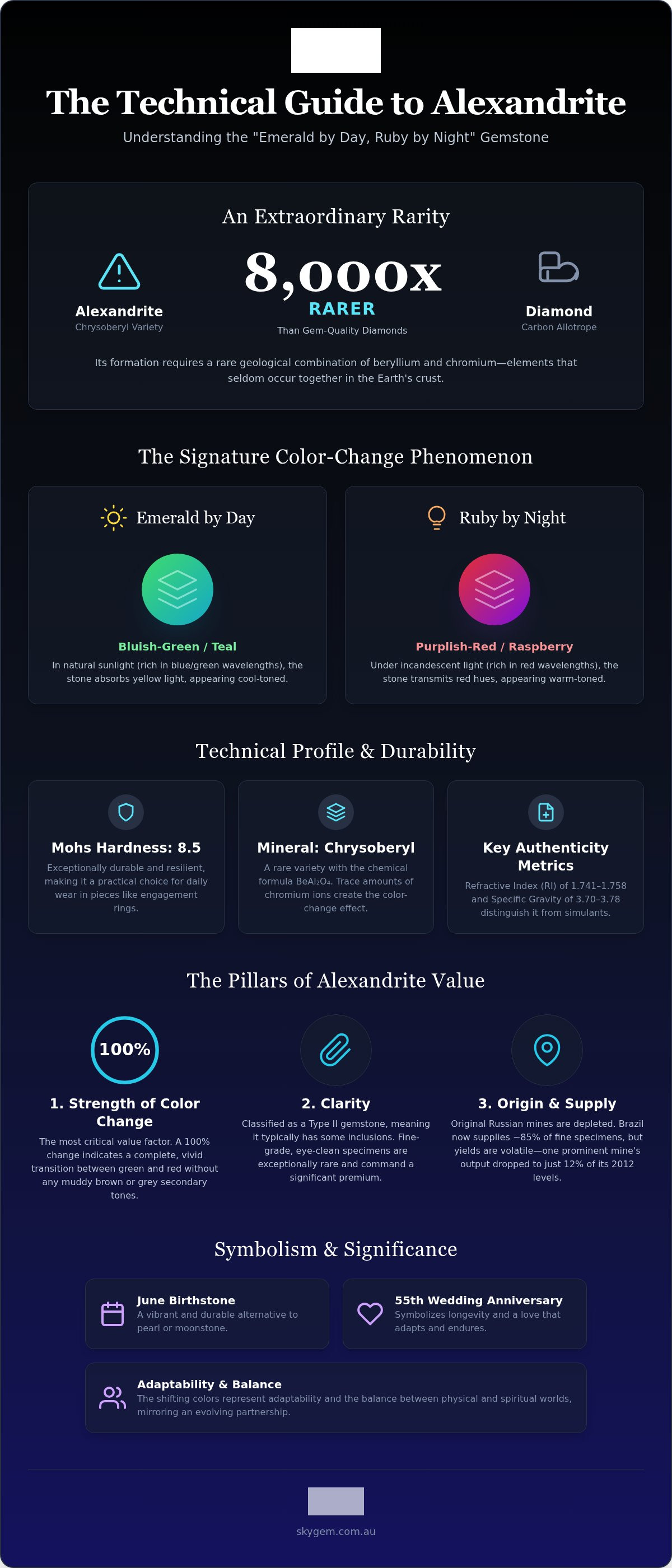
Did you know that gem-quality alexandrite is approximately 8,000 times rarer than white diamonds? This staggering scarcity, combined with its unique "emerald by day, ruby by night" phenomenon, makes the alexandrite stone one of the most technically complex and sought-after assets in the world of high jewellery. You're likely here because you're captivated by its shifting hues but feel overwhelmed by the nuances of colour-change percentages, origin premiums, and the stark differences between natural and lab-grown specimens.
We understand that selecting such a rare gemstone requires more than just an appreciation for its beauty; it demands a technical consultant’s eye for detail. This guide will provide the clarity needed to evaluate investment-grade stones, distinguish genuine natural material from imitations, and understand the durability metrics that make it suitable for daily wear. We'll explore the specific value drivers behind this chrysoberyl variety and provide a methodical framework for incorporating this rare specimen into a bespoke piece that balances structural integrity with aesthetic brilliance.
Key Takeaways
- Understand the mineralogical rarity of the chrysoberyl variety and how trace elements of chromium create the world's most famous colour-change effect.
- Learn why a Mohs hardness rating of 8.5 makes the alexandrite stone a durable and practical choice for daily wear in bespoke engagement rings.
- Identify the primary value drivers for fine-grade specimens, specifically the percentage of colour shift and the clarity standards for Type II gemstones.
- Discover the technical considerations for bespoke design, including how metal choice and light-optimised settings affect the stone's visual performance.
- Gain insights into a professional procurement process that prioritises transparency, ethical sourcing, and the long-term viability of your gemstone asset.
Understanding the Allure of the Alexandrite Stone
The alexandrite stone is defined by its remarkable pleochroism, famously described as "emerald by day, ruby by night." This optical trick occurs because the stone absorbs light in a way that shifts its perceived colour from a cool teal or bluish-green in natural sunlight to a warm raspberry red or purplish-red under incandescent bulbs. Discovered in the Ural Mountains in 1830, it was named after Czar Alexander II. Because its colours matched the military hues of Imperial Russia, it became a symbol of national pride and remains one of the most prestigious gemstones in history. Its historical pedigree is matched only by its technical complexity, making it a cornerstone of high-end gemological collections.
For those seeking a non-traditional engagement ring, the stone offers a symbolic depth that static gems cannot match. It represents adaptability and the ability to find beauty in changing circumstances. This makes it a compelling choice for couples who value technical rarity and a distinct aesthetic narrative. The shifting nature of the gem mirrors the evolving stages of a lifelong partnership, providing a dynamic visual experience that standard white diamonds lack. You can explore our curated selection of alexandrite gemstones to see these variations in person and understand how they interact with different lighting environments.
The Birthstone of June and 55th Anniversaries
Sharing its status as a June birthstone with the pearl and moonstone, alexandrite provides a durable, high-performance alternative for those seeking a more vibrant expression of their birth month. Traditional lore associates the gem with good fortune and the balancing of the physical and spiritual worlds. In the context of long-term commitment, it serves as the designated gift for 55th wedding anniversaries. Its ability to withstand the test of time, both physically and stylistically, reinforces its reputation as a permanent asset rather than a fleeting fashion choice. It's a stone that rewards the wearer with a sense of quiet confidence and reliability.
The Rarity Factor: Why Natural Alexandrite is a Finite Resource
The geological requirements for this gem are extraordinarily specific. It requires a rare combination of beryllium and chromium, elements that rarely occur together in the Earth's crust. While diamonds are found in various pipes globally, the Alexandrite mineralogy requires a precise environment that has led to it being approximately 8,000 times rarer than white diamonds. While the original Russian mines are largely exhausted, modern deposits in Brazil now provide about 85% of the fine specimens on the market. However, supply remains volatile. Yields from the prominent Hematita mine in Brazil have dropped to just 12% of their 2012 levels, highlighting the finite nature of this resource and its status as a high-value hard asset for serious collectors.
The Technical Properties and Mineralogy of Alexandrite
The alexandrite stone is a rare variety of the mineral chrysoberyl, an aluminate of beryllium with the chemical formula BeAl2O4. While standard chrysoberyl is typically yellow or green, the specific presence of chromium ions replacing aluminium in the crystal lattice creates the stone's signature optical phenomenon. From a technical standpoint, identifying authentic material requires verifying a refractive index (RI) between 1.741 and 1.758, alongside a specific gravity of 3.70 to 3.78. These performance metrics are essential for distinguishing natural stones from common simulants like synthetic corundum or spinel, which often lack the specific spectral fingerprint of true chrysoberyl.
The Physics of Colour Change
The "alexandrite effect" is driven by a narrow absorption band in the visible light spectrum at approximately 580 nanometres. This band effectively blocks yellow light, forcing the human eye to perceive the stone based on the dominant wavelengths of the ambient light source. In daylight, which is rich in blue and green wavelengths, the stone appears teal or forest green. In contrast, incandescent light is heavily weighted toward the red end of the spectrum, causing the stone to transmit the warm purplish-red hues we associate with fine specimens. Evaluating alexandrite quality depends on the "strength" of this shift; a 100% change indicates a complete transition between these spectral peaks without muddy secondary tones like brown or grey.
Physical Resilience and Daily Wear
Selecting a gemstone for a high-use piece like an engagement ring requires a balance of aesthetic appeal and structural integrity. With a Mohs hardness of 8.5, alexandrite is exceptionally durable. It's significantly tougher than emeralds and nearly as scratch-resistant as sapphires. This physical resilience means it can withstand the rigours of daily wear without the high risk of cleavage or surface abrasion common in softer gems.
Technical precision in the design process is vital because the stone's stability allows for intricate bespoke settings that might be too risky for more fragile materials. It's resistant to standard household chemicals and maintains its integrity under the heat used in most jewellery-making processes. If you're interested in how these technical properties translate into a physical design, you might consider scheduling a technical consultation to discuss your project requirements. The structural stability of the material supports various setting styles, ensuring the stone remains a permanent, evolving asset for decades.
Evaluating Quality: The Three Pillars of Alexandrite Value
Determining the value of an alexandrite stone requires a methodical assessment of its optical performance and physical rarity. Unlike white diamonds, where clarity and cut often lead the conversation, alexandrite value is primarily driven by the "alexandrite effect." This refers to the percentage and saturation of the colour shift. A stone exhibiting a 100% shift from a vivid blue-green to a purplish-red typically commands a 60% premium over a specimen with only a 70% shift. For a June birthstone of this calibre, saturation is equally vital; a weak, washed-out green that shifts to a muddy brown holds little investment appeal compared to deep, vivid primary hues.
Secondary to colour is the interplay between clarity and carat weight. As a Type II gemstone, natural alexandrite is expected to contain some minor inclusions. However, eye-clean specimens are the industry standard for fine quality. Any internal flaws that obstruct the passage of light or interfere with the colour change will devalue the stone significantly. Scale also plays a pivotal role in the pricing structure. Because large, gem-quality crystals are exceptionally rare, prices experience exponential jumps at specific weight milestones, most notably at the 1.00-carat mark. High-quality specimens in the 1.00 to 1.99-carat range are significantly more expensive per carat than smaller stones of identical quality.
Natural vs. Lab-Grown Alexandrite
Distinguishing between natural and lab-grown material is a critical step in the procurement process. While lab-created stones possess the same chemical and physical properties as the natural alexandrite stone, they have zero resale value and lack the geological history that defines a hard asset. Natural, unheated material remains the gold standard for collectors. It's essential to maintain transparency during selection, as lab-grown options are purely aesthetic choices and don't function as long-term investments. We prioritise education to ensure you understand exactly what you're acquiring for your precious gemstone collection.
The Importance of Origin and Certification
Origin remains one of the most influential factors in the global market. Russian stones, though nearly impossible to source today, command a 200% price premium over other origins due to their historical prestige and superior colour shift. Brazil currently accounts for approximately 85% of the fine specimens available, often producing stones with excellent clarity and a strong 100% shift. Sri Lankan (Ceylon) material frequently yields larger sizes but may exhibit less intense colour saturation. Because of these nuances, third-party certification from a laboratory like the Gemological Institute of America (GIA) is non-negotiable. It provides an objective verification of origin and authenticity, protecting the long-term viability of your purchase.
Designing Bespoke Alexandrite Jewellery
Designing for the alexandrite stone involves a high degree of technical precision to ensure the "emerald by day, ruby by night" effect is fully realised. Unlike static gems, this chrysoberyl variety demands a setting that facilitates varied light interaction. Platinum is often the professional choice for bespoke pieces because its neutral, white lustre doesn't interfere with the stone’s shifting hues. While 18k yellow gold can complement the warm purplish-red seen under incandescent light, it may subtly alter the perceived saturation of the daylight green. By utilising a bespoke CAD design process, we act as technical consultants, simulating how different metal volumes and geometries will interact with the stone before any material is cast. This ensures the final piece reflects both aesthetic intent and optical efficiency.
Alexandrite Engagement Rings: A Unique Choice
For those interested in a solitaire engagement ring, a central alexandrite provides a sophisticated alternative to traditional diamonds. However, many clients prefer trilogy or halo styles to add visual complexity. Incorporating high-grade white diamonds creates a brilliant contrast that makes the alexandrite’s colour transition appear more dramatic. The diamonds provide a constant source of white light reflection, which serves as a baseline against which the alexandrite’s shift is measured. When designing these rings, structural integrity is paramount. We focus on settings that protect the stone’s edges while ensuring the pavilion remains accessible. This accessibility is vital for professional cleaning and maintenance, as even a small amount of debris on the stone's underside can dampen its optical performance and obscure the colour-change effect.
Maximising Light Performance in Fine Jewellery
The visual success of any colour-change gemstone depends heavily on how light enters and exits the crystal lattice. Open galleries are a critical design feature in our bespoke process. By reducing the amount of metal surrounding the pavilion, we allow maximum light entry from multiple angles, which is essential for triggering the pleochroism described earlier. Prong placement also requires a technical touch; prongs that are too bulky can block the very light paths needed for the colour shift. This level of detail extends to earrings and pendants, where the stone’s movement against the wearer’s body creates a constantly evolving display of teal and raspberry hues. We ensure the alexandrite stone is positioned to catch shifting light, maintaining its status as a dynamic and permanent asset.
Sourcing and Crafting Your Alexandrite Piece with SkyGem & Co.
At SkyGem & Co., we treat the procurement of an alexandrite stone as a collaborative engineering project. Our role is to act as your technical consultant, translating complex gemological data into a piece of fine jewellery that meets your specific performance requirements. This process begins with education. We ensure you understand the metrics behind colour-change percentages and the importance of unheated material before any selection is made. This commitment to transparency establishes a foundation of reliability, ensuring that your investment is grounded in verified data rather than marketing hype.
Sourcing Rare Unheated Alexandrite
Finding high-quality, unheated material requires a robust network of reputable global suppliers. We specialise in identifying specimens that exhibit the rare combination of high clarity and a strong 100% colour shift. For our clients seeking precious gemstones, we provide comprehensive documentation for every stone, including third-party laboratory reports that confirm origin and treatment status. This rigorous screening process ensures that every stone we source meets the strict quality benchmarks required for a high-value hard asset.
The SkyGem & Co. Bespoke Experience
The transition from a loose stone to a finished custom-made engagement ring involves several stages of technical design. We utilise advanced CAD software to create a digital twin of your piece, allowing us to evaluate the structural integrity and light paths discussed in previous sections. Our manufacturing process focuses on hand-finished bespoke settings that offer superior longevity compared to mass-produced alternatives. This precision ensures a perfect fit and a secure environment for your stone, protecting its edges and maintaining its optical performance over decades of wear.
A bespoke piece is a permanent and evolving asset that requires ongoing professional maintenance. We recommend periodic inspections to verify prong security and professional ultrasonic cleaning to remove debris that might impede light entry. By maintaining the structural stability of the setting, you preserve the long-term viability of the heirloom. Our partnership doesn't end at the point of delivery; we remain dedicated to the ongoing performance and preservation of your alexandrite stone, ensuring it remains as captivating as the day it was first set.
Securing Your Legacy with Rare Alexandrite
Selecting an alexandrite stone is an investment in one of the world's most scientifically intriguing and finite resources. We've explored how its value is dictated by the precision of its colour shift and its remarkable 8.5 Mohs hardness; these factors make it a practical yet prestigious choice for bespoke jewellery. By prioritising GIA certified natural gemstones and understanding the technical requirements of light performance, you ensure your piece remains a durable, high-value asset for generations.
Our approach at SkyGem & Co. focuses on expert technical consultations and hand-finished craftsmanship to unlock the full potential of every specimen. We act as your partners in design, ensuring every structural element supports the stone's unique optical properties. This methodical process guarantees a result that is as reliable as it is beautiful.
We look forward to helping you navigate the complexities of sourcing and setting this captivating gem. Your journey toward a truly one-of-a-kind heirloom begins with a commitment to quality and technical excellence.
Frequently Asked Questions
Is alexandrite more expensive than a diamond?
Yes, high-quality natural specimens often command a higher price per carat than standard white diamonds of similar size. This price disparity is driven by extreme scarcity, as gem-quality material is approximately 8,000 times rarer than diamonds. While commercial stones are more accessible, fine-grade specimens with a 100% colour shift are valued as significant hard assets. We recommend reviewing GIA certification to verify the quality and origin of any potential investment.
How can I tell if an alexandrite is natural or lab-grown?
Distinguishing between natural and lab-created material requires professional gemological testing. While lab-grown stones share the same chemical properties, they lack the geological inclusions and resale value of the natural alexandrite stone. We utilise advanced testing to verify the refractive index and specific gravity of every specimen. Securing a report from an independent laboratory like the GIA is the only definitive way to ensure you're purchasing a natural, unheated asset rather than a synthetic simulant.
Does alexandrite change colour in all lighting conditions?
The "alexandrite effect" relies on specific wavelengths of light to trigger its characteristic shift. You'll observe a teal or forest green hue in natural daylight or fluorescent lighting, which is rich in blue and green wavelengths. When moved into incandescent light, such as candlelight or standard household bulbs, the stone shifts to a purplish-red. This transition isn't constant; it's a reactive optical phenomenon that depends entirely on the spectral balance of your current environment.
Is alexandrite durable enough for an everyday engagement ring?
Yes, this gemstone is an excellent choice for an everyday engagement ring due to its high physical resilience. With a rating of 8.5 on the Mohs scale, it's significantly harder than emeralds and nearly as scratch-resistant as sapphires. It effectively resists surface abrasion and chemical exposure from common household products. Its structural stability allows our technical team to create intricate bespoke settings that remain secure and durable over decades of continuous daily use.
What is the best metal to set an alexandrite stone in?
Platinum is the most effective metal for showcasing the stone's pleochroism because its neutral, white lustre doesn't bleed into the gem's shifting colours. However, 18k yellow gold is a popular alternative for those who wish to enhance the warm, raspberry-red tones seen under incandescent light. During our bespoke design process, we use CAD simulations to evaluate how different metal choices will affect the perceived saturation and light paths within your specific alexandrite stone.
Where does the best quality alexandrite come from today?
Brazil currently provides approximately 85% of the fine-grade specimens on the global market, particularly from the Hematita mine. These stones are prized for their high clarity and distinct colour shift. While Russian mines produced the historical benchmark for quality, they're now largely exhausted and command a significant origin premium. Sri Lankan material is also available and often yields larger carat weights, though these stones frequently exhibit a less intense colour transition than Brazilian specimens.
How should I clean and care for my alexandrite jewellery?
Maintaining your jewellery involves regular professional cleaning to ensure the pavilion remains free of debris. Even minor buildup on the stone's underside can obstruct light entry and dampen the colour-change effect. You can safely use warm soapy water at home, but we recommend periodic ultrasonic cleaning and prong inspections by a specialist. These maintenance steps preserve the structural integrity of the setting and the long-term viability of the gem as a permanent family heirloom.
Disclaimer
This article is for general informational purposes only and may include AI-assisted content. Pricing, specifications, and availability are subject to change. For accurate advice and current information, please contact SkyGem & Co. directly. Nothing in this content constitutes professional or financial advice.