
How to Pair Your Engagement Ring with a Wedding Band: The Complete 2026 Guide

A wedding band shouldn't just sit next to your engagement ring; it should integrate with it like a precision-engineered component. You likely spent months selecting the perfect stone, so it's frustrating when a standard band creates an unsightly 2mm gap or begins to abrade the delicate prongs of a low-set diamond. We understand that a bridal set is a permanent asset that requires both aesthetic harmony and structural integrity. Selecting the right ring with wedding band is not merely a stylistic choice but a technical decision that impacts the long-term wear and maintenance of your jewellery.
This 2026 guide provides the architectural framework you need to achieve a seamless fit, ensuring your rings function as a cohesive unit. We'll master the mechanics of flush fits, the durability of mixed metal alloys, and the specific contours required for complex settings. You will gain the technical confidence to choose between natural and lab-grown diamonds while ensuring your set meets the high standards of Australian-led design and durability.
Key Takeaways
- Understand the structural and symbolic logic behind the traditional Australian wearing order to ensure your bridal stack remains a permanent and meaningful asset.
- Learn how to technically pair your engagement ring with wedding band by matching metal alloys to ensure long-term structural integrity and durability.
- Master the engineering of band profiles, including Court and D-shape designs, to achieve a seamless architectural fit and superior ergonomic comfort.
- Identify the structural benefits of curved and contoured bands for protecting the delicate girdles of rubies, sapphires, and other coloured gemstones.
- Follow a methodical step-by-step framework to determine your ring's specific shank profile and setting height for a perfectly integrated bespoke solution.
The Fundamentals of Wearing a Ring with a Wedding Band
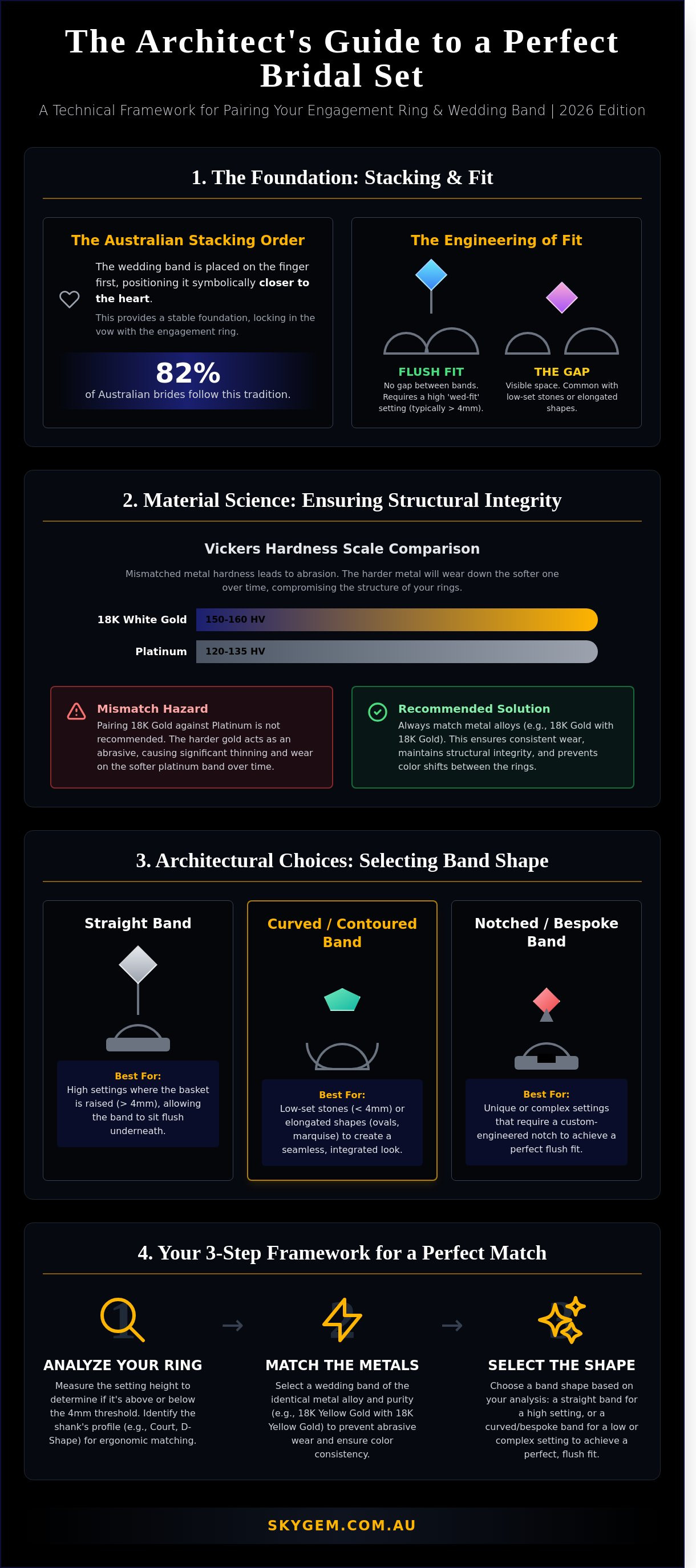
In the Australian jewellery landscape, the concept of the 'bridal stack' has transitioned from a simple dual-ring pairing to a sophisticated architectural assembly. Choosing a ring with wedding band requires an understanding of both symbolic heritage and structural engineering. Historically, Australian couples have favoured a sequence that prioritises the wedding band's position. By placing the wedding band on the finger first, it sits physically closer to the heart. This placement isn't just sentimental; it provides a stable foundation for the engagement ring, which often features a more prominent centre stone and complex setting. Data from 2024 consumer surveys indicates that approximately 82% of Australian brides still adhere to this traditional stacking order, though modern customisations are becoming more frequent.
The aesthetic success of this pairing often hinges on the 'Flush-Fit' versus 'The Gap' debate. A flush-fit occurs when the wedding band sits directly against the engagement ring's shank without any visible space. This requires the engagement ring to have a 'wed-fit' setting, where the basket or collet is elevated high enough to allow a straight band to slide underneath. Conversely, many modern designs embrace a deliberate gap, often seen with low-set rings or elongated diamond shapes like ovals and marquise cuts. This gap highlights the individual character of each piece rather than blending them into a single unit. The height of your engagement ring setting is the primary technical factor here. A setting height of less than 4mm typically necessitates a contoured or curved wedding band if a flush look is desired.
The Tradition of the Wedding Ring Finger
In Australia, the fourth finger of the left hand remains the standard for both engagement and wedding rings. The tradition of wedding rings suggests this finger contains a vein leading directly to the heart, a concept that influences how we stack these pieces. While some European cultures prefer the right hand, Australian conventions dictate that the wedding band is placed on the finger first during the ceremony. This sequence ensures the band, representing the permanent vow, is 'locked in' by the engagement ring. It's a practical arrangement that also protects the more delicate wedding band from external impact.
Understanding the 'Bridal Set' Concept
A bridal set refers to a pair of rings designed concurrently to ensure perfect alignment in metal weight, diamond quality, and profile height. Choosing a pre-designed set eliminates the technical challenges of matching a wedding band to an existing ring later. However, a curated stack allows for more personal expression, such as mixing 18K yellow gold with platinum for a contemporary contrast. If you're in the early stages of planning, it's beneficial to explore our curated engagement rings to see how different setting heights influence your future band options. This proactive approach prevents common issues like metal-on-metal friction, which can lead to premature wear if the rings don't share the same structural profile.
Technical Considerations for a Seamless Match
Achieving a flush fit between two rings requires more than a visual preference; it involves precise mechanical engineering. When you pair a ring with wedding band, the structural integrity and long term wear of both pieces depend on how their technical specifications interact. A mismatch in metal hardness or profile height doesn't just look awkward, it can lead to premature structural failure or the need for frequent resurfacing. Expert precision ensures that the two pieces function as a single, cohesive unit rather than two competing components.
Metal Compatibility and Durability
Metals interact on a molecular level. Platinum and 18K white gold shouldn't be worn against each other because they sit at different points on the Vickers hardness scale. Platinum has a hardness of approximately 120 to 135, while 18K white gold typically measures between 150 and 160. Over time, the harder metal will act as an abrasive against the softer one, leading to significant thinning of the shanks. Consistency in alloy batches is also vital to prevent subtle colour shifts, especially under different lighting temperatures. For a deeper technical breakdown, consult this guide to gold jewellery purity and craftsmanship.
Ring Profiles and Comfort
The profile refers to the cross-sectional shape of the band, which dictates how it sits against the finger and the adjacent ring. Engineering a seamless transition requires matching the "wall height," which is the vertical thickness of the metal. A discrepancy of even 0.2mm can create a tactile ledge that gathers debris and causes skin irritation. Common profiles include:
- Court profile: Curved on both the interior and exterior for maximum ergonomic comfort.
- Flat profile: A modern, architectural look with a squared-off surface that sits flush against straight-edged engagement settings.
- D-shape profile: Flat on the inside but curved on the outside, providing a traditional aesthetic with a lower profile height.
Proportional balance is the final technical hurdle. A centre stone weighing 2.0 carats often requires a band width of at least 2.2mm to maintain visual equilibrium. If the band is too narrow, the centre stone looks top-heavy; if it's too wide, it diminishes the diamond's perceived scale. Light performance must also be synchronised. If your engagement ring features a Triple Excellent cut diamond, the melee diamonds in the wedding band must match in colour and clarity. Using G/H colour stones next to a D colour centre stone will make the ring with wedding band look mismatched under natural Australian sunlight.
If you're unsure how to align these technical variables, our team can provide a bespoke design consultation to ensure your set is perfectly engineered for life.
Choosing Between Straight, Curved, and Contoured Bands
Selecting a ring with wedding band involves more than aesthetic preference; it requires an understanding of structural geometry and metal-on-metal friction. For 2026, the market has shifted toward precision-engineered sets that prioritise the longevity of the setting alongside visual symmetry. Straight bands represent the standard for high-set solitaires where the basket sits high enough to allow a band to slide underneath without obstruction. If the engagement ring features a low-set basket or an elongated centre stone, such as a 3-carat oval or a radiant cut, a straight band will create a visible gap. While some wearers appreciate this negative space, many seek a flush fit to prevent the rings from rotating independently throughout the day.
Contoured and curved bands solve this architectural challenge by mimicking the specific silhouette of the engagement ring. For those seeking a more dramatic transformation, ring enhancers or jackets serve as a technical upgrade. These dual-band structures encase the solitaire, effectively converting a minimalist design into a multi-stone halo configuration. This provides a modular solution for those who want a modest look for professional environments and a more ornate profile for formal occasions. Choosing the right ring with wedding band depends on how often you intend to wear the band as a standalone piece.
When to Opt for a Contoured Band
A contoured design is technically essential for pear, marquise, or low-profile emerald cuts. These shapes often feature tips or pavilions that extend beyond the footprint of the band. A bespoke curve ensures that the two pieces lock together, which reduces the mechanical wear caused by stones rubbing against metal. The primary trade-off is the standalone appearance. Because a contoured band follows a specific arc, it often looks asymmetrical or incomplete when worn without the engagement ring. This is a critical consideration for individuals who remove their engagement ring for manual work or exercise but wish to keep their wedding band on.
The Versatility of the Straight Band
Straight bands remain the most frequent choice for solitaire engagement rings because of their inherent modularity. They allow for effortless stacking, enabling the wearer to add eternity bands for anniversaries or milestones without worrying about geometric alignment. To avoid long-term damage, you must ensure the straight band doesn't sit directly against low-set prongs. Constant contact can lead to metal fatigue or the thinning of prongs over time. Industry data suggests that maintaining a 0.2mm clearance or using a thin spacer band can extend the life of the setting by over 10 years. This approach maintains the timeless appeal of the set while protecting the structural integrity of the primary stone.
A Step-by-Step Guide to Finding Your Perfect Bridal Set
Selecting a ring with wedding band requires a methodical approach to ensure both structural compatibility and aesthetic balance. This process moves beyond simple preference, focusing on the engineering of the jewellery to ensure long-term durability and comfort. By following a structured sequence, you can avoid common pitfalls such as mismatched metal wear or uncomfortable physical gaps.
- Step 1: Identify setting height and shank profile. Measure the clearance between the base of the diamond setting and the finger. High-set rings typically accommodate a straight band, while low-profile settings may require a bespoke contoured design to sit flush against the engagement ring.
- Step 2: Establish your metal philosophy. You can opt for a monochromatic look with matching 18K gold or platinum, or create architectural contrast by mixing metals. Consistency in alloy purity is recommended to ensure both rings age at the same rate and maintain similar hardness levels.
- Step 3: Determine gemstone coverage. Decide between a half-eternity, three-quarter, or full eternity band. While full eternity bands offer uninterrupted brilliance, half-eternity styles allow for easier resizing and offer better protection for the stones on the underside of the hand.
- Step 4: Trial various widths. The visual sweet spot often depends on the proportions of your hand. A 1.5mm band offers a minimalist look, whereas a 3mm band provides a more substantial foundation for a larger centre stone.
- Step 5: Conduct a technical fit assessment. A specialist can identify potential rubbing points where the metal of one ring might wear down the prongs of the other over time. This is a critical step for future-proofing your investment.
Choosing Your Diamond Type
Maintaining visual consistency across your bridal set is a technical requirement for a cohesive look. When you browse our lab-grown diamond options, it's essential to match the colour and clarity of these stones to your existing engagement ring. If your centre stone is an F-grade colour, choosing G or H-grade stones for the wedding band can create a noticeable yellow tint in the smaller diamonds. Consistency in the origin and grading of the stones ensures the light performance remains uniform across the entire stack.
The Final Fitting Process
It's vital to try on the band with your actual engagement ring before finalizing the purchase. This physical trial allows you to check for spinning, a common issue where the rings move independently and cause discomfort. When pairing a ring with wedding band, a correct fit ensures the two pieces lock together comfortably, preventing unnecessary wear on the shanks. For more detailed insights into material durability and Australian market trends, consult the Definitive Buyer's Guide for Wedding Rings. Achieving this precision is the final step in securing a set that functions as a single, unified asset.
Bespoke Solutions for Unique Gemstone Rings
Pairing a complex engagement ring with wedding band components requires more than aesthetic alignment; it demands technical precision to ensure the longevity of the primary gemstone. Coloured stones like emeralds, rubies, and sapphires often feature unique crystal habits and varying levels of cleavage, making them more susceptible to damage if the wedding band isn't engineered correctly. For instance, an emerald's girdle is notoriously delicate. A standard straight band might exert lateral pressure or cause friction against the pavilion, leading to micro-fractures over time. Our approach treats the bridal set as a unified structural system rather than two separate pieces of jewellery.
At SkyGem & Co., our technical consultation process focuses on creating a "shadow fit" where the wedding band follows the exact topography of the engagement ring. We often recommend Zada or Chevron styles to frame unusual gemstone shapes like pears, marquises, or elongated cushions. These contoured designs provide a structural buffer, ensuring the metal of the wedding band never makes direct contact with the gemstone's edge. This engineering-first mindset protects your investment while creating a cohesive architectural profile on the finger.
Framing Natural Rubies and Sapphires
Achieving the right visual balance for natural rubies often involves selecting 18K yellow or rose gold to intensify their warm, red fluorescence. Conversely, we use diamond accents in the wedding band to create a high-contrast frame for deep blue stones. This technique increases the perceived saturation of the sapphire by providing a neutral, brilliant backdrop. You can view our collection of natural sapphires to see how different cuts influence the final silhouette of the bridal set. By matching the diamond melee's colour grade to the primary stone's secondary hues, we create a harmonious spectrum that feels intentional and premium.
The Custom Design Journey
The transition from a standalone piece to a unified set involves rigorous CAD modelling. We achieve a 0.1mm precision fit to eliminate the "gap" that often plagues off-the-shelf pairings. Because bespoke engagement rings frequently feature non-standard heights or elongated prongs, a custom-contoured partner is a functional necessity. This technical alignment prevents the rings from grinding against each other, which preserves the metal integrity over decades of wear. Our Melbourne-based workshop treats every ring with wedding band project as a specific engineering challenge. The result is a hand-finished, technically aligned set that offers long-term durability and future-proofs your jewellery against the rigours of daily life.
Engineering Your Perfect Bridal Match
Selecting the right ring with wedding band is a decision that balances aesthetic harmony with long-term structural integrity. You've seen that a flush fit isn't just about appearance; it prevents abrasive wear between precious metals over decades of daily use. Whether you choose a contoured band for a low-set sapphire or a straight pavé band for a high-set GIA diamond, technical precision remains the priority for a lasting match.
At SkyGem & Co., we've spent over 20 years refining our technical jewellery expertise within our family-owned boutique. We utilize bespoke CAD design to create a digital map of your existing ring, ensuring a micron-perfect fit that off-the-shelf options can't provide. Our specialists focus on sourcing rare natural gemstones and GIA-certified diamonds to maintain the premium standards your investment deserves. It's about creating a permanent asset that stands up to the rigours of time and movement.
Book a technical consultation with SkyGem & Co. to design your perfect bridal set and ensure your rings are engineered for a lifetime. We're ready to help you achieve a seamless match that reflects your personal style.
Frequently Asked Questions
Can I wear my engagement ring and wedding band on different hands?
Yes, you can wear your engagement ring on your right hand and your wedding band on your left to ensure ergonomic comfort and prevent metal friction. This configuration is particularly effective for high-carat center stones that create a top-heavy balance. According to 2023 Australian jewelry consumer data, approximately 12% of brides choose this split style to highlight the individual architectural details of each piece.
Is it okay to mix a platinum engagement ring with an 18K white gold wedding band?
Mixing these metals is technically inadvisable because platinum is significantly denser and harder than 18K white gold. Over a period of 5 to 10 years, the platinum ring will act as an abrasive against the softer gold alloy, leading to structural thinning. To maintain the integrity of your ring with wedding band pairing, you should match the metallurgical specifications to ensure uniform wear rates across both pieces.
How do I prevent my wedding band from scratching my engagement ring?
You can prevent mechanical wear by introducing a thin 1mm spacer band or by selecting a wedding ring with a recessed diamond setting. When diamonds are set with exposed girdles, they act like glass cutters against the adjacent metal. Ensuring a 0.2mm clearance between the stone edges and the neighboring band preserves the polished finish and prevents the need for premature metal replacement.
Do I need a curved wedding band for a pear-shaped engagement ring?
A curved wedding band is necessary if your pear-shaped ring has a low-profile basket that sits flush against the finger. Without a 2mm to 4mm contour, the pointed end of the pear setting creates a physical obstruction. Modern CAD software now allows for precision-milled curves that follow the exact geometry of your engagement ring for a seamless, integrated fit that protects the center stone's integrity.
What is a 'flush-fit' engagement ring and do I have one?
A flush-fit engagement ring is engineered with a raised setting that allows a straight wedding band to sit directly against the shank. You can identify this by checking if there's a clear 1.5mm to 2mm vertical space beneath the diamond's basket. Since 2021, nearly 70% of Australian bridal designs have moved toward this high-set architecture to accommodate the growing preference for traditional straight bands.
Should the diamonds in my wedding band be the same size as my engagement ring side stones?
Matching the millimeter width of the diamonds creates a cohesive visual line and ensures the light performance is consistent across both rings. If your engagement ring features 0.05ct side stones, selecting a wedding band with the same 2.2mm stone diameter provides a professional, technical alignment. This prevents one ring from visually overpowering the other, maintaining a balanced aesthetic that looks like a singular, engineered system.
Can I add a second wedding band for an anniversary later on?
Adding a second band creates a symmetrical stack that enhances the overall presence of your jewelry. This modular approach is a practical way to future-proof your collection, allowing for evolution in style without replacing the original ring with wedding band set. Statistics from independent Australian retailers show a 22% increase in anniversary stacker sales in 2024, reflecting a shift toward multi-layered, architectural jewelry configurations.
How much should I spend on a wedding band relative to the engagement ring?
Industry data from the Australian Wedding Industry Report suggests that couples typically allocate 15% to 20% of the engagement ring's cost toward the wedding band. For an engagement ring valued at A$10,000, a budget of A$1,500 to A$2,000 is standard for a high-quality band. This investment ensures the materials and craftsmanship meet the same technical standards as the primary ring, providing a durable solution for long-term daily wear.
Disclaimer
This article is for general informational purposes only and may include AI-assisted content. Pricing, specifications, and availability are subject to change. For accurate advice and current information, please contact SkyGem & Co. directly. Nothing in this content constitutes professional or financial advice.