
How to Explain Ring Value to Your Family

Paying a 300% markup for a famous retail logo is often the least practical way to secure a genuine family legacy. You've probably felt the weight of family expectations, especially when relatives insist that a "brand name" is the only way to guarantee quality or status. It's difficult to stay confident when you're explaining the value of a bespoke ring to family members who view custom design as an unnecessary luxury rather than a technical advantage.
You don't have to feel defensive about your budget or your choice to move away from the traditional showroom model. This guide provides the technical and financial framework needed to transform family skepticism into genuine support for your vision. We will examine how bespoke engineering ensures structural longevity, why component-level transparency beats bundled retail pricing, and how to frame your decision as a sophisticated investment in a permanent asset that will last for generations. By focusing on the intersection of precision design and long-term viability, you can help your loved ones understand why a custom-designed heirloom is the most responsible path forward in 2026.
Key Takeaways
- Understand why work-hardened metals and custom CAD engineering offer superior structural integrity compared to mass-produced retail settings.
- Learn to identify hidden retail markups and redirect those funds into higher-grade GIA-certified diamonds or increased metal weight.
- Master a communication framework for explaining the value of a bespoke ring to family by positioning the piece as a durable legacy asset rather than a retail commodity.
- Discover how bespoke manufacturing provides exact millimeter precision for your chosen gemstone, ensuring maximum security and a flush fit for future wedding bands.
- Shift the narrative from a simple purchase to a technical partnership, where transparency in stone sourcing and design leads to a more informed investment.
Defining the Shift from Mass-Production to Bespoke Excellence
The core of bespoke craftsmanship lies in the transition from a passive consumer purchase to an active technical partnership. While a retail showroom offers a finished product designed for the broadest possible market, bespoke design focuses on the specific requirements of the wearer and the unique physical properties of the chosen gemstone. This distinction is vital when explaining the value of a bespoke ring to family members who might assume that custom work is simply an aesthetic indulgence. In reality, it's a strategic choice that prioritises structural integrity and financial transparency over the convenience of shop-front inventory.
Many people hold the misconception that "custom" translates to a higher price tag. However, the cost structure of a bespoke piece is often more efficient. Traditional retailers must account for standing inventory that may sit for months, high-rent storefronts, and national advertising campaigns. A bespoke model eliminates these overheads, allowing your budget to be directed entirely toward GIA-certified stones and high-density metal. This ensures that every dollar spent contributes to the tangible quality of the ring rather than the retailer's operational costs.
The Limitations of Mass-Produced Retail Rings
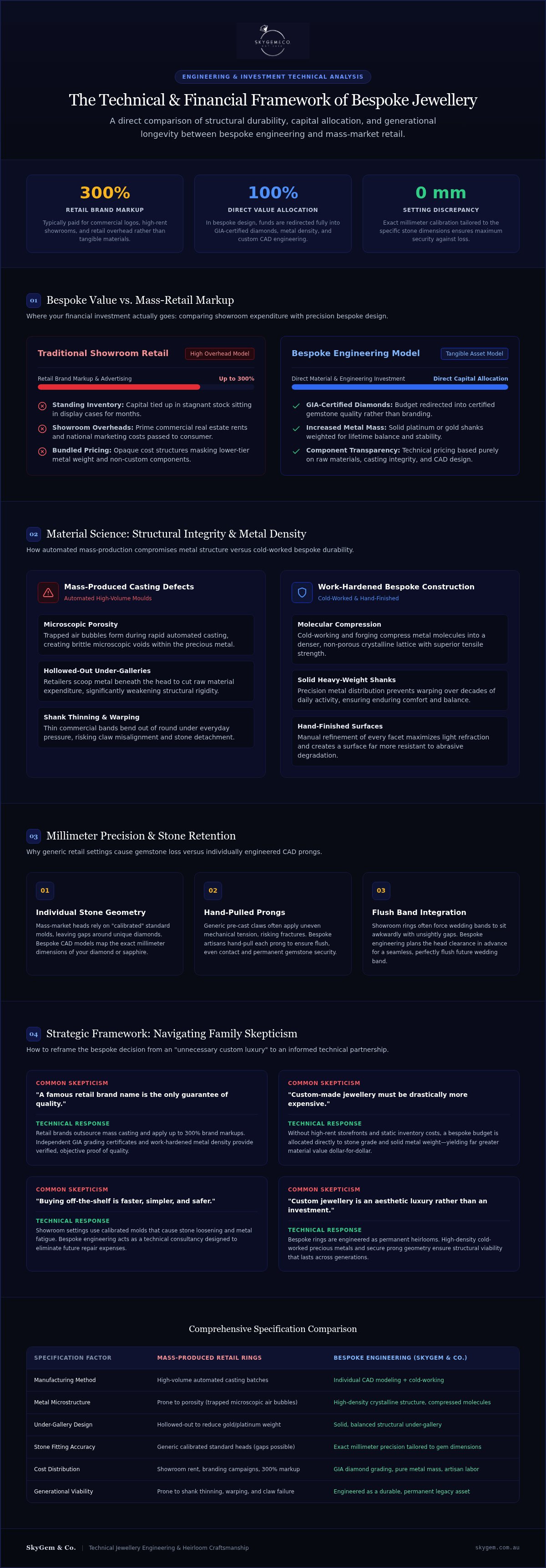
Mass-produced rings are typically created using high-volume casting moulds designed to fit "calibrated" stones. To save on costs, these settings often feature hollowed-out under-galleries and thinner bands. This high-speed manufacturing process can lead to "porosity," where microscopic air bubbles are trapped within the metal. Over time, porous metal is prone to cracking or warping, especially under the rigors of daily wear. When you choose a bespoke path, you're opting out of these compromises in favour of solid, reliable construction that withstands the test of time.
The Bespoke Design Philosophy
Intentional design means every millimetre of the ring is engineered to support the specific dimensions of your diamond or sapphire. Using advanced CAD technology, artisans at SkyGem & Co. provide mathematical precision that ensures the prongs are hand-pulled and the shank is weighted correctly for balance. This level of detail in bespoke engagement rings ensures that the piece isn't just beautiful today, but remains a stable asset for decades. Explaining the value of a bespoke ring to family becomes much easier when you highlight that this process is essentially a technical consultancy aimed at preventing future repair costs and stone loss.
The Technical Merits of Bespoke Craftsmanship
When you're explaining the value of a bespoke ring to family, the conversation often stays on the surface level of aesthetics. However, the true distinction lies in the invisible engineering that ensures a ring survives decades of daily activity without structural failure. Unlike mass-produced items, bespoke pieces utilise work-hardened metals and hand-finished components that are tailored to a specific gemstone. Hand-finishing is the manual refinement of every metal surface for maximum light return. This meticulous process ensures the metal isn't just a carrier for the stone, but a structurally sound asset that enhances the overall brilliance of the piece while resisting the microscopic wear that degrades commercial jewellery.
Structural Integrity and Metal Density
A primary technical advantage of bespoke manufacturing is the density of the precious metal. In high-volume retail, rings are often cast in large batches using automated processes, which can result in a lighter, more brittle structure. Bespoke pieces in platinum or high-karat gold are often cold-worked or hand-forged, a process that compresses the metal molecules to create a denser, more durable band. This increased density means the ring is far less likely to bend out of shape or suffer from the shank thinning that typically affects commercial pieces after only a few years of wear. For a deeper look at these material properties, you can review our Definitive Guide to Gold Jewellery to understand how purity and craftsmanship impact long-term investment value.
Precision Stone Setting and Security
Gemstone security is perhaps the most compelling argument for custom work. Retailers often use "standard" pre-cast heads designed to fit a range of stone sizes. This "close enough" approach can leave gaps or apply uneven pressure on the stone, significantly increasing the risk of loss. In a bespoke setting, the prongs are built specifically for the unique dimensions of your loose diamond or sapphire. By referencing the 4Cs of diamond quality, we ensure the setting respects the specific girdle thickness and depth of your stone. This precision fit requires less maintenance over the ring's lifespan, as the prongs don't need constant tightening to compensate for a poor fit. If you're ready to see how these technical details apply to your own design, consider booking a technical consultation to discuss your requirements with an expert.
Bespoke Value vs. Retail Markup: A Financial Comparison
Explaining the value of a bespoke ring to family requires a clear breakdown of where every Australian Dollar is actually going. In a traditional retail environment, a significant portion of the purchase price covers non-tangible costs like prime shopping centre leases, national marketing campaigns, and the insurance for sitting inventory. Research indicates that conventional luxury retailers routinely apply markups of 200% to 300% over the cost of materials. When you choose a bespoke model, those markups are eliminated. Your budget is instead allocated directly to the physical assets: the high-density metal and the certified centre stone. Over a 50-year lifespan, the price-per-wear of a structurally superior bespoke ring is significantly lower than a mass-produced piece that requires frequent prong repairs or shank replacements.
Eliminating the 'Brand Premium'
Large retailers often leverage brand prestige to obscure the actual market value of the materials used. By focusing on direct stone procurement, you gain access to competitive pricing for natural white diamonds without the "brand tax" added by luxury fashion houses. This transparency allows you to see the line-item cost for the stone and the labour separately, ensuring you aren't paying for a blue box or a famous logo. It's a more fiscally responsible approach that prioritises the quality of the diamond over the reputation of the retailer. This data-driven approach helps skeptical relatives understand that you're paying for tangible assets rather than corporate overhead.
Material Quality and Certification Standards
Family members often worry about the authenticity and long-term value of a custom purchase. This is why GIA certification remains the non-negotiable standard for trust in 2026. Following international FTC jewelry buying guidelines, we provide full disclosure on gemstone origin and quality metrics. While 61% of couples now choose lab-grown diamonds for their price efficiency, natural diamonds continue to hold a different market position for those prioritising traditional value retention. Our 2026 lab grown diamond guide details these market shifts, helping you provide your family with evidence that your choice is based on current market realities rather than marketing hype. By presenting these objective standards, you shift the conversation from personal taste to technical and financial logic.
A Communication Framework for Navigating Family Skepticism
Engaging with family members about a high-value purchase often brings unsolicited advice, especially when they're accustomed to traditional retail models. Common objections usually centre on the perceived convenience of "buying what's in the window" or the assumption that custom design carries a luxury premium. When you're explaining the value of a bespoke ring to family, it's effective to frame the conversation around your educational journey. By demonstrating that you've moved beyond surface-level aesthetics to understand metal density and stone security, you shift the narrative from an emotional impulse to an informed technical decision. You're not just buying jewellery; you're acting as a project manager for a long-term asset.
One of the most persuasive arguments involves the "Insurance and Maintenance" logic. While a mass-produced ring might have a lower entry price in A$, its long-term cost is often higher due to the structural compromises discussed earlier. A bespoke ring is a legacy asset engineered to withstand fifty years of wear, whereas a commercial piece often requires expensive shank replacements or prong retipping within a decade. By investing in a work-hardened, custom-fit setting now, you're effectively pre-paying for decades of durability and reducing the risk of losing a precious centre stone. This approach positions the purchase as a fiscally responsible choice that prioritises longevity over retail convenience.
Addressing the 'Price vs. Value' Objection
Family members often equate a lower upfront price with better value. You can counter this by applying the "buy once, buy well" philosophy. Explain that retail rings often use hollowed-out designs to save on metal costs, which leads to warping and stone loss. Using your GIA report as objective proof allows you to show that your budget has been allocated to the diamond's quality rather than a brand's marketing budget. This transparency provides a level of certainty that off-the-shelf products simply cannot match, making it easier for skeptical relatives to respect the logic behind the investment.
Framing the Ring as a Future Heirloom
Beyond the technical specs, a bespoke ring carries an emotional weight that a commercial commodity lacks. Because the design is unique to your partnership, it possesses a "story" that begins at the CAD stage and continues through generations. Invite your family into this process by explaining how specific design choices were made to ensure the ring could be passed down as a durable heirloom. When they understand that the piece is designed for multi-generational survival, the "extra" effort of the bespoke process becomes a clear advantage rather than a complication.
Designing Your Legacy with SkyGem & Co.
Choosing a bespoke path requires more than just a design vision; it demands a technical partner who prioritises your long-term success. At SkyGem & Co., we view the design process as a collaborative consultancy rather than a simple retail transaction. Having a professional advocate who can provide data-backed justifications for every component is invaluable. By arming you with technical data, we simplify the task of explaining the value of a bespoke ring to family members who may only see the price tag. We ensure that your decision is rooted in technical precision and material transparency, providing you with the confidence to defend your investment against traditional retail biases.
The Educational Consultation Process
Our approach centres on total transparency, starting with the procurement of the centre stone. We guide you through the complexities of the 4Cs and GIA standards, allowing you to inspect loose diamonds before they're ever placed in a setting. This level of involvement is a hallmark of our custom made engagement rings, ensuring you understand exactly what you're paying for. By separating the stone selection from the setting design, we eliminate the opaque "bundled" pricing common in showrooms. This methodical process ensures that when you discuss the ring with relatives, you can speak authoritatively about the specific performance metrics of your chosen diamond.
Tailoring to Your Specific Budget
Budgetary constraints shouldn't necessitate a compromise on structural integrity. We specialise in tailoring bespoke designs to specific financial requirements by strategically prioritising features that offer the best return on investment. For instance, choosing a lab-grown diamond can allow for a larger carat weight or a more intricate setting while maintaining a strict budget. Conversely, we can focus on high-purity natural stones for those who value traditional rarity. Our goal is to ensure that the final piece reflects your family’s values, making the process of explaining the value of a bespoke ring to family a matter of shared pride rather than defensive justification. We provide a clear roadmap from the initial CAD rendering to the final hand-finished setting, ensuring no hidden costs arise during production. This structured approach respects both your time and your investment, resulting in a piece that remains a permanent asset. Taking the first step toward your custom heirloom is a decision to prioritise quality over marketing hype.
Securing Your Family Legacy Through Technical Precision
Choosing a bespoke path is a strategic investment in structural longevity and financial transparency. By moving away from the high markups of traditional retail showrooms, you ensure your budget is allocated directly to tangible assets like GIA Certified Natural Diamonds and high-density metals. This approach prioritises technical CAD precision over mass-produced convenience, resulting in a piece that functions as a permanent household asset rather than a temporary purchase.
Ultimately, explaining the value of a bespoke ring to family is about demonstrating the difference between a retail commodity and a durable heirloom. You've transitioned from a passive consumer to an informed project stakeholder, ensuring that premium hand-finished settings protect your investment for decades to come. Armed with this technical framework and a solution-oriented mindset, you can move forward with the quiet confidence that your decision is both fiscally responsible and aesthetically superior.
We look forward to partnering with you to engineer a piece that reflects your exact standards and withstands the test of time.
Frequently Asked Questions
Is a bespoke ring always more expensive than one from a retail store?
A bespoke ring is not inherently more expensive than a retail alternative; in many cases, it offers better value for the same spend. By removing the costs associated with prime retail leases and standing inventory, a larger percentage of your A$ budget is directed toward the certified centre stone and metal weight. This direct-to-manufacturer model allows for higher-grade materials without the significant brand markups typically found in luxury shopping centres.
How do I explain the benefits of a custom ring to my parents?
When explaining the value of a bespoke ring to family, focus on structural longevity rather than just aesthetics. Explain that custom-fit settings are engineered to protect the gemstone specifically, whereas mass-produced rings use generic heads. Highlight that a bespoke piece is a permanent asset designed to survive fifty years of daily wear without the recurring repair costs often associated with thinner, cast-moulded retail bands.
Why is bespoke jewellery considered a better long-term investment?
Bespoke jewellery represents a superior long-term investment due to its work-hardened metal and precise engineering. Commercial rings often suffer from porosity or thinning shanks after a few years, leading to stone loss or warping. A bespoke setting is custom-built to the exact millimetre dimensions of the gem, ensuring maximum security. This technical precision reduces maintenance overhead and preserves the integrity of the piece as a multi-generational heirloom.
What are the technical advantages of a custom-designed setting?
The technical advantages include increased metal density and exact stone-to-setting calibration. Using advanced CAD technology, artisans engineer the ring to provide structural reinforcement in high-stress areas. Hand-finishing ensures that every surface is refined for maximum light return and durability. Unlike mass-produced settings that use hollowed-out galleries to save on gold, bespoke rings prioritise solid metal weight for a balanced, secure fit that resists bending.
Can I create a bespoke ring on a modest budget?
Yes, bespoke design allows for strategic budget allocation that isn't possible with ready-to-wear pieces. You can choose to prioritise a higher-grade setting for durability while selecting a lab-grown diamond or an Australian sapphire to manage costs. This flexibility ensures you don't compromise on craftsmanship. By working with a technical consultant, you can adjust specifications like metal purity or stone dimensions to meet your specific financial requirements without sacrificing structural quality.
How long does the bespoke design process typically take in 2026?
In 2026, the standard lead time for a bespoke engagement ring is typically four to six weeks. This timeframe includes the initial consultation, CAD design approval, gemstone procurement, and the final hand-finishing process. While retail purchases are immediate, this deliberate production schedule ensures that every structural element is meticulously checked. This duration reflects the precision required to create a custom-engineered piece that meets the highest regulatory and quality standards.
Is it better to choose a natural or lab-grown diamond for a bespoke ring?
The choice between natural and lab-grown diamonds depends on your priorities regarding tradition and price efficiency. Lab-grown diamonds currently cost up to 80% less per carat, allowing for a larger stone within the same budget. Natural GIA-certified diamonds remain the choice for those seeking traditional rarity and established market value. Both options are suitable for bespoke settings, provided they are accompanied by independent laboratory certification to verify their technical specifications.
What happens if my family doesn't agree with the cost of a bespoke ring?
If disagreements arise, provide a transparent breakdown of the component costs versus retail markups. Use your GIA report and CAD renderings to show that the investment is in tangible assets like high-density metal and certified gemstones. Explaining the value of a bespoke ring to family often succeeds when you shift from emotional arguments to technical data. Demonstrating that you're paying for engineering rather than marketing helps relatives view the purchase as a responsible, long-term decision.