
Fabricated Diamonds: A Guide to Lab-Grown Gems

If you placed a high-quality lab-grown gem alongside a mined stone, even a seasoned gemologist would require specialized spectroscopic equipment to identify the difference. This is because fabricated diamonds are not imitations; they're the result of peak human engineering that replicates the exact carbon-lattice structure found in nature. You've likely encountered a confusing array of industry jargon, ranging from "synthetic" to "simulant," which often obscures the technical reality of these stones. It's understandable to feel hesitant about purchasing a gem that might lack the longevity or brilliance of a traditional diamond.
We believe that transparency is the foundation of a successful bespoke project. This guide provides an unbiased, technical framework to help you navigate the modern Australian market with confidence. You'll discover the specifics of the HPHT and CVD creation processes, the implications of the updated 2025 GIA "Premium" and "Standard" grading categories, and how these stones offer a practical path to larger carats without compromising on structural integrity. By the end of this analysis, you'll have a clear understanding of how to evaluate a lab-grown stone as a permanent and evolving asset.
Key Takeaways
- Understand why fabricated diamonds are chemically and physically identical to mined stones, distinguishing them from inferior simulants like moissanite.
- Explore the technical precision of HPHT and CVD synthesis and how these methods replicate the natural formation process within a controlled environment.
- Confirm that lab-grown gems offer the same structural integrity as natural diamonds, both scoring a maximum 10 on the Mohs scale for hardness.
- Learn to apply the 4Cs and navigate the updated GIA grading categories to ensure the long-term quality and performance of your selection.
- Discover how to leverage the value of lab-grown stones in bespoke settings to achieve larger carat weights while maintaining high aesthetic standards.
What Are Fabricated Diamonds? Defining the Modern Lab-Grown Stone
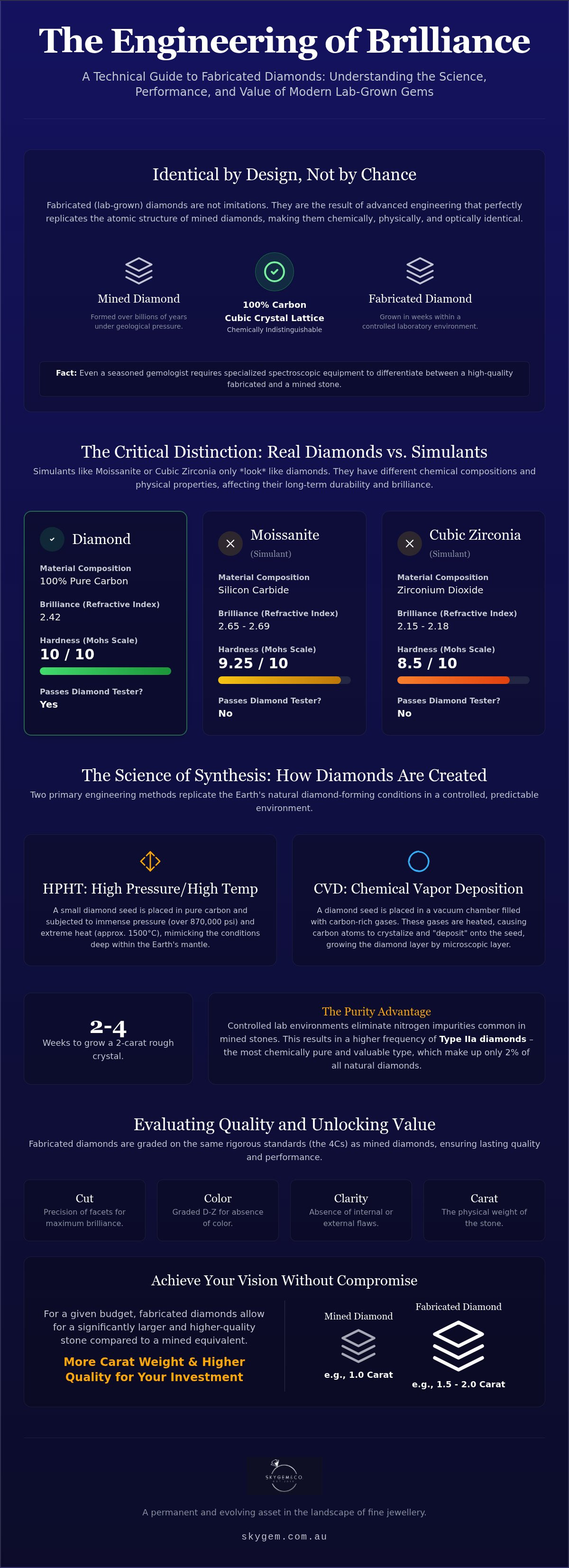
The term fabricated diamonds describes gemstones produced through high-level industrial synthesis. These stones aren't mere imitations; they consist of 100% carbon arranged in a cubic crystal structure. While the word "fabricated" might imply something artificial in common parlance, in the context of gemmology, it represents the precision of modern engineering. This nomenclature is gaining traction among technical specialists who want to emphasize the controlled growth environment over the uncontrolled geological processes of the Earth's mantle.
When we examine the technical landscape of What Are Fabricated Diamonds?, the focus remains on the chemical composition. These stones are physically and optically indistinguishable from their mined counterparts. For clients exploring bespoke jewellery options, understanding this distinction is the first step toward a confident purchase. You can view our curated range of lab-grown white diamonds to see how this engineering translates into aesthetic brilliance.
Fabricated vs. Simulant: Why Material Science Matters
It's vital to distinguish fabricated diamonds from simulants like cubic zirconia or moissanite. A simulant merely looks like a diamond but possesses entirely different physical properties. For example, a diamond has a refractive index of 2.42, which determines its characteristic fire and brilliance. Simulants often have different refractive indices and lower hardness ratings, making them prone to scratching or clouding over time.
Material science also explains why these stones pass standard "diamond testers." These devices typically measure thermal conductivity. Since a fabricated stone is pure carbon, it conducts heat in the exact same manner as a mined diamond. Simulants lack this property, which is why they're easily identified by even basic testing equipment. This reliability ensures that your selection retains its physical integrity and performance for a lifetime.
The Rise of Engineering in Fine Jewellery
The transition of diamond synthesis from industrial abrasive applications to the luxury market represents a significant milestone in material engineering. Modern "diamond foundries" now utilize high-pressure systems to create crystals that meet the rigorous standards of the Australian jewellery market. This shift allows for a level of consistency and purity that was previously difficult to achieve through traditional mining alone.
A fabricated diamond is a laboratory-grown carbon crystal with identical optical properties to natural diamonds. By focusing on the intersection of technical precision and aesthetic design, the industry has created a solution that meets both regulatory standards and consumer expectations for longevity. These stones are not a temporary trend; they are a permanent and evolving asset in the landscape of fine jewellery.
The Science of Synthesis: How Fabricated Diamonds Are Created
The production of fabricated diamonds relies on two distinct engineering pathways, each designed to simulate the extreme conditions of the Earth's mantle within a laboratory setting. Unlike the chaotic geological forces that formed natural stones billions of years ago, laboratory synthesis provides a streamlined and predictable thermodynamic environment. This precision allows engineers to produce a 2-carat rough crystal in approximately two to four weeks, a timeline that reflects the efficiency of modern material science. By focusing on the specific chemical triggers that force carbon atoms into a diamond lattice, the industry can now offer stones that meet the highest technical specifications.
One of the primary advantages of this controlled growth is the ability to manage chemical purity. In natural environments, nitrogen is abundant and often becomes trapped within the crystal structure, resulting in the yellow tints common in many mined stones. Laboratory environments allow for the purging of these atmospheric gases, which results in a higher frequency of Type IIa stones. These are the most chemically pure diamonds, representing only 2% of the world's natural supply. If you're interested in exploring how these high-purity stones appear in finished jewellery, you can view our technical range of lab-grown white diamonds.
HPHT (High Pressure High Temperature) Method
The HPHT method directly replicates the intense heat and pressure found approximately 150 kilometres below the Earth's surface. A small diamond "seed" is placed in a growth chamber alongside a carbon source and a metallic catalyst. The system is then subjected to pressures exceeding 5 GPa and temperatures reaching 1,500 degrees Celsius. As the metal melts, it dissolves the carbon, which then precipitates onto the seed to grow the crystal. While early HPHT stones occasionally exhibited a faint blue tint due to boron exposure, modern refinements in catalyst chemistry have largely eliminated this characteristic.
CVD (Chemical Vapour Deposition) Method
The CVD method, often referred to as the "plasma" method, utilizes a vacuum chamber and carbon-rich gases such as methane. A microwave beam ionises the gas into plasma, causing the carbon atoms to break free and settle onto a diamond substrate. The diamond grows layer by atomic layer, allowing for exceptional control over clarity and structural integrity. This method is highly favoured for creating high-clarity gems, as maintaining a stable vacuum environment prevents the introduction of unwanted structural defects. The precision involved in CVD synthesis ensures that fabricated diamonds possess the same optical and physical properties as those formed by nature.
Comparing Fabricated and Natural Diamonds: Performance and Value
The visual performance of a diamond is determined by its ability to manipulate light through refraction and dispersion. Because fabricated diamonds share the identical carbon-lattice structure of mined stones, their optical properties are indistinguishable. Both types of stones possess a refractive index of 2.417 and a dispersion rate of 0.044, which dictates the "fire" or spectral flashes visible to the human eye. Even under 10x magnification, a professional gemmologist cannot separate the two based on visual cues alone, as the brilliance and scintillation patterns remain identical.
Durability is another critical metric where these stones show total parity. Both natural and fabricated gems score a perfect 10 on the Mohs scale of mineral hardness. This makes them the hardest known material on Earth, capable of resisting scratches from almost any other substance. This structural integrity ensures that the stone remains a permanent asset, unaffected by daily wear or environmental exposure. In the Australian market, this technical reliability has made lab-grown options a staple for those seeking high-performance jewellery that adheres to modern regulatory standards.
The Value Proposition of Fabricated Stones
The primary advantage of choosing lab-grown gems lies in the pricing architecture of the modern market. Data from early 2026 indicates that the average price of a 1-carat lab-grown diamond has decreased by approximately 74% since 2020. This shift allows couples to allocate their budget toward higher colour and clarity grades that might be inaccessible in the natural market. For instance, a "Premium" GIA-graded stone with D colour and VVS clarity becomes a practical reality rather than a rare exception. You can explore these high-specification options in our collection of lab-grown white diamonds to see how this value translates into larger carat weights.
Resale and Long-term Sentiment
While the physical "forever" quality of a diamond is unchanged by its origin, the secondary market treats these stones differently. Natural diamonds historically retain a higher percentage of their initial cost, whereas fabricated diamonds have seen significant wholesale price depreciation as production technology scales. Industry reports from the second quarter of 2026 showed that wholesale prices declined by an average of 13% year-over-year. For many buyers, however, the value is found in the lived environment and the aesthetic impact of the piece rather than its potential as a liquid financial asset. Understanding the nuances of Natural vs Lab-Grown Diamonds is essential for aligning your purchase with your long-term financial and sentimental goals.
Selection Criteria: What to Look for in a Quality Fabricated Diamond
Evaluating fabricated diamonds requires the same rigorous attention to detail as natural stones, yet the technical priorities often shift. While the 4Cs (Cut, Colour, Clarity, and Carat) remain the industry standard, the accessibility of lab-grown gems means you shouldn't settle for anything less than an "Excellent" or "Ideal" cut grade. A superior cut is the primary driver of brilliance; it ensures that light enters the crown and reflects back to the eye rather than leaking through the pavilion. In the Australian market, selecting a stone with precise proportions is the most effective way to guarantee that your jewellery performs as well in the lived environment as it does under laboratory lights.
Technical precision doesn't end with the cut. You must also consider the presence of post-growth treatments. Some stones undergo additional HPHT annealing or irradiation after the initial synthesis to improve their colour or clarity. While these treatments are stable, a high-quality selection should ideally be "as-grown" to ensure the highest level of structural integrity. Engaging with a technical consultant can help you decipher these nuances and select a stone that serves as a permanent and evolving asset.
The Role of Certification (GIA and IGI)
Independent certification is the only way to verify the quality and origin of your gem. As of October 2025, the GIA has implemented a "Laboratory-Grown Diamond Quality Assessment" that categorizes stones as "Premium" or "Standard." To achieve a "Premium" classification, a stone must be D colour and VVS clarity or higher, with Excellent cut, polish, and symmetry. While the IGI remains the most popular authority for lab-grown stones due to its use of the traditional 4Cs scale, the GIA's new standards provide a clear benchmark for high-performance gems. Understanding GIA certification importance is vital for protecting your investment and ensuring that the laser inscription on the girdle matches the documentation provided.
Avoiding Common Pitfalls in Lab-Grown Stones
Lower-quality fabricated diamonds can exhibit specific technical defects that are often invisible to an untrained eye. In CVD-grown stones, rapid growth cycles can result in "strain lines" or "grain blocks," which are internal striations that can give the stone a hazy or blurred appearance. Conversely, HPHT stones sometimes display a "Blue Nuance," a faint blue tint caused by the presence of boron during the synthesis process. While these stones might appear "eye-clean" at first glance, these defects can impact the stone's long-term brilliance and light return. A professional consultation is essential for identifying these subtleties and ensuring your stone meets the highest aesthetic standards. If you're ready to begin your selection process, you can explore our options for a custom-made engagement ring tailored to your specific technical requirements.
Bespoke Design: Integrating Fabricated Diamonds into Fine Jewellery
The integration of fabricated diamonds into bespoke jewellery projects represents a shift toward high-performance, user-focused design. Because these stones are produced with industrial consistency, they're particularly well-suited for complex settings that require multiple stones of identical colour and clarity. In traditional mining, sourcing ten perfectly matched stones for a Halo Engagement Ring or a trilogy setting can be a significant logistical challenge. With lab-grown options, we can achieve a level of uniformity that enhances the overall symmetry and brilliance of the final piece.
This technical reliability also facilitates hybrid designs, where fabricated diamonds are used as accent stones alongside a natural centre stone. Since the carbon structure and refractive index are identical, there's no visual discrepancy between the two origins. This approach allows for a more efficient allocation of your budget, enabling the creation of intricate, multi-stone designs that might otherwise be cost-prohibitive. Our role at SkyGem & Co. is to source these specific stones, ensuring they meet the precise dimensions and quality grades required for your unique vision.
Crafting Your Custom Engagement Ring
Utilising CAD technology is a standard part of our consultation process, allowing you to visualise how your chosen stone interacts with the architecture of the ring. This digital precision is essential when balancing the proportions of larger carats within a bespoke engagement ring design. The choice of metal also plays a critical role in the stone's performance. For example, the high-purity white of a Type IIa lab-grown diamond is often best complemented by the neutral tone of Platinum or 18K White Gold, which prevents any warmth from reflecting into the crystal.
Beyond the Engagement Ring: Fine Jewellery Essentials
The benefits of lab-grown gems extend into everyday luxury items such as diamond tennis bracelets and pendants. Creating a cohesive look is simplified when you can match the technical specifications of your earrings to your primary ring. As the Australian jewellery industry moves toward a model of sustainable luxury, these stones are increasingly viewed as permanent and evolving assets. By focusing on quality over hype, you can build a collection of fine jewellery that adheres to the highest regulatory standards while delivering exceptional visual impact.
Advancing the Standard of Modern Jewellery Design
The evolution of the Australian gemstone market has established that fabricated diamonds are no longer a niche alternative but a primary choice for high-specification bespoke projects. By prioritising chemical purity and structural integrity, you ensure that your selection remains a permanent and evolving asset. Whether you're navigating the updated GIA grading categories or seeking the efficiency of a CVD-grown stone, the focus remains on technical precision and long-term viability. These stones provide a practical path to achieving significant carat weights without compromising the optical performance expected of a premium gem.
Our studio provides a collaborative environment where expert gemmological advice on the 4Cs meets the latest CAD technology. This allows you to visualise your design with absolute clarity before the production phase begins. With nationwide Australian shipping and technical support, we act as your consultant throughout the entire lifecycle of your project, ensuring a result that meets rigorous professional standards. Quality and performance should always take precedence over market hype.
Book a bespoke consultation to explore our curated fabricated diamonds and discover how industrial precision can elevate your next design. We look forward to partnering with you on a piece that balances aesthetic brilliance with engineering excellence.
Frequently Asked Questions
Are fabricated diamonds considered 'real' diamonds by jewellers?
Yes, they're chemically, physically, and optically identical to diamonds formed in the Earth's mantle. In 2018, the Federal Trade Commission (FTC) expanded the definition of "diamond" to include laboratory-grown stones, acknowledging that their carbon-lattice structure is indistinguishable from natural ones. Every professional gemmological authority treats fabricated diamonds as authentic gemstones rather than imitations or simulants.
Will a fabricated diamond ever get cloudy or change colour over time?
No, a high-quality lab-grown stone possesses the same permanent stability as a mined diamond. Because they score a 10 on the Mohs scale of hardness and share the same cubic crystal structure, they don't degrade, fade, or cloud when exposed to UV light or daily wear. Provided the stone is free from significant internal strain or poor growth cycles, its brilliance remains a permanent asset for the lifetime of the jewellery.
Can a diamond tester tell the difference between fabricated and natural stones?
Standard handheld diamond testers cannot distinguish between the two because they measure thermal or electrical conductivity, which is identical in both stones. Identifying a lab-grown origin requires advanced spectroscopic equipment found in gemmological laboratories. These machines detect minute growth patterns or trace elements that are only present in stones produced through HPHT or CVD synthesis.
Why is a fabricated diamond significantly cheaper than a mined one?
The pricing architecture reflects the efficiency of a modern, technology-driven supply chain rather than the high overheads of global mining operations. While the engineering required to produce fabricated diamonds is complex, the ability to create crystals in weeks reduces the scarcity that drives natural diamond prices. As of 2026, this allows for a more accessible entry point for high-carat, premium-grade stones.
What is the best certification for a fabricated diamond in Australia?
The GIA and IGI are the most reputable and widely used grading authorities in the Australian market. As of October 2025, the GIA uses a specific "Premium" and "Standard" assessment for lab-grown stones, while the IGI continues to provide detailed 4Cs grading. Both certificates ensure transparency regarding the stone's origin and technical specifications, providing a reliable framework for your purchase.
Do fabricated diamonds have the same sparkle and brilliance as natural ones?
Yes, the light performance is identical because the refractive index and dispersion rates are exactly the same. Brilliance is a function of the cut quality rather than the stone's origin. A lab-grown diamond with an "Excellent" cut grade will exhibit the same fire and scintillation as a natural diamond of the same grade, as both materials manipulate light in the same manner.
Can I use a fabricated diamond for a bespoke engagement ring?
Absolutely, lab-grown stones are ideal for bespoke projects because they offer greater flexibility within a specific budget. They're frequently used in solitaire, halo, and trilogy engagement rings, allowing for larger centre stones or higher clarity grades. Their industrial consistency also makes them excellent for matching side stones in complex custom settings where uniformity is a technical requirement.
What happens to the value of a fabricated diamond over time?
The value of a lab-grown stone is primarily found in its aesthetic performance and sentimental impact rather than its resale potential. While natural diamonds historically retain a higher percentage of their initial cost, fabricated stones have seen significant wholesale price depreciation as production technology scales. It's best to view these stones as a permanent lifestyle asset rather than a liquid financial investment.
Disclaimer
This article is for general informational purposes only and may include AI-assisted content. Pricing, specifications, and availability are subject to change. For accurate advice and current information, please contact SkyGem & Co. directly. Nothing in this content constitutes professional or financial advice.