
A Guide to Selecting Premium Jewellery Stores: The Melbourne CBD Standard

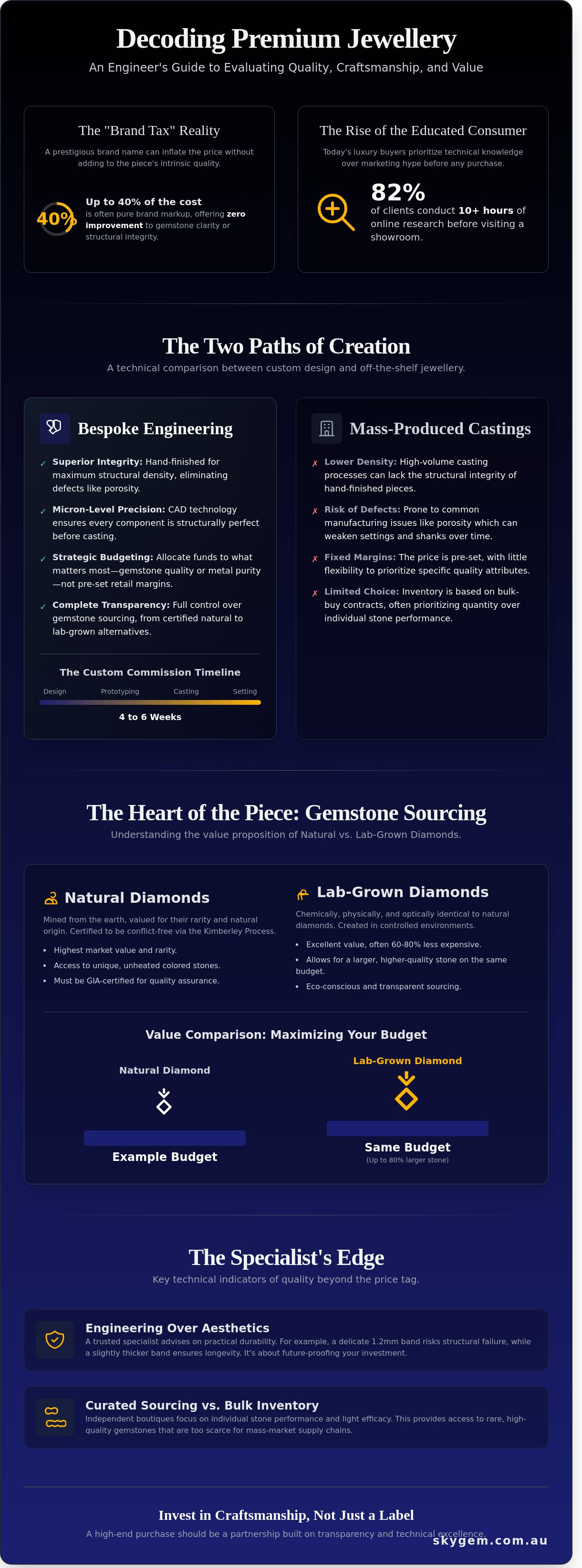
A prestigious brand name on a prominent storefront often accounts for up to 40% of a piece's final price, yet it provides zero improvement to the structural integrity or gemstone clarity of the item. You've likely felt the frustration of trying to discern whether you're paying for actual material quality or simply a glossy marketing campaign. When exploring premium jewellery stores, it's natural to feel uncertain about the technical differences between natural and lab-grown stones or the complexities of a bespoke design. We believe that a high-end purchase should be a partnership built on transparency and technical excellence rather than high-pressure sales tactics.
This guide provides a professional framework to help you evaluate premium retailers through the lens of engineering precision and gemstone provenance. You'll gain the confidence to distinguish between superior hand-forged settings and mass-produced casts while learning to navigate the value proposition of different gemstone types. We'll outline the exact milestones of a custom commission, ensuring your investment results in a durable, future-proof asset that meets the highest industry standards of craftsmanship.
Key Takeaways
- Understand why the most prestigious jewellery stores melbourne cbd have transitioned to an independent boutique model to preserve high-level artisanal standards.
- Evaluate the technical advantages of hand-finished bespoke design over mass-produced castings to ensure superior structural integrity and longevity.
- Navigate the complexities of gemstone sourcing by identifying the critical performance differences between unheated stones and GIA-certified natural diamonds.
- Identify key quality indicators, including how a stone’s cut impacts luminous efficacy and why specific metal selection is vital for future-proofing your piece.
- Discover how an education-first consultation model prioritises technical engineering and local design expertise over traditional high-pressure sales tactics.
The Evolution of Premium Jewellery Stores and the CBD Standard
Melbourne's central business district has served as the epicentre of Australian goldsmithing for over 150 years. The "CBD Standard" represents a benchmark where technical precision meets high-level artistry. The Evolution of Premium Jewellery demonstrates that while styles fluctuate, the requirement for metallurgical integrity remains absolute. Recent industry reports from 2023 indicate that 82% of luxury consumers conduct over 10 hours of online research before visiting a showroom. This shift has forced jewellery stores melbourne cbd to evolve from simple retail outlets into technical consultancies.
Physical boutiques now serve a critical role that online-only wholesalers cannot replicate. They provide a space for tactile verification of light performance and structural weight. In an era of digital transparency, the premier jewellery stores melbourne cbd are where technical data meets human-centric design. Clients don't just want a product; they want a partnership with a specialist who understands the rigours of the Australian lifestyle and the importance of future-proofing an investment.
The Role of the Trusted Specialist
Technical consultation now outweighs traditional sales tactics. It's no longer enough to show a diamond; a specialist must explain the intersection of architectural aesthetics and practical durability. For instance, a client might request a delicate 1.2mm band, but a trusted expert will explain why that thickness risks structural failure over time. This solution-oriented approach provides a turnkey experience. From the initial sourcing of raw materials to the final setting of a custom-made engagement ring in Melbourne, every step is governed by engineering-level precision.
Boutique Sourcing vs. Mass-Market Inventory
Curated gemstone selections differ fundamentally from mass-market inventory. While commercial chains rely on bulk-buy contracts that often prioritise quantity over clarity, independent jewellers focus on individual stone performance. These specialists often have exclusive access to rare, unheated gemstones that are too scarce for global supply chains. Choosing a local specialist ensures the piece is designed with Australian conditions in mind. It guarantees compliance with local metal purity standards and offers a level of artisanal detail that mass-produced items lack. This focus on quality over hype is what defines the modern Melbourne standard.
Bespoke Design vs. Ready-to-Wear: A Technical Comparison
Selecting a piece from jewellery stores melbourne cbd involves a critical choice between bespoke engineering and ready-to-wear convenience. While mass-produced castings are common in high-volume retail, they often lack the structural density found in hand-finished pieces. Bespoke manufacturing utilizes Computer-Aided Design (CAD) to achieve micron-level precision, ensuring every component is structurally sound before the metal is cast. This process eliminates common manufacturing defects like porosity, which can weaken the shank or settings over time.
The bespoke journey typically spans four to six weeks. This period accounts for initial design iterations, 3D printing of resin prototypes, casting in premium alloys, and the meticulous hand-setting of stones. This timeline ensures that every technical specification, from the height of the gallery to the thickness of the band, is optimized for the wearer's lifestyle.
Custom design allows for strategic budget allocation. Instead of paying for pre-set retail margins, clients can prioritise specific technical attributes, such as a higher metal purity or a specific diamond grade. Whether choosing natural diamonds, which must comply with the Kimberley Process Certification Scheme, or lab-grown alternatives, the bespoke route offers complete transparency. Lab-grown diamonds offer the same chemical and physical properties as natural stones but often at a 60% to 80% lower price point, allowing for larger carat weights within a fixed A$ budget.
The Bespoke Manufacturing Process
Modern precision relies on CAD to create a digital twin of the ring. This technology identifies potential structural weaknesses before production begins. Once cast, hand-finishing becomes the critical stage. Expert jewellers perform prong tightening and surface polishing to ensure long-term security. For a detailed look at this technical journey, explore our custom engagement rings Melbourne service. This approach ensures the final product is a durable asset rather than a fragile accessory.
Ready-to-Wear Collections
Ready-to-wear collections serve those requiring immediate acquisition without compromising on technical standards. These pieces undergo rigorous quality control to verify metal purity and stone stability. When browsing engagement rings, look for independent certifications from GIA or IGI. This ensures the technical specifications meet international benchmarks for brilliance and durability. If you're comparing options among jewellery stores melbourne cbd, consider how a tailored approach might better serve your long-term requirements. You can start by viewing our diamonds online Melbourne database to understand current market availability.
Ethical Sourcing: Navigating Natural Diamonds and Coloured Gemstones
Selecting a gemstone involves understanding the technical specifications that dictate both aesthetic beauty and long-term resale value. For those visiting jewellery stores melbourne cbd, the distinction between unheated and treated stones is the most critical value driver to master. Heat treatment is a standard industry practice, applied to roughly 95% of sapphires and rubies to enhance their colour and clarity. While these stones are genuine, unheated specimens that possess natural saturation are significantly rarer. These stones command a premium because they remain exactly as they were pulled from the earth, representing a finite geological miracle.
GIA certification serves as the non-negotiable benchmark for natural diamonds. It provides an objective, third-party audit of a stone's 4Cs: carat, colour, clarity, and cut. Without this documentation, buyers lack a technical guarantee of the diamond's origin and quality. This transparency is vital in the Australian market, where consumers increasingly prioritise the traceability of their investment pieces.
Coloured Gemstone Expertise
The rarity of unheated rubies makes them a standout for investment-grade collections. Most rubies undergo lead-glass filling or high-heat treatment to mask inclusions, but a natural, untreated ruby with high chromatic saturation is exceptionally scarce. Buyers should explore the full spectrum of gemstones, spanning from the cool tones of aquamarine to the colour-shifting properties of alexandrite.
Origin plays a decisive role in gemstone valuation. Ceylon sapphires from Sri Lanka are historically prized for their cornflower blue hues, yet there's a significant shift toward Australian-sourced stones. Local teal and peach sapphires have seen a 30% increase in demand over the last three years. These Australian gems offer unique bi-colour zoning and a harder mineral composition, making them ideal for daily wear in engagement rings. Emeralds and rubies require a different lens; for these, the focus is on "eye-clean" clarity and the presence of specific "garden" inclusions that prove natural origin without compromising structural integrity.
Diamond Transparency
The rise of lab-grown diamonds has introduced a new tier of cost-efficiency into the Melbourne market. These stones possess the same chemical and physical properties as mined diamonds but are produced in controlled environments. They offer a high level of technical efficacy for buyers who want a larger aesthetic impact for a lower initial spend. However, GIA certified natural diamonds remain the preference for those seeking a store of value. Natural diamonds have a historical track record of price stability that synthetic alternatives haven't yet established. To understand the shifting market dynamics, read our Lab Grown Diamonds: The 2026 Comprehensive Australian Buying Guide. Whether you choose a natural or lab-grown centre stone, the objective should always be a balance of light performance and ethical peace of mind. Many jewellery stores melbourne cbd now offer both options, allowing for a direct side-by-side comparison of brilliance and fire.
Technical Indicators of Quality in High-End Jewellery
When evaluating high-value assets at jewellery stores melbourne cbd, technical specifications dictate long-term performance and aesthetic stability. Luminous efficacy in a gemstone refers to the efficiency with which a stone returns light to the eye. While many buyers prioritise carat weight, the cut grade is the primary driver of visual impact. A diamond with an "Excellent" cut grade ensures that light enters through the table and reflects off the pavilion facets rather than leaking through the bottom. This precision creates a superior brightness that often makes a technically smaller stone appear more impressive than a larger, poorly cut counterpart.
Metal selection requires a similar engineering mindset. Platinum and 18K white gold are the industry standards for durability, yet they behave differently under mechanical stress. Platinum is a dense, ductile metal. When it's scratched, the metal is displaced rather than lost, creating a "patina" over time. White gold is an alloy that achieves its silver-white finish through rhodium plating. This coating requires maintenance every 12 to 24 months to restore its original lustre. For those seeking maximum structural integrity, 18K gold provides a balanced ratio of purity and hardness, making it ideal for daily wear in the Australian climate.
Metallurgy and Craftsmanship
Precision in the setting process involves careful thermal management. Excessive heat during manufacturing can induce stress in the metal or cause microscopic fractures in sensitive gemstones. High-end craftsmanship ensures that prongs are uniform and the metal density is consistent, avoiding the porosity often found in mass-produced cast pieces. To understand the relationship between metal composition and durability, read The Definitive Guide to Gold Jewellery: Purity, Craftsmanship, and Investment Value.
The 4Cs and Beyond
The cut remains the most critical of the 4Cs because it's the only human-controlled factor. Beyond the basic grade, professionals examine symmetry and fluorescence. Symmetry affects the alignment of facets, which determines the "crispness" of the light return. While fluorescence can cause a hazy appearance in roughly 3% of diamonds, it's often used strategically to improve the perceived colour of stones in the I-M range. Reading a GIA report like a technical professional involves checking the table percentage, which should ideally sit between 53% and 58% for round brilliant diamonds to ensure optimal light dispersion.
Future-proofing your investment requires a proactive maintenance schedule. Statistics indicate that over 65% of stone losses are preventable through biannual prong inspections. Identifying "red flags" in commercial-grade jewellery is essential for any serious buyer. Look for thin bands that measure less than 1.5mm at the base, as these are prone to warping. Avoid settings where the stone's girdle is exposed to direct impact or where the prongs appear unevenly spaced, as these are indicators of poor structural design.
Ensure your next acquisition meets these rigorous technical standards. Consult with our specialists on custom engagement ring design in Melbourne.
SkyGem & Co.: Australian-Led Design for a National Clientele
SkyGem & Co. operates at the intersection of metallurgical engineering and historic boutique elegance. While many jewellery stores melbourne cbd focus on high-volume transactions, our studio prioritises technical precision and an education-first methodology. We've removed high-pressure sales tactics, replacing them with 60-minute consultative sessions that empower clients to understand the structural integrity of their chosen metals. As an independent, family-owned firm, we maintain a level
Elevating Your Standard for Bespoke Excellence
Navigating the landscape of jewellery stores melbourne cbd requires a discerning eye for technical specifications and ethical provenance. A truly premium acquisition is defined by more than its initial brilliance; it relies on the structural durability of the mounting and the precision of GIA certified diamond grading. By prioritising Australian-led design and independent family-owned values, you ensure your investment is supported by local accountability and expert craftsmanship. Our methodology integrates precise CAD design with meticulous hand-finished detailing to create pieces that function as both artistic expressions and enduring assets.
SkyGem & Co remains committed to transparency in every facet of the design process. Whether you're assessing the saturation levels of rare coloured gemstones or the architectural integrity of a custom setting, our team provides the technical data required for an informed decision. We invite you to experience a consultation process that values engineering precision as much as aesthetic beauty. Book a Technical Consultation for Your Bespoke Engagement Ring and begin the journey toward a piece that reflects your highest standards. We look forward to engineering a legacy piece that you'll value for a lifetime.
Frequently Asked Questions
What should I look for when comparing jewellery stores in the Melbourne CBD?
When evaluating jewellery stores in the Melbourne CBD, prioritize establishments that demonstrate technical proficiency in metallurgy and CAD design. Look for retailers that provide transparent documentation regarding alloy compositions and ethically sourced materials. A reputable boutique should offer a consultative approach, ensuring that your choice aligns with both aesthetic goals and long-term durability standards required for the Australian climate.
Is a bespoke engagement ring more expensive than a ready-made one?
Bespoke engagement rings don't necessarily carry a higher price tag than mass-produced alternatives. Costs depend on material selection, gemstone quality, and the labour hours required for precise fabrication. By opting for a custom build, you eliminate the overhead costs associated with holding finished inventory, often allowing for a more efficient allocation of your budget toward higher grade metals or larger stones.
What is the difference between a lab-grown diamond and a natural diamond?
Lab-grown and natural diamonds share identical chemical, physical, and optical properties, both scoring 10 on the Mohs scale of hardness. The distinction lies in their origin; natural stones formed over billions of years, while lab diamonds are created using CVD or HPHT technology in weeks. Both possess a refractive index of 2.417, making them indistinguishable without specialized spectroscopic equipment used by gemological laboratories.
Why is GIA certification important for my diamond purchase?
GIA certification provides an objective, third party assessment of a diamond's quality based on the 4Cs. This report ensures you're receiving a stone that meets specific technical benchmarks for colour, clarity, cut, and carat weight. Without this independent verification, buyers risk purchasing misgraded stones, which can lead to significant discrepancies in the asset's market value and long-term insurance replacement costs.
How long does the custom jewellery design process typically take?
The custom design process generally requires 4 to 8 weeks from the initial consultation to final delivery. This timeline accounts for CAD rendering, 3D printing of wax models, precision casting, and hand-setting of stones. More complex architectural designs or the sourcing of rare coloured gemstones may extend this period by 14 to 21 days to ensure structural integrity and aesthetic precision.
Do you offer repair and maintenance for rings not purchased at your boutique?
We provide comprehensive repair and maintenance services for all high-quality jewellery, regardless of its origin. Our technicians conduct a thorough structural assessment to identify issues like thinning bands or loose claws before proceeding with any work. Regular maintenance, including professional cleaning and prong tightening every 12 months, is essential for future-proofing your investment and preventing the loss of valuable gemstones.
What are the most popular coloured gemstones for engagement rings in 2026?
Teal sapphires and forest green tourmalines are projected to lead the market in 2026, with an estimated 35 percent increase in consumer inquiries for these specific hues. These stones offer a Mohs hardness of 7 to 9, making them suitable for daily wear in Australia. Peach morganite and salt-and-pepper diamonds also remain popular choices for those seeking a distinct architectural aesthetic that diverges from traditional colourless options.
Can I select my own loose gemstone for a bespoke setting?
Selecting a loose gemstone is a critical step in the bespoke process, allowing for a direct inspection of the stone's performance under various lighting conditions. This approach ensures the setting is engineered specifically to the stone's unique dimensions and pavilion depth. By choosing your gem first, you can verify its photometric properties and ensure the final piece achieves optimal light return and structural balance.
Disclaimer
This article is for general informational purposes only and may include AI-assisted content. Pricing, specifications, and availability are subject to change. For accurate advice and current information, please contact SkyGem & Co. directly. Nothing in this content constitutes professional or financial advice.