
Diamond Earrings: The 2026 Australian Buyer’s Guide to Quality and Style

By 2026, the Australian diamond market has shifted so significantly that a high clarity grade on a laboratory report no longer serves as a reliable proxy for visual brilliance. You've likely encountered the widening price gap between lab-grown and natural stones, which often complicates the selection process for high-quality diamond earrings. It's understandable to feel overwhelmed by technical jargon like fluorescence or scintillation, particularly when you want to ensure your investment delivers maximum light performance rather than a dull finish. We approach this choice as a technical consultation, focusing on the intersection of mineralogical excellence and aesthetic precision.
This guide provides the professional framework needed to master the nuances of stone selection for lasting value. You'll learn exactly which of the 4Cs to prioritise for earrings, as the viewing distance and mounting style require a distinct technical strategy compared to an engagement ring. We'll also examine the protocols for verifying ethical origins and local compliance within the current Australian regulatory environment. This methodical analysis ensures you gain the confidence to select a pair that achieves peak brilliance through informed, data-driven decision-making.
Key Takeaways
- Understand why diamond earrings serve as a foundational asset in a curated jewellery collection, focusing on how specific light-catching properties enhance facial aesthetics.
- Learn to prioritise technical specifications, such as cut precision and symmetry, to ensure maximum light return and long-term value in your selection.
- Evaluate the structural integrity and security of various earring silhouettes, from the engineering of Alpha locks to the aesthetic impact of different drop lengths.
- Apply a professional selection framework to match earring geometry with your specific face shape, ensuring a balanced aesthetic that complements your unique features.
- Discover the advantages of Australian-led bespoke design and the necessity of sourcing ethically mined stones to ensure a responsible and permanent investment.
Beyond the Sparkle: Why Diamond Earrings are a Foundational Investment
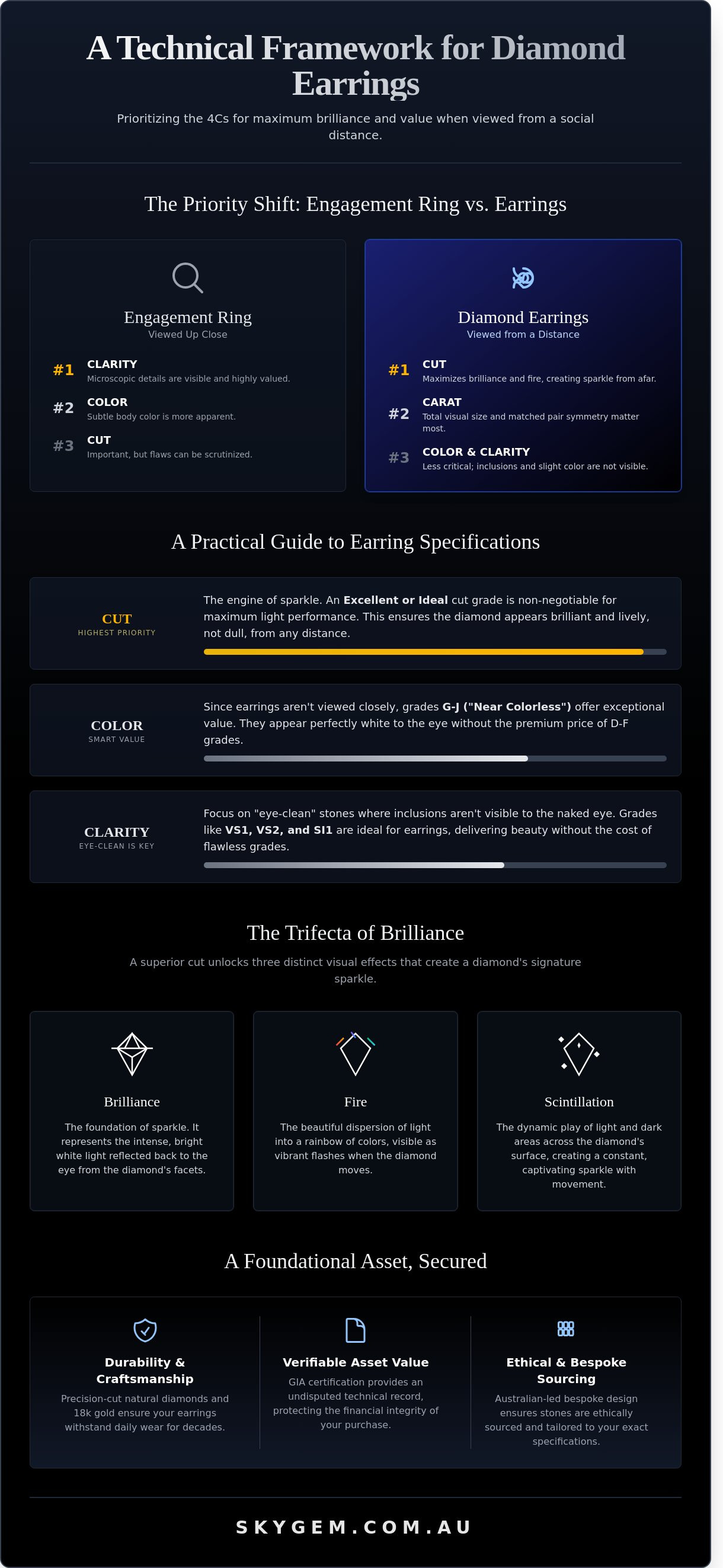
Diamond earrings represent a technical cornerstone in any curated jewellery collection. Unlike an engagement ring, which serves as a singular, static focal point, earrings provide a bilateral frame for the face. They utilise light-catching scintillation to enhance the wearer's natural features through constant motion. This psychological impact is deeply rooted in the specific diamond gemstone properties, particularly the high refractive index of 2.417 and the dispersion that allows stones to perform under varied Australian lighting conditions, from harsh midday sun to dimmed evening environments.
Mass-produced fashion jewellery often fails to meet the rigorous standards required for long-term wear. These pieces typically rely on base metals and low-grade stones that lose their lustre within 12 to 24 months. In contrast, high-fine jewellery utilizes 18k gold and precision-cut stones, ensuring the piece remains a durable asset. Evaluating diamond earrings requires a different mindset than selecting a bridal ring. While a ring is viewed closely by the wearer, earrings are observed from a distance and in motion. Consequently, the priority shifts toward matching the pair's face-up size and light return symmetry rather than focusing solely on microscopic internal characteristics.
The Versatility of the Diamond Stud
The classic solitaire stud is the most versatile configuration for a professional wardrobe. These pieces transition seamlessly from high-stakes boardroom environments to formal evening events. If you analyse the cost-per-wear over a 10-year period, a pair of high-quality diamond earrings proves more economical than seasonal fashion purchases. It's vital to select a metal that complements your specific skin tone to maximise the visual impact. You can explore these technical nuances in The Definitive Guide to Gold Jewellery.
Future-Proofing Your Jewellery Wardrobe
Investing in natural GIA certified diamonds ensures long-term asset retention. A GIA report provides a verifiable technical record of the stone's quality, which is essential for insurance valuations and future heritage transfers. Selecting timeless styles, such as the round brilliant or emerald cut, helps your collection remain relevant as fashion cycles fluctuate. Bespoke design offers a higher level of personal resonance than off-the-shelf options. This approach allows for precise control over the setting's architecture, ensuring the earrings are balanced for comfort and maximum light exposure.
- Durability: 18k gold and natural diamonds withstand daily wear for decades.
- Symmetry: Expertly matched pairs create a balanced visual frame.
- Asset Value: GIA certification protects the financial integrity of the purchase.
The Technicals: Evaluating Diamond Quality and Light Performance
Selecting diamond earrings requires a shift in technical priority compared to selecting a stone for an engagement ring. While a ring is often inspected at close range, earrings are primarily viewed in motion and from a distance. This makes "Cut" the most critical of the 4Cs. A diamond with an Excellent or Ideal cut grade ensures that the stone reflects the maximum amount of light back to the observer, maintaining its presence even in low-light environments. Precision in the cutting process determines how the stone handles light through three distinct channels: brilliance, fire, and scintillation.
Brilliance is the foundation of a diamond's appearance, representing the total white light reflected from the crown. Fire refers to the dispersion of that light into a spectrum of vivid colours, while scintillation describes the flashes of light and the pattern of dark and light areas visible as the wearer moves. For earrings to remain impactful, these three elements must be balanced through superior symmetry and polish. Symmetry ensures that the facets are aligned to bounce light internally with mathematical precision, while polish removes surface imperfections that might otherwise scatter light and reduce overall luminous efficacy.
The Australian environment introduces a specific technical variable: UV exposure. In Melbourne, where the UV index frequently reaches levels above 11 during summer, diamond fluorescence becomes a vital consideration. Fluorescence is the glow a diamond emits under ultraviolet light. While a "Faint" rating is often negligible, "Strong" blue fluorescence can interact with intense Australian sunlight to make a diamond appear hazy or milky, effectively dulling its visual output. Technical buyers should verify how a stone performs in natural light conditions before finalising a purchase.
Natural vs. Lab-Grown Diamonds for Earrings
Modern engineering allows for the creation of lab-grown diamonds that are chemically, physically, and optically identical to those mined from the earth. The primary technical difference lies in the growth morphology, which is only detectable using specialised laboratory equipment. For many clients in the Melbourne market, lab-grown stones offer a cost-effective solution to prioritise carat weight and cut quality within a fixed budget. Natural stones remain the choice for those valuing geological rarity and long-term asset stability. Every natural stone sourced by SkyGem & Co. adheres to The Kimberley Process Certification Scheme, ensuring that the technical beauty of the stone is matched by ethical procurement standards.
The Importance of Certification
Technical specifications are only as reliable as the laboratory that verifies them. For significant purchases, insist on grading reports from the GIA or IGI. These documents provide a definitive blueprint of the stone's dimensions, clarity characteristics, and light performance metrics. When purchasing pairs, the certification process is essential for matching. We look for stones with identical table percentages and crown angles to ensure the loose gemstones perform symmetrically when worn. This precision ensures that one earring does not appear "darker" than its counterpart due to slight variations in facet alignment. To explore our current inventory of certified stones, you can view our selection of diamonds online in Melbourne to find a perfectly matched pair.
Anatomy of Style: Comparing Studs, Hoops, and Drop Earrings
Selecting the ideal pair of diamond earrings requires an understanding of how geometry influences light return and wearer ergonomics. The structural silhouette of an earring dictates how it interacts with ambient light; studs offer a concentrated point of brilliance, while hoops and drops utilize movement to create dynamic flashes. From an engineering perspective, the security of the piece is as critical as its aesthetic. High-value earrings often utilize Alpha locks, which feature a spring-loaded mechanical trigger that provides superior retention compared to standard butterfly clips. While butterfly clips rely on friction and can loosen over a 12 to 24 month period of daily use, Alpha locks offer a fail-safe connection that’s essential for larger carat weights.
The setting style significantly impacts the perceived diameter of the stone. A bezel setting, which encircles the diamond in a thin rim of metal, can make a stone appear 10% to 15% larger by extending the visual perimeter. However, this comes at the cost of lateral light entry. In contrast, prong settings elevate the stone, allowing light to enter through the pavilion and maximize the refractive index. Balancing this brilliance with comfort is a matter of metallurgical precision. 18k gold has a density of approximately 15.5 grams per cubic centimetre; therefore, larger designs must be hollowed or strategically tapered to ensure they don't cause earlobe fatigue during 10 to 12 hours of continuous wear.
The Solitaire Stud: Pure Minimalism
Solitaire studs are the foundation of any collection, but the choice between a 3-prong and 4-prong setting is more than aesthetic. The 3-prong "martini" setting allows the diamond to sit lower and closer to the earlobe, reducing the "droop" often seen with heavier stones. A 4-prong basket setting provides a more architectural, square profile and increased protection for the stone’s girdle. For those looking to coordinate their aesthetic, many clients choose to align their stud settings with their bespoke engagement rings to create a cohesive visual language. We recommend a total carat weight of 0.50ct to 1.00ct for daily professional environments in Melbourne, as this provides a noticeable presence without compromising comfort.
Hoops and Drops: Architectural Movement
Modern diamond hoops often utilize an "inside-out" setting technique. This specific engineering placement ensures that diamonds are visible on the front exterior and the rear interior, ensuring sparkle is visible from every viewing angle. When selecting drop earrings, the pivot point is the most critical component. A well-engineered drop should have a fluid hinge that prevents the earring from tangling in hair or catching on clothing. To create a truly unique piece, consider integrating Australian sapphires into the drop design. This adds a layer of tonal complexity and local heritage to the architectural movement of the diamond earrings, resulting in a piece that functions as both a technical achievement and a personal statement.
The Selection Framework: Matching Diamonds to Face Shape and Occasion
Selecting the ideal pair of diamond earrings requires a technical understanding of how light and geometry interact with human features. It's not merely about the individual beauty of the stones; it's about structural balance. You must evaluate how the earring's silhouette contrasts with your jawline to create a harmonious visual profile. For instance, individuals with square jawlines benefit from rounded edges that soften angular features, while those with rounder profiles often require linear elements to provide verticality.
Metal selection serves as the foundational substrate for your diamonds. Your choice of 18ct white gold, yellow gold, rose gold, or platinum should be dictated by skin undertones rather than fleeting trends. Cool undertones typically align with the crisp reflectance of platinum or white gold. Warm undertones are best served by the rich saturation of 18ct yellow gold. This tonal compatibility ensures the jewellery enhances the wearer's natural complexion rather than competing with it.
Styling for Face Shapes
Precision in diamond shape selection influences how a face is framed. Round faces gain a sense of elongation from drop earrings, which draw the eye downward. Conversely, heart-shaped faces find balance through studs or designs that are wider at the base to fill the space near a tapered chin. The choice between a Round Brilliant cut, known for its high-intensity light return, and an Emerald cut, valued for its architectural lines, will significantly alter the facial aesthetic. You might also consider how a gold necklace can provide a secondary focal point to complete a cohesive ensemble.
Occasion-Based Selection
The functional application of diamond earrings dictates their technical specifications. For wedding day requirements, the design should maintain aesthetic continuity with the engagement ring to ensure a unified bridal look. In a professional Melbourne CBD environment, a "Goldilocks" size of 0.50ct to 1.00ct total carat weight provides a sophisticated presence without being intrusive. For milestone gifting, such as a 10th anniversary or a graduation, the longevity of the piece is paramount. Selecting high-clarity stones ensures the gift remains a permanent asset in a personal collection.
The final step in the framework involves verifying the "match" of the two stones. Diamonds are natural products; no two are identical. A specialist must evaluate the pair for optical symmetry, ensuring the colour grade and facet alignment are virtually indistinguishable to the naked eye. This rigorous matching process is what separates commercial-grade sets from investment-quality jewellery.
Ready to find your perfect pair? Consult with our Melbourne diamond specialists to ensure your selection meets the highest standards of symmetry and style.
The SkyGem & Co. Advantage: Bespoke Craftsmanship and Ethical Sourcing
Choosing an independent Melbourne boutique offers a level of technical oversight that mass-market retailers cannot replicate. At SkyGem & Co., we approach the creation of diamond earrings as a precision engineering project rather than a simple retail transaction. Every stone we source is verified as conflict-free and ethically mined, adhering to the Kimberley Process and rigorous ESG standards. This commitment ensures your jewellery aligns with modern ethical expectations without compromising on aesthetic quality.
Our technical consultants focus on maximising the refractive performance of your stones. By prioritising cut quality over raw carat weight, we help you achieve a higher visual impact within your specific budget. We don't just sell gems; we provide a consultancy service that balances light physics with architectural setting design to ensure your investment retains its value and brilliance over time.
Our Bespoke Design Process
We begin every custom project with a conceptual consultation to define the architectural requirements of the setting. Using advanced CAD (Computer-Aided Design) software, we create a digital twin of your earrings. This allows for sub-millimetre precision in prong placement and metal distribution, ensuring the structural integrity of the piece. For diamond earrings, achieving perfect symmetry is vital. We meticulously match pairs for colour, clarity, and physical dimensions to ensure a balanced visual profile from every angle. While custom work is our specialty, you can also explore our ready-to-ship collection for designs that are available for immediate acquisition.
Long-Term Maintenance and Care
High-performance jewellery requires periodic technical assessment to maintain its structural integrity and visual output. We recommend a professional inspection every 12 months to check for prong wear and stone security, preventing the loss of high-value diamonds. Our cleaning services utilize specialised equipment to remove environmental contaminants that diminish the stone's ability to refract light. We define luminous efficacy as the measure of light output relative to the diamond’s cut quality. Regular maintenance ensures this efficacy remains at its peak, protecting the luminous performance of the stones. This proactive approach mirrors the maintenance schedules used in high-end architectural systems, ensuring your earrings remain a permanent and evolving asset.
- Technical Precision: Every setting is engineered for maximum light entry.
- Ethical Assurance: 100% conflict-free diamonds sourced through verified channels.
- Symmetry Calibration: Expert matching of stones to ensure visual equilibrium.
- Local Expertise: Designed and finished in Melbourne to meet Australian quality standards.
Securing Your Investment for 2026 and Beyond
Selecting the right pair of diamond earrings in the 2026 market requires a balance of technical precision and personal aesthetic. High-performance diamonds, verified by GIA standards, ensure that your investment maintains its brilliance and value over decades. It's essential to prioritize light performance metrics and structural integrity over carat weight alone. Whether you're considering the stability of a classic stud or the architectural flow of bespoke drop earrings, the focus should remain on long-term durability and ethical traceability. SkyGem & Co. provides the technical framework needed for these decisions through our expert GIA-certified diamond consultations. We maintain a commitment to transparent pricing and ethical sourcing, ensuring every piece meets rigorous Australian standards for quality. Our bespoke design services allow you to move beyond mass-produced options to create a permanent asset tailored to your specific requirements. We're dedicated to providing the engineering excellence and architectural aesthetics your collection deserves.
Explore our curated collection of Diamond Earrings and Bespoke Designs
We look forward to partnering with you to find a piece that reflects both your style and your standards for quality.
Frequently Asked Questions
Which diamond cut is best for earrings?
The Round Brilliant cut is the optimal choice for diamond earrings because of its 58-facet structure designed for maximum light return. This specific geometry ensures that over 90% of entering light reflects back through the table, creating superior brilliance. While Princess and Emerald cuts offer unique architectural aesthetics, the Round Brilliant remains the industry standard for optical performance and visual impact in Melbourne.
Is it better to buy lab-grown or natural diamonds for earrings?
Choosing between lab-grown and natural diamonds involves balancing budget with long-term asset value. Lab-grown diamonds share the same chemical and physical properties as natural stones, including a refractive index of 2.417. They currently retail for approximately 60% to 80% less than natural diamonds. Natural stones, however, maintain a finite supply which historically supports their resale value in the Australian secondary market.
What is the most secure backing for expensive diamond earrings?
Screw backs and La Pousette locking mechanisms provide the highest level of security for high-value jewellery. Screw backs utilise a threaded post that requires the backing to be rotated until it sits flush against the earlobe. La Pousette backs feature a dual-trigger pressure system that locks into a specific groove on the post. These precision-engineered solutions prevent accidental loss during physical activity or garment changes.
How many carats should a diamond stud be for daily wear?
For daily wear, a total carat weight (CTW) between 0.50 and 1.00 is the most practical specification for Australian professionals. A 0.50 CTW pair provides a diameter of approximately 4.1mm per stone, offering a subtle yet professional aesthetic. Industry statistics show that 65% of buyers select 1.00 CTW for its ideal balance of visibility and comfort during extended ten-hour workdays.
Can I customise diamond earrings with other gemstones like sapphires or rubies?
Customising diamond earrings with sapphires or rubies is a common practice for those seeking a bespoke architectural look. Sapphires and rubies both rank 9 on the Mohs scale of mineral hardness, making them durable enough for daily integration alongside diamonds. Incorporating these stones allows for a tailored colour palette that can reflect personal branding or specific project milestones while maintaining structural integrity.
What is the difference between 9ct and 18ct gold for earrings?
The primary difference lies in the gold purity and structural density of the alloy. 18ct gold contains 75% pure gold, whereas 9ct gold contains only 37.5%. For earrings, 18ct gold is the preferred technical choice because its higher gold content is less likely to cause dermatological reactions. It also offers a richer, more authentic lustre that doesn't tarnish as quickly as 9ct alternatives.
How do I clean my diamond earrings at home safely?
You can safely clean your jewellery at home using a solution of warm water and mild, ammonia-free detergent. Soak the earrings for 20 minutes to break down accumulated oils and debris. Use a soft-bristle brush to gently clean around the setting's prongs where dust often collects. This simple maintenance routine ensures the diamond earrings maintain their intended optical performance without the need for abrasive chemicals.
Do diamond earrings hold their value over time?
High-quality natural diamonds generally retain a higher percentage of their initial purchase price compared to other luxury assets. Market data from the last 30 years shows that GIA-certified diamonds have historically maintained a steady value due to their scarcity. While they shouldn't be viewed as a high-yield liquid investment, their physical durability ensures they remain a stable store of value within a diversified portfolio of physical assets.
Disclaimer
This article is for general informational purposes only and may include AI-assisted content. Pricing, specifications, and availability are subject to change. For accurate advice and current information, please contact SkyGem & Co. directly. Nothing in this content constitutes professional or financial advice.