
Alexandrite Birthstone: Guide to June's Rare Color-Change Gem

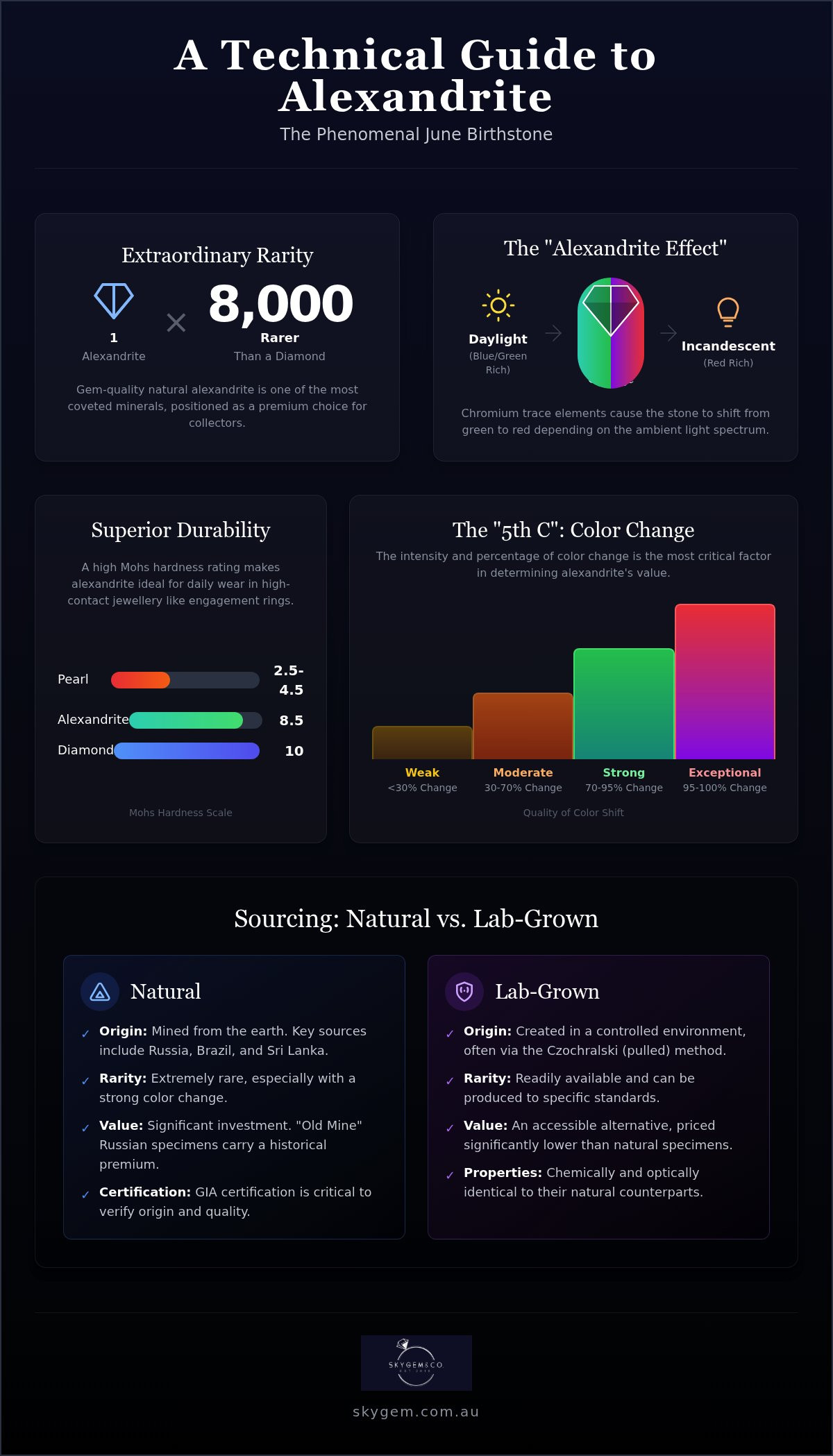
Did you know that gem-quality natural alexandrite is approximately 8,000 times rarer than a white diamond? This extraordinary scarcity makes the alexandrite birthstone one of the most coveted yet misunderstood gems in the world. While many are captivated by its legendary "emerald by day, ruby by night" transformation, there is often significant confusion regarding the vast price disparities between natural specimens and lab-grown alternatives. You may also feel uncertain about how to accurately judge a colour-change percentage through a digital screen or whether such a rare mineral can withstand the rigours of daily wear.
We understand that selecting a gemstone of this calibre requires more than just an appreciation for its beauty; it demands a technical understanding of its physical properties and market value. This guide serves as your professional consultant, providing the precision needed to master the technical nuances of June’s most mysterious gem. You'll learn to identify the specific 4Cs that dictate value, explore the science behind the "Alexandrite Effect," and gain the confidence required to commission a bespoke piece. We will examine why its 8.5 Mohs hardness rating makes it a superior choice for long-term viability in high-end jewellery design, ensuring your investment remains a permanent and evolving asset.
Key Takeaways
- Learn why the alexandrite birthstone is prized as the colour-change variety of chrysoberyl, offering a unique alternative to traditional June options like pearl or moonstone.
- Understand the technical "Alexandrite Effect," where chromium trace elements cause the stone to shift from green in daylight to red under incandescent light.
- Master the evaluation process by focusing on the intensity and percentage of colour change, often considered the most critical "5th C" for this specific gemstone.
- Discover how the 8.5 Mohs hardness rating ensures long-term durability for daily wear, making it a viable and high-performing choice for bespoke engagement rings.
- Navigate the significant price and value differences between GIA-certified natural specimens and lab-grown alternatives created via the Czochralski method.
What is Alexandrite? (June’s Rare Color-Change Gem)
Alexandrite, a variety of chrysoberyl, is defined by its remarkable ability to change colour under different light sources. This optical phenomenon makes it a unique entry in the mineral world. While diamonds and sapphires are prized for their brilliance and saturation, alexandrite offers a dynamic experience. It is the modern alexandrite birthstone for June, sharing the month with pearls and moonstones. However, its rarity is on a different scale entirely. Gem-quality natural specimens are roughly 8,000 times rarer than white diamonds, positioning it as a premium choice for collectors and those seeking high-performance bespoke designs.
The stone's dual nature suggests a sense of balance and adaptability. In many cultural contexts, this shift from green to red represents a transition between physical and spiritual states. It's often associated with good fortune, reflecting the stone's own ability to thrive and transform in changing environments. This symbolism, paired with its technical scarcity, makes it a compelling alternative for those who find traditional birthstones too common or delicate.
The History and Origin of the 'Tsar’s Stone'
Discovery of this mineral dates back to the 1830s in the Ural Mountains of Russia. It was named after Tsar Alexander II, as the discovery reportedly coincided with the future ruler's coming of age. The stone's specific hues held deep political significance at the time. The vibrant greens and reds mirrored the military colours of Imperial Russia, cementing its status as a royal gem. While the original Russian mines are largely exhausted, the transition to modern sources in Brazil and Sri Lanka has allowed for a continued supply of high-quality natural alexandrite gemstones. These newer deposits often provide stones with excellent clarity, though the "Old Mine" Russian specimens still carry a significant historical premium among investors.
Why Alexandrite is the Ultimate Alternative Birthstone
For those born in June, the choice often falls between the traditional pearl and the modern alexandrite. While pearls are classic, they are exceptionally fragile with a Mohs hardness of 2.5 to 4.5. In contrast, the alexandrite birthstone boasts a hardness of 8.5, making it far more suitable for daily wear in engagement rings or high-contact jewellery. It appeals to individuals who value technical precision and "phenomenal" optical properties over conventional aesthetics. Alexandrite is a chrysoberyl variety that exhibits a distinct colour change in different lighting. This durability, combined with its rare optical profile, ensures the piece remains a long-term asset rather than a delicate heirloom.
The Science Behind the Alexandrite Color Change
The transformation seen in an alexandrite birthstone is an optical phenomenon known as the "Alexandrite Effect." This isn't a mere surface reflection but a complex interaction between the stone's chemical composition and the light spectrum. At a molecular level, chromium trace elements replace aluminium in the chrysoberyl crystal lattice. These chromium ions create a specific absorption band in the yellow region of the visible light spectrum. Because the human eye is highly sensitive to green and red, the stone appears to "shift" depending on which part of the spectrum the ambient light source favours.
According to the Gemological Institute of America (GIA), the quality of this shift is the primary determinant of the stone's value. A high-performance specimen will exhibit a distinct, 100% colour change with no muddy secondary tones. This technical precision is what separates investment-grade gems from commercial-grade stock. If you're looking to evaluate a specific stone's performance, you can book a technical consultation to view these shifts under controlled lighting conditions.
The Role of the Light Spectrum
Daylight and fluorescent light are rich in blue and green wavelengths. When an alexandrite birthstone is viewed in these environments, typically above 5000 Kelvin, the stone's lattice allows the green spectrum to dominate, resulting in the "emerald" appearance. Conversely, incandescent light sources, such as candlelight or traditional tungsten bulbs, are skewed toward the red end of the spectrum (approximately 2700 Kelvin). Under these warm conditions, the stone absorbs the limited blue-green light and reflects the abundant red wavelengths, revealing raspberry or purplish-red hues. Testing a stone across this Kelvin scale is essential, as modern LED lighting can sometimes mask the true intensity of the transition.
Pleochroism vs. Colour Change
It's vital to distinguish between the Alexandrite Effect and pleochroism. While colour change depends on the light source, pleochroism is an internal property where the crystal shows different colours when viewed from different angles. Alexandrite is trichroic, meaning it can exhibit green, orange, and purple-red hues along its three optical axes. Expert cutters must meticulously orient the rough stone during the faceting process to ensure the most vibrant colours face upward. A poorly oriented cut can result in a stone that looks "dead" or fails to show its full phenomenal potential, regardless of the light source. This intersection of mineralogy and lapidary skill is what makes a well-cut alexandrite a true masterpiece of technical design.
Evaluating Value: The 4Cs of Alexandrite Gemstones
When assessing an alexandrite birthstone, the traditional 4Cs of diamond grading are insufficient. While cut, clarity, and carat weight remain relevant, they're secondary to what experts call the "5th C": the colour change. The formation of these crystals requires rare geological conditions where beryllium and chromium interact, a process that occurs far less frequently than the formation of diamonds or sapphires. This scarcity dictates that the primary value driver is the percentage and intensity of the colour shift. A stone that maintains high saturation in both daylight and incandescent light is technically superior to one that appears dull or "muddy" in either environment.
Carat weight presents a significant challenge for collectors and designers. Most natural alexandrite crystals are found in small sizes, typically under 0.50 carats. Once a specimen exceeds the 1.00-carat threshold, the price per carat doesn't just increase; it jumps exponentially. This reflecting the extreme difficulty in sourcing large, eye-clean rough that also possesses a top-tier colour shift. Finding a high-clarity stone over two carats is a rare event in the professional gemstone market, often necessitating a long-term sourcing strategy.
Grading Color Change:
The Gemological Institute of America grades the colour shift based on how complete the transformation is. A "faint" shift might only show a slight hue change, whereas a "strong" shift represents a 70% to 100% transition. The ideal colour shift is one that is vivid and complete without muddy undertones. Desirability is highest for stones that move from a crisp bluish-green to a distinct purplish-red or "raspberry" hue. While many stones in the commercial market are heat-treated, unheated alexandrite specimens are the gold standard for investment, as they represent the stone’s optical properties in their purest, unaltered state.
Cut, Clarity, and Carat Weight Price Scaling
Clarity expectations for alexandrite are unique. They are typically "cleaner" than emeralds, which are almost always included, but they're often more included than fine sapphires. Small silk-like inclusions or needles are common. However, if these inclusions are too dense, they can interfere with the transmission of light and dull the colour shift. Understanding the grading standards for precious gemstones helps buyers recognise that a slightly included alexandrite may still be more valuable than a clean one if the colour change is superior. Cutters generally prefer oval or cushion shapes because these deep facets help concentrate the colour and maximise the face-up "phenomenal" effect that defines the stone.
Designing with Alexandrite For Durability and Bespoke Jewellery Settings
Alexandrite's physical properties make it a standout choice for high-performance jewellery. With a Mohs hardness of 8.5, the alexandrite birthstone is one of the most durable coloured gems available, surpassed only by diamonds and sapphires. This level of hardness is essential for rings intended for daily wear, as it resists the abrasions and scratches that often dull softer stones. When designing a piece, the choice of metal is a critical technical decision. Platinum or white gold settings act as a neutral backdrop that emphasises the stone's cool, blue-green daylight hues. Conversely, yellow or rose gold can warm the incandescent red shift, making the "ruby" side of the gem appear more saturated.
The structural design must also prioritise light interaction to ensure the colour change remains vivid. Because this shift is an optical phenomenon, an open-back setting is often required to allow maximum light to pass through the pavilion facets. Expert orientation is equally vital; the stone must be set to align its most pleochroic axes with the viewer's line of sight. Choosing bespoke jewellery design ensures that the orientation and setting style are tailored to the specific optical profile of your individual stone.
Book a technical design consultation
Alexandrite Engagement Rings
The alexandrite birthstone has surged in popularity for those seeking non-traditional engagement rings. It offers a sophisticated alternative to the standard diamond solitaire while maintaining the durability required for a lifetime of wear. To enhance the stone’s naturally deep tones, many designers pair it with side diamonds. The colourless brilliance of diamonds provides a high-contrast frame that makes the alexandrite's colour shift appear even more dramatic. For a detailed look at the commissioning process and how to select the right mounting for a phenomenal gem, you can refer to our guide to bespoke jewellery.
Protecting Your Investment
Maintaining the long-term viability of an alexandrite piece requires specific care protocols to protect the crystal lattice. While the stone is hard, it can still be sensitive to thermal shock or high-pressure impacts if it contains specific internal inclusions. We recommend the following care steps:
- Avoid ultrasonic cleaners for stones with visible internal features, as vibrations can occasionally expand existing fractures.
- Use warm, soapy water and a soft brush for routine cleaning to maintain the stone's surface brilliance.
- Ensure the piece undergoes regular professional inspections to verify that the prongs remain secure.
A custom-fitted setting is superior for protecting the girdle of the stone, which is the most vulnerable point for chipping during accidental impact. This solution-oriented approach to design ensures your gemstone remains a permanent and secure asset.
Natural vs. Lab-Grown Alexandrite: Price & Value Comparison
The market for the alexandrite birthstone is defined by a significant divergence in value between earth-mined specimens and laboratory creations. As of May 2026, fine-grade natural alexandrite commands between $10,000 and $25,000 per carat, while investment-grade stones with a vivid, near 100% colour shift often exceed $40,000 per carat. In contrast, lab-grown alexandrite produced via the Czochralski method typically retails for $300 to $600 per carat. This price disparity reflects the extreme geological scarcity of natural chrysoberyl. While lab-grown stones are chemically and optically identical to their mined counterparts, they lack the historical and resale value associated with earth-mined gems. Selecting between the two depends on whether your priority is accessible aesthetic performance or long-term asset value.
Technical precision is required when identifying true alexandrite from "simulants." Many low-cost items marketed as lab alexandrite are actually synthetic corundum infused with trace elements to mimic a colour change. These simulants often cost as little as $10 to $50 per carat but do not possess the 8.5 hardness or specific refractive index of true chrysoberyl. For natural stones, a GIA or reputable laboratory certification is non-negotiable. This documentation verifies the stone's origin and confirms that the colour-change phenomenon is natural rather than the result of undisclosed treatments.
The Rarity of Natural Alexandrite
Natural alexandrite is often a superior investment to white diamonds due to its 8,000-fold greater rarity. The scarcity of large, eye-clean stones in the global market was highlighted in July 2026, when a 14.74-carat Brazilian specimen sold at auction for approximately $32,740 per carat. Such specimens are exceptionally rare, as most natural rough yields stones under one carat. For those weighing the ethical and financial implications of mined versus created gems, our buying guide for lab-grown stones provides a detailed comparison of market ethics and value retention. While lab-grown options offer a conflict-free and high-clarity alternative, the natural alexandrite birthstone remains the definitive choice for collectors seeking a finite geological masterpiece.
The Sourcing Process at SkyGem & Co.
We act as technical consultants during the procurement process, ensuring each client finds a stone that aligns with their specific colour-shift preferences. Some individuals prefer a dominant teal-to-raspberry shift, while others seek the classic emerald-to-ruby transition. Our sourcing network prioritises transparency and ethical standards, providing unheated alexandrite that has been vetted for both optical performance and structural integrity. We treat each gemstone acquisition as a partnership, focusing on the long-term viability of the piece within a bespoke setting.
Explore our collection of alexandrite gemstones or book a consultation to discuss your specific design requirements.
Securing Your Legacy with a Phenomenal Gemstone
Choosing an alexandrite birthstone represents a commitment to both technical excellence and geological rarity. We've explored how its chromium-rich lattice creates the legendary colour shift and why its 8.5 Mohs hardness provides the long-term viability required for bespoke engagement rings. Whether you prioritise the investment value of a natural GIA-certified specimen or the accessible brilliance of a lab-grown stone, understanding these nuances is essential for a successful acquisition.
As an independent family-owned boutique, we act as your technical consultants throughout the design process. Our expertise in sourcing rare, unheated alexandrite ensures that your custom piece is not just a purchase; it's a permanent asset built on transparency and precision. We focus on technical education to help you identify the highest performance metrics in every stone. This solution-oriented approach guarantees that your jewellery meets both your aesthetic goals and rigorous quality standards.
Design your bespoke alexandrite piece with SkyGem & Co.
We look forward to helping you translate these technical specifications into a masterpiece that reflects your unique vision and endures for generations.
Frequently Asked Questions
Is alexandrite rarer than a diamond?
Natural alexandrite is significantly rarer than a diamond. Gem-quality specimens are approximately 8,000 times rarer than white diamonds due to the specific geological conditions required for their formation. While diamonds are found in various locations globally, fine alexandrite deposits are incredibly limited. This scarcity makes the alexandrite birthstone a premier choice for collectors and individuals seeking a high-value, non-traditional gemstone that offers both technical interest and long-term investment potential.
Can alexandrite be used for an engagement ring?
Alexandrite is an excellent choice for an engagement ring because of its high durability. It ranks 8.5 on the Mohs scale, making it one of the hardest gemstones available for daily wear. This hardness ensures the stone resists scratching and maintains its brilliance over time. We recommend bespoke settings that protect the girdle of the stone while allowing enough light to enter the pavilion, ensuring the colour-change phenomenon remains the central focus of the design.
What light makes alexandrite change colour?
The colour change is triggered by the balance of wavelengths in different light sources. Daylight and fluorescent light are rich in blue and green wavelengths, which the stone reflects to appear green or teal. Incandescent light, such as candlelight or warm LED bulbs, contains more red wavelengths. Because the chromium in the crystal lattice absorbs yellow light, the alexandrite birthstone shifts to a purplish-red or raspberry hue when moved from cool to warm lighting environments.
Is lab-grown alexandrite a 'real' alexandrite?
Lab-grown alexandrite is considered 'real' in a technical sense because it possesses the same chemical, physical, and optical properties as mined chrysoberyl. Created using methods like the Czochralski process, these stones are chemically identical to their natural counterparts. However, they are distinct from 'simulants' like colour-change sapphire or glass. While lab-grown options provide a high-clarity, high-performance alternative for jewellery, they lack the geological history and resale value associated with natural, earth-mined specimens.
How much does a 1-carat natural alexandrite cost?
Natural alexandrite prices are determined by the quality of the colour shift. Commercial-grade stones with duller tones typically range from $3,000 to $6,000 per carat. Fine-grade specimens with strong transitions are valued between $10,000 and $25,000 per carat. Extra-fine or investment-grade stones with vivid shifts can reach over $40,000 per carat. These values reflect the stone's extreme scarcity, especially when specimens exceed the significant 1.00-carat weight threshold.
Does all alexandrite change colour perfectly?
The quality of the colour change varies significantly between individual stones. A 'perfect' shift is defined by a vivid, 100% transition between primary hues without muddy or grey secondary tones. Many stones in the commercial market only exhibit a moderate shift of 50% to 70%. When evaluating an alexandrite birthstone, the intensity and completeness of this shift are the primary value drivers, often outweighing clarity or carat weight in professional grading assessments.
How do I clean my alexandrite jewellery at home?
To clean your jewellery at home, use warm water mixed with a mild, non-abrasive detergent. Gently scrub the stone and setting with a soft-bristled brush to remove accumulated oils or dust. It's best to avoid ultrasonic or steam cleaners if your stone has internal inclusions, as high-frequency vibrations can potentially stress the crystal structure. For long-term maintenance, we suggest professional cleaning and prong inspections to ensure your gemstone remains a permanent and secure asset.
Disclaimer
This article is for general informational purposes only and may include AI-assisted content. Pricing, specifications, and availability are subject to change. For accurate advice and current information, please contact SkyGem & Co. directly. Nothing in this content constitutes professional or financial advice.