
10 Critical Mistakes to Avoid When Buying a Diamond: The 2026 Technical Guide

A diamond is less of a romantic symbol and more of a precision-engineered asset where performance is dictated by light physics and structural integrity. You likely recognize that a significant investment requires more than a cursory glance at a grading report, especially as 2026 brings complex shifts in certification standards and new EU Due Diligence regulations. It's easy to feel overwhelmed by conflicting data or the fear of overpaying for a stone that lacks true brilliance. This technical guide identifies the most critical mistakes to avoid when buying a diamond, providing the clarity needed to secure a stone with maximum light performance and long-term structural viability.
We'll move beyond marketing hype to analyze the specific metrics that define a high-quality acquisition. You'll learn how to evaluate the widening price gap between natural and lab-grown stones, why the GIA's new classification system for lab-grown diamonds matters, and how to verify the structural soundness of a bespoke setting. By the end of this analysis, you'll have the technical confidence to ensure your purchase remains a permanent and high-performing asset.
Key Takeaways
- Prioritise cut precision over carat weight to ensure maximum light performance and avoid the "carat trap" where stones appear smaller than their weight suggests.
- Learn to identify the most common mistakes to avoid when buying a diamond by understanding the hierarchy of gemological laboratories like GIA and IGI.
- Assess the engineering of a ring setting to ensure its structural integrity is sufficient for long-term durability and daily wear.
- Distinguish between the chemical identity and the evolving market value of natural versus lab-grown stones to align with your investment objectives.
- Move beyond transactional discounts by seeking a technical consultation that focuses on performance metrics rather than marketing illusions.
Overlooking Cut Quality in Favour of Carat Weight
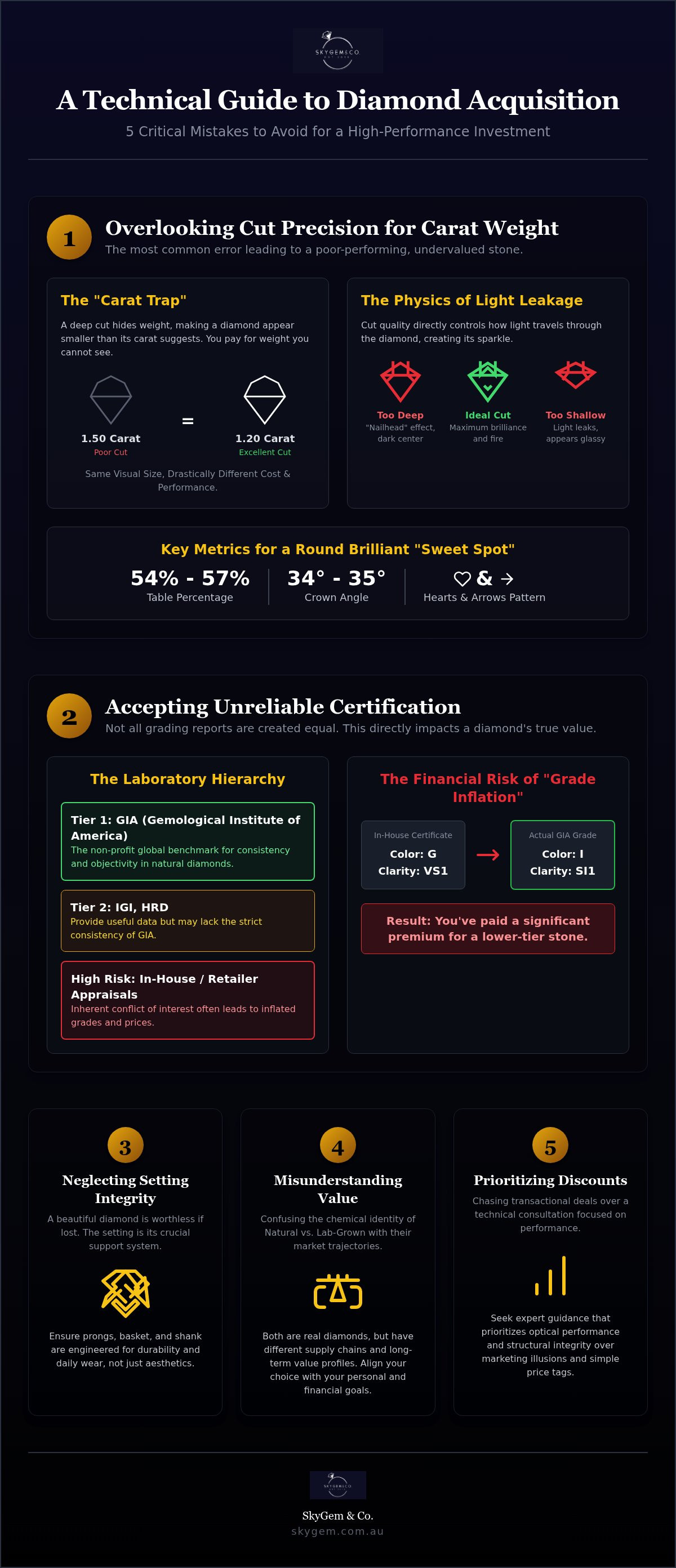
The most pervasive of the mistakes to avoid when buying a diamond is the tendency to prioritize carat weight over cut precision. This often leads buyers into the "Carat Trap," where a stone carries significant mass but lacks the physical dimensions to project it. A diamond with a deep cut hides its weight in the pavilion, resulting in a 1.50-carat stone that possesses the face-up diameter of a well-proportioned 1.20-carat stone. You're effectively paying for weight that remains invisible once the stone is set. Precision engineering is what transforms a rough crystal into a high-performance asset.
Technical performance is determined by the relationship between specific angles and percentages. For a round brilliant, a table percentage between 54% and 57% combined with a crown angle of 34 to 35 degrees represents the industry "sweet spot." While many retailers market "Triple Excellent" stones as the pinnacle of quality, this GIA grade is actually a broad category. It serves as a baseline rather than a ceiling. Within that grade, there's a wide variance in light performance metrics, specifically brilliance (white light return), fire (spectral flashes), and scintillation (the play of light during movement). Understanding Diamond gemstone properties is essential for identifying which stones actually maximize these optical effects.
The Physics of Light Leakage
When a diamond is cut too shallow, light strikes the pavilion facets at a low angle and exits through the bottom of the stone instead of reflecting back to the crown. Conversely, a cut that's too deep creates a "nailhead" effect, where the center of the diamond appears dark and lifeless because light is lost through the sides. To ensure optical symmetry, we look for a "Hearts and Arrows" pattern. This visual phenomenon confirms that all 57 or 58 facets are aligned with extreme precision, ensuring that light is managed efficiently across the entire volume of the stone.
Balancing the 4Cs for Maximum Value
Investing in a superior cut allows you to be more flexible with other specifications without sacrificing the visual impact of the piece. A perfectly cut stone can mask slight tints in natural white diamonds or hide small inclusions, allowing you to select "eye-clean" stones that offer better value than internally flawless alternatives. Light performance is the efficient return of light to the observer’s eye. By focusing on this metric, you ensure your budget is directed toward the stone's actual performance rather than laboratory paper grades that don't translate to real-world beauty.
Accepting Secondary Certification or In-House Grading
Securing a high-performance stone requires more than just a piece of paper; it requires a certificate from a laboratory with a proven record of objective rigor. One of the most expensive mistakes to avoid when buying a diamond is accepting a secondary or in-house grading report as fact. While a certificate might look official, the standards applied vary significantly between institutions. For natural stones, the Gemological Institute of America (GIA) remains the industry benchmark. Other labs like IGI or HRD provide useful data, but their grading metrics often lack the conservative consistency found at GIA.
The risk of "in-house" grading is particularly high. When a jeweler issues their own certificate, they face an inherent conflict of interest. They're effectively grading their own inventory to maximize its perceived value. This lack of neutrality often leads to grade inflation, where a stone is assigned a higher color or clarity rating than an independent lab would allow. This isn't just a technical discrepancy; it's a financial one. A diamond graded as "G" color on a secondary certificate might only achieve an "I" grade at GIA, meaning you've paid a premium for a lower-tier asset. Without a neutral third-party audit, you don't have a reliable way to verify your investment's true specifications.
Why GIA is the Global Industry Benchmark
GIA operates as a non-profit research and educational organization, which isolates its graders from the commercial pressures of the retail market. This independence ensures that a grade assigned in 2026 holds the same weight and meaning as one assigned a decade ago. Every report includes a unique identification number often laser-inscribed on the diamond's girdle. You can easily verify these details through the GIA online database to ensure the stone matches its documentation. For those seeking long-term security, focusing exclusively on natural GIA certified diamonds is the most reliable way to mitigate risk.
Reading the Fine Print on a Grading Report
A grading report is a technical map of a stone's internal and external characteristics. You must look beyond the 4Cs and examine the "Comments" section carefully. Notes like "clarity enhanced" or "laser drilled" indicate treatments that significantly reduce the stone's market value and structural integrity. Similarly, the presence of strong fluorescence can make a diamond appear "milky" or hazy in certain UV conditions, even if the color grade is high. Always study the plot diagram to distinguish between surface-level blemishes and internal inclusions that might threaten the stone's durability over time.
If you're evaluating a specific stone and feel unsure about its technical specifications, a consultation with a specialist can provide the clarity you need. You can explore our selection of engagement rings to see how certified stones are integrated into high-quality, professional designs.
Neglecting the Structural Integrity of the Finished Setting
While much of the focus in diamond acquisition remains on the stone, the engineering of the mounting is equally critical. One of the subtle mistakes to avoid when buying a diamond is neglecting the structural integrity of the finished setting in favor of a minimalist aesthetic. Daily-wear jewelry is subjected to significant mechanical stress; it's not a static museum piece. High-quality settings must balance the visual desire for thin lines with the physical necessity of metal volume to prevent deformation or stone loss. Structural integrity ensures the diamond remains secure through decades of mechanical stress.
Mass-produced cast settings often suffer from porosity, a condition where microscopic bubbles are trapped within the metal during the cooling process. This weakens the structure. In contrast, hand-finished or precision-engineered pieces utilize denser metal that offers superior resistance to fatigue. When comparing materials, platinum is technically more durable than 18K gold because it's more ductile. While gold can wear away over decades of friction, platinum tends to displace rather than shed mass. This makes it a more permanent choice for a lifetime asset, particularly in the demanding Australian climate where active lifestyles are common.
Prong Engineering and Stone Security
The "Thin Band" trend has popularized bands under 1.8mm, but these often lack the cross-sectional area to withstand accidental impacts. From a technical safety perspective, six prongs are superior to four; they provide a redundant failsafe if one prong is damaged. For fancy shapes like Princess or Pear cuts, V-prongs are essential. These specialized prongs wrap around the vulnerable corners of the stone, protecting the points where the diamond is most susceptible to chipping or cleavage. Proper prong tension is a hallmark of professional design that prevents the stone from rotating or becoming loose over time.
Bespoke Design vs. Off-the-Shelf Castings
Off-the-shelf castings are designed to fit a range of stone sizes, which often results in a sub-optimal seat for your specific diamond. Utilizing bespoke engagement rings allows for the use of Computer-Aided Design (CAD) to tailor the mounting to the exact micron-level dimensions of your stone. This precision ensures a perfectly flush fit with wedding bands and eliminates the gaps that can lead to accelerated metal wear. When you treat the setting as a technical component of a larger system, you ensure the longevity of the entire project. This methodical approach reflects the precision required in large-scale technical design, ensuring your investment remains structurally sound for the long term.
Misunderstanding the Long-Term Value of Natural vs. Lab-Grown Diamonds
While lab-grown and natural diamonds are chemically, physically, and optically identical, their market trajectories represent two entirely different asset classes. One of the most significant mistakes to avoid when buying a diamond is failing to distinguish between a purchase intended as a store of value and one intended for maximum immediate aesthetic impact. Natural diamonds derive their value from geologic scarcity and a finite supply. Conversely, lab-grown diamonds are a product of advanced technology, where increasing production efficiencies lead to a steady depreciation in market price. Understanding this distinction is vital for aligning your acquisition with your long-term financial objectives.
In 2026, sourcing transparency has moved from a voluntary ethical stance to a regulatory requirement. New EU Due Diligence regulations now mandate that diamond origins be verifiable, a trend that is rapidly influencing the Australian professional landscape. Whether you choose a natural or lab-grown stone, full disclosure of the stone's origin is paramount. Natural diamonds often retain a higher percentage of their original retail price, typically ranging from 20% to 60%, while lab-grown stones are increasingly viewed as a high-performance consumption item with a lower resale ceiling. This doesn't make one "better" than the other; it simply means they serve different roles in a project's lifecycle.
Lab-Grown Diamonds: Performance and Accessibility
The two primary methods of synthesis, High Pressure High Temperature (HPHT) and Chemical Vapor Deposition (CVD), each offer specific technical advantages. CVD is often preferred for high-purity Type IIa stones, while HPHT can sometimes produce stones with superior colour consistency. Lab-grown diamonds allow for a strategic allocation of budget toward larger carat sizes or fancy shapes that might be cost-prohibitive in the natural market. For a deeper technical dive into the local market, consult our Lab Grown Diamonds: The 2026 Comprehensive Australian Buying Guide.
Natural Diamonds: Scarcity and Heritage
Natural diamonds are the result of geologic processes spanning billions of years, a timeline that underpins their inherent rarity. Ethical Australian sourcing and adherence to the Kimberley Process ensure that these stones meet modern standards for environmental and social responsibility. For many, the heritage of a natural stone makes it the preferred choice for multi-generational assets. You can explore our range of natural white diamonds to find a stone that meets these rigorous standards of scarcity and performance.
If you're ready to secure a stone that meets your specific technical requirements, you can browse our certified diamond inventory today to see how these specifications translate into real-world value.
Prioritising Transactional Discounts Over Technical Consultation
Procurement should be viewed as a technical partnership rather than a simple retail transaction. One of the final mistakes to avoid when buying a diamond is prioritising transactional discounts over expert consultation. High-level acquisition requires a methodical approach to data, where the lowest price tag often masks deficiencies in stone performance or setting durability. A "50% off" sale is frequently a pricing illusion designed to create a false sense of urgency, whereas a professional consultant focuses on the intersection of technical precision and aesthetic design.
A technical consultant acts as a project manager for your acquisition. They don't just sell a stone; they explain how the pavilion angle interacts with the crown height to maximise light return. Choosing the cheapest online option often results in the highest long-term cost. Without a dedicated professional to verify the stone's physical properties or the setting's structural integrity, you risk future mechanical failures or the loss of the diamond itself. A reliable partnership ensures that your investment remains a permanent and evolving asset rather than a one-off purchase.
Evaluating Your Jeweller’s Expertise
A professional jeweller should provide clear documentation regarding the manufacturing process and the specific origin of their stones. Ask whether the setting is a mass-produced casting or a hand-finished bespoke piece. A physical boutique in a recognised professional district serves as a signature of reliability and ongoing accountability. For those seeking a benchmark for quality, A Guide to Selecting Premium Jewellery Stores provides a framework for evaluating potential partners.
The Long-Term Partnership Model
Ongoing maintenance is essential for the longevity of high-wear jewellery. Regular prong checks, professional polishing, and ultrasonic cleaning ensure that the stone remains secure and the metal retains its structural properties. A jeweller who offers bespoke CAD services can ensure that future additions, such as matching wedding bands, fit perfectly with the original piece. This level of technical support is what distinguishes a premium acquisition from a standard retail purchase. If you're ready to move beyond the marketing hype, you can schedule a technical consultation with SkyGem & Co. to ensure your project meets the highest standards of performance.
Securing Your Technical Asset for the Future
Acquiring a diamond is a technical project where success is defined by precision and structural longevity. By prioritising light performance over raw carat weight and insisting on GIA certification, you ensure your stone possesses both verified quality and visual brilliance. It's equally vital to remember that the mounting is a functional component; a hand-finished setting provides the mechanical security necessary for a lifetime of daily wear. These elements work together to create a system that maintains its integrity through decades of use.
Navigating the various mistakes to avoid when buying a diamond is a simpler process when you move from a transactional mindset to a consultative one. Since 2018, we've provided expert technical guidance to help clients secure assets that meet the most rigorous standards. Whether you're selecting GIA certified natural diamonds or commissioning bespoke hand-finished settings, your focus on technical precision ensures a superior outcome. We invite you to Book a Private Consultation with SkyGem & Co. to discuss your specific requirements and ensure your acquisition is a success. Building a legacy of quality starts with a single, well-informed decision.
Frequently Asked Questions
What is the most common mistake when choosing a diamond clarity grade?
The most frequent error is overpaying for high clarity grades like VVS1 or Internally Flawless when a VS2 or SI1 stone would appear identical to the naked eye. Selecting an "eye-clean" stone allows you to reallocate your budget toward a superior cut grade. This ensures the diamond has maximum light performance rather than just a higher laboratory rating on paper.
Does diamond fluorescence matter if the GIA grade is high?
Fluorescence can negatively impact a stone's transparency even if the colour and clarity grades are high. While faint fluorescence is often negligible, strong or very strong fluorescence can make a diamond appear hazy or oily in natural sunlight. This effect reduces the overall brilliance of the stone, making it a critical technical detail to verify before purchase.
Can I trust a diamond certificate that is not from GIA?
While laboratories like IGI or HRD provide legitimate documentation, they often utilize less conservative grading standards compared to GIA. Accepting secondary certification is one of the critical mistakes to avoid when buying a diamond because it can lead to grade inflation and overpayment for an inferior asset. For natural stones, GIA remains the global benchmark for consistency and objective rigor.
Is it better to buy a slightly smaller diamond with a better cut?
Prioritising cut quality over carat weight is almost always the superior technical choice. A smaller diamond with an "Excellent" cut will return more light and often appear larger and more brilliant than a heavier, poorly cut stone that suffers from light leakage. Precision engineering is what determines the visual impact of the stone, not its mass alone.
What should I look for in a ring setting to ensure the diamond is safe?
You should evaluate the prong engineering and the thickness of the band to ensure the structure can withstand daily mechanical stress. Six prongs provide a necessary redundancy over four; they ensure the stone remains secure if one prong is damaged. Additionally, ensure the band is at least 1.8mm thick to prevent the metal from deforming over time.
How do I avoid overpaying for a lab-grown diamond in 2026?
To avoid overpaying, focus on stones with IGI or GIA certification and recognize that lab-grown prices are driven by production efficiency rather than scarcity. Monitoring market stabilization is key to identifying mistakes to avoid when buying a diamond in the lab-grown category. Ensure you aren't paying a premium brand markup for a stone that has the same chemical properties as more competitively priced options.
What happens if I buy a diamond that is not "eye-clean"?
If a diamond isn't eye-clean, internal inclusions like crystals or clouds will be visible to the observer without magnification. This significantly disrupts the stone's light performance and can affect the overall aesthetic of the piece. In larger carat sizes, these inclusions are more prominent, making it essential to confirm the stone's visual purity through high-resolution imaging or a technical consultation.
Is it a mistake to buy a diamond ring online without seeing it?
Buying online isn't a mistake if the retailer provides high-resolution 360-degree videos and a full GIA report. However, purchasing based on a static image alone is risky because it doesn't reveal how the stone interacts with light or the true nature of its inclusions. A professional online acquisition requires access to granular technical data and a clear return policy to mitigate risk.
Disclaimer
This article is for general informational purposes only and may include AI-assisted content. Pricing, specifications, and availability are subject to change. For accurate advice and current information, please contact SkyGem & Co. directly. Nothing in this content constitutes professional or financial advice.