
Where to Buy High-Quality Natural Rubies: The 2026 Australian Connoisseur’s Guide

Did you know that less than 1% of rubies recovered globally are found in their natural, unheated state with sufficient clarity for investment purposes? You’ve likely felt the frustration of seeking a genuine legacy stone only to be met with glass-filled fillers or confusing pricing structures that don't reflect a gem's true rarity. It's a valid concern when a slight difference in origin or treatment can swing a valuation by tens of thousands of Australian Dollars. If you are wondering where to buy high quality natural ruby in melbourne? you need more than a retail recommendation; you require a technical framework to evaluate your purchase.
This guide empowers you to master the nuances of ruby quality, from the chemical markers of Burmese origin to the crucial importance of unheated GIA certification. We'll provide the data needed to distinguish between commercial-grade stones and investment-grade assets. You'll learn how to source these rarities across the Australian market while ensuring your A$10,000 or A$50,000 acquisition is backed by rigorous laboratory standards and the 2026 pricing benchmarks for the Indo-Pacific region.
Key Takeaways
- Understand the mineralogical composition of corundum and how chromium-induced fluorescence determines the technical value and "glow" of a natural ruby.
- Learn to evaluate the 4Cs with precision, focusing on the specific saturation levels and hue benchmarks required for investment-grade gemstone status.
- Discover the significant rarity and value premiums associated with unheated rubies compared to the standard heat-treated varieties found in the broader market.
- Identify the critical certification and origin standards required when researching where to buy high quality natural ruby in melbourne? to ensure your acquisition is ethically sourced and GIA-validated.
- Master the collaborative bespoke design process, utilizing advanced CAD technology to transform a loose stone into a durable, Australian-crafted masterpiece.
The Standard for High-Quality Natural Rubies in Australia
A natural ruby is a red variety of the mineral corundum, a crystalline form of aluminium oxide. While other corundum colours are classified as sapphires, the presence of chromium defines the ruby. This trace element doesn't just provide the hue; it creates a distinct red fluorescence. When exposed to ultraviolet light, the stone emits its own glow, which intensifies the perceived saturation and depth of colour. For collectors researching where to buy high quality natural ruby in melbourne?, understanding this interaction between light and mineral chemistry is essential for identifying top-tier specimens.
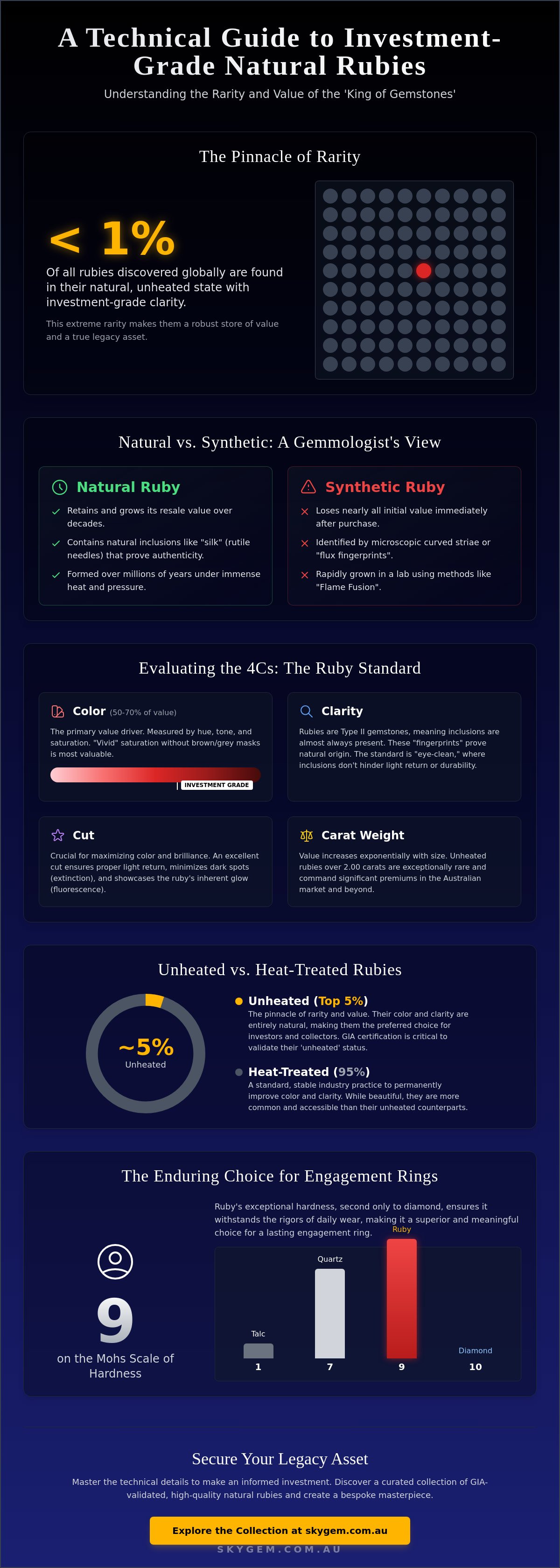
High quality requires a precise equilibrium of several factors. Colour remains the primary value driver, specifically a vivid, medium-dark red often referred to as pigeon's blood. However, clarity and treatment status are equally critical to the stone's long-term worth. In the Australian market, investment-grade stones are defined by their lack of significant treatment. While approximately 95% of rubies globally undergo thermal enhancement to improve clarity, unheated stones represent the pinnacle of rarity. Finding stones over 2.00 carats with high transparency is exceptionally difficult, ensuring these gems remain robust stores of value in a volatile market.
The Distinction Between Natural and Synthetic Rubies
Lab-grown stones typically use "Flame Fusion" or "Flux" growth methods. Flame fusion is a rapid process common for costume jewellery, while flux growth mimics natural conditions over several months. Verification relies on microscopic inclusion analysis performed by qualified gemmologists. Natural stones contain "silk" (rutile needles) or mineral crystals, whereas synthetics often show curved striae or flux fingerprints. Natural stones retain their resale value over decades, whereas lab-fabricated alternatives lose nearly all their initial value immediately after purchase. For those seeking genuine assets, viewing a high quality natural ruby inventory is the first step toward a secure acquisition.
Why Ruby is a Superior Choice for Engagement Rings
Ruby scores a 9 on the Mohs scale, making it the hardest coloured gemstone available. It's second only to diamond, ensuring it withstands the rigours of daily wear without significant abrasion or surface scratching. Historically revered as the "King of Gemstones," it symbolises passion and longevity, making it a meaningful alternative to traditional diamonds. For those exploring setting options, our bespoke jewellery guide offers technical insights into how these stones integrate with various precious metals to ensure structural integrity. When deciding where to buy high quality natural ruby in melbourne?, choosing a provider that understands the intersection of gemmology and bench craftsmanship is vital for a lasting ring design.
Evaluating the 4Cs: The Technical Anatomy of a Premium Ruby
Evaluating the 4Cs for a ruby requires a different technical lens than diamond grading. For collectors asking where to buy high quality natural ruby in melbourne?, the focus remains on the interplay between chemical composition and light performance. Unlike diamonds, where the absence of colour is often prized, rubies are defined by the depth and character of their red. Colour represents approximately 50% to 70% of a ruby's market value. This is measured through hue, tone, and saturation. A premium ruby typically sits at a 60% to 70% tone; anything darker risks looking "inky" or black in low-light environments, while anything lighter may be classified as a pink sapphire.
The technical evaluation of a ruby also involves a deep understanding of its physical structure and rarity. While clarity is important, rubies are classified as Type II gemstones, meaning they almost always contain natural inclusions. These internal characteristics are vital for proving a stone is natural rather than synthetic. The following criteria define the technical standards for investment-grade rubies:
- Colour: Saturation is the primary driver. The most valuable stones exhibit "vivid" saturation, where the red is intense and lacks brown or grey masks.
- Clarity: We look for "eye-clean" stones where inclusions don't interfere with light return. These inclusions are often referred to as the gemstone's "fingerprint."
- Cut: Precision cutting is rare in rubies because cutters often prioritise weight retention. However, a well-proportioned cut prevents "windowing," a defect where light passes through the centre of the stone.
- Carat: The price per carat increases exponentially at the 1.00, 2.00, and 5.00-carat marks. A 2.05-carat ruby can command a price 40% higher per carat than a 1.95-carat stone of identical quality due to the rarity of larger crystals.
The 'Pigeon’s Blood' Standard
This trade term represents the pinnacle of ruby grading. It describes a vivid red hue with a subtle blue undertone, creating a deep, rich crimson. This effect is driven by high chromium content and a lack of iron. When exposed to UV light, such as natural Australian sunlight, the chromium causes the stone to fluoresce, making it appear to glow from within. This specific designation is strictly regulated; only stones with "Vivid Red" grading from reputable labs like GIA or GRS qualify for this label. It's the gold standard for those seeking the highest quality natural ruby in Melbourne.
Clarity and Inclusions: The "Silk" of a Ruby
Fine rutile needles, known as "silk," are a hallmark of high-quality natural rubies. When distributed evenly, silk can actually enhance a ruby's beauty by softening the light and spreading it across the facets. This creates a velvety appearance that synthetic stones cannot replicate. However, buyers must distinguish between these aesthetic inclusions and structural fissures. Surface-reaching cracks can compromise the stone's long-term durability. We recommend inspecting any prospective purchase under 10x magnification to ensure the internal landscape is stable. To see how these technical elements come together, you can view our curated selection of natural rubies which are vetted for both beauty and structural integrity.
Heat Treatment vs. Unheated Rubies: Understanding Rarity and Value
Determining where to buy high quality natural ruby in melbourne? requires a technical understanding of thermal enhancement. Statistics from the International Colored Gemstone Association indicate that over 95% of rubies on the global market undergo heat treatment to improve their visual characteristics. An unheated ruby is a specimen that has undergone no treatment other than mechanical cutting and polishing. These stones are geological rarities that represent nature’s optimal conditions without human interference.
The rarity of unheated stones creates a significant pricing gap. Buyers should expect a price premium of 50% to 100%, and sometimes more, for unheated rubies compared to heated stones of identical weight and clarity. While heat-treated gems are excellent for daily wear, unheated stones are the primary choice for serious Australian collectors and investors. It's vital to distinguish these from "lead-glass filled" or "composite" rubies found in mass-market retail. Those products are heavily fractured stones infused with glass to mimic transparency; they lack durability and hold almost no resale value.
The Process of Traditional Heat Treatment
Traditional heat treatment involves placing the gemstone in a controlled furnace at temperatures typically ranging from 800°C to 1,800°C. This process dissolves rutile "silk" inclusions, which improves the stone's clarity and shifts the hue toward a more saturated red. This is an industry-accepted practice because the resulting colour is permanent and stable. It won't fade over time or react to cleaning chemicals. When researching where to buy high quality natural ruby in melbourne?, prioritize vendors who provide full disclosure of these treatments to ensure you're paying a fair market price for the stone's specific grade.
Why Connoisseurs Seek Unheated Rubies
Connoisseurs value unheated rubies for their "natural as found" status. These gems are the pinnacle of the market because they achieved their vivid saturation and transparency through millions of years of tectonic pressure alone. You can explore examples of these rare specimens in our loose ruby collection, where each stone's provenance and treatment status are clearly defined.
Verification of unheated status relies on precision engineering and laboratory analysis. Gemologists use infrared spectroscopy and microscopic inspection to check for internal features like intact rutile needles or unaltered crystal inclusions. If a stone shows no signs of thermal alteration, it's issued a certificate stating "no indications of heating." This document is the most critical asset for protecting the long-term value of your purchase in the Australian market.
Sourcing and Certification: Navigating the Global Ruby Market
The global ruby market has undergone a structural shift over the last decade, moving toward higher transparency and more diverse sourcing. For collectors asking where to buy high quality natural ruby in melbourne? the answer begins with a technical understanding of origin and laboratory verification. While beauty is subjective, value in the 2026 market is driven by scarcity, provenance, and the absence of thermal enhancement. A ruby’s chemical fingerprint tells a story that determines its long-term asset performance.
The Shift from Burma to Mozambique
Historically, the Mogok Valley in Burma (Myanmar) represented the pinnacle of ruby quality. These stones are known for their high chromium content and low iron, which produces a distinct fluorescence. This internal glow creates a vibrant, pinkish-red hue often described as "pigeon’s blood." However, limited supply and complex trade regulations have redirected the market toward the Montepuez region in Mozambique. Since the discovery of these deposits in 2009, Mozambique has become the primary source for high-clarity, ethically mined rubies.
Mozambique rubies offer a different visual profile than their Burmese counterparts. They typically exhibit a deeper, more saturated crimson due to higher iron content. This chemical composition results in less fluorescence but provides a rich, consistent colour that performs exceptionally well in various lighting environments. For the Australian buyer, Mozambique rubies often represent a practical balance of aesthetic depth and supply chain integrity.
The Role of GIA, GRS, and SSEF Reports
Independent, third-party certification is a non-negotiable requirement for any high-value gemstone purchase. Local "in-house" certificates often lack the advanced spectroscopic equipment needed to identify modern treatment methods. International laboratories like the Gemological Institute of America (GIA), GemResearch Swisslab (GRS), and the Swiss Gemmological Institute (SSEF) provide the gold standard for authentication. These institutions use chemical analysis to confirm the stone's natural origin and geographic provenance.
One of the most critical data points on a grading report is the "Treatment" or "Indications of Heating" section. Approximately 95% of rubies on the market have undergone thermal enhancement to improve colour and clarity. A report stating "No indications of heating" identifies a stone of extreme rarity. Such gems can command a price premium of 50% to 100% over heated stones of similar appearance. When you are looking for where to buy high quality natural ruby in melbourne? ensure the provider can supply a digital link to verify the report on the laboratory’s official database.
- Species and Variety: Confirms the stone is a natural corundum (ruby).
- Geographic Origin: Specifies if the stone is from Burma, Mozambique, Madagascar, or Thailand.
- Treatment Status: Explicitly looks for "N" (No heat) or "H" (Heated).
- Dimensions and Weight: Verified to the third decimal place to ensure the stone hasn't been swapped.
- Report Verification: Use the QR code or report number on the lab's website to confirm the document's authenticity.
Precision in selection is the hallmark of a true connoisseur. By focusing on verified data and ethical provenance, you secure a gemstone that serves as both a visual masterpiece and a stable store of value. We invite you to explore our curated selection of authenticated stones to find your perfect match.
Secure your investment by browsing our collection of certified natural rubies today.
Creating Bespoke Ruby Jewellery: From Loose Stone to Masterpiece
Selecting a loose gemstone is the most technically sound approach for any serious collector. When you view a ruby before it's set, you gain an unobstructed 360-degree view of its anatomy, including the girdle and pavilion. This transparency ensures that no inclusions are hidden beneath metal prongs. If you've been researching where to buy high quality natural ruby in melbourne? you'll find that viewing unmounted stones is the industry standard for verifying colour saturation and light return without the interference of metal reflections.
Modern jewellery engineering relies heavily on Computer-Aided Design (CAD). This collaborative process allows you to see a digital 1:1 scale model of your piece. CAD ensures the structural integrity of the ring, allowing for precise calculations of metal weight and stone clearance. We recommend 18K yellow gold for rubies with slightly cooler undertones, as the 75% gold content adds a perceived warmth to the gem. Conversely, platinum provides a stark, architectural contrast that highlights the vivid reds of a "pigeon blood" stone. For high-value natural rubies, we utilise double-claw settings. This technique uses two slim prongs at each corner to distribute pressure evenly, which significantly reduces the risk of the stone shifting over decades of wear.
The Bespoke Design Journey
The process begins with an initial consultation where we review your selected stone under 10x magnification. This technical grounding ensures the custom engagement ring design is built around the specific dimensions of your ruby rather than forcing a gem into a pre-made setting. We often integrate side stones to enhance the central ruby's profile. Tapered baguettes offer a clean, Art Deco aesthetic, while half-moon diamonds can soften the transition between the centre stone and the band. These proportions are fine-tuned during the digital rendering phase to ensure a balanced, ergonomic fit.
Long-term Care and Maintenance
Rubies are durable, ranking 9 on the Mohs scale, but they still require a structured maintenance routine. You can perform basic cleaning at home using a soft-bristled brush and a solution of mild detergent in warm water. This removes the build-up of oils that can dull the stone's refractive index. For the metal components, refer to our guide to gold jewellery to understand how different purities react to daily wear. We advise a professional inspection every 12 months. During these check-ups, we examine the prong tension and the integrity of the setting under a microscope to prevent any potential stone loss. It's a simple step that protects your investment for the long term.
When you're deciding where to buy high quality natural ruby in melbourne? remember that the purchase is only the first stage. The engineering of the setting and the commitment to ongoing maintenance are what transform a loose crystal into a generational asset.
Securing Your Investment in Natural Ruby Excellence
Selecting a gemstone of this magnitude requires a technical approach grounded in geological data and market transparency. We've explored how the 4Cs and the absence of thermal treatment define a ruby's long-term appreciation, ensuring your acquisition remains a stable asset through 2026. When you're determining where to buy high quality natural ruby in melbourne?, it's vital to partner with specialists who prioritize GIA and GRS certification to verify origin and treatment status. Skygem operates as a technical consultant for your bespoke jewellery projects; we're an independent, family-owned boutique that provides on-site expertise from qualified gemmologists. Our commitment to Australian-led design standards ensures every stone is vetted for optical performance and structural integrity. Whether you seek a loose stone for a commission or a finished masterpiece, we offer secure nationwide delivery to every Australian state. We invite you to explore our curated collection of natural unheated rubies today. Your journey toward owning one of nature's rarest treasures begins with a partnership built on precision and trust.
Frequently Asked Questions
What is a "Pigeon’s Blood" ruby and why is it so expensive?
A "Pigeon’s Blood" ruby represents the highest industry grade for colour, characterized by a vivid red hue with high saturation and strong red fluorescence. This specific classification, traditionally associated with the Mogok Valley in Myanmar, can command prices 50% to 100% higher than standard fine rubies. The premium reflects the rarity of stones that achieve this precise balance of chromium without secondary brown or orange undertones.
Can I tell if a ruby is unheated without a laboratory report?
Identifying an unheated ruby requires advanced gemmological equipment to detect the presence of intact rutile "silk" and other microscopic inclusions. While a 10x loupe might show some features, it's impossible to confirm the absence of thermal treatment without a report from a laboratory like GRS or SSEF. Over 95% of rubies on the market undergo heat treatment to improve clarity and colour, making unheated specimens a significant rarity.
Are natural rubies suitable for everyday engagement rings?
Natural rubies are exceptionally suitable for daily wear because they possess a hardness of 9 on the Mohs scale. This makes them the second hardest natural gemstone after diamonds, ensuring they resist scratches and abrasions during routine activities. Their structural stability ensures that a high-quality setting will protect the stone for decades, making them a reliable choice for Australian engagement rings that require long-term durability.
How much should I expect to pay for a 1-carat high-quality natural ruby?
A high-quality 1-carat natural ruby typically ranges from A$7,000 to over A$25,000 depending on its origin and treatment status. According to 2024 market data from the International Gem Society, unheated stones from premium origins like Burma sit at the top of this pricing bracket. If you're looking for where to buy high quality natural ruby in melbourne, local specialist dealers often provide detailed price breakdowns based on current global auction results.
What is the difference between a ruby and a red sapphire?
The distinction between a ruby and a red sapphire is based solely on the intensity of the red hue, as both are varieties of the mineral corundum. Gemmological laboratories use master stones to determine if a specimen has enough chromium to be classified as a ruby. If the primary colour is perceived as pink, purple, or orange, the stone is technically categorized as a fancy sapphire rather than a ruby.
Why do some rubies look pinkish rather than true red?
Rubies appear pinkish when they contain lower concentrations of chromium or specific amounts of iron and titanium. This variation in trace elements affects how the crystal absorbs light, often resulting in a lighter tone or a different secondary hue. In the Australian market, stones with a strong pink secondary are often priced 20% to 40% lower than those exhibiting a pure, deep red saturation.
How does the origin of a ruby affect its resale value?
Origin significantly dictates resale value, with Burmese rubies often fetching a 30% to 60% premium over stones from Mozambique or Madagascar. This price disparity exists because of the historical prestige and unique fluorescent properties found in Mogok deposits. Investors and collectors prioritize geographic provenance as a key metric for long-term value retention, provided the stone is accompanied by a reputable independent origin report.
Is it better to buy a loose ruby or a pre-set ruby ring?
Purchasing a loose ruby is generally the superior option for connoisseurs because it allows for a 360-degree inspection of the cut, clarity, and weight. When a stone is already in a setting, metal claws can obscure inclusions or hide a shallow pavilion that affects light performance. Knowing where to buy high quality natural ruby in melbourne starts with finding a supplier who presents loose stones alongside their certification to ensure full transparency.
Disclaimer
This article is for general informational purposes only and may include AI-assisted content. Pricing, specifications, and availability are subject to change. For accurate advice and current information, please contact SkyGem & Co. directly. Nothing in this content constitutes professional or financial advice.