
What is Diamond Fluorescence and is it Bad? A Comprehensive 2026 Buyer’s Guide

That subtle blue glow on your grading report might actually be the secret to securing a whiter-looking diamond for a lower price. Most buyers see the term "fluorescence" and immediately worry they're looking at a defective stone. You're likely asking, what is diamond fluorescence and is it bad for the long-term value of your engagement ring? It's a common concern, especially when technical grading reports seem to highlight it as a potential flaw rather than a natural physical property. Approximately 30 to 35 percent of diamonds exhibit this trait, yet it remains one of the most misunderstood aspects of gemology.
This guide will help you master the technical nuances of this trait so you can distinguish between a "milky" deal-breaker and a hidden opportunity. We've structured this analysis to provide the clarity you need to make a confident purchase. We'll examine the GIA grading scales, the specific impact on pricing in the 2026 market, and exactly how to evaluate the visual performance of a stone beyond the paper report. By understanding how fluorescence interacts with different colour grades, you can ensure your bespoke ring achieves the perfect balance of aesthetic precision and financial value.
Key Takeaways
- Understand the five-level GIA grading scale to interpret technical reports with precision and identify how sub-microscopic structures influence light performance.
- Discover exactly what is diamond fluorescence and is it bad for your selection, particularly how blue fluorescence acts as a natural colour-corrector for stones in the I-M range.
- Learn to leverage market pricing shifts to secure a premium aesthetic at a lower price point, potentially reducing costs by 2% to 15% without compromising visual beauty.
- Identify the specific "Caution Zones" where fluorescence necessitates a professional physical inspection to ensure the stone retains its structural clarity and brilliance.
- Distinguish between a beneficial vibrant glow and the rare "oily" effect to guarantee your bespoke diamond remains a high-performing and long-term asset.
Defining Diamond Fluorescence: The Science of the Subtle Glow
Approximately 30 to 35 percent of natural diamonds exhibit some degree of fluorescence. This phenomenon occurs when sub-microscopic structures within the carbon lattice react to ultraviolet (UV) radiation, causing the stone to emit a visible glow. While it might sound like a synthetic trait, it's a entirely natural physical property. The Gemological Institute of America (GIA) classifies Diamond fluorescence as an identifying characteristic rather than a primary grading factor like the 4Cs. It's a signature of the stone's unique formation process deep within the earth's mantle.
When technical consultants evaluate a stone, they refer to the GIA scale, which ranges from None to Very Strong. This scale measures the intensity of the glow under controlled UV lighting conditions. Clients often ask what is diamond fluorescence and is it bad for the stone's long-term durability. It's vital to understand that fluorescence doesn't compromise the diamond's structural integrity. It's a light-performance trait that only becomes relevant when considering how the diamond interacts with specific environments, such as bright sunlight or high-UV settings.
For those designing a custom-made engagement ring, this trait can be a strategic asset. The presence of nitrogen atoms, the most common impurity in diamonds, typically results in a blue glow. Because blue is the complementary colour to yellow, this fluorescence can actually make a stone with a lower colour grade appear whiter and brighter than its technical grade suggests. This creates a practical opportunity to maximise visual impact while maintaining a specific project budget.
The UV Interaction Explained
The glow you see is a reaction to short-wave and long-wave UV light. Most fluorescence is triggered by long-wave UV, which is present in natural sunlight. In standard indoor office lighting, where UV levels are negligible, the effect is usually invisible to the naked eye. It's also distinct from phosphorescence. While fluorescence stops the moment the UV source is removed, phosphorescence involves a delayed glow that lingers in the dark. This distinction is a key technical metric used during the certification of natural white diamonds.
Common Colours of Fluorescence
Blue fluorescence dominates the market, appearing in roughly 95 percent of fluorescent stones. However, rare variations exist, including yellow, white, and green. While blue is often viewed as a "colour-corrector," yellow or green fluorescence is generally approached with more caution. These rare hues don't offer the same whitening benefit and can occasionally clash with the diamond's natural body colour. Understanding these nuances is part of the technical due diligence required when selecting a high-performance stone for a bespoke setting.
The Visual Impact: Does Fluorescence Change a Diamond’s Appearance?
Visual perception of a diamond changes significantly based on its environment. While a grading report provides a static value, the real-world performance of the stone is dynamic. Many buyers ask Is Diamond Fluorescence Good or Bad? when they see "Strong Blue" on a certificate. In many instances, it's a distinct visual advantage. In natural sunlight, which is rich in UV rays, a diamond with strong blue fluorescence can appear one to two colour grades whiter than its laboratory assessment suggests. This is a primary reason why some "Strong Blue" stones look more vibrant than "None" stones of the same colour grade when viewed outdoors.
The interaction between fluorescence and diamond cut is a critical technical consideration for any project. Round brilliant cuts are designed for maximum light return, which can sometimes mask the subtle glow. However, step cuts like Emerald or Asscher shapes have larger, open facets that reveal body colour more readily. For these shapes, blue fluorescence acts as a powerful corrective tool. It neutralises the slight yellow tints often found in near-colourless stones, resulting in a crisper, more premium aesthetic. When assessing what is diamond fluorescence and is it bad, the answer often depends on how the cut handles light.
The Benefits for Near-Colourless Stones
Blue fluorescence acts as a natural counterbalance to the faint yellow hues found in I, J, and K colour diamonds. By emitting a blue light that is complementary to yellow, the stone effectively "whitens" itself in UV-rich environments. This allows a high-performing natural white diamond to be selected at a more accessible price point. Medium Blue is often the "sweet spot" for J-colour solitaire engagement rings because it provides effective colour correction without the risk of visual haziness.
Understanding Haziness and Overblues
A common concern involves the "overblue" or "oily" effect. This occurs when an extremely high concentration of fluorescence causes the stone to look milky or cloudy in direct sunlight. It's essential to recognise that this phenomenon is exceptionally rare, affecting fewer than 1% of diamonds with strong fluorescence according to industry studies. Most haziness reported by consumers is actually caused by internal inclusions like clouds or twinning wisps rather than the fluorescence itself. If you're concerned about a stone's clarity, our specialists can help you design a custom-made engagement ring using stones that have been hand-vetted for transparency. When evaluating what is diamond fluorescence and is it bad, remember that professional physical inspection is the only way to confirm if a stone is an "overblue."
Market Value and Pricing: The Financial Impact of Fluorescence
Market value in the diamond industry is determined by a complex interplay between technical grading and market perception. This creates what is known as the "Fluorescence Discount," a pricing adjustment that can reduce the cost of a stone by 2% to 15%. For high-colour stones in the D to F range, Strong fluorescence often results in a 10% to 15% price reduction. In the case of Very Strong fluorescence, this discount can exceed 20%. When buyers ask what is diamond fluorescence and is it bad for their project budget, they're often surprised to find it acts as a strategic opportunity to acquire a larger or higher-clarity stone for the same investment.
The impact on resale value is a primary concern for many clients. While fluorescence is an identifying characteristic, the market generally maintains these pricing tiers over time. A stone purchased with a discount will likely be sold with a similar discount in the future. Because the visual performance of the diamond remains the primary driver of desirability, a well-selected fluorescent stone that shows no haziness remains a stable asset. It's a matter of technical due diligence rather than a blanket rule of avoidance.
The Pricing Paradox
Price movements are often dictated by B2B trading platforms, where technical specifications on a certificate drive initial valuations. This leads to a pricing paradox. While D-colour diamonds are penalised for any degree of fluorescence to maintain a standard of "purity," near-colourless stones in the I to M range can command a slight premium of up to 2%. This occurs because the blue glow effectively masks yellow tints, improving the stone's appearance "off-paper." Success in diamond acquisition often involves buying a stone that performs better visually than its technical certificate might suggest to a layperson.
Fluorescence and Lab-Grown Diamonds
The presence of fluorescence is significantly rarer in lab-grown diamonds compared to their natural counterparts. In the current 2026 market, lab-grown stones typically cost about 67% less than natural diamonds. While natural stones usually glow blue due to nitrogen, lab-created diamonds produced via CVD or HPHT methods may occasionally exhibit orange or red fluorescence. These rare hues don't offer the same whitening benefits as blue fluorescence and can negatively impact the stone's aesthetic appeal.
The GIA now uses a "Laboratory-Grown Diamond Quality Assessment Report" that categorises stones as 'Premium' or 'Standard' rather than providing traditional specific grades. This shift highlights the importance of understanding the lab-grown vs natural diamond price gap. When evaluating what is diamond fluorescence and is it bad for a lab-grown stone, the focus shifts to ensuring the stone doesn't possess these unconventional glow colours. Selecting a stone with "None" or "Faint" fluorescence is generally the safest technical path for lab-grown selections.
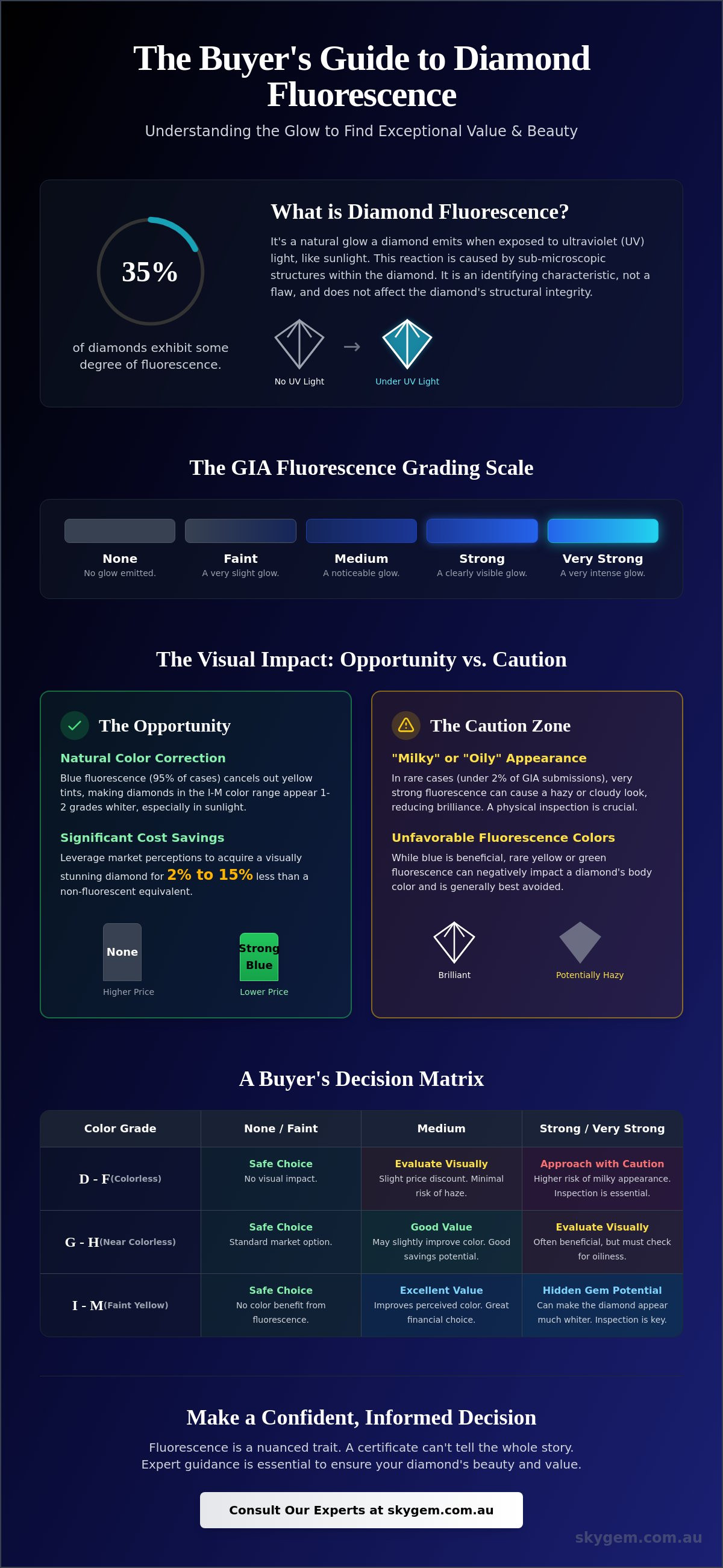
The Fluorescence Decision Framework: A Buyer’s Matrix
Technical precision in diamond selection requires moving beyond binary labels. To determine what is diamond fluorescence and is it bad for your specific project, we utilise a structured decision matrix. This framework categorises stones into zones based on how their fluorescence level interacts with their GIA colour grade. By following these parameters, you can leverage the "Safe Zone" to enhance a stone's appearance while avoiding the "Avoid Zone" where light performance might be compromised. While a certificate provides the raw data, this matrix provides the strategy for a high-performing selection.
When using our natural diamond ring builder, this framework serves as an essential filter for technical performance. The primary objective is to ensure the diamond maintains its transparency and fire regardless of the lighting environment. A well-selected fluorescent stone should remain vibrant and crisp, never dull or hazy. Understanding these specific combinations allows you to secure a diamond that performs at a level far exceeding its paper specifications.
The Colour-Fluorescence Match
- D to F Colour: For these premium colourless stones, "None" to "Faint" remains the gold standard. High fluorescence in this range can occasionally cause a hazy appearance, which detracts from the stone's icy brilliance.
- G to H Colour: This is the balance zone. "Faint" to "Medium" blue fluorescence often provides the best value, offering a slight discount without any risk to the stone's visual crispness.
- I to K Colour: Here, "Medium" to "Strong Blue" is a technical advantage. It can save you thousands of dollars while making the stone look significantly whiter in daylight by neutralising faint yellow tints.
Practical Inspection Tips
Evaluation shouldn't rely solely on paper reports. To inspect a "Strong Blue" stone, view it in direct sunlight to see if it retains its transparency or develops a milky sheen. A simple UV torch can confirm the glow's intensity, but daylight reveals the true impact on clarity. Use a 10x loupe to check for structural haziness that persists even when the UV source is removed. Always place the diamond against a neutral white background to accurately assess how the blue glow interacts with the stone's body colour. This methodical approach ensures your selection is a permanent and evolving asset for your ring.
You can apply these technical filters immediately by exploring our diamonds online Melbourne selection to find a stone that meets your specific performance criteria.
Selecting Your Diamond: Why Expert Consultation is Essential
Grading reports provide a critical baseline, but the physical reality of a stone requires expert verification. When assessing what is diamond fluorescence and is it bad for your specific ring, remember that two stones with identical "Strong Blue" ratings can exhibit vastly different light performance. One might be a vibrant masterpiece that appears whiter than its grade, while another could suffer from sub-microscopic structural haziness. This discrepancy is why a technical consultation is vital for the success of a high-end jewellery project.
Balancing fluorescence with the 4Cs is a nuanced engineering challenge that requires a trained eye. A master jeweller evaluates how the blue glow interacts with the specific cut and clarity of the stone to ensure a cohesive design. For a custom-made engagement ring, every variable must align to ensure long-term viability and aesthetic precision. We prioritise "face-up" beauty, ensuring the stone performs optimally in all lighting environments, from dim interiors to bright Australian sunlight. High-quality macro photography and 4K video are non-negotiable tools in this process, allowing you to inspect the stone's transparency from every angle.
The Role of the Master Jeweller
Boutique lighting is often specifically engineered to accentuate brilliance, which can sometimes mask the subtle visual effects of fluorescence. A dedicated technical consultant provides a transparent evaluation by viewing the stone in neutral, non-commercial lighting conditions. SkyGem & Co. employs a rigorous internal vetting process to filter out stones with any hint of milkiness or oiliness before they are ever presented to a client. This methodical approach ensures that only high-performing assets are selected for your bespoke design, removing the risk associated with buying based on paper statistics alone.
Final Checklist for Your Purchase
Before finalising your acquisition, ensure your technical due diligence is complete. Confirm that the GIA report explicitly details the fluorescence grade and that the stone's price reflects the current 2026 market tiers for its specific colour and fluorescence combination. It's also prudent to verify the return policy for any stone with Strong or Very Strong fluorescence to protect your investment. We recommend booking a consultation to observe the difference between "None" and "Strong Blue" in person. This practical comparison is the most reliable way to decide if a specific fluorescent stone represents a hidden opportunity for your engagement ring.
Strategic Diamond Selection for Your Bespoke Ring
Fluorescence represents a sophisticated intersection of geological science and market value. By understanding the technical nuances of the GIA scale, you can distinguish between a stone with rare structural haziness and one with a beneficial, vibrant glow. We've established that the question of what is diamond fluorescence and is it bad depends entirely on the specific stone's interaction with light and its base colour grade. For many projects, it's a strategic opportunity to secure a whiter-looking diamond while capitalising on significant market discounts.
Successful acquisition requires a partner who prioritises visual performance over paper specifications. Our expert GIA-trained consultants provide direct access to global diamond inventories, ensuring every selection meets the rigorous standards required for high-end bespoke design. Whether you're working within a specific budget or seeking a rare colourless stone, technical due diligence remains the foundation of a confident purchase. This methodical approach ensures your engagement ring remains a permanent and evolving asset.
Explore our curated selection of GIA-certified natural diamonds to find a high-performing stone that perfectly complements your vision. With the right technical guidance, your diamond will remain a brilliant and enduring symbol of your commitment.
Frequently Asked Questions
Is diamond fluorescence common in high-quality stones?
Approximately 30 to 35 percent of all natural diamonds exhibit some degree of fluorescence. This includes high-quality stones across the entire colour and clarity spectrum. While it's a natural phenomenon, the rarity of "None" or "Faint" grades in the premium D to F range often leads to higher market prices for those specific combinations. It remains a common trait even in the most prestigious gemstone categories.
Can fluorescence make a diamond look fake?
Fluorescence is a natural physical property that often serves as a hallmark of a diamond's terrestrial origin. It doesn't make a stone look fake. In fact, many people asking what is diamond fluorescence and is it bad find that the subtle glow adds a unique character to their ring. Only the rarest "overblue" stones appear milky, which is a structural transparency issue rather than a sign of a non-natural stone.
Does GIA grade fluorescence as a flaw?
The Gemological Institute of America (GIA) classifies fluorescence as an identifying characteristic rather than a quality flaw or a grading factor. It's not part of the 4Cs, which include Cut, Colour, Clarity, and Carat. Instead, it's a descriptive data point that helps gemologists identify individual stones. It doesn't negatively impact the official grade of a diamond's colour or clarity on a technical report.
Will fluorescence affect the sparkle or brilliance of my ring?
Sparkle is primarily a function of a diamond's cut quality and light return. Fluorescence generally has no impact on brilliance or fire. The only exception occurs in the very small percentage of stones that exhibit a "milky" or "oily" appearance under UV light. For the vast majority of fluorescent diamonds, the sparkle remains exactly the same as a non-fluorescent counterpart when the cut is executed with precision.
Is blue fluorescence better than yellow fluorescence?
Blue fluorescence is technically superior for most buyers because blue is the complementary colour to yellow. This allows it to neutralise faint yellow tints in near-colourless stones. Yellow or green fluorescence doesn't provide this whitening benefit and can sometimes make a diamond's body colour appear more saturated. Most technical consultants recommend sticking to blue fluorescence for maximum visual performance in bespoke designs.
Should I buy a "Strong Blue" diamond if I am on a budget?
Purchasing a "Strong Blue" diamond is a highly effective strategy for maximising a budget. These stones often carry a price discount of 10 to 15 percent in higher colour grades. If the stone has been hand-selected to ensure it doesn't have any visual haziness, you can acquire a larger or higher-quality diamond for a significantly lower investment than a stone with "None" fluorescence.
Does fluorescence change over time or fade?
Fluorescence is a permanent characteristic of the diamond's atomic structure. It's caused by the presence of specific elements, like nitrogen, within the carbon lattice during the stone's formation millions of years ago. It won't fade, change colour, or disappear over time. Your diamond will exhibit the same reaction to UV light decades from now as it does today, ensuring long-term consistency in its appearance.
Can I see fluorescence without a UV light?
Most fluorescence is invisible under standard indoor lighting because these environments lack sufficient UV radiation. You'll typically only see the effect in direct sunlight or under a dedicated UV lamp. When people research what is diamond fluorescence and is it bad, they often learn that "Medium" to "Strong" blue stones simply look exceptionally crisp and white in natural daylight due to the UV present in the sun's rays.
Disclaimer
This article is for general informational purposes only and may include AI-assisted content. Pricing, specifications, and availability are subject to change. For accurate advice and current information, please contact SkyGem & Co. directly. Nothing in this content constitutes professional or financial advice.