
What Diamond Shape Looks the Largest? Maximising Visual Presence and Value

You might assume that a one-carat diamond always maintains the same visual presence, regardless of its cut, but weight and dimensions are two distinct metrics in the world of technical gemmology. When clients ask what diamond shape looks the largest, they're often surprised to learn that a round brilliant, despite its market dominance, doesn't actually offer the most expansive surface area. It's a common frustration to find that a stone looks smaller on the finger than its laboratory certificate suggested, especially when you're working within specific budget parameters.
We understand that selecting a diamond requires a balance of technical precision and aesthetic impact. You don't have to compromise on visual scale just because you've prioritised a certain carat weight. This guide will provide a clear analysis of which shapes offer the greatest face-up area and reveal the professional secrets to choosing a stone that looks significantly larger than its mass implies. We'll explore the performance of elongated cuts like the oval and marquise, examine how setting styles influence perceived dimensions, and give you the technical confidence to commission a bespoke ring that delivers maximum value and presence.
Key Takeaways
- Distinguish between carat weight and face-up area to ensure your investment prioritises the physical dimensions visible once the stone is set.
- Evaluate the specific geometry of elongated cuts to determine what diamond shape looks the largest on the finger while maintaining optimal light performance.
- Examine the technical reasons why the round brilliant cut often appears smaller than fancy shapes of the same weight due to its specific depth requirements.
- Utilise professional design techniques, such as halo configurations and refined band proportions, to amplify the visual scale of a stone.
- Learn the expert methodology for balancing the 4Cs to achieve a larger visual presence without exceeding your project's budgetary constraints.
Carat Weight vs. Visual Size: Why Dimensions Matter More Than Mass
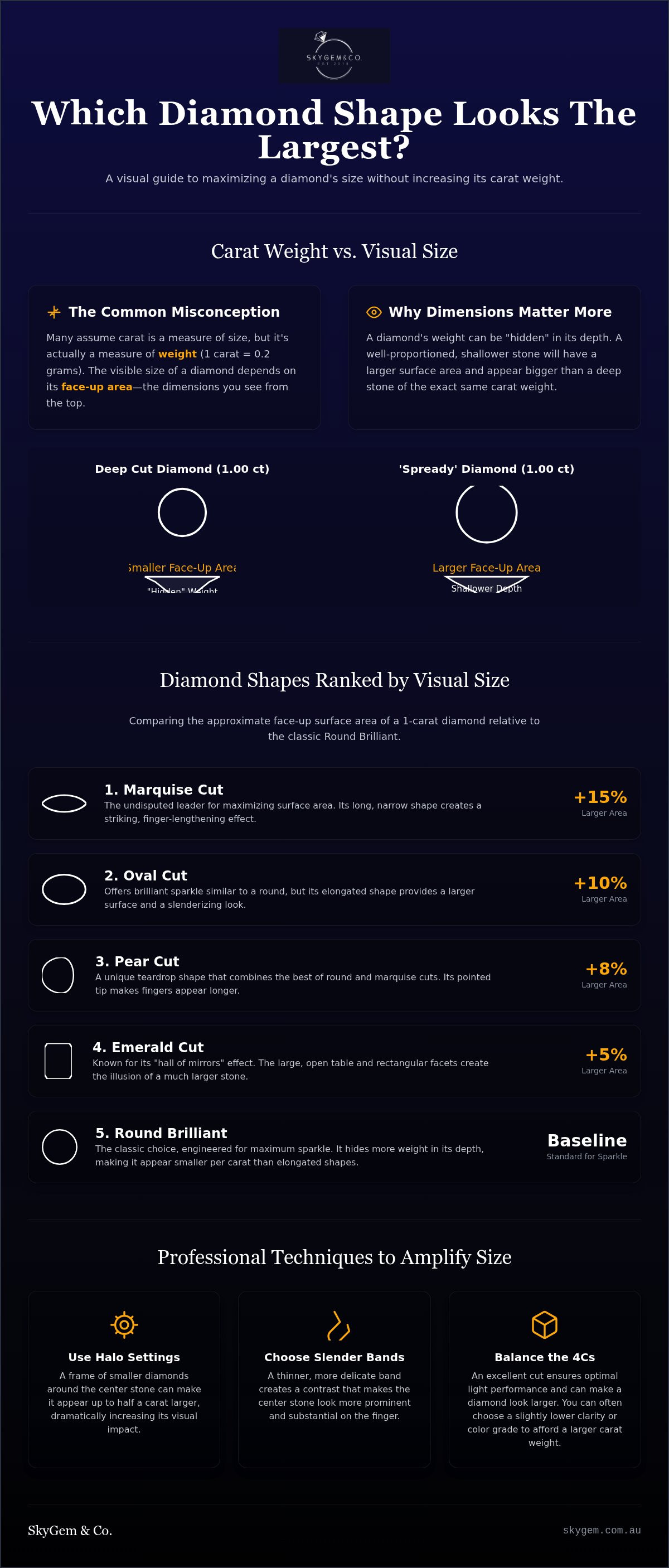
Carat is a measure of weight, not a physical measurement of width or length. One carat is exactly 0.2 grams, which is roughly the weight of a single paperclip. This distinction is vital when you're trying to determine what diamond shape looks the largest. Weight is a three-dimensional metric that includes the depth of the stone, while visual size is almost entirely dependent on the two-dimensional surface area you see when the ring is on a finger. If two diamonds have the same weight, the one with more mass distributed across its surface will naturally appear more impressive.
Face-up area is the primary metric for perceived diamond size, representing the total millimetres squared visible when the stone is viewed from the top.
When mass is concentrated in the depth of the stone, it's essentially "wasted" from a visual perspective. Diamonds with a deep pavilion hide their weight beneath the girdle where it cannot be seen once the stone is set. This leads to a common scenario where a 0.90-carat diamond with excellent proportions can actually look larger than a poorly cut 1.00-carat stone. Understanding this geometric reality allows you to optimise your budget by focusing on dimensions rather than just the number on the certificate.
The Concept of 'Spready' Diamonds
In technical jewellery design, a "spready" diamond refers to a stone cut intentionally shallower to increase its diameter. By redistributing the mass from the depth of the stone to its width and length, the diamond achieves a larger footprint. This can be a strategic choice for bespoke designs where visual presence is the priority. However, there's a delicate trade-off to manage. If a stone is cut too shallow, it may lose its ability to refract light effectively, resulting in a loss of "fire" and brilliance. A balanced, slightly shallower stone often provides a significantly more impressive appearance without the premium cost associated with higher carat weights.
Where Diamonds Hide Their Weight
Diamonds often hide their weight in areas that remain invisible after the stone is secured in a setting. The pavilion, which is the lower portion of the diamond, can be cut excessively deep. These "bottom-heavy" stones retain their carat weight but look much smaller from above than a well-proportioned stone of the same mass. Additionally, an overly thick girdle adds weight to the stone's perimeter without contributing to its visual diameter.
When you're comparing natural GIA certified diamonds, it's essential to scrutinise the proportions listed on the report. These documents provide the precise measurements needed to understand the relationship between different diamond cuts and their actual visual impact. By analysing the depth percentage and table percentage, you can avoid stones that carry "dead weight" beneath the surface. This technical approach ensures that every milligram of the stone contributes to its visible scale and brilliance, helping you identify what diamond shape looks the largest within your specific requirements.
The Top Diamond Shapes That Look the Largest
While the round brilliant is the industry standard for light return, it is rarely the correct answer when determining what diamond shape looks the largest per carat. Elongated shapes achieve a greater face-up area by distributing their mass horizontally rather than vertically. This creates an optical stretch that makes the stone appear more substantial on the hand. When comparing a standard 1-carat round brilliant to a 1-carat marquise, the visual difference is striking. A round stone typically measures around 6.4mm in diameter, whereas a marquise can span up to 10mm in length; it occupies significantly more space on the finger for the exact same weight.
The Marquise: The Undisputed Queen of Scale
The marquise cut is the leader in visual scale. Its pointed ends and elongated body offer the largest surface area of any cut. To achieve a balanced silhouette, we recommend a length-to-width ratio between 1.75 and 2.15. This specific geometry maximises the stone's footprint while maintaining structural integrity. Beyond its dimensions, the marquise provides a finger-lengthening effect, making both the diamond and the wearer's hand appear more slender and refined. It's a technical choice that prioritises presence without requiring the budget of a much heavier stone.
Oval and Pear: The Modern Favourites for Size
Ovals and pears are currently the most sought-after diamond shapes that look the largest while retaining a brilliance comparable to a round cut. An oval diamond typically offers approximately 10% more surface area than a round brilliant of equivalent weight. The pear shape, with its asymmetrical teardrop design, draws the eye along its entire length. This visual pathing increases the perceived scale of the stone. For these shapes, orientation is a critical design choice; while an east-west setting provides a modern look, a traditional vertical orientation usually maximises the lengthening effect. If you're beginning your search, exploring our collection of engagement rings can help you visualise how these different geometries interact with various settings.
Emerald and Radiant: Large Footprints with Different Sparkle
Emerald and radiant cuts offer substantial footprints through their rectangular outlines. The emerald cut features a broad, flat table that acts as a window into the stone, showcasing its size and clarity through step-cut facets. In contrast, the radiant cut mimics this large outline but incorporates the facet pattern of a brilliant cut for higher sparkle. Because radiant cuts have broader corners than princess cuts, they often appear more substantial and take up more visual real estate within a setting. With any elongated cut, you must account for the bow-tie effect. This is a dark shadow across the centre of the stone caused by light leakage; minimising this requires a technical assessment of the stone's depth and facet angles to ensure consistent light return across the entire surface.
The Round Brilliant Dilemma: Classic Sparkle vs. Visual Scale
The round brilliant cut is often the default choice for its unmatched light performance, but it presents a technical trade-off regarding visual scale. Because this shape is engineered for maximum fire and brilliance, it requires a specific, deep geometry to refract light effectively. This depth consumes a significant portion of the stone's carat weight. When clients evaluate what diamond shape looks the largest, the round brilliant rarely tops the list. Its perfectly symmetrical design means that much of its mass is held in the pavilion rather than the diameter. For instance, a well-cut 1-carat round brilliant typically measures approximately 6.4mm in diameter. In contrast, an oval diamond of the same weight can reach a length of roughly 7.7mm, occupying a far more prominent position on the finger.
Choosing a round diamond is a decision to prioritise internal light return over external dimensions. It remains the gold standard for "fire," the rainbow-like flashes of light that occur when a diamond is moved. If your project goals focus on brilliance above all else, the round brilliant is technically superior. However, it's essential to understand that you're sacrifice face-up area to achieve that specific optical result.
The 'Triple Excellent' Standard
To ensure a round diamond performs as intended, we look for GIA Excellent grades in cut, symmetry, and polish. These standards ensure the weight is distributed for light performance, not just to increase the stone's footprint. There's a common pitfall in selecting stones with "Poor" or "Fair" cut grades that appear larger due to a shallower depth. While these stones might seem like a bargain for their size, they often look "dark" or "glassy" because light leaks through the bottom rather than reflecting back to the eye. Our approach to bespoke engagement rings focuses on "Ideal" proportions. We believe a slightly smaller, high-performing stone offers more long-term value than a larger stone that lacks life.
Maximising a Round Diamond's Presence
If you prefer the classic round aesthetic but want to maximise its presence, you can look for stones that follow the "60/60" rule. This refers to a diamond with a table percentage and a total depth percentage both near 60%. While modern light-performance theories often prefer a slightly smaller table, a stone with a 60% table can "face up" larger than its peers. This broader table makes the stone look more expansive and can compensate for the naturally smaller diameter of the round cut. It's a technical nuance that allows you to maintain the traditional silhouette while pushing the boundaries of its perceived size. By scrutinising these percentages, you can find a stone that balances the brilliance of a round cut with a more impressive visual scale.
Beyond the Stone: Design Techniques to Maximise Perceived Size
While the geometry of the stone is the primary factor in determining what diamond shape looks the largest, the surrounding architecture of the ring plays a decisive role in perception. A stone's visual presence can be amplified or diminished by technical choices made during the setting process. By manipulating proportions and light interaction, a skilled designer can create a finished piece that appears significantly more substantial than the carat weight of the centre stone alone suggests. These design refinements ensure that the investment you make in the diamond is fully realised once the ring is on the finger.
The Power of the Halo and Trilogy Settings
The halo effect remains one of the most effective methods for increasing visual scale. By surrounding the centre stone with a border of smaller, high-quality diamonds, you add physical millimetres to the total diameter of the setting. A seamless halo can make a 1-carat centre stone achieve the visual footprint of a 2-carat diamond, providing a massive look for a fraction of the cost. Similarly, trilogy rings use side stones to create "wall-to-wall" diamond coverage across the finger, which enhances the horizontal presence of the piece. If you prefer a more minimalist approach, you can learn more about Solitaire Engagement Rings and the specific ways to enhance their singular focus through refined mounting techniques.
The 'Optical Illusion' of the Tapered Band
The width of the band provides the necessary contrast to highlight the diamond's scale. A band measuring between 1.5mm and 1.8mm is often ideal; it provides a delicate foundation that makes the centre stone "pop" in comparison. Conversely, a wider 2.5mm band can absorb the visual impact of the stone, making it appear smaller. A tapered band, which narrows as it approaches the setting, further concentrates the viewer's focus on the diamond. Design features like a "hidden halo" or "under-rail" sparkle add complexity from the profile view, ensuring the ring looks impressive from every angle without detracting from the centre stone's crown area.
Prong selection is a granular detail that impacts the stone's silhouette. A four-prong setting typically reveals more of the diamond's surface and can make round stones appear slightly more square, whereas a six-prong setting reinforces a circular outline but covers more of the stone's edge. Using "Eagle" or "Claw" prongs—which are filed to a fine point—minimises the amount of metal covering the crown facets. Additionally, choosing white gold or platinum for the prongs allows the metal to blend with the diamond's edge, creating a continuous field of light that extends the perceived boundary of the stone. These technical refinements are essential when considering what diamond shape looks the largest in a completed setting, as the mounting can either hide or highlight the stone's true dimensions.
To explore these technical design options in person, you can book a consultation to view our range of engagement rings and discuss a bespoke configuration that maximises your diamond's presence.
The Expert Approach: Selecting Proportions at SkyGem & Co.
At SkyGem & Co., we approach the diamond selection process with the precision of a technical consultant. Determining what diamond shape looks the largest requires more than a cursory glance at a grading report. It involves a rigorous analysis of light performance and physical dimensions that is best conducted through an in-person viewing. Seeing stones under varied lighting conditions allows you to understand how a specific cut distributes light across its surface. Our commitment to transparency means we provide a detailed proportion analysis for every stone, ensuring you understand exactly where the mass is distributed before you commit to a design.
To achieve maximum visual scale, we often recommend a strategic balance of the 4Cs. For many projects, it's logical to move down one or two grades in colour or clarity to facilitate a larger footprint. This is a practical way to prioritise the physical presence of the stone over microscopic details that aren't visible to the naked eye. This approach is especially effective when exploring Lab-Grown Diamonds. These stones provide the opportunity to select significantly larger shapes and higher carat weights without exceeding the initial budget, effectively increasing the visual impact of the final piece.
Bespoke Design for Maximum Impact
The way a stone is integrated into the mounting is just as important as the stone itself. Our Custom Made Engagement Ring process utilises CAD design to ensure the final proportions are technically sound and aesthetically harmonious. We can visualise exactly how a stone sits on the band before the manufacturing phase begins. We often design low-profile settings that allow the diamond to sit closer to the finger, which can make the stone appear more integrated and substantial. This tailored approach ensures that every design element, from prong height to the taper of the band, serves to enhance the centre stone's presence.
Final Checklist for Buying a 'Large-Looking' Diamond
When you're ready to make a selection, use this technical checklist to ensure you're getting the best visual value for your investment:
- Always verify the millimetre measurements on the certificate; don't rely solely on the carat weight to judge size.
- Look for 'long' rather than 'wide' aspect ratios in elongated shapes to maximise the lengthening effect on the finger.
- Prioritise 'Excellent' polish and symmetry grades. Bright, well-defined edges create a clearer visual boundary and make the stone look more expansive.
- Consider the table percentage carefully. In certain shapes, a slightly larger table can increase the perceived face-up area.
By following this methodical approach, you can be confident that you're choosing a diamond that offers the greatest possible visual presence. Whether you're comparing natural stones or lab-grown alternatives, focusing on dimensions and design will help you determine what diamond shape looks the largest for your specific project.
Achieving Maximum Presence through Technical Precision
Identifying what diamond shape looks the largest requires a shift in perspective from raw carat weight to geometric performance. By prioritising elongated silhouettes and understanding the relationship between face-up area and light return, you can select a stone that commands attention. You don't have to settle for a stone that appears smaller than its weight suggests. Whether you opt for the expansive footprint of a marquise or the modern elegance of an oval, the right proportions ensure your investment is visible from every angle. Technical design choices, such as tapering the band or incorporating a halo, further amplify this effect to create a piece with significant visual scale.
Our expert GIA-trained consultants are dedicated to providing the proportion analysis and technical insight required for a successful commission. We offer ethically sourced natural and lab-grown diamonds, utilising bespoke CAD design for every client to ensure a perfect integration of stone and setting. Book a bespoke consultation with SkyGem & Co. to find your perfect diamond and experience a partnership grounded in reliability and expertise. We look forward to helping you design a ring that delivers exceptional value and lasting impact.
Frequently Asked Questions
Does an oval diamond look bigger than a round diamond?
An oval diamond almost always appears larger than a round brilliant of the same carat weight. This is because ovals distribute more of their mass across the top surface, providing approximately 10% more surface area. While a round stone is deeper to achieve its signature sparkle, the oval uses its length to occupy more space on the finger.
Which diamond shape is the most expensive per carat?
The round brilliant is the most expensive diamond shape per carat due to the significant amount of rough diamond lost during the precision cutting process. Approximately 60% of the original rough stone is typically discarded to achieve the specific proportions required for maximum light return. Fancy shapes, such as ovals or emerald cuts, retain more of the rough material and generally cost less per carat.
What is the best 1-carat diamond shape for a small hand?
Elongated shapes like the oval, pear, or marquise are the most flattering choices for smaller hands. These cuts create a vertical line that lengthens the appearance of the finger while providing a substantial visual footprint. If you're investigating what diamond shape looks the largest on a smaller frame, these shapes offer the most balanced yet impressive presence.
Do lab-grown diamonds look the same size as natural diamonds?
Lab-grown diamonds are identical in size and physical properties to natural diamonds of the same carat weight and cut. Because they share the same chemical composition, a 1-carat lab diamond will have the same millimetre measurements as a 1-carat natural stone. The primary difference is the price point, which often allows for a larger stone within the same budget.
Will a 'shallow' diamond lose its sparkle?
A diamond cut too shallow will inevitably lose its brilliance and fire. While a shallow cut increases the stone's diameter, it allows light to leak out through the bottom of the pavilion rather than reflecting it back to the eye. This results in a dull, glassy appearance that undermines the stone's value despite its larger footprint.
What is the 'Face-Up' area of a diamond?
The face-up area is a technical metric that represents the total surface area of a diamond visible from the top view, measured in square millimetres. This value is the most accurate predictor of how large a stone will actually look when set in a ring. It accounts for the length and width of the stone rather than just its weight in carats.
How much does a halo setting actually add to the size?
A halo setting can increase the perceived size of a centre stone by as much as half a carat to a full carat in visual impact. By adding a perimeter of smaller diamonds, the total diameter of the setting increases by several millimetres. This creates a continuous field of light that tricks the eye into seeing the entire configuration as one large, cohesive diamond.
Can a princess cut look larger than a round brilliant?
A princess cut often appears smaller than a round brilliant of the same weight despite having a larger diagonal measurement. Because the corners of a princess cut are thin, they don't provide the same visual mass as the consistent diameter of a round stone. However, its square footprint can appear more substantial if the setting highlights its sharp, modern edges.
Disclaimer
This article is for general informational purposes only and may include AI-assisted content. Pricing, specifications, and availability are subject to change. For accurate advice and current information, please contact SkyGem & Co. directly. Nothing in this content constitutes professional or financial advice.