
Vintage Engagement Rings Melbourne: A Guide to Timeless Bespoke Design

An heirloom's true value isn't found in its age, but in its ability to survive the next century of daily wear. While the romantic allure of Art Deco filigree or Edwardian milgrain is undeniable, many couples find that genuine antique rings often come with compromised settings or thinning bands that risk losing precious stones. If you're searching for vintage style engagement rings, you likely want the soul of a historical jewellery piece without the structural anxiety of a fragile relic.
We understand that choosing a ring is a significant technical and emotional investment. You shouldn't have to choose between a secure, modern setting and a timeless aesthetic. This guide will show you how to blend historical design motifs with modern engineering standards. We'll explore the technical precision of bespoke CAD design, the importance of using certified stones in heritage settings, and how to select durable materials to ensure your ring remains a permanent asset for generations to come.
Key Takeaways
- Understand the structural advantages of modern alloys and casting techniques over antique estate jewellery to ensure long-term stone security.
- Learn how technical CAD design allows for the precise recreation of Art Deco and Edwardian motifs without compromising the ring's structural integrity.
- Discover the benefits of selecting GIA certified diamonds or Australian sapphires to provide high-performance durability within a heritage-inspired setting.
- Gain expert guidance on the bespoke journey for creating vintage style engagement rings melbourne that serve as permanent and evolving assets.
- Identify key decorative elements, such as milgrain and hand-engraving, that bridge the gap between historical artistry and modern engineering standards.
Exploring Vintage Engagement Ring Styles: From Art Deco to Edwardian
The enduring appeal of heritage-inspired design lies in its ability to communicate a narrative through intricate craftsmanship. For those seeking vintage style engagement rings melbourne, the journey often involves a deep dive into the specific design languages of the 19th and early 20th centuries. While the Victorian era (1837-1901) is defined by its romantic floral motifs and the heavy use of yellow gold, later periods introduced technical advancements that fundamentally changed how jewellery was constructed. These historical pieces often featured symbolic engravings like ivy leaves for fidelity or snakes for eternal love, though modern versions prioritise structural durability alongside these sentimental aesthetics.
The Geometry of Art Deco Design
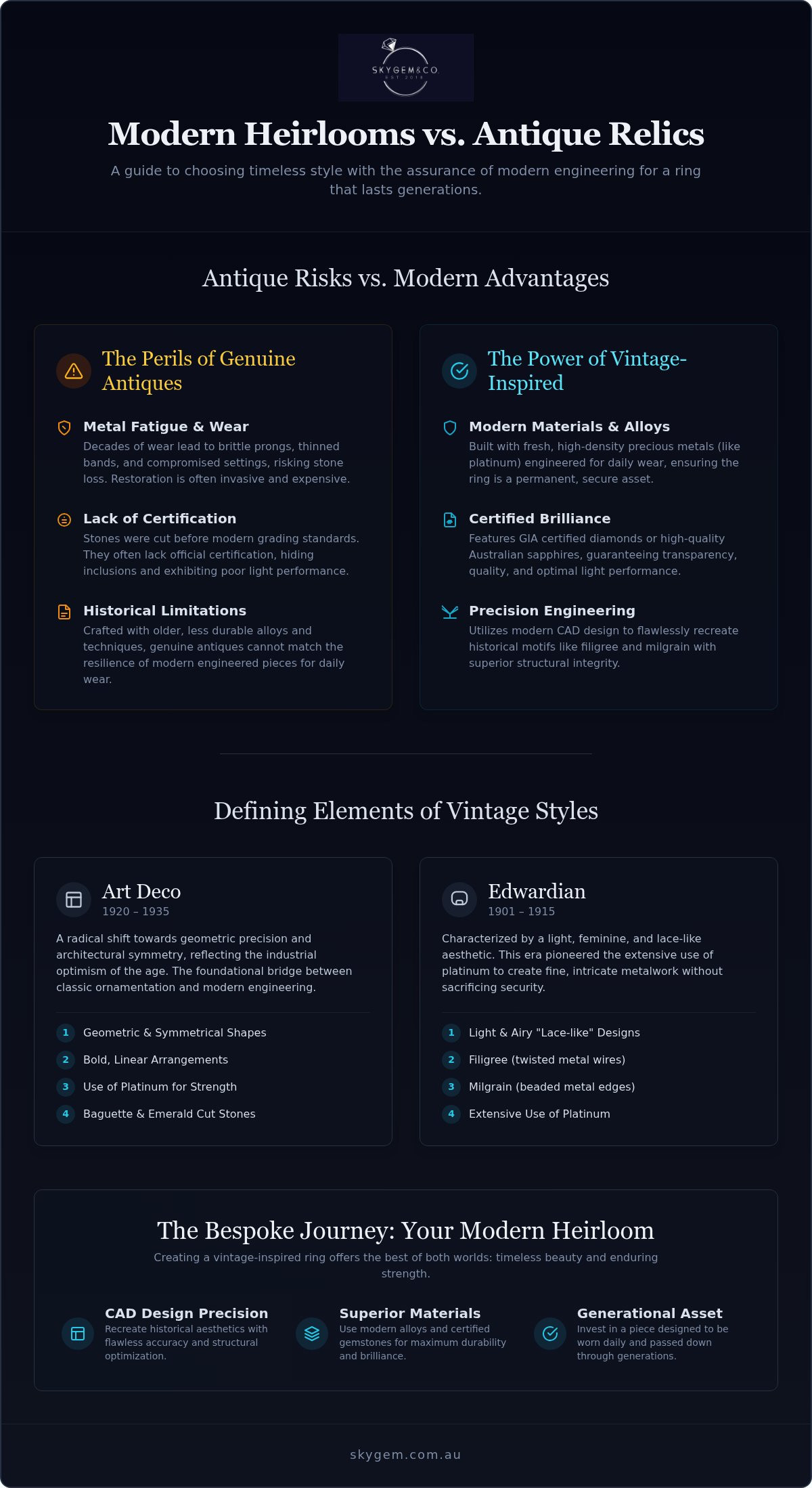
The Art Deco period, spanning from 1920 to 1935, represented a radical departure from organic forms toward geometric precision and architectural symmetry. This era coincided with the rise of platinum as a preferred metal, valued for its superior tensile strength and naturally white lustre that didn't require rhodium plating. Design silhouettes from this time often feature stepped shoulders and bold, linear arrangements that reflect the industrial optimism of the age.
Baguette and emerald cuts are particularly effective in Art Deco settings because their clean lines and step facets complement the era's focus on structured repetition. When we consult on these projects, we focus on the alignment of these stones to ensure the geometric integrity of the piece remains flawless. Art Deco serves as the foundational bridge between classical ornamentation and the streamlined engineering of modern bespoke jewellery.
Edwardian Elegance and Filigree Work
Preceding Art Deco, the Edwardian period (1901-1915) focused on a lighter, more feminine aesthetic often described as lace-like. This era was the first to extensively utilise platinum, allowing jewellers to create incredibly fine metalwork without compromising the ring's structural security. A hallmark of this style is milgrain, a technique where small beads of metal are applied to the edges of a setting to create a textured finish that diffuses light.
Filigree is another defining characteristic, involving the delicate twisting of fine metal wires into intricate patterns. It's vital to distinguish between genuine, hand-crafted filigree and modern cast imitations; the former offers a crispness and depth that mass-produced casting simply cannot replicate. For couples interested in vintage style engagement rings melbourne, these technical details are what transform a standard setting into a true heritage piece. Understanding the history of the engagement ring provides the necessary context to appreciate how these early 20th-century innovations continue to set the standard for high-end custom-made engagement ring design.
Antique vs. Vintage-Inspired: Evaluating Longevity and Craftsmanship
Deciding between a genuine antique and a modern recreation involves balancing aesthetic preference with technical performance. While an estate piece carries historical weight, it often presents invisible structural risks that can compromise the security of the centre stone. For clients seeking vintage style engagement rings melbourne, the bespoke route offers the opportunity to replicate the intricate motifs of Art Deco jewelry design while utilising contemporary alloys that are engineered for daily wear.
Addressing Metal Fatigue in Heritage Pieces
Precious metals are subject to fatigue over decades of use. In many 100-year-old heritage pieces, the prongs have become brittle or the band has thinned to a critical point where it can no longer support the weight of the setting. Restoring these items often requires invasive laser welding or total reconstruction. By starting with fresh, high-density precious metals in a bespoke project, you ensure the ring possesses the structural integrity required to serve as a permanent asset. For those investing in vintage style engagement rings melbourne, this technical reliability is a critical factor in ensuring the piece survives for future generations.
Modern Certifications in Classic Settings
A significant challenge with genuine antique rings is the lack of stone transparency. Historical stones were often cut before modern grading standards existed, meaning they may have hidden inclusions or lack the light performance of a modern cut. When you explore our range of natural diamonds, you have access to GIA-certified stones that meet rigorous quality benchmarks. This ensures your vintage-inspired setting houses a diamond with verified colour, clarity, and cut specifications.
Ethical considerations also play a vital role in the modern bespoke journey. Unlike estate jewellery with unknown origins, new gemstones can be sourced through transparent supply chains. The availability of lab-grown diamonds further allows for high-clarity centrepieces that align with modern values without sacrificing the classic aesthetic. If you're ready to begin your project, you can book a design consultation to discuss the technical requirements of your heritage-inspired ring.
Key Design Elements of Vintage-Style Engagement Rings
Recreating the aesthetic of a bygone era requires a precise understanding of the technical decorative techniques that defined historical jewellery. When commissioning vintage style engagement rings melbourne, the focus shifts from mass production to granular artistry. These elements aren't merely decorative; they serve to enhance the visual performance of the stones and the structural profile of the band. By integrating traditional motifs with modern engineering, we create pieces that capture a specific historical atmosphere while maintaining the durability required for a lifetime of daily wear.
The Art of Milgrain and Filigree
Milgrain, derived from the French "mille-grain" meaning a thousand grains, is a decorative technique where small beads of precious metal are applied to the edges of a setting. This creates a fine, textured border that diffuses light and adds a layer of sophistication to the metalwork. While many modern rings use cast milgrain patterns that can appear soft or blurred, a high-level bespoke project utilises technical CAD design to establish perfect symmetry before hand-finishing the textures. This ensures the crispness associated with authentic Edwardian era jewelry, where precision was a hallmark of luxury.
Filigree work involves the intricate manipulation of fine metal wires to create lace-like patterns within the ring's gallery. Achieving this level of detail requires a technical consultant who understands the limits of metal tension. In a modern context, we often combine these delicate visuals with reinforced under-galleries. This approach allows for the "hidden" details-such as small pavé-set stones or scrollwork visible only from the side profile-that provide a private narrative for the wearer without compromising the security of the centre stone.
Choosing the Right Metal for the Era
The choice of precious metal fundamentally dictates the ring's historical character and its long-term maintenance requirements. Platinum remains the gold standard for those seeking the geometric sharpness of the Art Deco period or the ethereal lightness of Edwardian designs. Its natural density allows for incredibly fine prongs and filigree that won't wear down as quickly as white gold. Conversely, yellow and rose gold alloys are essential for capturing the romantic, warm tones of the Victorian era, where floral engravings and soft curves were dominant.
Setting styles also play a critical role in era-specific accuracy. Bezel settings, where a metal rim completely surrounds the gemstone, offer a sleek, historical look that is exceptionally secure. Claw settings, while more common today, were historically more prominent in the late 19th century to allow maximum light entry into the stone. Our bespoke engagement ring process ensures that every technical choice, from the alloy composition to the setting style, aligns with your aesthetic goals. This methodical approach is what distinguishes high-quality vintage style engagement rings melbourne from generic, off-the-shelf alternatives.
Choosing Gemstones and Metals for a Heritage-Inspired Setting
The selection of a centrepiece gemstone is a technical decision that balances aesthetic heritage with physical durability. Historically, the vintage style engagement rings melbourne couples admire were not limited to white diamonds; they often featured vibrant coloured stones that provided deep visual contrast. Before the 1940s, sapphires and rubies were frequently the primary choice due to their high ranking on the Mohs scale of hardness. This physical property is vital for daily wear, as a stone must resist scratching and chipping over decades of mechanical contact.
Sapphires and Rubies in Vintage Design
Sapphires were the standard preference for engagement rings long before modern marketing shifted the focus toward diamonds. Their structural density makes them an ideal candidate for the fine, intricate settings found in bespoke vintage designs. Australian sapphires, particularly teal and peach varieties, are currently seeing a significant revival. For those commissioning vintage style engagement rings melbourne, teal sapphires offer a unique, multi-tonal depth that pairs exceptionally well with rose gold, creating a sophisticated contrast that feels both antique and modern. You can browse our curated collection of precious gemstones to identify a stone that aligns with your specific era-based design goals.
Diamond Cuts That Define the Era
The geometric silhouette of a diamond is the most immediate indicator of its historical inspiration. Art Deco enthusiasts typically gravitate toward Emerald and Asscher cuts, which feature step-cut facets that prioritise linear clarity over multi-directional sparkle. These cuts mirror the architectural movements of the 1920s and require high-clarity stones, as their large tables leave inclusions more visible to the naked eye. Alternatively, Victorian-inspired settings often utilise Oval or Pear cuts within romantic halo arrangements to achieve a softer, organic aesthetic. GIA certification remains essential for vintage-style stones because it provides a technical guarantee of light performance and stone integrity that historical "eye-grading" simply cannot match.
While yellow gold dominated the Victorian era, platinum became the industrial standard for the precision work of the early 20th century. Choosing the correct metal alloy is not just about colour; it's about the technical partnership between the metal's tensile strength and the security of the stones it holds. Our approach focuses on this long-term viability, ensuring the materials selected today remain stable for the next century.
The Bespoke Journey: Creating a Modern Heirloom
The creation of a custom ring is a methodical process that bridges the gap between historical artistry and modern engineering. For those seeking vintage style engagement rings melbourne, the bespoke journey provides a structured framework to ensure that aesthetic aspirations are matched by structural performance. This sequence moves from high-level conceptualisation to granular technical refinement, resulting in a piece that functions as a permanent asset rather than a temporary purchase.
The process begins with an initial consultation where we act as technical consultants to translate your vintage inspiration into a formal design brief. We examine specific era-based motifs and evaluate their feasibility within a modern setting. Sourcing the central gemstone follows, involving the evaluation of GIA-certified natural diamonds or high-performance lab-grown alternatives. Once the stone is secured, the project enters the CAD design phase. This technology allows for the precise visualisation of intricate details, such as under-gallery scrollwork, before manufacturing begins. It provides a platform for refinement, ensuring every geometric line aligns with the technical brief.
A Solution-Oriented Design Approach
Our methodology prioritises structural viability alongside aesthetic vision. By operating as a partnership, we provide budgetary transparency throughout the bespoke process, linking technical specifications directly to your long-term goals. High-quality jewellery requires extensive hand-finishing after the casting phase. This manual intervention ensures that textures remain crisp and prongs are perfectly seated, a level of detail often missing in mass-produced items. This phase is where the "New Vintage" standard is realised, marrying 1920s artistry with 2026 engineering standards.
The Final Polish and Aftercare
A modern heirloom requires ongoing maintenance to preserve its intricate details and ensure the security of the settings. Professional aftercare, including regular prong inspections and specialised cleaning, is essential for long-term viability. This commitment to maintenance ensures that your vintage style engagement rings melbourne remain as secure and vibrant as the day they were completed. For a broader perspective on the custom process and regional design standards, you may consult The Definitive Guide to Bespoke Jewellery. This holistic approach focuses on the intersection of technical precision and aesthetic design, providing a reliable path toward a lasting legacy.
Engineering Your Future Heirloom
Choosing a ring that captures historical elegance requires more than just an appreciation for the past; it demands a commitment to technical precision and material integrity. We've explored how modern CAD design and high-density alloys provide a structural foundation that genuine antiques often lack. By prioritising stone security and metal durability, you ensure your investment remains a permanent asset rather than a fragile relic.
Whether you're drawn to the geometric lines of Art Deco or the romantic motifs of the Victorian era, the bespoke journey allows for total customisation. You have the opportunity to integrate ethically sourced Australian Sapphires or GIA-certified diamonds into a setting designed specifically for your lifestyle. When seeking vintage style engagement rings melbourne, the goal is to balance timeless artistry with the reliability of modern engineering standards.
We look forward to acting as your technical consultants, guiding you through every specification to create a piece that truly lasts for generations.
Frequently Asked Questions
Is a vintage-style engagement ring more expensive than a modern solitaire?
The cost of a vintage-style piece is primarily influenced by the complexity of its decorative elements and the volume of precious metal required. While a modern solitaire focuses on a single stone and a streamlined band, vintage designs often incorporate labour-intensive techniques like hand-applied milgrain or intricate filigree. These technical details require higher levels of craftsmanship and time during the manufacturing phase, which can lead to a higher price point compared to a basic solitaire setting.
Can I use a family heirloom stone in a new vintage-style setting?
You can certainly integrate a family heirloom stone into a new bespoke setting. This approach allows you to preserve sentimental value while ensuring the structural integrity of the ring is modern and secure. Before manufacturing begins, a technical assessment of the stone is necessary to identify any existing chips or inclusions that might affect the setting process. This ensures your heritage diamond or sapphire is housed in a stable environment designed for long-term wear.
How do I clean a ring with intricate filigree or milgrain details?
Intricate details like milgrain and filigree require a gentle cleaning method to prevent debris buildup without damaging the fine metalwork. You should use a soft-bristled toothbrush and a solution of warm water with mild, pH-neutral soap to reach into the recessed areas of the design. Regular professional maintenance is also vital. A technical consultant can perform an ultrasonic clean and a thorough prong inspection to ensure the stones remain secure within their ornate settings.
What is the difference between antique, vintage, and estate jewellery?
These terms refer specifically to the age and history of a piece. Antique jewellery is defined as being at least 100 years old, while vintage items are typically between 20 and 100 years old. Estate jewellery simply refers to any piece that has been previously owned, regardless of its age. For those seeking vintage style engagement rings melbourne, a modern bespoke recreation offers the aesthetic of these eras with the superior structural performance of contemporary alloys.
Are lab-grown diamonds suitable for vintage-style engagement rings?
Lab-grown diamonds are an excellent choice for vintage-inspired designs as they possess the same physical, chemical, and optical properties as natural diamonds. They offer exceptional light performance and durability, making them suitable for the complex settings typical of Art Deco or Edwardian styles. Using a lab-grown centrepiece allows you to allocate more of your project resources toward intricate metalwork or larger stone specifications while maintaining a high standard of technical precision and ethical transparency.
How long does the bespoke design process take for a vintage ring?
The timeline for a bespoke project typically spans several weeks to account for the technical design and manufacturing phases. The CAD design phase alone requires dedicated time to refine intricate heritage patterns and ensure every geometric line is symmetrical. Following the approval of the digital model, the casting, hand-finishing, and stone-setting stages are completed with methodical care. This thorough approach ensures the final piece meets the rigorous quality standards required for a modern heirloom.
Which metal is best for a durable vintage-style engagement ring?
Platinum is the superior choice for durability, particularly for designs featuring fine filigree or delicate prongs. Its high density and tensile strength allow it to hold stones more securely over time compared to gold alloys. However, 18ct yellow or rose gold is ideal for capturing the specific warmth associated with Victorian-era romance. Your choice should balance your desired historical aesthetic with the technical requirements of the setting to ensure the ring's long-term structural viability.
Can I customise a vintage design to include modern elements like a hidden halo?
Customising a heritage-inspired design with modern features like a hidden halo is a common request in bespoke jewellery. This hybrid approach allows you to enjoy a classic profile while adding contemporary "secret" details that are only visible from certain angles. When creating vintage style engagement rings melbourne, our technical CAD process enables us to integrate these modern elements seamlessly into the under-gallery. This ensures the ring remains structurally sound while reflecting a unique, personal narrative that bridges different design eras.
Disclaimer
This article is for general informational purposes only and may include AI-assisted content. Pricing, specifications, and availability are subject to change. For accurate advice and current information, please contact SkyGem & Co. directly. Nothing in this content constitutes professional or financial advice.