
Understanding Alexandrite Colour Change: The Science of the 'Emerald by Day, Ruby by Night' Effect

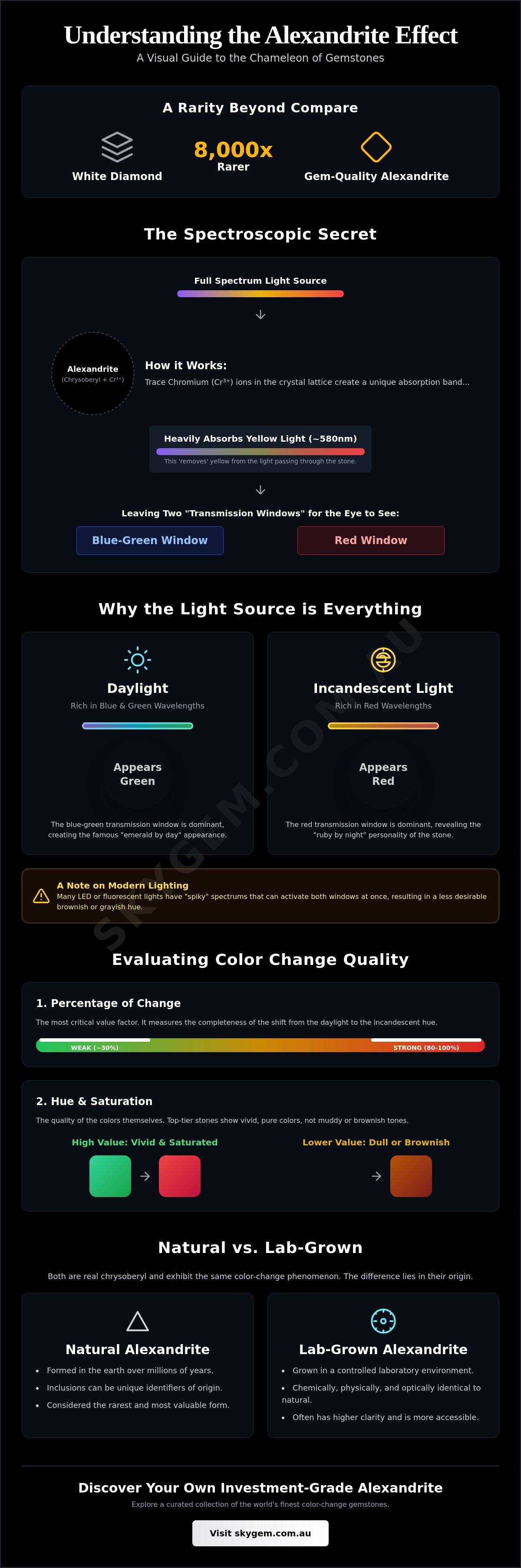
Gem-quality alexandrite is estimated to be 8,000 times rarer than white diamonds, yet its true prestige lies in a rare spectroscopic accident that defies standard gemological expectations. While many collectors are drawn to the 'emerald by day, ruby by night' allure, understanding alexandrite color change requires looking past the surface to the specific chromium trace elements within the chrysoberyl lattice. It's a complex phenomenon often confused with pleochroism, making it difficult for even seasoned investors to distinguish between a mediocre shift and a truly investment-grade specimen.
You likely recognize that a stone's value depends on the strength of this transition, but verifying whether a shift is truly 'strong' or 'weak' can feel subjective without a technical framework. We'll help you master the sophisticated physics and chemical composition behind these rare colour-shifting properties so you can secure a high-quality asset. This guide examines the specific absorption bands that create the effect, the difference between natural and lab-grown mechanics, and the rigorous grading standards used by leading laboratories to ensure your selection meets the highest professional benchmarks.
Key Takeaways
- Examine the chemical composition of chrysoberyl and how chromium impurities cause the specific light absorption that defines this rare phenomenon.
- Master the nuances of understanding alexandrite color change by comparing the impact of blue-green rich daylight against red-dominant incandescent light sources.
- Learn to evaluate the three critical pillars of quality, focusing on why the percentage of change and hue saturation determine a stone's long-term value.
- Gain clarity on the technical differences between natural specimens and lab-grown alternatives, including the sophisticated growth methods used for high-quality synthetics.
- Explore how specific precious metals and open-setting designs can either enhance or diminish the intensity of the gemstone's shifting phases.
The Science of the Alexandrite Effect: A Spectroscopic Overview
The Alexandrite Effect is a complex optical phenomenon characterized by a significant shift in hue when viewed under different light sources. Unlike simple surface reflections or the sparkle of a diamond, this is a phenomenon of varying absorption within the stone's internal structure. For those committed to understanding alexandrite color change, it's essential to recognize that this shift is a direct result of the gemstone's unique chemical composition. Alexandrite is a variety of chrysoberyl (BeAl2O4) that contains trace amounts of chromium (Cr3+) impurities. These impurities are not merely additives; they are the primary drivers of the stone's value and visual identity.
While many minerals exhibit pleochroism, which is a change in colour based on the angle of observation, the alexandrite effect is fundamentally different. It depends entirely on the spectral composition of the ambient light rather than the viewer's orientation. The crystal lattice structure of chrysoberyl provides a stable environment for chromium ions, yet it differs from other minerals like emerald or ruby. In those stones, chromium typically produces a single, consistent hue. In alexandrite, the lattice environment causes the chromium to react dynamically to the surrounding light spectrum, creating the famous 'emerald by day, ruby by night' transition.
Chromium's Role in Light Absorption
In the formation of alexandrite, chromium ions replace aluminium within the crystal lattice. This substitution is not a perfect fit, creating a specific internal tension that influences how the stone interacts with photons. Specifically, these ions cause a heavy absorption of yellow light at approximately 580 nm. This concentrated absorption band acts as the catalyst for the shift, effectively stripping the yellow portion from the visible spectrum and leaving only the blue-green and red extremes to reach the eye.
Transmission Windows: The Blue-Green and Red Balance
Because the yellow light is absorbed, the stone creates two distinct "windows" of transmission that allow light to pass through simultaneously. One window sits in the blue-green part of the spectrum, while the other occupies the red. The perceived colour depends on which light source provides more energy to these specific windows. Natural daylight is rich in blue and green wavelengths, causing the stone to appear emerald-like. Conversely, incandescent light is weighted toward the red end, activating the second window. Achieving a balance where the stone sits halfway between these states requires a precise concentration of chromium. This differs significantly from standard alexandrite gemstones of lower quality or sapphires, where a single transmission window usually dominates the visual profile regardless of the light source.
Light Sources and the Visible Spectrum: Why Environment Matters
Light is not a static medium; it is a complex distribution of energy across the visible spectrum. For anyone committed to understanding alexandrite color change, it's vital to grasp that the stone acts as a spectral filter. Its appearance is entirely dictated by the dominant wavelengths of the ambient environment. This interaction is often measured on the Kelvin (K) scale, where lower temperatures represent 'warm' red light and higher temperatures represent 'cool' blue light. A high-quality alexandrite requires a light source with a specific spectral output to activate its distinct transmission windows. Detailed research into the science of chrysoberyl confirms that the chromium ions within the lattice are specifically tuned to react to these environmental shifts.
Modern lighting environments, particularly those utilizing LED and fluorescent technology, can often 'confuse' the gemstone's appearance. Unlike the smooth, continuous curve of natural sunlight, many LEDs have 'spiky' spectral distributions. These spikes can inadvertently activate both the blue-green and red transmission windows simultaneously, resulting in a muddy brownish or greyish hue. This is why professional gemologists always evaluate a stone under controlled, standardized light sources. For those seeking a specimen with a verified, dramatic shift, exploring a curated collection of alexandrite gemstones is the best way to observe these physics in practice.
The 'Emerald by Day' Phenomenon
During daylight hours, the stone is exposed to a spectrum rich in high-energy blue and green wavelengths. Sunlight, especially northern daylight with a color temperature of approximately 5500K to 6500K, provides ample energy that passes through the gemstone's green transmission window. This abundance of blue-green light effectively suppresses the red window, making the stone appear vibrant green or bluish-green. Atmospheric conditions play a role here too. Overcast skies tend to enhance the blue tones, while direct, midday sun can increase the saturation of the green. While other precious gemstones like emerald or tsavorite garnet maintain a consistent green regardless of the light source, alexandrite’s dual-nature makes it a dynamic asset.
The 'Ruby by Night' Phenomenon
As the environment shifts to incandescent light or candlelight, the available energy moves toward the red end of the spectrum. Incandescent bulbs, typically sitting around 2700K, are virtually devoid of blue and green wavelengths. Because there is no blue-green light to transmit, the stone's chromium ions allow the dominant red wavelengths to pass through the secondary window. This results in the 'ruby by night' effect, where the stone transforms into a purplish-red or raspberry hue. The warmth of the light source is the critical factor. In the trade, a 'raspberry red' is considered the most sought-after incandescent hue, as it indicates a clean, high-percentage transition without the interference of secondary brown or orange tones.
Evaluating Colour Change Quality: The Professional Framework
Assessing a specimen requires a systematic approach that separates subjective beauty from technical performance metrics. When alexandrite gemstones are evaluated for investment or bespoke design, professionals rely on three primary pillars: percentage of change, hue saturation, and clarity. By applying this rigorous technical lens, understanding alexandrite color change becomes a matter of data-driven observation rather than guesswork. It's a process of identifying how effectively the stone filters the visible spectrum to produce a distinct, high-contrast transition.
Percentage and Degree of Shift
Gemmologists grade the transition on a percentage scale, typically ranging from 50% to the elusive 100% mark. A 100% change indicates that every facet of the stone shifts hue completely when moved between light sources. While the trade considers an 85% to 100% shift as investment grade, these stones are exceptionally rare in natural deposits. In fact, even a 30% to 40% shift is considered significant for a natural stone if the clarity remains high. According to the GIA, the alexandrite effect is most prized when the transition is "complete," moving from a crisp forest green to a distinct purplish-red without lingering brown or grey undertones.
The Impact of Hue and Saturation
The value of the shift isn't just about the percentage of the stone that changes; it's about the quality of the colours involved. Primary hues—vivid green and vivid red—command the highest premiums in the global market. If a stone displays secondary hues like yellowish-green or brownish-red, its value drops, as these muddy the visual impact of the shift. Saturation must be carefully balanced. It needs to be intense enough to make the transition distinct, yet low enough to avoid 'extinction,' a state where the stone appears black due to excessive light absorption. High-quality saturation ensures the 'speed' of the transition feels immediate when moving between environments.
A common issue in lower-quality specimens is 'bleed-through,' where both green and red components are visible simultaneously under a single light source. This usually indicates a lack of spectral purity and is generally undesirable in premium stones. The cut of the gemstone also plays a vital role in this framework. A master lapidary will orient the stone to maximize the light's path through the crystal lattice, ensuring the chromium ions have the best opportunity to activate the shift. An inferior cut can 'choke' the light, making a stone with high chromium content appear dull or unresponsive.
Natural vs. Lab-Grown Alexandrite: Mechanics of the Shift
While the visual results may appear similar to the untrained eye, the mechanics behind lab-grown and natural specimens differ significantly in their origin and consistency. Lab-grown alexandrite is a 'true' synthetic, meaning it possesses the exact chemical, physical, and optical properties as its natural counterpart. For those committed to understanding alexandrite color change, it's vital to recognize that laboratory environments allow for precise control over chromium levels. This often results in a 100% colour change that is difficult to find in nature. Two primary methods dominate the market: the Czochralski 'pulled' method, which creates large, high-clarity crystals by pulling them from a melt, and the Flux method, which utilizes a chemical solvent to grow crystals over several months, more closely mimicking geologic processes.
Natural alexandrite remains the pinnacle of rarity, especially specimens from the historical Ural Mountain deposits in Russia. These stones set the benchmark for the 'emerald by day, ruby by night' effect, though modern supplies primarily come from Brazil and Sri Lanka. Data from early 2026 indicates that yields from the significant Hematita mine in Brazil have dropped to just 12% of their 2012 production levels. This scarcity, combined with a 22% increase in global demand for top-tier stones over the last 24 months, reinforces the status of natural alexandrite as a high-performance asset for serious collectors.
The Value Proposition of Natural Stones
Natural stones carry 'fingerprints of nature' in the form of inclusions. As a Type II gemstone, alexandrite is expected to have some internal characteristics, and these serve as essential proof of natural origin. The investment value of unheated, natural alexandrite is substantial; a top-tier one-carat stone purchased in 2014 was reported to have surged in value by 300% by 2024. This long-term viability makes natural stones a preferred choice for heritage pieces, much like the decision-making process detailed in our lab grown diamonds guide, where the balance between rarity and accessibility is a key consideration for modern buyers.
Identifying Synthetic Transitions
Identifying a synthetic stone often requires looking for perfection. Lab-grown alexandrite frequently appears 'too clean' and may exhibit a slightly different spectral shift, often moving from a vivid blue to a deep purple rather than the classic forest green to raspberry red. Because these stones are mass-produced, they lack the investment potential of natural specimens. Independent verification is essential. A GIA or AGL certificate is the only way to confirm a stone's natural origin and the exact percentage of its colour shift. If you prioritize the visual drama of a 100% shift over historical rarity, you can browse our alexandrite gemstones to compare the technical performance of various specimens and find the right balance for your project.
Selecting Alexandrite for Bespoke Jewellery Design
While the technical properties discussed in previous sections establish the stone's rarity, the final success of a project depends on how these characteristics are integrated into a physical environment. Selecting a mounting for alexandrite requires a deep understanding of light management. Because the stone relies on specific spectral absorption, the surrounding materials must support rather than hinder this process. With a hardness of 8.5 on the Mohs scale, alexandrite is a practical and durable choice for daily wear, sitting just below sapphire and ruby in terms of resilience. This makes it an excellent candidate for engagement rings that require both aesthetic brilliance and long-term durability.
A successful design balances the stone's dual nature by providing a neutral backdrop that doesn't bias the colour shift toward one end of the spectrum. Pairing the gemstone with high-quality side stones, such as natural GIA certified diamonds, can provide a necessary point of reference. The white brilliance of a diamond helps the eye calibrate its perception of the alexandrite's primary hue, making the 'emerald' or 'ruby' phases appear even more saturated by comparison. This technical approach ensures that the gemstone remains the focal point regardless of the ambient lighting.
The Impact of Metal Reflectivity
Metal choice acts as a permanent environmental filter for the stone. White metals, such as Platinum or 18K White Gold, are the preferred choice for highlighting the 'emerald' green phase of the stone. These metals provide a crisp, neutral reflection that doesn't introduce warm tones into the blue-green transmission window. While Rose Gold can beautifully enhance the 'ruby' red phase, it often introduces copper-toned reflections that can muddle the green phase, making it appear brownish. For those exploring bespoke engagement rings, selecting a metal that complements both phases is a critical decision in the design phase.
Designing for the 'Alexandrite Effect'
The architecture of the setting must prioritize light entry to activate the stone's chromium ions effectively. Specific styles, such as a solitaire, are ideal because they allow light to enter the stone from multiple angles. We recommend 'open' settings with a minimal under-gallery to ensure that light isn't 'choked' by excessive metal. This structural transparency is essential for understanding alexandrite color change in a real-world setting. During a custom-made engagement ring consultation, it's best to view the stone under both daylight and incandescent sources to ensure the setting doesn't create unwanted shadows that could dampen the intensity of the shift.
Securing Your Investment in Rare Optical Phenomena
Masterful gemstone selection requires a synthesis of spectroscopic knowledge and design precision. You've explored how chromium ions dictate the stone's dual-nature and why the Kelvin scale is a vital tool for evaluating performance in different environments. Understanding alexandrite color change ensures that your selection is based on quantifiable metrics, from the percentage of shift to the spectral purity of the hues. These technical considerations are what separate a common specimen from a truly investment-grade asset that doesn't lose its relevance over time.
As specialists in unheated and rare gemstones, we act as technical consultants to help you navigate these complexities. Whether you seek expert gemmological consultations or require bespoke design services for unique engagement rings, our focus remains on technical excellence and reliability. We invite you to explore our curated collection of rare alexandrite gemstones to find a specimen that meets your exact performance standards. Securing a piece of this rare spectroscopic history is a sophisticated step toward a permanent and evolving legacy.
Frequently Asked Questions
What exactly causes the colour change in alexandrite?
Chromium (Cr3+) ions within the chrysoberyl crystal lattice are the primary cause of the transition. These ions create a concentrated absorption band at approximately 580 nanometres, which effectively removes yellow wavelengths from the visible spectrum. This leaves two distinct transmission windows, blue-green and red, that allow the stone to react dynamically to the specific wavelengths present in the ambient light source.
Is alexandrite colour change the same as pleochroism?
They're distinct optical phenomena. Pleochroism involves a gemstone displaying different colours based on the viewing angle due to its crystal structure. In contrast, the alexandrite effect depends entirely on the spectral composition of the ambient light source. Understanding alexandrite color change requires distinguishing between these two, as a high-quality stone can exhibit both effects simultaneously, though only one is light-dependent.
Does lab-grown alexandrite change colour as well as natural stone?
Lab-grown alexandrite is a true synthetic that shares the same chemical and physical properties as natural specimens, including the colour-shift mechanism. Because laboratory environments allow for precise control over chromium concentrations, synthetic stones often exhibit a consistent and dramatic 100% colour shift. While they lack the investment value of natural stones, their technical performance is often superior in terms of clarity and the speed of the transition.
What lighting conditions show the best alexandrite colour shift?
The most dramatic shift occurs when moving between natural northern daylight and traditional incandescent light. Daylight, which is rich in blue and green wavelengths, activates the primary transmission window. Incandescent light or candlelight, which is weighted toward the red end of the spectrum, activates the secondary window. Avoiding modern LEDs with spiky spectral distributions is essential for observing the cleanest and most accurate transition.
Why does my alexandrite look brownish or grey in certain lights?
A muddy or grey appearance usually indicates a lack of spectral purity or the interference of secondary hues. This often happens under modern fluorescent or LED lighting, which can activate both transmission windows simultaneously. In lower-quality stones, this bleed-through is more pronounced, preventing the stone from reaching a distinct green or red phase regardless of the light source's colour temperature.
Is alexandrite durable enough for an engagement ring?
With a Mohs hardness rating of 8.5, alexandrite is exceptionally durable and well-suited for daily wear in engagement rings. It's more resilient than most other coloured gemstones, surpassed only by sapphire, ruby, and diamond. Its structural stability ensures that the facets remain crisp and the polish lasts for decades, making it a reliable choice for long-term jewellery assets that require minimal maintenance.
How do I know if the colour change in a gemstone is high quality?
High-quality change is defined by a high percentage of transition and the purity of the resulting hues. Ideally, a stone should shift at least 85% of its visible surface from a vivid forest green to a distinct raspberry red. When you're committed to understanding alexandrite color change, you'll look for the absence of brown, yellow, or grey undertones during the transition between light sources.
Why is natural alexandrite so much more expensive than other gemstones?
Natural alexandrite’s high value is a result of its extreme geological scarcity and the specific conditions required for its formation. It requires beryllium and chromium to meet under rare tectonic circumstances, a process that occurs in very few locations worldwide. With production from historical sources declining and global demand for investment-grade stones rising, the limited supply of natural specimens ensures they remain among the most expensive gemstones on the market.
Disclaimer
This article is for general informational purposes only and may include AI-assisted content. Pricing, specifications, and availability are subject to change. For accurate advice and current information, please contact SkyGem & Co. directly. Nothing in this content constitutes professional or financial advice.