
The Price of Diamonds: Understanding the Relationship Between Price and Characteristics

In April 2026, the RapNet Diamond Index for 1-carat stones fell by 1.4%, yet the price for 0.30-carat diamonds actually rose by 2.6%. This data confirms that diamond value is not a linear scale but a complex interplay of market demand and technical rarity. You likely feel overwhelmed by technical grading reports or the fear of overpaying for characteristics that remain invisible to the naked eye. It is a common frustration when trying to reconcile a specific budget with the desire for a high-performance stone.
This guide provides the technical clarity required to master the price of diamonds: a relationship between price and characteristics. We will equip you with a professional framework to balance the 4Cs and achieve maximum visual impact for your investment. We examine the latest 2026 industry shifts, such as the EU enforcement of diamond origin statements and GIA's simplified grading for lab-grown stones, to ensure you select a certified stone with absolute confidence. You will learn how to prioritise specific attributes to secure a high-value asset that meets both your aesthetic and financial objectives.
Key Takeaways
- Understand the non-linear pricing of carat weight and why a single 1.0ct stone carries significantly more value than two 0.50ct diamonds of equal quality.
- Identify why the Round Brilliant cut maintains a consistent price premium over fancy shapes and how to evaluate fluorescence to ensure optimal light performance.
- Master the price of diamonds: a relationship between price and characteristics to find the technical "sweet spot" where aesthetic beauty meets financial efficiency.
- Evaluate the long-term investment outlook for GIA certified natural diamonds compared to the immediate cost-effectiveness of modern lab-grown alternatives.
- Learn how a bespoke consultation allows you to leverage the "Jeweller’s Eye" to source stones that outperform their technical paper grades.
The 4Cs: Establishing the Baseline of Diamond Valuation
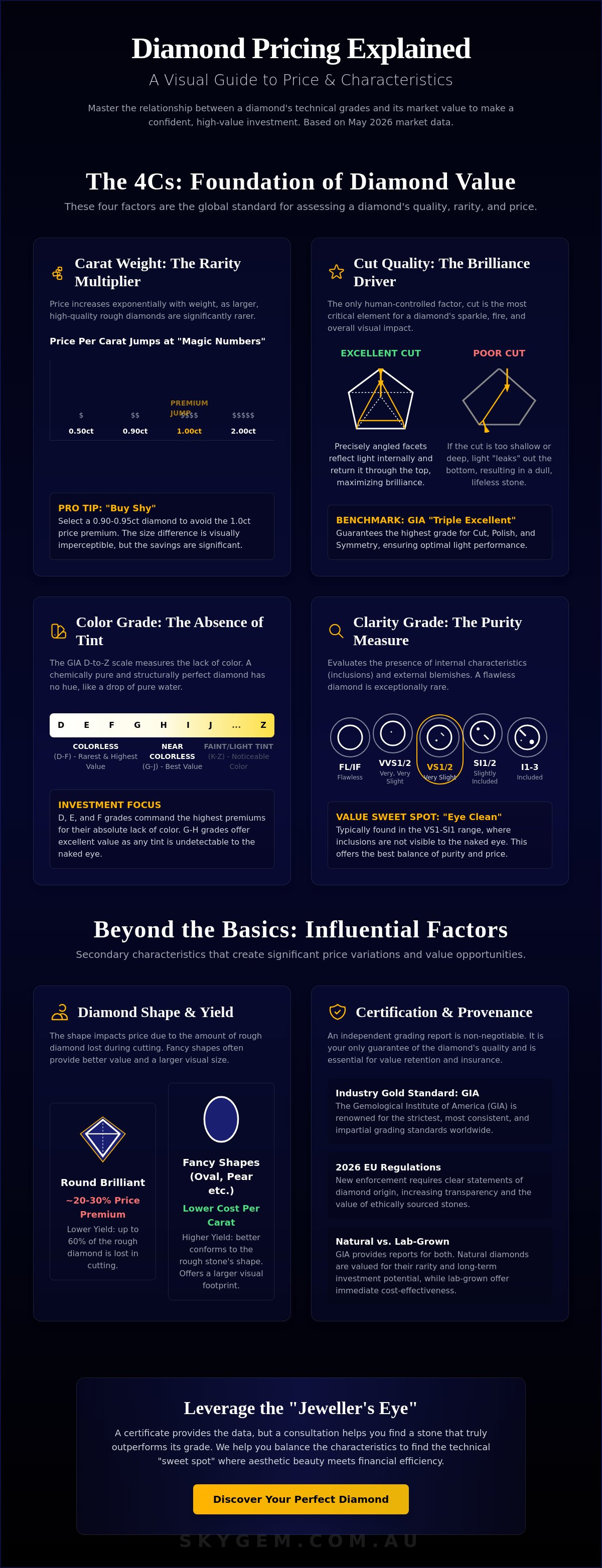
To accurately assess the price of diamonds: a relationship between price and characteristics, you must first master the 4Cs. These technical benchmarks, comprising Carat, Colour, Clarity, and Cut, form the foundational framework used by laboratories like the GIA to quantify rarity. While many buyers view these as independent variables, they function as an integrated system where one attribute directly influences the performance of another. A diamond's value isn't merely a sum of its parts; it's a reflection of how these specific Diamond characteristics interact to produce a stone of exceptional rarity and light performance.
The Exponential Nature of Carat Pricing
Carat weight is a measurement of physical mass where one carat equals exactly 0.2 grams; it doesn't correlate linearly with price. In the current May 2026 market, a 1.0ct diamond costs significantly more than two 0.50ct stones of identical quality. This occurs because large, high-quality rough crystals are exponentially rarer to mine than smaller ones. Professional buyers often target "magic numbers" such as 0.50ct, 1.0ct, and 2.0ct, where price per carat spikes sharply. To maximise value, we often recommend "buying shy" by selecting a 0.90ct or 0.95ct stone. This strategy allows you to avoid the 1.0ct price premium while securing a diamond that's visually indistinguishable from its heavier counterparts.
Colour and clarity further refine this valuation. The D-to-Z colour scale measures the absence of tint, with colourless D-grade stones commanding the highest premiums due to their scarcity. Clarity tracks the internal and external landscape of the stone, transitioning from "Included" to the pinnacle of "Internally Flawless." For most high-value investments, finding an "Eye Clean" stone, where inclusions aren't visible to the naked eye, is the most practical way to balance technical rarity with cost-effectiveness.
Light Performance and the "Triple Excellent" Standard
Cut is the only human-controlled factor in the 4Cs, making it the most critical element for visual impact. Even a diamond with perfect colour and clarity will appear dull if the cut proportions are poor. The industry benchmark for a natural white diamond is the GIA "Triple Excellent" rating, which confirms that the cut, polish, and symmetry meet the highest technical standards.
This precision directly dictates scintillation, the play of light and dark flashes seen when the stone moves. A Triple Excellent rating ensures that light enters the crown and reflects back to the observer's eye rather than leaking through the pavilion. When you prioritise cut precision, you ensure the diamond achieves maximum luminous efficacy, often allowing a stone with slightly lower colour or clarity grades to outshine a theoretically "better" stone on paper. Understanding this synergy is vital when navigating the price of diamonds: a relationship between price and characteristics to ensure your investment delivers lasting aesthetic value.
Beyond the Basics: How Shape and Fluorescence Influence Cost
While the 4Cs establish the baseline, secondary technical specifications frequently cause significant price fluctuations. Understanding the price of diamonds: a relationship between price and characteristics requires looking beyond the grade to the physical geometry and chemical properties of the stone. Factors such as shape and fluorescence aren't merely aesthetic choices; they're economic drivers that reflect the efficiency of the cutting process and the market's perception of rarity.
The Yield Factor: Why Shape Matters
The Round Brilliant cut remains the industry benchmark, typically commanding a 20% to 30% premium over fancy shapes. This price gap is primarily dictated by the "yield" from the rough diamond crystal. When a master cutter produces a Round Brilliant, they often lose approximately 50% to 60% of the original rough stone's mass. In contrast, elongated shapes like Ovals, Pears, and Marquises follow the natural octahedral shape of diamond rough more closely. This efficiency allows for a higher carat weight retention, translating to a lower cost per carat for the consumer. Beyond price, these shapes offer a larger visual footprint, making them a strategic choice for those seeking maximum surface area.
The Fluorescence Discount or Premium
Fluorescence refers to a diamond's tendency to emit a soft glow, usually blue, when exposed to ultraviolet light. This characteristic remains a point of technical debate. In high colour grades like D, E, or F, strong fluorescence often results in a market discount because of the potential for a milky or oily appearance that hinders transparency. However, for stones in the I to K colour range, blue fluorescence can actually serve as a benefit. It effectively masks yellowish tints, making the diamond appear whiter in natural sunlight. As of May 2026, market data shows that elongated fancy shapes in the 2-carat plus range are seeing increased demand in the Australian market.
Final valuation also depends on the "make" of the stone, which includes symmetry and polish. These finishing touches ensure that every facet aligns perfectly to redirect light. Minor deviations in symmetry can lead to light leakage, reducing the stone's brilliance regardless of its clarity grade. By examining these factors, you can better navigate the price of diamonds: a relationship between price and characteristics that rewards technical knowledge. If you're comparing stones, viewing a curated selection of diamonds online in Melbourne can help you identify how these subtle technical differences impact the final price.
The Synergistic Relationship: How Characteristics Interact to Dictate Price
Technical rarity doesn't always translate to visual superiority. To master the price of diamonds: a relationship between price and characteristics, you must understand how these variables interact rather than viewing them in isolation. While a D-colour, Internally Flawless (IF) stone represents the pinnacle of laboratory grading, a G-colour, VS2-clarity diamond often appears identical to the naked eye. The price difference between these two stones can be substantial, yet the aesthetic return on that extra investment is negligible for most wearers. We focus on finding the "sweet spot" where technical specifications and budget efficiency intersect.
Metal choice also plays a critical role in this technical synergy. If you're selecting a setting in 18K White Gold or platinum, the white metal will highlight any slight yellow tint in the stone. This requires a higher colour grade, typically G or better, to maintain a bright, colourless appearance. Conversely, yellow or rose gold settings allow for more flexibility. The warm tones of the metal complement stones in the I to K colour range, allowing you to reallocate your budget toward a higher carat weight or superior cut precision.
Visual Balance vs. Paper Grade
The concept of "Eye Clean" diamonds is the most effective way to manage costs without compromising beauty. For most engagement rings, an SI1 or VS2 clarity grade provides a stone where inclusions are invisible without 10x magnification. However, this relationship changes as carat weight increases. Large diamonds have larger facets, which act as windows into the stone. While a VS2 is usually eye-clean at 1.0ct, a 2.0ct or 3.0ct diamond may require a VS1 or VVS2 grade to ensure no internal characteristics are visible to the observer. This scaling requirement is a vital component of the price of diamonds: a relationship between price and characteristics.
The Relationship Table: Price Sensitivity by Characteristic
Establishing a hierarchy of importance allows you to build a stone that performs above its paper grade. Our technical framework for balancing the 4Cs prioritises attributes based on their impact on light performance:
- Cut: Non-negotiable. Always splurge here. A "Triple Excellent" cut is the engine of the diamond's brilliance.
- Colour: Context-dependent. Spend enough to ensure the stone looks white in its specific metal setting.
- Clarity: Functional. Only pay for the grade required to achieve an "Eye Clean" result.
- Carat: Flexible. Use the "buy shy" strategy mentioned in previous sections to reach your target size.
Rarity on a certificate doesn't always equal beauty on the finger. By distinguishing between "Investment Grade" stones—those bought for their paper rarity—and "Aesthetic Grade" stones—those bought for their visual performance—you can make a more informed and confident purchase.
Provenance and Certification: Protecting Your Investment
Certification is not merely a document of purchase; it is the technical validation of your asset's identity. In the global trade, the price of diamonds: a relationship between price and characteristics is only as reliable as the laboratory issuing the report. The Gemological Institute of America (GIA) remains the global benchmark because their grading criteria are consistently more stringent than smaller, "in-house" labs. These lesser laboratories often inflate colour or clarity grades to justify higher retail prices, which can lead to significant financial loss for an uninformed buyer. A GIA report ensures the characteristics you pay for are precisely what you receive.
The Lab-Grown Revolution and Price Dynamics
As of 2026, lab-grown diamond prices have largely decoupled from the rarity-based pricing of natural stones. Market data from May 2026 indicates that lab-grown alternatives now cost between 60% and 80% less than natural diamonds of comparable quality. This shift allows buyers to prioritise the highest technical grades—such as "premium" descriptors under the revised 2026 GIA standards—at a lower entry point. While this offers exceptional aesthetic value, it is vital to distinguish between these manufactured stones and the long-term asset stability of natural stones. For a deeper technical analysis of this sector, consult our Lab Grown Diamonds: The 2026 Comprehensive Australian Buying Guide.
The "Fifth C": Confidence and Certification
Technical verification extends beyond the digital report. Every Natural GIA Certified Diamond features a microscopic laser inscription on the girdle that must match the certificate exactly. This protects you against stone switching and confirms provenance. This is particularly relevant following the January 2026 EU regulations that mandate a "Due Diligence Statement on Diamond Origin" for polished stones of 0.50 carats or larger. A reputable Australian jeweller uses these markings to verify the stone's data under 40x magnification, providing a layer of security that paper documents alone cannot offer.
Future-proofing your purchase requires this level of independent valuation and ethical transparency. By selecting stones with verified provenance, you ensure your investment retains its integrity and secondary market interest. Understanding the price of diamonds: a relationship between price and characteristics relies on this foundational trust. You can explore our strictly vetted collection of Natural GIA Certified Diamonds to see how provenance influences long-term asset stability.
The Bespoke Path: Balancing Characteristics for Your Budget
Navigating the global diamond market requires more than a basic understanding of the 4Cs. While previous sections detailed the technical synergies that define the price of diamonds: a relationship between price and characteristics, the bespoke path provides a strategic advantage that retail lists cannot replicate. A professional consultation allows you to leverage the "Jeweller’s Eye" to source stones that perform significantly above their paper grade. This involves identifying diamonds with optimal facet angles and light return that a standard certificate might not fully convey, ensuring you don't pay a premium for technical rarity that offers no visual benefit.
Sourcing the Impossible: The Procurement Process
In the current 2026 landscape, sourcing the ideal stone involves accessing real-time global inventories rather than relying on static retail stock. This procurement process ensures that we can find specific characteristic combinations, such as an exceptionally bright G-colour stone with VS2 clarity that avoids the "magic number" price spikes discussed earlier. Once the stone is secured, advanced CAD design is utilised to ensure the diamond is showcased optimally within a custom-made engagement ring. This technical precision ensures that the setting does not obstruct light entry, maintaining the stone's luminous efficacy. For a deeper look at this integrated process, see our guide on Bespoke Engagement Rings: The Definitive Guide to Custom Design.
From Concept to Creation
Setting a realistic budget requires a clear hierarchy of the characteristics you prioritise. If maximum visual impact is the objective, we focus the investment on cut precision and carat weight while managing colour and clarity requirements based on the chosen metal and setting style. Hand-finished settings provide a level of durability and precision that mass-produced rings cannot match, protecting the stone's integrity for the long term. This tailored approach is the most efficient way to navigate the price of diamonds: a relationship between price and characteristics while ensuring the final piece meets your exact architectural and aesthetic standards.
As you finalise your selection in 2026, use this checklist to ensure a high-value investment:
- Verify the GIA certificate matches the microscopic laser inscription on the stone's girdle.
- Ensure the diamond origin complies with the latest 2026 EU traceability standards for stones over 0.50ct.
- Confirm the "Triple Excellent" rating for round diamonds to guarantee maximum scintillation.
- Consult with a technical specialist to identify "Eye Clean" stones that offer better value than higher clarity grades.
We invite you to book a technical consultation to receive a tailored quote and expert guidance on balancing technical specifications for your specific project requirements.
Securing Long-Term Value Through Technical Precision
Selecting a high-value diamond requires a transition from emotional preference to technical evaluation. We established that valuation is a non-linear process driven by technical rarity and light performance. You now understand how carat "magic numbers" and shape-specific yields dictate market costs. By mastering the price of diamonds: a relationship between price and characteristics, you can move beyond basic paper grades to identify stones that offer the greatest visual return for your investment. This analytical approach ensures you don't pay a premium for technical attributes that remain invisible to the observer.
Protecting your asset requires the rigorous standards of GIA Certified Natural Diamonds and the security of verified provenance, especially following the 2026 EU enforcement of origin statements. At SkyGem & Co., we integrate precision bespoke engineering with Australian-led design excellence to ensure every stone is showcased with technical perfection. It's about more than just a purchase; it's a partnership focused on durability and aesthetic performance. Begin your journey with a technical diamond consultation at SkyGem & Co. to secure a stone that balances performance and value. We look forward to helping you select a diamond that meets your exact technical and architectural requirements with absolute confidence.
Frequently Asked Questions
How much should I spend on a diamond engagement ring in 2026?
Expenditure should align with your specific financial objectives rather than arbitrary social rules. In April 2026, market data showed a divergence where 1-carat round diamond prices fell by 1.4% while smaller 0.30-carat stones rose by 2.6%. This volatility suggests that setting a budget based on technical performance—prioritising cut precision over absolute carat weight—is the most sustainable approach for securing a high-value asset.
Does a higher clarity grade make a diamond sparkle more?
Clarity has almost no impact on a diamond's sparkle; that is the primary function of the cut. While clarity grades like VVS1 or IF ensure the absence of internal characteristics under 10x magnification, sparkle is a result of light performance and scintillation. A "Triple Excellent" cut is the engine of brilliance, whereas clarity simply ensures the stone remains transparent and "eye clean" to the observer.
Is there a specific relationship between diamond shape and its perceived size?
Elongated shapes such as Ovals, Marquises, and Emerald cuts provide a larger visual footprint than round diamonds of the same carat weight. This occurs because of the surface area distribution on the crown of the stone. Choosing an elongated fancy shape allows you to achieve a more significant aesthetic impact without the exponential cost increase associated with moving to a higher carat weight bracket.
Why are natural diamonds more expensive than lab-grown if they look the same?
Natural diamonds carry a premium due to geological rarity and finite supply chain dynamics. As of May 2026, lab-grown diamonds cost 60-80% less because they're manufactured in controlled laboratory environments. Natural stones are finite assets, and their value is underpinned by global mining constraints and new 2026 EU regulations regarding origin traceability, which manufactured stones don't share.
Can fluorescence actually make a diamond more valuable?
Fluorescence usually results in a market discount rather than a price premium. While it's technically a characteristic that can lower the entry price for a stone, it can improve the visual appearance of J or K colour stones by making them look whiter in natural sunlight. However, from a strictly financial perspective, fluorescence remains a factor that reduces the cost per carat compared to non-fluorescent stones.
What is the most important of the 4Cs when considering price?
Carat weight is the most significant driver of the price of diamonds: a relationship between price and characteristics. Because larger stones are exponentially rarer, the price per carat increases sharply at "magic numbers" like 1.0ct or 2.0ct. While cut dictates the visual beauty, the physical mass of the stone is what primarily determines the baseline financial investment required for the purchase.
How does GIA certification affect the resale value of a diamond?
GIA certification provides a globally recognised technical baseline that facilitates secondary market liquidity. Without an independent report, a diamond's characteristics are subjective, which increases the risk for future buyers or valuers. Having a GIA report ensures the stone's data is verified against a strict, unyielding standard, protecting the integrity of your investment and ensuring its long-term market interest.
Is it better to have a larger diamond with lower quality or a smaller one with higher quality?
Balancing size and quality requires a deep understanding of the price of diamonds: a relationship between price and characteristics. A larger stone with a poor cut or visible inclusions will lack the light performance and "fire" that defines a premium diamond. It's usually better to prioritise a "Triple Excellent" cut and an "eye clean" clarity grade first, then select the largest carat weight your budget allows.
Disclaimer
This article is for general informational purposes only and may include AI-assisted content. Pricing, specifications, and availability are subject to change. For accurate advice and current information, please contact SkyGem & Co. directly. Nothing in this content constitutes professional or financial advice.