
The Definitive Guide to Diamond Pendant Necklaces: Quality, Design, and Technical Excellence

While 65% of Australian consumers now prioritize ethical sourcing when selecting fine jewellery, few understand how the technical architecture of a setting impacts the long-term performance of the stone. You likely recognize that choosing diamond pendant necklaces involves more than just selecting a sparkling stone; it requires a balance of metallurgical integrity and optical precision. It is common to feel overwhelmed by how the 4Cs translate from rings to neckwear or to worry about the structural security of a delicate chain and the purity of the metal used.
This guide will provide you with the technical expertise needed to evaluate premium pendants, ensuring you invest in a piece that maintains its aesthetic and structural value for decades. We will examine the critical specifications of diamond cut for pendants, the durability of various metal purities, and how to align design choices with your specific lifestyle requirements. By understanding the intersection of regional design standards and international quality metrics, you can proceed with the confidence that your selection is a permanent asset rather than a temporary purchase.
Key Takeaways
- Identify why a high-quality pendant acts as the foundational anchor of a jewellery collection through its central aesthetic positioning.
- Master the technical nuances of the 4Cs, specifically focusing on why cut quality determines the performance of diamond pendant necklaces under varied lighting conditions.
- Distinguish between the structural engineering of solitaire prong settings and the visual enhancement provided by micro-pavé halo designs.
- Select the optimal combination of metal purity and chain architecture, such as wheat or box links, to ensure the physical security of your piece.
- Understand how the synergy between technical precision and timeless design ensures your selection remains a permanent, high-value asset.
The Architecture of Elegance: Why Diamond Pendant Necklaces Are a Foundational Asset
A diamond pendant is often the primary piece of high-end jewellery a collector acquires after an engagement ring. It serves as a central anchor, providing a consistent visual reference point that ties together other accessories. Unlike rings, which are frequently in motion and subjected to physical impact, diamond pendant necklaces occupy a stable, high-visibility position on the chest. This placement carries significant psychological weight; it acts as a signature of personal style and a testament to refined taste. While mass-market retailers often treat these pieces as simple fashion accessories, a technical perspective reveals that the setting's architecture is just as critical as the diamond's carat weight.
The history of the pendant necklace shows it has always been more than a mere ornament. It is a focal point that draws the eye and anchors the silhouette. When you select a premium piece, you aren't just buying a stone; you're investing in a technical assembly designed to maximize light return and ensure structural longevity. Technical precision in the setting ensures that the stone is showcased with maximum efficiency. Several factors determine this performance:
- Setting Depth: This determines how the stone sits against the chest and influences its profile.
- Bail Integration: The design of the bail affects the "swing" and balance of the entire piece.
- Prong Geometry: The shape and placement of prongs determine how much light enters the diamond's pavilion.
The Role of Symmetry in Pendant Design
Symmetry is the silent driver of a pendant's performance. Because a pendant interacts with the wearer's movement, it faces unique engineering challenges that a stationary ring doesn't. If the weight distribution is even slightly off-centre, the piece will tilt or flip, obscuring the diamond's table and reducing its brilliance. Achieving a consistent "face-up" appearance requires precise calculation of the stone's depth relative to the bail's attachment point. A well-engineered setting ensures the diamond remains flat against the skin, catching light from multiple angles even as the wearer moves.
Bespoke vs. Ready-to-Wear: Finding Your Standard
Choosing between mass-produced and hand-finished options significantly affects the security of your gemstone. Ready-to-wear pieces often use thin prongs and lightweight castings to reduce costs, which can lead to stone loss over time. In contrast, the technical standards applied to bespoke engagement rings are increasingly being sought for pendants. Custom-designed settings provide superior protection by tailoring the metalwork to the specific dimensions of the stone. This technical precision doesn't just enhance the aesthetic; it guarantees the longevity of the piece as a permanent asset in your collection rather than a one-off purchase.
Technical Specifications: Navigating the 4Cs for Diamond Necklaces
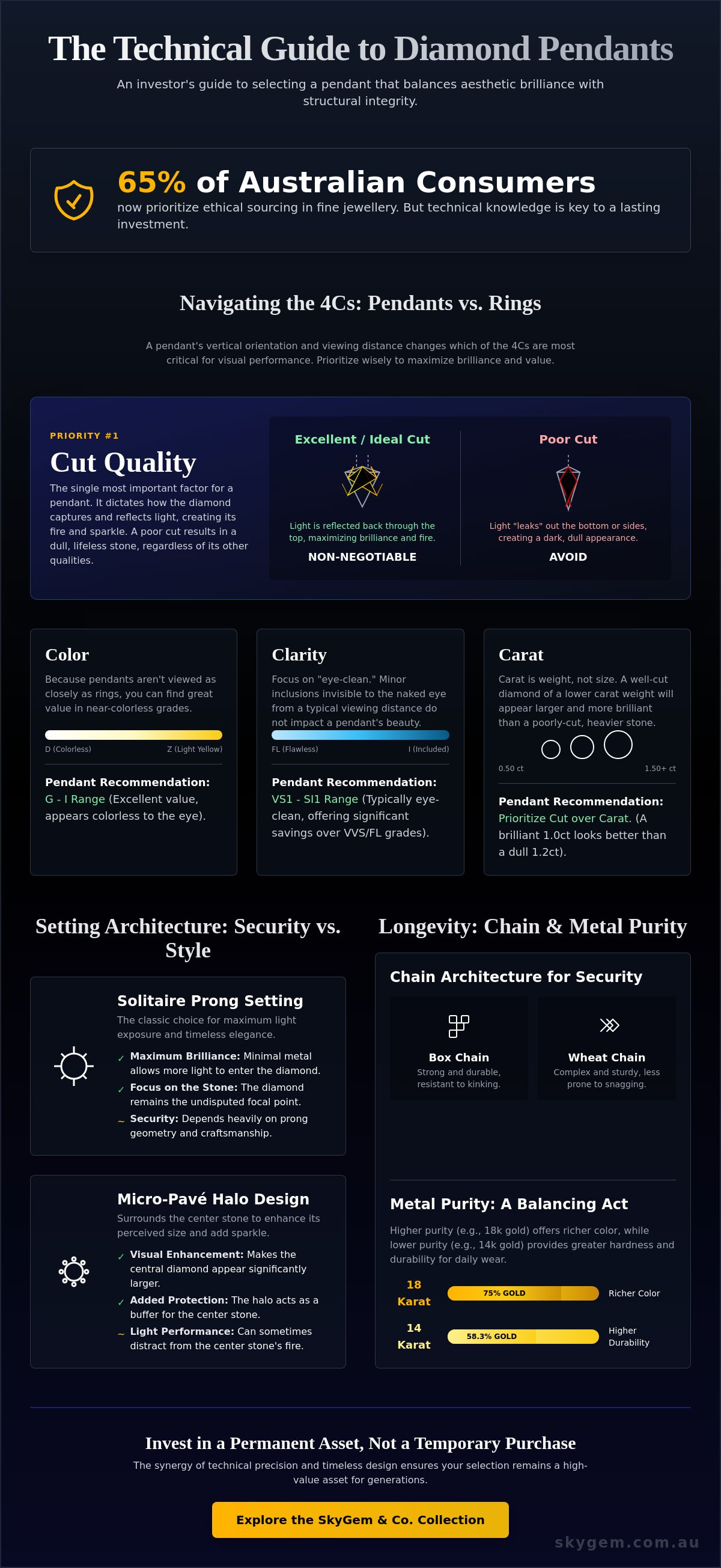
Navigating the 4Cs within the context of a pendant requires a shift in technical priority. While all four metrics determine value, the physical orientation of a necklace changes how a diamond interacts with light. Unlike a ring that's viewed closely and from various side angles, a pendant is typically observed from the front under overhead or ambient lighting. This makes the cut quality the primary driver of the piece's value and visual impact. Understanding these nuances ensures you don't overpay for invisible features while maximizing the stone's performance.
The Impact of Cut on Light Performance
An "Ideal" cut is the non-negotiable standard for high-performance diamond pendant necklaces. If a stone's proportions are off, light leaks through the pavilion rather than returning to the eye, resulting in a "dead" appearance where the centre of the diamond looks dark. Because a pendant hangs vertically against the chest, it relies heavily on its ability to reflect light back to the viewer. A precision-cut diamond maximizes fire and scintillation, ensuring the piece remains brilliant even in low-light environments. You should prioritize an Excellent cut grade over a larger carat weight to ensure the stone actually sparkles as intended.
Carat weight for pendants focuses on a "sweet spot" for daily wearability, typically ranging between 0.50 and 1.50 carats. Beyond this range, the physical weight can cause the chain to pull or the setting to tilt forward. Pendants also allow for more flexibility in clarity and colour than rings. Since the piece isn't viewed under the same scrutiny as a hand-worn diamond, grades such as SI1 clarity or G-H colour often appear identical to higher tiers to the naked eye. This allows you to allocate more of your budget toward a superior cut, which is the most visible metric of quality.
Natural vs. Lab-Grown: A Performance Comparison
The technical choice between GIA-certified natural diamonds and lab-grown alternatives often comes down to carats versus investment profile. Both options are chemically and physically identical, but lab-grown diamonds offer a significant price advantage. Based on May 2026 data, lab-grown stones can cost over 90% less than natural counterparts of the same quality. For those seeking a larger statement piece without compromising on technical specifications, lab grown diamonds represent a strategic and ethical choice. Natural stones remain the preference for those valuing long-term rarity and traditional market value.
If you're ready to explore these specifications in practice, you can browse our certified diamond selection to compare performance metrics and find the right balance for your project.
Design Frameworks: Evaluating Solitaire, Halo, and Statement Configurations
Selecting the structural configuration for diamond pendant necklaces requires a careful evaluation of how different settings interact with both the gemstone and the wearer’s lifestyle. While the diamond’s cut determines its light performance, the setting architecture serves as the mechanical framework that ensures the stone remains secure and properly oriented. A well-designed setting acts as a technical solution to the challenges of daily wear, balancing metal volume with maximum gemstone exposure. Whether you prioritise the minimalist profile of a solitaire or the reinforced brilliance of a halo, each design choice carries specific engineering implications for the piece’s longevity.
For individuals with high-activity lifestyles, the bezel setting offers the highest level of physical security. By encircling the entire girdle of the diamond with a thin rim of metal, the bezel protects the stone from edge chips and prevents it from snagging on fabrics. This industrial-strength approach provides a sleek, modern aesthetic while eliminating the maintenance requirements often associated with traditional prongs. It is a practical choice for those who view their jewellery as a permanent, functional asset rather than a delicate occasional piece.
The Solitaire: Minimalist Precision
The solitaire configuration relies on the precision of its basket height and prong geometry to achieve the "floating" diamond effect. A low-profile basket ensures the pendant sits flat against the chest, preventing the "flipping" issue common in top-heavy designs. When selecting a solitaire, the choice between four and six prongs involves a trade-off between light entry and security. Four prongs allow more light into the diamond’s pavilion, while six prongs provide a more rounded silhouette and greater redundancy if a single prong is damaged. For fancy shapes like pears or marquises, V-shaped prongs are technically necessary to protect the vulnerable points of the stone.
Halo and Multi-Stone Engineering
A halo configuration uses a perimeter of micro-pavé diamonds to enhance the visual carats of the centre stone, but its technical value extends beyond mere aesthetics. A correctly engineered halo acts as a structural buffer, protecting the centre diamond's girdle from lateral impacts. The performance of a halo depends heavily on the calibration of the melee diamonds; they must match the colour and clarity of the primary stone to ensure a seamless field of scintillation. In mass-produced versions, stones are often lost due to thin, shared prongs. High-quality designs utilise individualised settings for each melee stone, ensuring the assembly remains intact over decades of use. If you are considering a more complex configuration, exploring custom made standards can provide the structural integrity required for multi-stone designs.
Selecting for Longevity: Chain Mechanics and Metal Purity
The longevity of diamond pendant necklaces depends as much on the tensile strength of the chain as it does on the quality of the stone. While the diamond serves as the visual focus, the chain acts as the mechanical lifeline that secures your investment. Selecting the wrong link type or metal purity can lead to premature wear, thinning, or total mechanical failure. In the Australian market, where active lifestyles are common, choosing a chain with high structural integrity is essential for ensuring the piece remains a permanent asset in your collection.
The clasp is another critical component that is often overlooked. For high-value pendants, the lobster claw clasp is the preferred technical standard. It utilises a spring-loaded lever mechanism that is significantly more robust than the simpler spring ring clasp. While spring rings are lighter, they are more prone to internal spring fatigue and accidental opening. A lobster claw provides a more substantial metal-on-metal connection, offering the security required for daily wear.
Metal Purity and Structural Integrity
18K gold is the industry benchmark for high-end settings due to its optimal balance of purity and durability. Unlike 24K gold, which is too malleable for secure prong work, 18K gold is alloyed with other metals to increase its hardness while maintaining its rich colour and resistance to tarnish. For those with sensitive skin or a preference for maximum density, Platinum is an excellent alternative. It is naturally hypoallergenic and does not wear away over time; instead, the metal is merely displaced, maintaining its volume and weight. You can explore these nuances further in our definitive guide to gold jewellery.
Chain Maintenance and Security
Identifying potential "weak links" is vital for preventing the loss of a pendant. Chain links are subjected to constant friction, which can cause them to thin over years of use. We recommend evaluating three primary link types for their structural benefits:
- Wheat Chains: These consist of four strands of interwoven teardrop-shaped links that mimic the look of a stalk of wheat. They are technically the strongest link type for their weight.
- Box Chains: Composed of square links that create a smooth, geometric profile, these are highly durable and resist kinking.
- Cable Chains: A classic series of identical oval links. While easy to repair, they should be selected in a gauge that matches the weight of the pendant to avoid stretching.
A well-engineered chain will always include a "jump ring" between the chain and the clasp. This ring is designed to be the weakest point in the assembly, intended to fail under extreme tension to prevent the chain itself from snapping or causing injury. Regular professional inspections should focus on checking these connection points and the thickness of the links near the bail. To ensure your piece is built to these exacting standards, you can view our 18K gold settings to see how we integrate high-purity metals with secure design.
The SkyGem & Co. Collection: Exceptional Diamond Jewellery Australia-Wide
SkyGem & Co. operates as a technical partner for clients seeking high-performance diamond pendant necklaces. We don't just sell ornaments; we provide engineered assets designed for lifelong durability. Our approach to these designs centers on transparency, ensuring every technical specification, from the depth of the pavilion to the tensile strength of the bail, meets our rigorous internal standards. This commitment to precision ensures that every piece in our collection functions as a reliable anchor for your personal style.
The Solitaire Diamond Pendant remains our foundational offering. It's available in various carat weights, allowing you to select the exact volume that suits your daily requirements. For a more intricate light profile, our Halo Diamond Necklace represents a study in precision pavé work. Each melee diamond is individually set to create a seamless field of brilliance, reinforcing the centre stone while providing a protective structural buffer. If our ready-to-wear configurations don't meet your specific project needs, our custom design service allows for the creation of a unique heirloom built to your exact specifications.
Standout Pieces from the Collection
The Classic Round Brilliant Solitaire is a testament to timeless engineering. It prioritizes the Excellent cut grade to ensure maximum scintillation from every angle. For those seeking an elongated silhouette, the Pear-Shaped Diamond Pendant offers a sophisticated alternative that draws the eye vertically. We also offer a Lab-Grown Statement Pendant, which maximizes visual impact and value by utilizing premium lab grown diamonds that are physically and chemically identical to mined stones.
The Boutique Advantage
Our boutique model provides direct access to expert consultations and a curated selection of GIA-certified stones. We maintain a strict commitment to ethically sourced natural diamonds and premium lab-grown options, adhering to the latest regulatory standards. This focus on quality over volume ensures that you receive a piece that is both a beautiful accessory and a secure investment. You can proceed with the confidence that your jewellery is backed by regional expertise and a dedication to long-term viability. To find the diamond pendant necklaces that align with your lifestyle, explore the full SkyGem & Co. collection today.
Securing Your Technical and Aesthetic Investment
Selecting a high-performance piece requires a deliberate balance between optical excellence and structural integrity. You now understand that cut quality remains the primary driver of brilliance in diamond pendant necklaces, particularly given the unique lighting angles of chest-worn jewellery. By prioritizing 18K gold or Platinum settings alongside robust chain mechanics, you ensure that your piece remains a permanent and secure asset within your collection. These technical considerations are the difference between a temporary accessory and a lifelong heirloom.
SkyGem & Co. operates as a specialized Australian-owned boutique dedicated to technical precision and ethical transparency. Our collection features GIA certified diamonds and utilizes bespoke design expertise to create pieces that meet the highest standards of the regional professional landscape. We invite you to browse the SkyGem & Co. Diamond Pendant Collection to find a configuration that aligns with your specific requirements. Whether you choose a classic solitaire or a custom-engineered halo, you can proceed with the quiet confidence that your selection is built on a foundation of reliability and ethically sourced materials. We look forward to helping you find a piece that truly reflects your standards.
Frequently Asked Questions
Can I wear my diamond pendant necklace every day?
Yes, you can wear a diamond pendant daily provided the setting is engineered for structural durability. While diamonds are the hardest natural material, the metal setting and chain are subject to mechanical wear. It's advisable to remove your jewellery during high-impact exercise or while sleeping to prevent unnecessary tension on the chain links and potential thinning of the metal prongs over time.
Is it better to choose a natural or lab-grown diamond for a pendant?
The choice depends on whether you prioritize long-term rarity or visual scale for your investment. Lab-grown diamonds offer the same physical and chemical properties as natural stones but at a significant price reduction; data from May 2026 shows lab-grown options can be approximately 93.35% more affordable than natural stones of the same size. Natural GIA-certified diamonds remain the preferred choice for those seeking a traditional asset with a limited global supply.
What is the most secure setting for a diamond pendant?
The bezel setting provides the highest level of physical security for diamond pendant necklaces. By encircling the entire circumference of the stone with a protective rim of metal, it prevents the diamond from snagging on clothing or sustaining edge chips from lateral impacts. This configuration is a technical solution for individuals with active lifestyles who want to minimize the ongoing maintenance required by traditional prong settings.
How do I choose the right chain length for a diamond necklace?
Standard chain lengths for pendants typically range from 40cm to 45cm to ensure the stone sits prominently on the chest. A 42cm chain is often considered the "sweet spot" for most necklines, allowing the pendant to remain visible without disappearing beneath clothing. You should consider your physical frame and the specific neckline of your wardrobe to determine where the stone's center of gravity should sit for optimal aesthetic balance.
Does a diamond pendant need GIA certification?
Verification of technical specifications is essential for any high-value diamond purchase. A GIA report provides an objective assessment of the stone's performance metrics and confirms its origin. This documentation is also vital for compliance with Australian 2026 AML/CTF regulations, which require strict reporting and verification for precious stone transactions exceeding specific thresholds.
What metal is best for a diamond pendant: gold or platinum?
Platinum is the superior choice for longevity due to its high density and displacement properties. Unlike gold, which loses microscopic amounts of metal through friction, platinum merely shifts when scratched, maintaining its original volume over decades. However, 18K gold remains the industry standard for its structural balance and rich color profiles, provided the wearer adheres to a regular inspection schedule for prong wear.
How much should a high-quality diamond pendant cost in Australia?
Market data from March 2026 shows that the average price for diamonds in Australia is approximately USD $4,262 per carat. The final cost of a pendant is determined by the synergy of the stone's cut quality and the complexity of the setting architecture. While prices for both natural and lab-grown stones saw a slight decrease of 0.7% in May 2026, the value of the piece as a long-term asset remains tied to its technical excellence.
How do I clean and maintain my diamond pendant at home?
Maintain your pendant's brilliance by soaking it in warm water mixed with a mild, oil-free detergent. Use a soft-bristled brush to gently remove skin oils and debris from the pavilion and under-gallery of the setting, as these areas are critical for light return. While home cleaning is effective for daily maintenance, you should still schedule a professional inspection every twelve months to check the integrity of the clasp and the security of the prongs.
Disclaimer
This article is for general informational purposes only and may include AI-assisted content. Pricing, specifications, and availability are subject to change. For accurate advice and current information, please contact SkyGem & Co. directly. Nothing in this content constitutes professional or financial advice.