
The 3D CAD Jewellery Design Process: A Guide to Precision Craftsmanship

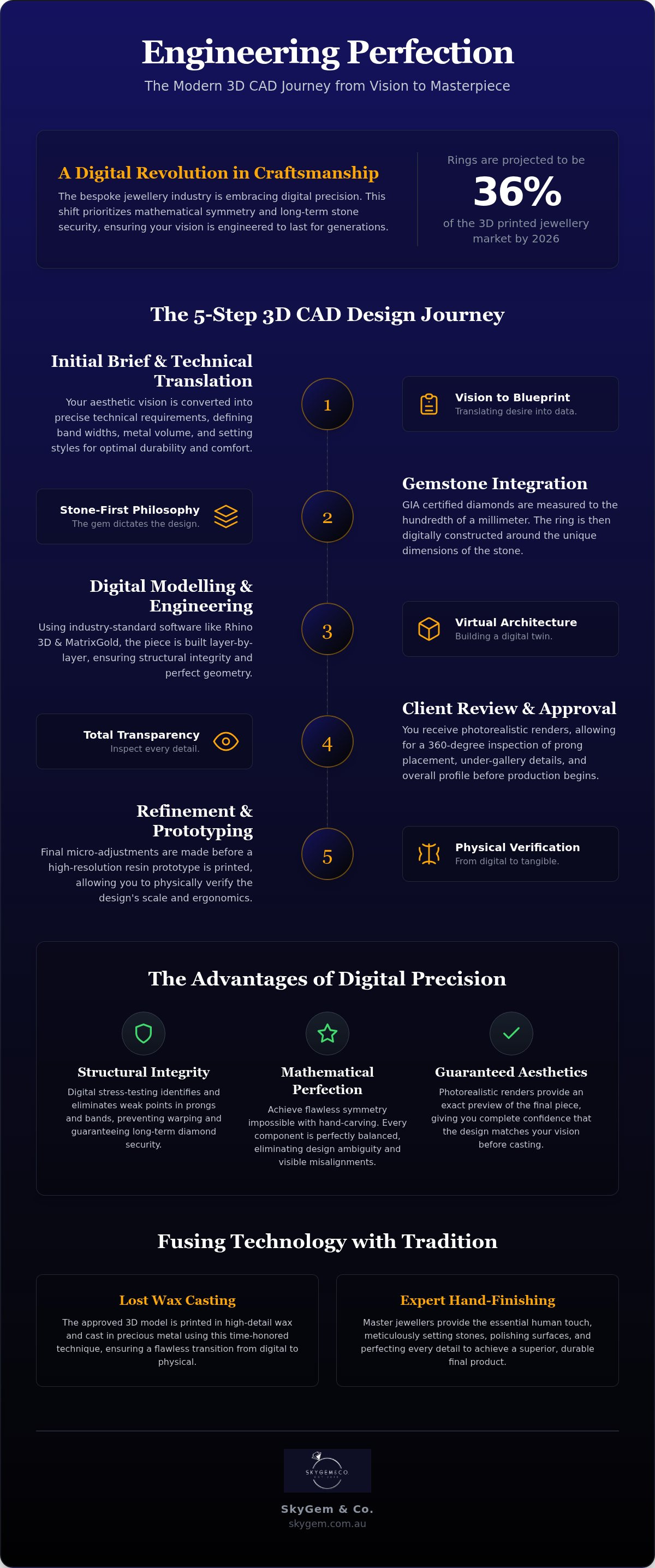
The most intricate bespoke jewellery isn't created by a steady hand alone; it's engineered through a digital lens to achieve a level of structural perfection that the naked eye cannot replicate. While some fear that technology replaces artistry, the modern 3D CAD jewellery design process is actually a high-performance tool for precision craftsmanship. With rings accounting for 36% of the 3D printed jewellery market in 2026, it's clear that discerning clients are prioritising mathematical symmetry and stone security over traditional guesswork.
You've likely felt the hesitation that comes with bespoke design: the fear that the finished piece won't look like the sketch, or concerns about the long-term integrity of the setting. We believe a ring should be a permanent asset, which is why our approach focuses on long-term viability and technical excellence. This guide will show you how 3D Computer-Aided Design transforms your vision into a structurally sound masterpiece before the first grain of metal is cast. You'll gain total confidence in your journey, ensuring every technical specification meets rigorous standards for durability and aesthetic balance.
Key Takeaways
- Understand how transitioning from 2D sketches to a 3D virtual environment eliminates design ambiguity and ensures mathematical perfection in every component.
- Follow the structured 5-step 3D CAD jewellery design process to translate aesthetic desires into technical specifications for a bespoke, high-performance masterpiece.
- Learn how digital engineering pre-calculates structural stress points to prevent band warping and guarantee the long-term security of GIA certified diamonds.
- Discover the value of high-resolution resin prototyping, which allows you to verify the scale and ergonomics of your design before manufacturing begins.
- Explore the vital intersection of technology and tradition, where the lost wax casting technique and expert hand-finishing deliver a superior, durable final product.
What is 3D CAD in Jewellery Design?
In the context of fine jewellery, Computer-Aided Design (CAD) represents a paradigm shift from traditional manual drafting to precision digital engineering. It's no longer just about the artistic stroke of a pencil; it's about creating a mathematically perfect virtual blueprint. Modern designers utilise computer-aided design programs (CAD) to build three-dimensional models that account for every micron of metal and every facet of a gemstone. This evolution from 2D sketches to 3D environments allows for a 360-degree inspection of a piece, ensuring that the structural integrity of the design is sound from every angle before a single gram of metal is cast.
The 3D CAD jewellery design process enables the creation of complex geometries that would be physically impossible, or at the very least highly unstable, if carved by hand from wax. Intricate under-galleries, perfectly spaced pavé settings, and complex lattice structures are now achievable with a level of repeatability and precision that defines the modern standard of luxury. By building the piece in a virtual space, we can stress-test the architecture of the design, identifying potential weak points in a prong or a shank that a hand-carver might only discover once the piece is finished.
The Software Behind the Art
Professional design requires industrial-grade tools. Software such as Rhinoceros 3D (Rhino 8) and MatrixGold 4 are the industry standards for high-level jewellery engineering. These programs do more than create a visual; they act as technical calculators. For instance, MatrixGold 4, which carries a professional license value of $5,995, allows designers to input specific gemstone volumes and calculate the exact metal density of the finished piece. This data is critical for ensuring the longevity of the item. By knowing the precise weight of the metal required, we can predict the durability of a band or the security of a prong with scientific accuracy. It's a level of technical oversight that traditional methods simply cannot match.
Why Modern Bespoke Design Starts Digitally
Precision is the foundation of aesthetic beauty. When designing solitaire engagement rings, even a fraction of a millimetre of misalignment can be visible to the discerning eye. Starting the design process digitally ensures perfect symmetry, where the digital architecture of the ring is balanced to support the centre stone securely for decades. Beyond the technical benefits, this process provides clients with photorealistic renders. These high-definition images eliminate the anxiety often associated with bespoke commissions, as the client sees exactly how the light interacts with the metal and stones. It transforms the journey from a leap of faith into a transparent, data-driven partnership that respects both the client's vision and the rigours of engineering.
The 5-Step 3D CAD Design Journey
The 3D CAD jewellery design process is a methodical sequence that ensures the final product is a high-performance masterpiece. Unlike traditional methods that rely on hand-carved wax templates, this digital journey allows for a "stone-first" philosophy. Every design decision is dictated by the physical properties of the selected gems and the structural requirements of the precious metal. This engineering-led approach eliminates the margin for error, providing a transparent roadmap from concept to completion.
- Step 1: The Initial Brief. We translate your aesthetic vision into technical requirements. This involves determining band widths, metal volume, and the specific setting style that will best support your lifestyle.
- Step 2: Gemstone Integration. This is where we differ from generic manufacturers. We measure your GIA certified diamonds or sapphires to the hundredth of a millimetre. The ring is built around the stone, not the other way around.
- Step 3: Digital Modelling. Using advanced software, the ring is constructed layer-by-layer. This digital architecture prepares the file for the future additive manufacturing of jewellery, ensuring the file is ready for high-resolution 3D printing.
- Step 4: Client Review. You are presented with photorealistic renders from multiple angles. This allows you to inspect the under-gallery, prong placement, and overall profile before any manufacturing begins.
- Step 5: Final Refinement. We make micro-adjustments to prong heights and internal curvature. These small technical tweaks ensure optimal comfort and maximum stone security.
Integrating Natural and Lab-Grown Diamonds
Achieving a perfect fit requires accounting for the specific light-performance metrics of your centre stone. For natural white diamonds, we use laser-scanned dimensions to create a bespoke "seat" that allows for maximum light entry through the pavilion. This same precision is applied when we work with lab-grown white diamonds, which often have unique proportions that require a tailored setting to ensure the stone sits flush and secure. By designing with these exact metrics, we guarantee that the finished piece will perform brilliantly in all lighting conditions.
Virtual Review and Adjustments
The digital environment provides a level of flexibility that hand-carving cannot match. We can instantly toggle between different metal types, such as 18K Yellow Gold or Platinum, to see how the colour interacts with the gemstones. If you've chosen side stones, we can scale them in real-time to match the centre gem's proportions perfectly. Perhaps most importantly, we can virtually test the "stackability" of the ring against future wedding bands. This foresight ensures that your bridal set will sit together without gaps, creating a cohesive and comfortable long-term asset. If you are ready to begin this technical consultation, you can explore our options for a custom made engagement ring.
The Advantages of Digital Precision Over Hand-Carving
The superiority of the 3D CAD jewellery design process lies in its ability to eliminate the human margin of error inherent in hand-carved wax models. While hand-carving is a traditional skill, it often lacks the mathematical precision required for modern, high-performance jewellery. Digital engineering allows us to achieve absolute symmetry, where every facet and prong is aligned to the micron. This isn't just about aesthetics; it's about structural stability. By pre-calculating stress points within the software, we can identify areas where a band might be prone to warping or thinning, reinforcing these sections before the piece is ever cast in precious metal.
Weight distribution is another critical factor that separates digital design from manual craft. A ring that constantly spins on the finger is often the result of poor weight optimisation. Through CAD, we can calculate the exact centre of mass, ensuring the ring remains balanced and upright. This precision extends to stone security. We engineer prongs with a thickness specifically tailored to the gemstone's dimensions and hardness, providing a level of protection that generic, hand-filed settings cannot match.
Perfecting the Solitaire and Halo
Precision is non-negotiable when creating solitaire engagement rings. Because the design is so focused on a single stone, any slight deviation in the prongs is immediately noticeable. In halo designs, the complexity increases with micro-pavé settings. These require incredibly small, uniform holes for accent stones, a task that is nearly impossible to execute with perfect consistency by hand. The 3D CAD jewellery design process also allows us to engineer the gallery or under-carriage of the ring. This ensures there's enough space for light to enter and for the wearer to clean the piece effectively, maintaining its brilliance over time.
Consistency for Future Matching
One of the most practical benefits of digital design is the ability to create perfectly flush-fitting wedding bands. Because we possess the original digital blueprint, we can design a matching band that follows the exact contours of the engagement ring. This eliminates the gap often seen with off-the-shelf pairings. If a piece is ever lost or damaged, the digital file allows for an exact replication, ensuring your heirloom is never truly gone. The CAD file serves as a permanent, immutable record of a bespoke commission's technical specifications.
Prototyping: From Digital Model to Physical Resin
The 3D CAD jewellery design process reaches its most tangible milestone during the prototyping phase. While the digital model provides a mathematically perfect blueprint, the human hand remains the ultimate testing ground for ergonomics and scale. To bridge this gap, we utilise high-resolution 3D printers to create a 1:1 scale resin model of your design. This physical prototype is an essential safeguard, allowing you to verify that the proportions of the ring look exactly as intended when placed on your finger. It's the moment where abstract dimensions become a tactile reality.
A physical resin prototype provides a "try-on" experience that no screen can replicate. It allows you to feel the height of the setting, the width of the band between your fingers, and the overall profile of the piece. This stage is critical for identifying potential design flaws in the physical world before any gold or platinum is cast. If a prong feels too sharp or a band feels too substantial, adjustments can be made easily in the digital file. This iterative approach ensures that the final masterpiece is not only beautiful but also comfortable for daily, long-term wear.
The 3D Printing Process
Precision in prototyping requires industrial-grade technology. In the jewellery sector, Stereolithography (SLA) is the leading technology, currently holding a 35% market share due to its ability to capture microscopic detail. While Digital Light Processing (DLP) is often faster, SLA uses a precision laser to cure resin with incredible accuracy. We use specialised castable resins that are engineered to leave zero ash residue during the manufacturing process. In a professional boutique environment, this phase typically takes 24 to 48 hours, providing a swift transition from digital approval to physical inspection.
Final Approval Milestones
This phase represents the final opportunity for tactile changes. We compare the physical resin model directly against the digital renders to ensure absolute accuracy in the translation. It's during these bespoke engagement ring consultations that we confirm the final technical specifications. Once you've felt the design on your hand and approved the scale, the digital file is locked for casting. If you're ready to see your vision take shape in a physical form, you can book a technical consultation to begin the engineering of your piece.
Casting and Hand-Finishing: The Human Touch
The 3D CAD jewellery design process doesn't conclude with a digital file or a resin model. It transitions into the physical world through the "Lost Wax" casting technique, a process that bridges modern engineering and ancient craft. The resin prototype created in the previous stage is encased in a plaster-like investment material. When heated in a kiln, the resin burns away completely, leaving a mathematically perfect negative cavity. Molten precious metal, such as Platinum or 18K Gold, is then vacuum-cast into this void. While technology creates the initial form, the transition from a raw casting to a finished masterpiece requires the specialized skill of a master jeweller.
There is a common misconception that computer-aided design replaces the artisan. In reality, CAD provides the high-precision "chassis," but the jeweller provides the "soul." A raw casting emerges from the investment looking dull and unfinished, often covered in "sprue" marks where the molten metal entered the mold. These marks must be meticulously removed by hand. The metal is then hand-burnished to compress the surface, which increases the structural density and prepares the piece for a high-mirror finish. Without this manual intervention, the digital precision remains an unfinished concept.
The Marriage of Tech and Tradition
The synergy between digital architecture and manual finishing is most evident during the setting phase. While the CAD software prepares the "seats" for your precious gemstones, a master setter must still secure each stone individually. Using microscopic tools, the setter carefully folds the metal prongs over the crown of the gem. This ensures that the tension is exactly right, providing security without compromising the stone's light performance. It's a delicate balance where the setter's experience informs the final structural integrity of the piece.
Quality Assurance and Longevity
Final quality control is a rigorous process that goes beyond simple aesthetics. We test the structural rigidity of the final cast to ensure the band won't warp under daily pressure. Every piece undergoes a purity verification to guarantee the metal meets strict regulatory standards for 18K Gold or Platinum. This technical oversight ensures that your jewellery isn't just a beautiful object, but a permanent, evolving asset. The journey ends with a final hand-polish and a comprehensive inspection, marking the beginning of a lifetime maintenance partnership dedicated to the long-term success of your bespoke commission.
Engineering Your Legacy in Fine Jewellery
The journey from a conceptual brief to a finished heirloom is a sophisticated blend of digital engineering and traditional craftsmanship. By utilising the 3D CAD jewellery design process, you ensure your piece is built on a foundation of mathematical perfection and structural durability. This methodical approach allows for the precise measurement of GIA certified or lab-grown diamonds, guaranteeing a bespoke fit that hand-carving alone cannot achieve. It's about more than just aesthetics; it's about creating a permanent asset that stands the test of time.
Our expertise as technical consultants ensures that every facet of your design is optimised for both performance and beauty. From the initial virtual render to the final hand-setting of your stones, we manage every technical specification with professional rigour. If you're ready to transform your vision into a high-performance masterpiece, we invite you to take the first step. Book a Bespoke Consultation to Start Your 3D CAD Design Journey and experience the intersection of technical precision and elite design. We look forward to partnering with you on your next project.
Frequently Asked Questions
Is 3D CAD jewellery design more expensive than traditional methods?
The 3D CAD jewellery design process often proves more cost-effective for complex pieces because it eliminates the trial and error associated with manual wax carving. While there is a technical fee for the engineering phase, the reduction in metal waste and labor hours provides a superior return on investment. It's a premium service that prioritises long-term structural integrity and mathematical precision over the guesswork of traditional carving.
Can I use my own heirloom diamond in a 3D CAD design?
You can certainly incorporate an heirloom diamond into a new digital design. We measure your stone to the hundredth of a millimetre to ensure the digital model is built with a bespoke seat tailored to its specific dimensions. This precision measurement ensures that your existing gem is perfectly protected and displayed within its new architecture, maintaining its security for the next generation.
How long does the 3D CAD design process take from start to finish?
The typical 3D CAD jewellery design process takes between three and six weeks from the initial consultation to the final hand-polish. This timeline accounts for the technical modelling, resin prototyping, and the meticulous hand-finishing required for high-performance jewellery. Complex trilogy or halo designs may require additional time for precise stone matching and technical refinements to the setting.
Is a CAD-designed ring considered "hand-made"?
A CAD-designed ring is a hybrid creation that combines digital engineering with traditional artisan skills. While the initial form is created through additive manufacturing, every piece requires extensive hand-finishing, stone setting, and polishing by a master jeweller. It's more accurately described as "precision-engineered and hand-finished," offering a level of symmetry and structural stability that pure hand-making cannot replicate.
Can I make changes to the design once the 3D model is finished?
You can make micro-adjustments to the digital model before it moves to the prototyping stage. The software allows us to modify band widths, prong orientations, or gallery heights instantly to better suit your preferences. This flexibility is a core benefit of the digital journey, ensuring the technical specifications align perfectly with your vision before any precious metal is cast.
What happens if I don’t like the 3D resin prototype?
If the resin prototype doesn't meet your expectations, we simply adjust the digital file and print a revised model for your inspection. This stage is designed as a safety net to verify the scale and ergonomics of the design in the physical world. We don't proceed to the final casting phase until you are completely confident in the prototype's fit, feel, and aesthetic balance.
Will the final ring look exactly like the digital render?
The final ring will be a physical, high-lustre version of the photorealistic render you approved during the design phase. While the render simulates light interaction and metal colour, the finished piece possesses the actual weight of the gold or platinum and the natural fire of the gemstones. The hand-polishing process adds a depth of brilliance and tactile quality that a digital image can only approximate.
Does 3D CAD work for all types of gemstones, like sapphires or rubies?
Digital design is highly effective for all gemstone types, including Australian sapphires, rubies, and emeralds. Because natural gemstones often have unique depth and pavilion proportions, we use CAD to engineer a setting that accommodates these specific physical properties. This ensures maximum light performance and security for even the most unusually shaped gems, providing a level of bespoke fit that is technically superior.
Disclaimer
This article is for general informational purposes only and may include AI-assisted content. Pricing, specifications, and availability are subject to change. For accurate advice and current information, please contact SkyGem & Co. directly. Nothing in this content constitutes professional or financial advice.