
Solitaire Engagement Rings: The 2026 Australian Guide to Timeless Design

The most minimalist jewellery design is frequently the most complex to engineer correctly. While a solitaire setting appears effortless, it demands the highest level of structural precision to ensure a lifetime of performance. For couples researching solitaire engagement rings melbourne, the true challenge lies in distinguishing between a standard mass-produced mount and a bespoke architectural setting designed for durability.
You likely recognise that a solitaire is the definitive expression of timeless elegance, but the technical differences in diamond grading and setting security can feel unnecessarily opaque. This guide provides a professional framework for evaluating solitaire anatomy, from the precision of GIA-certified diamond selection to the performance metrics of high-density metals like platinum and 18k gold. We will examine the structural standards required for world-class design, ensuring you have the technical confidence to select a piece that balances aesthetic brilliance with long-term viability.
Key Takeaways
- Identify the critical engineering differences between 4-prong and 6-prong configurations to balance stone security with optimal light entry.
- Navigate the technical specifications of natural and lab-grown diamonds to ensure your choice of solitaire engagement rings melbourne meets global performance standards.
- Compare the durability and maintenance profiles of platinum and 18k gold to select a metal that supports the long-term viability of the setting.
- Recognise why GIA certification remains the non-negotiable industry standard for verifying the technical properties and authenticity of high-value centre stones.
- Learn how bespoke CAD design serves as a technical partnership to achieve a level of structural precision impossible in mass-market manufacturing.
The Enduring Significance of Solitaire Engagement Rings
The solitaire remains the definitive choice for engagement jewellery because it prioritises the optical performance of the centre stone above all else. By eliminating side stones or complex halos, the design allows light to enter the pavilion facets with minimal obstruction. This results in a superior display of brilliance, fire, and scintillation. For those seeking solitaire engagement rings melbourne, the appeal lies in this functional simplicity. Design dictates performance. It is an architectural approach where the metal serves as a support system for the diamond, rather than a distraction from it. The focus is entirely on the stone's refractive index and cut precision.
The history of the engagement ring reveals a steady progression toward this minimalist ideal. Early designs often featured heavy metalwork that obscured the stone's natural beauty. Today, the evolution of solitaire design has moved from the traditional, high-set six-prong mounts to lower-profile, four-prong settings. These offer a sleeker aesthetic without compromising security. It's a shift that reflects a modern preference for wearable, understated luxury that doesn't sacrifice structural integrity.
Historical Context and Modern Relevance
Modern Australian jewellery workshops have transitioned from traditional hand-forged methods to integrated CAD (Computer-Aided Design) and 3D printing workflows. This shift has allowed for a level of technical precision that was previously unattainable in manual production. While the aesthetic remains rooted in tradition, the engineering standards for claw thickness, seat depth, and metal density have improved significantly. This ensures that the minimalist profile of a contemporary solitaire doesn't lead to structural weakness. It is a balance of heritage and innovation that defines the current market. Reliability is built into the design from the initial digital blueprint.
Aesthetic Versatility Across Gemstone Varieties
While natural white diamonds are the most common choice, the solitaire framework is exceptionally versatile. It provides a neutral platform that highlights the unique saturation and pleochroism of coloured stones. For instance, Australian Sapphires are frequently set in solitaire mounts to allow their deep teals, greens, and blues to be viewed without visual competition from surrounding diamonds. This isolation allows the natural character of the gem to emerge.
The choice of gemstone shape also dictates the final aesthetic and structural requirements of the ring:
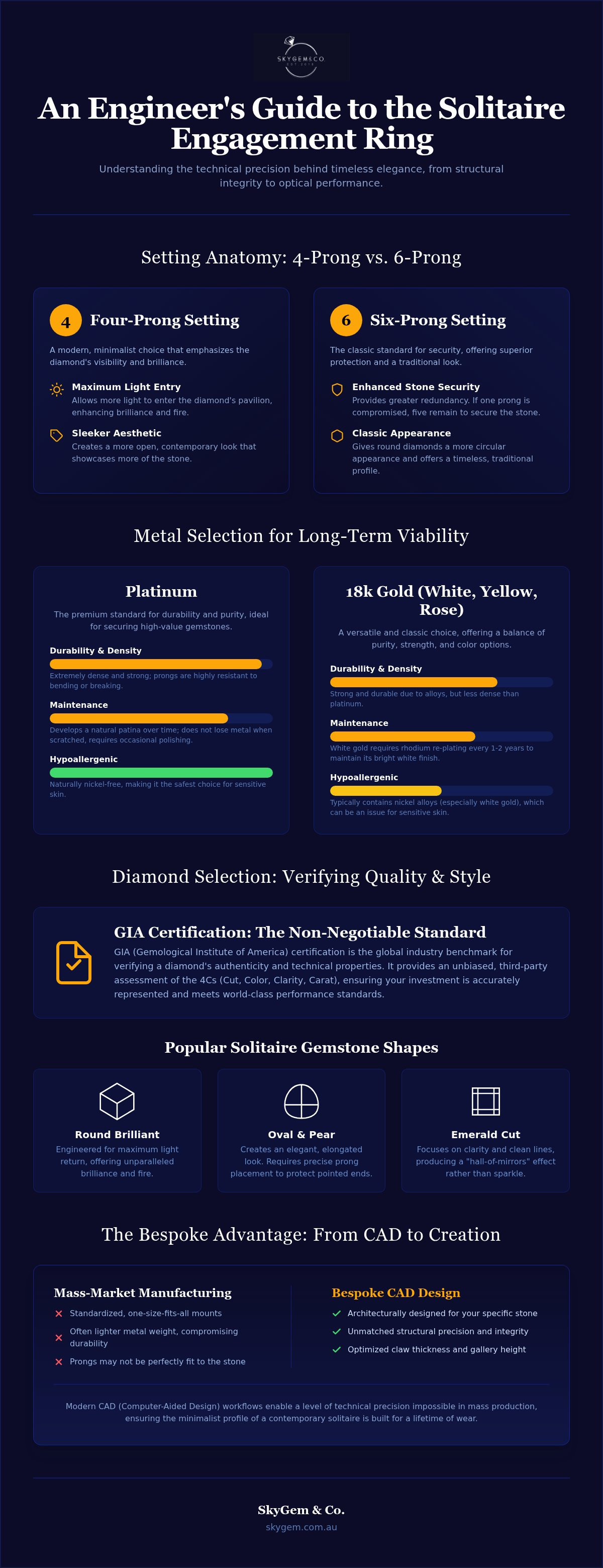
- Round Brilliant: Maximises light return and remains the most popular choice for its symmetrical balance.
- Oval and Pear: Offers an elongated visual effect that can make the wearer's finger appear slimmer while requiring specific prong placement to protect the points.
- Emerald Cut: Focuses on clarity and "hall-of-mirrors" light reflections rather than traditional sparkle, demanding a higher clarity grade for the centre stone.
Clarity is paramount. Regardless of the stone choice, the solitaire configuration ensures that the primary asset remains the undisputed focal point. It acts as a permanent showcase for the gem's intrinsic value.
Setting Anatomy: The Technical Engineering of a Solitaire
The visual simplicity of a solitaire setting is a deliberate engineering achievement. Every component must be mathematically precise to ensure the stone remains secure while maximising light performance. When evaluating the structural standards of solitaire engagement rings melbourne, look for a balance between metal weight and aesthetic elegance. The setting shouldn't just hold the stone; it must protect it from the rigours of daily wear.
Prong configuration is the primary technical choice. A four-prong setting is often preferred for its ability to allow maximum light entry into the diamond's pavilion, which enhances brilliance. Conversely, a six-prong setting offers a higher degree of redundancy. If one claw is compromised, the remaining five prongs are typically sufficient to hold the stone in place until it can be repaired. Gallery height also plays a vital role in the ring's longevity. A well-engineered gallery ensures the culet is protected from impact while maintaining a height that feels comfortable for the wearer during regular activity.
Prong Geometry and Stone Security
Claw design is a functional decision that impacts both security and style. The geometry of the claw determines how much of the stone is visible and how it's protected from impact. Common styles include:
- Eagle Claw: A sharp, refined finish that minimises metal coverage on the diamond's crown.
- Round Prongs: A classic, durable profile that provides a soft aesthetic.
- Tab Prongs: Wide, flat prongs frequently used for step-cut stones to provide corner protection.
The security of these configurations relies on metal memory, which is the ability of high-quality alloys to maintain constant tension against the gemstone. A gallery rail is a horizontal metal band connecting the prongs that serves as a critical secondary security feature for large diamonds by preventing the stone from shifting if a single claw is damaged.
Band Structural Integrity and Longevity
For a ring to withstand decades of wear, the band must meet specific dimensional standards. We recommend a minimum width of 1.8mm and a thickness of at least 1.6mm at the base of the shank. While "tapering" the band toward the centre stone is a popular method for making the diamond appear larger, it must be done carefully. Reducing the metal too much at the shoulders can create a structural weak point where the head meets the band.
The manufacturing method is equally important. Mass-produced cast settings can suffer from porosity, which refers to microscopic air bubbles trapped during the cooling of the metal. This makes the ring brittle and prone to cracking. Choosing bespoke manufacturing ensures that the metal is dense and hand-finished to professional standards. This technical partnership results in solitaire engagement rings melbourne that act as permanent assets rather than fragile accessories.
Diamond Selection for Solitaires: Natural vs. Lab-Grown Standards
Selecting a diamond for a solitaire requires a higher level of scrutiny than multi-stone designs. Because the centre stone is the sole focus, any optical deficiency or structural flaw is immediately apparent. For clients seeking solitaire engagement rings melbourne, the selection process is a technical audit of the stone's refractive properties. While aesthetics are subjective, performance is quantifiable through the "Four Cs": Cut, Colour, Clarity, and Carat weight. Among these, Cut remains the primary driver of light performance. An Excellent or Ideal cut ensures that light entering the crown reflects back through the table rather than leaking through the pavilion facets.
The technical equivalence of lab-grown and natural diamonds is now a settled industry fact. Both consist of pure carbon in a cubic crystal structure, possessing identical hardness (10 on the Mohs scale) and refractive indices. The choice between them isn't one of quality, but of origin and value distribution. Regardless of the origin, GIA certification is the non-negotiable standard for solitaire diamonds in Australia. It provides an objective, third-party verification of the stone's technical specifications, ensuring the data matches the physical asset.
GIA Certified Natural Diamonds
The appeal of natural white diamonds lies in their geological rarity and established long-term value proposition. When reviewing a GIA report, it's vital to look beyond the top-level grade. The inclusion plot is a technical map of the stone's internal landscape. We advise avoiding "crystals" or "feathers" located near the girdle, as these can pose a structural risk during the setting process. Furthermore, ethical sourcing is integrated into the procurement chain via the Kimberley Process, ensuring that the stone's journey from the mine to a workshop for solitaire engagement rings melbourne adheres to strict regulatory standards.
Premium Lab-Grown Diamond Innovations
Modern manufacturing techniques, specifically Chemical Vapour Deposition (CVD) and High Pressure High Temperature (HPHT), have refined the production of lab-grown white diamonds. CVD is often preferred for high-clarity white stones because it avoids the metallic flux inclusions sometimes found in HPHT growth. From a project management perspective, lab-grown diamonds offer significant budget flexibility. Data from 2026 indicates that lab-grown options are approximately 70-85% more cost-effective than natural equivalents of the same grade. This allows for the selection of higher carat weights or superior clarity grades without exceeding the initial investment parameters. It's a technological solution that prioritises visual impact and environmental efficiency.
Metal Selection: Platinum vs. 18k Gold for Long-Term Viability
The choice of metal for a solitaire setting is more than a stylistic preference; it is a critical engineering decision that affects the structural longevity of the entire piece. Unlike multi-stone rings where the metal is reinforced by additional settings, a solitaire relies on a single point of failure. When commissioning solitaire engagement rings melbourne, the choice between platinum and 18k gold dictates the maintenance schedule for the next decade. Each material possesses distinct physical properties, including density, tensile strength, and hardness, which influence how the ring responds to daily mechanical stress.
Metal density also determines the perceived quality and "hand-feel" of the ring. Platinum is significantly denser than 18k gold, providing a reassuring weight that many clients associate with premium craftsmanship. This higher density means that a platinum ring will feel heavier on the finger than an identical design cast in gold. It is a subtle but permanent indicator of the material's industrial-grade durability.
The Platinum Advantage in Solitaire Settings
Technical specialists often recommend platinum for solitaire engagement rings melbourne because of its superior grip on the centre stone. Platinum is a "sticky" metal; when it is scratched, the metal is displaced rather than lost. This creates a "patina" over time, which can be polished back to a mirror finish without thinning the band or the prongs. This displacement property makes platinum the preferred metal for thin, minimalist prongs. It provides maximum security with minimum metal volume. Additionally, platinum is naturally hypoallergenic and maintains its white colour indefinitely without the need for chemical treatments.
Gold Alloys and Aesthetic Precision
18k gold remains a standard for its balance of purity and hardness. While 24k gold is too soft for jewellery, the 75% gold content in 18k alloys provides enough resistance for secure stone setting. Each alloy serves a specific aesthetic and technical purpose. For instance, matching the metal tone to the diamond's colour grade can optimise visual performance. A lower colour grade (J-K) may appear whiter when set in 18k yellow gold, whereas a D-F grade diamond requires the neutral backdrop of white gold or platinum to avoid reflecting warmth into the stone.
White gold presents a specific maintenance requirement that is often overlooked in standard retail environments. It is an alloy of yellow gold and white metals, which requires a rhodium plating finish to achieve its bright surface. This plating is a consumable layer that typically requires re-application every 12 to 24 months to prevent the underlying yellowish tint from appearing. For a deeper look at purity and craftsmanship, refer to our Gold Jewellery Guide. Understanding these maintenance cycles is essential for the long-term viability of your investment.
Browse our full range of bespoke engagement rings to evaluate these high-performance metals in person and select the alloy that best suits your lifestyle requirements.
The Bespoke Consultation: A Technical Partnership
Moving beyond mass-market options requires a shift in perspective. For those commissioning solitaire engagement rings melbourne, the process is less a retail transaction and more a technical consultation. A custom-made engagement ring allows for the integration of specific engineering requirements that off-the-shelf products cannot match. This partnership ensures that the final piece is optimised for the wearer's lifestyle while adhering to strict structural standards. It is a methodical approach that prioritises long-term viability over immediate convenience.
Computer-Aided Design (CAD) serves as the foundation of this technical process. It provides mathematical precision, allowing for the simulation of stone security and metal stress before manufacturing begins. We use these digital models to refine the proportions of the setting, ensuring that the gallery height and band thickness are perfectly calibrated to the specific dimensions of the chosen diamond. This digital blueprinting phase eliminates the guesswork associated with traditional hand-carved waxes, resulting in a more stable and symmetrical finished product.
The Design and Manufacturing Workflow
The workflow begins with an initial stone viewing. Examining a loose diamond under magnification is technically superior to viewing a pre-set ring, as the setting can often mask inclusions or girdle irregularities. Once the stone is selected, the CAD model is refined to adjust prong height and band taper for the individual wearer. This level of customisation prevents the structural inconsistencies common in bulk-cast items. The final setting and polishing stages involve the human element, where master jewellers hand-finish the metal to achieve a high-density surface that meets national Australian standards for jewellery manufacturing.
Ongoing Care and Structural Maintenance
Long-term viability depends on a consistent maintenance schedule. While platinum and 18k gold are durable, they are not impervious to mechanical wear over decades of daily use. Professional cleaning and prong inspections should be conducted regularly to ensure the setting remains tensioned correctly. Protecting your investment also involves formal valuation and insurance, which are essential requirements in the Australian market to safeguard against loss or accidental damage.
A 12-month structural check-up is vital for solitaire rings to identify potential metal fatigue or prong displacement before the centre stone is compromised. This proactive approach ensures the ring remains a permanent and evolving asset. By treating the engagement ring as a precision-engineered object, you ensure its aesthetic beauty is supported by sound structural integrity.
Securing Your Investment in Timeless Design
Selecting a solitaire ring is a decision that balances high-level aesthetics with rigorous engineering standards. By prioritising GIA-certified natural diamonds and high-performance metals like platinum or 18k gold, you ensure that the minimalist profile is supported by lasting structural integrity. The transition from a standard setting to a bespoke CAD-designed mount represents a commitment to technical precision and professional craftsmanship. This methodical approach guarantees that every claw and gallery rail is optimised for the specific dimensions of your chosen gemstone, ensuring long-term viability.
For those navigating the options for solitaire engagement rings melbourne, the process should be viewed as a technical partnership rather than a simple purchase. Our expert technical consultations and bespoke CAD design services provide the transparency required to select a world-class asset that retains its value over time. Using advanced digital modelling, we refine every detail to meet national Australian standards for durability and comfort. It's a process designed to respect your time and your investment.
Explore our curated collection of Solitaire Engagement Rings to discover how technical precision and aesthetic beauty intersect. We look forward to assisting you in creating a piece that stands as a permanent symbol of your commitment.
Frequently Asked Questions
Is a solitaire engagement ring a good long-term investment?
Solitaire engagement rings represent a stable long-term investment because their value is concentrated in the centre stone rather than complex metalwork. The design's enduring popularity ensures high liquidity in the secondary market. By selecting a high-grade GIA-certified diamond, you're acquiring a portable asset with a documented history of value retention. This minimalist framework remains immune to shifting fashion trends, making it a reliable choice for multi-generational longevity and wealth preservation.
What is the most popular diamond shape for solitaire rings in 2026?
While the round brilliant remains the industrial standard for light performance, oval cuts have been the most searched shape for three consecutive years as of 2026. Oval diamonds offer a larger visual surface area per carat compared to round stones, providing a flattering elongated effect on the finger. Emerald cuts are also seeing a resurgence in professional circles, particularly for those who value clarity and geometric precision over traditional scintillation patterns.
Can I use a lab-grown diamond in a bespoke solitaire setting?
You can absolutely integrate a lab-grown diamond into a bespoke solitaire setting. Since lab-grown diamonds possess the same physical and chemical properties as natural stones, they respond identically to the setting and polishing process. Using a lab-grown centre stone often allows for a significant increase in carat weight or clarity within the same project budget. Our technical team treats lab-grown stones with the same engineering precision as natural diamonds during the CAD design phase.
How do I choose the correct band width for a solitaire engagement ring?
Choosing the correct band width requires a balance between aesthetic preference and structural integrity. For daily wear, we recommend a minimum width of 1.8mm to ensure the ring doesn't warp under mechanical stress. While thinner bands can make the centre stone appear larger, they risk structural failure over time. A professional consultation helps determine the optimal taper, ensuring the band remains robust enough to support the weight of the setting and the centre stone.
What is the difference between a 4-prong and 6-prong solitaire setting?
The primary difference lies in the balance between light entry and stone security. A 4-prong setting allows more light to enter the pavilion facets, which can enhance the brilliance of smaller stones. However, a 6-prong setting provides critical redundancy; if one prong is damaged, the stone is less likely to fall out. For larger centre stones in solitaire engagement rings melbourne, a 6-prong configuration is often the preferred technical solution for long-term security.
How does platinum compare to 18k white gold for solitaire rings?
Platinum is a superior choice for solitaire settings due to its high density and natural white colour. Unlike 18k white gold, which is an alloy requiring periodic rhodium plating to maintain its finish, platinum is a pure metal that won't change colour over time. Platinum's "sticky" nature also means that prongs are less likely to snap, as the metal tends to bend rather than break under impact. It represents the industrial standard for durability.
Can a solitaire engagement ring be customised or upgraded later?
The modular nature of a solitaire ring makes it an ideal candidate for future customisation or upgrades. Because the design is centred on a single stone, it's technically straightforward to reset the diamond into a more complex mount, such as a halo or trilogy setting, at a later date. Alternatively, the centre stone itself can be upgraded while retaining the original band. This flexibility makes the solitaire a versatile foundation for a lifetime of jewellery evolution.
Why is GIA certification essential for solitaire diamonds?
GIA certification is essential for solitaire engagement rings melbourne because it provides an objective, third-party audit of the diamond's technical specifications. Since the centre stone is the sole focal point, verifying the cut grade, colour, and clarity is vital for ensuring you're paying for a high-performance asset. A GIA report also identifies internal inclusions that could compromise the stone's structural integrity during the setting process, acting as a critical risk-mitigation tool for buyers.
Disclaimer
This article is for general informational purposes only and may include AI-assisted content. Pricing, specifications, and availability are subject to change. For accurate advice and current information, please contact SkyGem & Co. directly. Nothing in this content constitutes professional or financial advice.