
Solitaire Engagement Rings Melbourne: The 2026 Technical Buying Guide

A solitaire engagement ring is the ultimate test of a jeweller’s technical precision because there is nowhere for a design flaw to hide. When you strip away the accents and halos, the integrity of the piece relies entirely on the quality of the centre stone and the structural engineering of the setting. It's common to feel a sense of hesitation when selecting solitaire engagement rings Melbourne, especially when faced with the complex choice between natural and lab-grown diamonds or concerns about the long-term durability of a delicate band.
You want a ring that remains as secure and radiant in thirty years as it is today. This guide provides the technical clarity you need to master the nuances of diamond selection and setting mechanics to secure a piece of enduring Australian craftsmanship. We will analyse the latest 2026 certification standards from the GIA and IGI, evaluate the performance metrics of various metal alloys, and provide a transparent look at the custom design process. By focusing on precision and objective data, you can move forward with the confidence that your selection is a high-performance asset rather than a speculative purchase.
Key Takeaways
- Understand why the solitaire design remains the technical benchmark for light performance and diamond prominence.
- Evaluate the structural integrity of solitaire engagement rings Melbourne by assessing prong configurations and gallery rail engineering.
- Compare the performance metrics of natural GIA-certified diamonds against lab-grown alternatives to determine the best fit for your specific requirements.
- Discover how CAD technology and technical consultations translate aesthetic concepts into precise, durable jewellery designs.
- Identify the 2026 certification standards from GIA and IGI that ensure the long-term viability and insurance value of your centre stone.
The Enduring Value of Solitaire Engagement Rings Melbourne
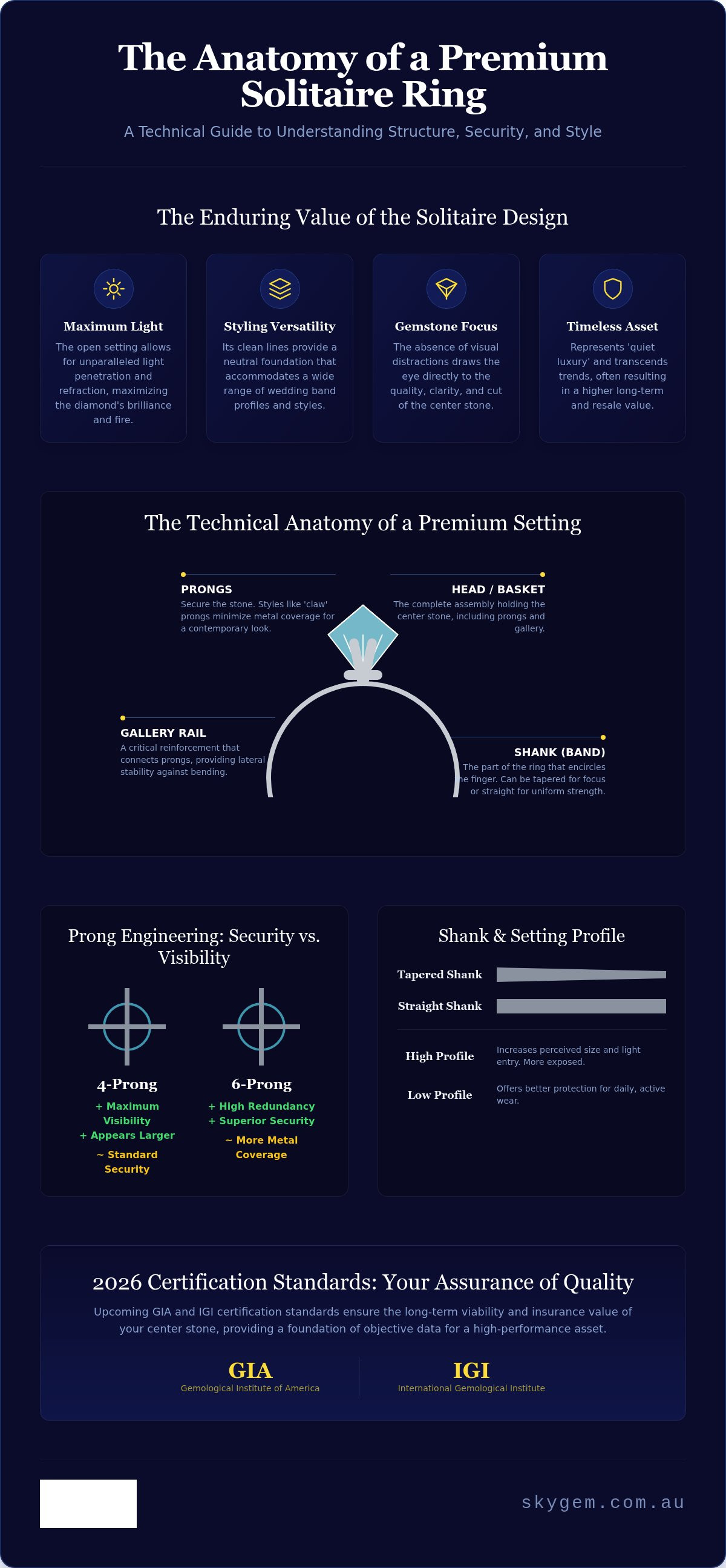
The solitaire engagement ring represents the peak of minimalist jewellery design, stripping away extraneous ornamentation to focus entirely on a singular centre stone. In the context of solitaire engagement rings Melbourne, this design philosophy serves a practical purpose beyond mere aesthetics. By isolating the diamond, the setting allows for maximum light penetration and refraction, which directly enhances the stone's brilliance and fire. This technical advantage ensures that the diamond's inherent quality remains the focal point, making it a superior choice for those who value performance over complexity.
From a styling perspective, the solitaire offers unparalleled versatility. Its clean lines provide a neutral foundation that accommodates a wide range of wedding band profiles, from simple polished metal to intricate diamond-set pavé designs. This adaptability is a key reason why the style maintains its status as a primary choice for Australian couples. It offers a sense of long-term aesthetic viability that more decorative, trend-heavy settings often lack.
Why Solitaire Designs Dominate the Australian Market
As we move through 2026, the Australian market has seen a distinct shift toward 'quiet luxury'. This movement prioritises high-quality materials and expert craftsmanship over loud, oversized designs, a trend reflected in the rising demand for solitaire engagement rings Melbourne. Choosing a solitaire is often a strategic financial decision; it allows the buyer to allocate their entire budget toward a single, higher-quality centre stone rather than distributing funds across multiple smaller accents. This approach typically results in a higher resale value and better long-term durability. While the history of engagement rings includes various ornate periods, the solitaire's ability to transcend generational shifts means it's a reliable asset.
The Role of the Solitaire in Showcasing Gemstone Purity
The technical benefit of a solitaire setting is the total absence of visual distraction. Without side stones or halos competing for attention, the eye is drawn immediately to the clarity and cut of the main gem. This makes the setting particularly suitable for showcasing natural GIA certified diamonds, where the stone’s unique characteristics are the primary draw.
Technical specifications such as setting height also play a critical role. A higher setting can increase the perceived size of the diamond and allow more light to enter the pavilion, while a lower-profile setting offers better protection for daily wear. Balancing these parameters is essential for achieving a design that is both visually striking and structurally sound.
The Technical Anatomy of a Premium Solitaire Setting
While often perceived as a minimalist choice, the structural integrity of solitaire engagement rings Melbourne depends on precise mechanical specifications. A premium setting is an exercise in engineering balance, where the goal is to secure the centre stone without obstructing its light performance. Every component, from the thickness of the shank to the placement of the gallery rail, serves a specific functional purpose in ensuring the piece survives the rigors of daily wear for decades.
The gallery rail acts as a critical reinforcement point. This horizontal band of metal connects the prongs below the diamond's girdle, providing lateral stability. Without this rail, prongs are more susceptible to bending if caught on fabric or hard surfaces. Additionally, the shank design affects both the visual profile and the physical balance of the ring. A tapered shank, which narrows as it approaches the diamond, creates a visual focus on the gemstone, whereas a straight shank offers uniform strength and a more substantial feel on the finger.
Prong Engineering: Security vs. Visibility
Prong selection is a primary technical decision that impacts both security and aesthetic exposure. A six-prong setting offers a high degree of redundancy; if one prong is damaged, the stone is still held by five others. This configuration also maintains the round silhouette of the diamond. Conversely, a four-prong setting allows more of the diamond's pavilion to be visible, which can increase light entry and make the stone appear larger. Many modern designs now utilise 'claw' prongs, which are tapered to a fine point. These provide a sharp, contemporary look while minimising the amount of metal covering the crown facets. Regardless of the style, periodic prong tightening is a necessary maintenance step to ensure the stone remains seated correctly within the head.
Metal Selection: Platinum vs. 18K Gold Purity
The choice of metal is not merely a matter of colour but of physical properties and performance metrics. Platinum is favoured for its extreme density and 'displacement' properties. Unlike gold, which loses microscopic amounts of metal when scratched, platinum simply shifts, making it highly resistant to thinning over time. For those preferring gold, 18K alloys provide the optimal balance of purity and hardness. White gold requires rhodium plating to maintain its bright finish, while yellow and rose gold offer a classic warmth without the need for ongoing surface treatments. For a deeper analysis of these materials, you may consult our Definitive Guide to Gold Jewellery. High-end manufacturing also involves work-hardening the metal, a process that increases the hardness of the setting through mechanical pressure, ensuring the prongs remain rigid.
Setting height is the final technical consideration. A high-profile setting elevates the diamond, allowing for maximum light refraction and making it easier to pair with flush-fitting wedding bands. However, a lower profile is often more ergonomic for individuals with active lifestyles, as it reduces the risk of the ring snagging. If you are uncertain which configuration suits your requirements, you can explore our range of bespoke engagement rings to see these technical variations in practice.
Selecting the Centre Stone: Natural vs. Lab-Grown Diamonds
The 4Cs (Cut, Colour, Clarity, and Carat) serve as the essential technical framework for evaluating any diamond. When sourcing solitaire engagement rings Melbourne, the centre stone is the sole protagonist; therefore, each specification must be scrutinised with precision. While Carat weight often dominates the conversation, the Cut grade is the most critical metric for light performance. A diamond with an 'Excellent' cut grade will maximise light return through the crown, ensuring the stone remains vibrant even in low-light environments. This is particularly vital in a solitaire setting, where there are no accent stones to compensate for a dull centre gem.
The market has seen a significant shift with the rise of lab-grown diamonds as a high-performance alternative. These stones are chemically, physically, and optically identical to natural diamonds but are available at a substantially lower price point. In 2026, a 1-carat lab-grown diamond typically costs roughly 90% less than a comparable natural stone. This price discrepancy allows clients to prioritise higher Colour and Clarity grades or significantly larger Carat weights within the same budget. To ensure technical accuracy, every stone should be accompanied by a GIA or IGI certificate. As of October 2025, the GIA uses a simplified "Premium" and "Standard" tier for lab-grown stones, whereas IGI continues to provide the full 4Cs letter-and-number scale, which many technical buyers prefer for granular comparison.
The 2026 Diamond Landscape in Australia
Carbon is carbon. Whether formed in the earth's mantle or a plasma reactor, the physical properties remain identical. However, the 'Origin' factor remains a significant variable in the long-term value of natural stones. Natural diamonds are finite assets, which appeals to those viewing their purchase through a lens of rarity. Conversely, lab-grown stones focus on technical perfection and ethical transparency. Regardless of origin, the diamond's shape dictates its light performance. Round brilliants offer the highest refraction, while elongated shapes like Ovals or Pears provide a larger surface area, though they require careful inspection to avoid the 'bow-tie' effect in the centre of the stone.
Beyond Diamonds: Coloured Gemstones in Solitaire Settings
While diamonds remain the standard, many clients opt for precious gemstones as a centrepiece. Technical considerations for coloured stones differ significantly from diamonds. The Mohs scale of mineral hardness is the primary metric here; sapphires and rubies score a 9, making them suitable for daily wear. Emeralds, scoring between 7.5 and 8, are more brittle and require protective settings like a bezel or a thicker gallery rail. The longevity of solitaire engagement rings Melbourne featuring these stones depends entirely on matching the gemstone's physical properties with an appropriate setting architecture.
The Bespoke Design Process: From Concept to Craftsmanship
The creation of bespoke solitaire engagement rings Melbourne is a structured engineering project that begins with a detailed technical consultation. During this phase, aesthetic preferences are translated into precise design parameters. We evaluate the centre stone’s specific dimensions, including its depth and girdle thickness, to determine the optimal seat height and prong placement. This level of technical planning ensures that the final piece is not only visually balanced but also structurally sound for long-term use as a permanent asset.
The transition from a conceptual sketch to a physical ring requires a methodical workflow. By acting as technical consultants, we help you understand how minor adjustments in band thickness or prong orientation can significantly impact the ring's durability. This collaborative approach removes the uncertainty often found in traditional retail environments, replacing it with a transparent, data-driven design experience.
CAD Design and Prototyping
Computer-Aided Design (CAD) is the cornerstone of modern high-precision jewellery manufacturing. By creating a digital 3D model, we can account for the exact measurements of your selected diamond to the tenth of a millimetre. This technology allows us to adjust critical specifications, such as the width of the tapered shank or the thickness of the gallery rail, before any metal is cast. A significant benefit of this process is the production of a 3D-printed resin prototype. This physical model allows you to assess the ring’s proportions and profile height on your finger, ensuring the design meets your ergonomic requirements.
Hand-Finishing and Quality Control
Once the digital model is finalised, the piece moves into the manufacturing stage, typically utilising the 'lost wax' casting method or specialised hand-forging techniques for premium platinum designs. The transition from a raw casting to a finished asset involves several stages of meticulous hand-finishing. Skilled jewellers hand-polish the internal galleries and the under-bezel to ensure maximum wearer comfort and light reflection. This stage is critical because even the most precise casting requires human expertise to achieve a mirror-like finish.
The final setting of the stone is a high-stakes technical procedure. The jeweller carefully carves seats into the prongs, ensuring the diamond sits level and secure. Following the setting, the ring undergoes a rigorous quality control inspection where we verify metal integrity and prong tension. This methodical approach ensures that every piece meets the highest standards of Australian craftsmanship. If you are ready to begin your own design project, you can explore our custom engagement rings service to see how these technical stages come together.
Securing Your Ideal Solitaire Engagement Ring with SkyGem & Co.
Choosing a solitaire engagement ring is a significant technical and financial undertaking that requires more than a simple retail transaction. At SkyGem & Co., we position ourselves as technical consultants rather than traditional retailers. From our Melbourne-based workshop, we provide expert guidance to clients across Australia, ensuring that every design decision is backed by data and engineering logic. Our commitment to transparency means you receive a full disclosure of diamond origin and technical specifications, allowing you to secure a piece of jewellery that functions as a high-performance asset.
The beauty of a solitaire lies in its technical perfection. Because there are no secondary stones to mask imperfections, the craftsmanship of the setting and the quality of the centre stone must be absolute. We invite you to experience a process where engineering meets elegance, resulting in a ring that is both a personal symbol and a masterclass in structural design. Whether you are located in Victoria or elsewhere in the country, our consultative approach ensures your requirements are translated into a durable, timeless piece of Australian jewellery.
The SkyGem Standard: Reliability and Precision
One of the primary risks of mass-produced jewellery is the use of lightweight castings and thin prongs to reduce manufacturing costs. These shortcuts often lead to stone loss or band deformation over time. In contrast, a bespoke piece from our engagement rings collection is engineered for longevity. We focus on the intersection of metal density and prong tension to create a secure environment for your diamond. To support the long-term viability of your ring, we offer ongoing maintenance and repair services. This includes periodic technical inspections of the setting and professional cleaning to maintain the stone’s light performance, ensuring your investment remains in peak condition for decades.
Planning Your Consultation
Preparation is essential for a productive technical design session. Before your consultation, it's helpful to establish a baseline for your preferences regarding metal type and diamond origin. Consider whether the superior density of platinum or the classic appeal of 18K gold better suits your lifestyle. Additionally, having an accurate ring size is critical, as resizing certain high-precision solitaire settings can occasionally impact the structural balance of the shank. During our session, we will review GIA and IGI certification reports together, helping you understand the performance metrics of specific stones.
If you are ready to move from concept to creation, we are here to provide the technical expertise required for a successful project. Book a bespoke consultation with our technical experts today to begin designing your solitaire engagement rings Melbourne.
Investing in Enduring Craftsmanship
Selecting a solitaire setting is a commitment to minimalist excellence where every technical specification matters. By prioritising structural integrity through precise prong engineering and CAD-driven design, you eliminate the risks associated with mass-produced alternatives. Whether you opt for a natural GIA-certified diamond or a high-performance lab-grown stone, the focus must remain on light performance and material durability to ensure the piece remains a permanent asset.
Finding the right solitaire engagement rings melbourne requires a partnership with a technical consultant who understands the nuances of regional craftsmanship. SkyGem & Co. combines expert technical consultations with premium manufacturing to deliver pieces that withstand the rigours of daily wear while maintaining aesthetic brilliance. Our use of CAD precision and certified gemstones provides the transparency you need for a secure buying experience.
Design your bespoke solitaire engagement ring with SkyGem & Co. and secure a piece that reflects both technical precision and timeless elegance. We look forward to helping you translate your vision into a precisely engineered reality.
Frequently Asked Questions
What is the difference between a four-prong and a six-prong solitaire setting?
A six-prong setting provides greater redundancy and security, whereas a four-prong setting increases the exposure of the diamond’s facets. In a six-prong configuration, the round silhouette of the stone is better maintained; if one prong is compromised, the remaining five continue to secure the gem. Conversely, four prongs allow more light to enter the pavilion from the sides, which can enhance the perceived size of solitaire engagement rings Melbourne.
Are lab-grown diamonds as durable as natural diamonds for a solitaire ring?
Lab-grown diamonds possess the exact same physical and chemical properties as natural diamonds, resulting in identical durability. Both stones score a 10 on the Mohs scale of mineral hardness, making them highly resistant to scratching and surface wear. For a solitaire ring, this means a lab-grown centre stone will maintain its structural integrity and light performance over decades of daily use, provided the setting is engineered correctly.
How do I choose the right metal for my solitaire engagement ring?
Selecting the right metal involves balancing density, maintenance, and aesthetic preference. Platinum is the most durable choice due to its high density and displacement properties; it doesn't lose metal when scratched. 18K gold, available in white, yellow, and rose, offers a classic look with a high purity level. White gold requires periodic rhodium plating to maintain its bright finish, while yellow and rose gold are lower maintenance for long-term wear.
Can I customise a solitaire ring if I already have a loose diamond?
You can certainly customise a setting for a loose diamond through a bespoke design process. This approach is technically superior because it uses CAD technology to model the setting around the exact dimensions of your specific stone. We measure the diamond's girdle thickness, pavilion depth, and crown angle to ensure the prongs and gallery rail provide a precise, secure fit that mass-produced mounts cannot achieve for unique solitaire engagement rings Melbourne.
What is the most popular diamond shape for solitaire rings in Australia?
The round brilliant cut remains the most popular choice for its unmatched light performance, though elongated shapes like ovals have seen a significant rise in 2026. Round diamonds are engineered for maximum refraction, making them the standard for solitaire designs. Ovals and pear shapes are favoured by those seeking a larger surface area relative to carat weight, though they require precise setting techniques to ensure the stone is balanced.
How often should I have my solitaire ring setting inspected for security?
We recommend a technical inspection every six to twelve months to ensure the security of your centre stone. During this process, a jeweller checks for prong tension, metal fatigue, and any signs of thinning in the shank. Regular maintenance is essential for solitaire rings, as the single-stone design places all the structural stress on the primary setting. Catching minor prong movement early prevents the risk of stone loss or serious damage.
Is a solitaire engagement ring more expensive than a halo setting?
A solitaire setting is generally less expensive to manufacture than a halo setting because it requires fewer components and less labour-intensive stone setting. However, because the solitaire focuses entirely on one gem, buyers often allocate the savings into a higher-quality centre stone. This shift in budget distribution ensures that the primary investment is placed into the most valuable part of the ring rather than into smaller, decorative accent diamonds.
How does the height of the setting affect the diamond's sparkle?
The height of a setting primarily impacts light entry and refraction rather than the diamond's inherent sparkle. A high-profile setting elevates the stone, allowing more light to penetrate the pavilion and crown, which can make the diamond appear more vibrant. While lower settings offer better protection against snagging, they may slightly restrict light access. The optimal height is a technical balance between maximising light performance and ensuring the ring is practical for daily wear.
Disclaimer
This article is for general informational purposes only and may include AI-assisted content. Pricing, specifications, and availability are subject to change. For accurate advice and current information, please contact SkyGem & Co. directly. Nothing in this content constitutes professional or financial advice.