
Ruby Durability for Everyday Wear: A Specialist Guide to Longevity

While the diamond is frequently positioned as the only viable candidate for high-impact jewellery, the technical reality of gemstone physics suggests a different hierarchy for the discerning owner. You likely understand the weight of investing in a piece that must withstand the rigours of a professional environment; yet, the fear of a single accidental knock causing irreparable damage remains a common deterrent for many Australians. Understanding ruby durability for everyday wear requires looking beyond simple marketing and into the structural reality of the Mohs scale, where rubies sit at a formidable 9. This rating confirms that rubies are not just decorative, they are engineered by nature to resist the abrasions of an active lifestyle.
It's natural to worry that modern chemicals like hand sanitiser or household cleaners might degrade a premium stone over time. This specialist guide clarifies the vital distinction between mineral hardness and structural toughness, providing the technical validation you need to wear your investment with quiet confidence. We will detail how the specific crystalline structure of corundum compares to diamond, which protective settings offer the best long-term security, and how to ensure your ruby remains a permanent asset that lasts a lifetime.
Key Takeaways
- Understand the technical advantages of the corundum mineral family, where a Mohs hardness rating of 9 provides a stable foundation for long-term gemstone performance.
- Learn how the absence of cleavage planes facilitates superior ruby durability for everyday wear, offering a resilient alternative to gemstones prone to structural splitting.
- Assess the resistance of rubies to common environmental stressors, including household detergents and alcohol-based sanitisers, to preserve surface lustre.
- Distinguish between natural and treated specimens to avoid the structural vulnerabilities associated with lead-glass filling in high-use jewellery.
- Establish a professional maintenance protocol to ensure prong security and protect the long-term architectural integrity of your investment.
Understanding Ruby Hardness: The Mohs Scale and Corundum
Rubies belong to the corundum family, a mineral group defined by its exceptional stability and chemical integrity. This stability stems from its primary composition of Aluminium Oxide. In the Australian jewellery market, where longevity is a non-negotiable requirement for investment pieces, understanding this mineral structure is vital. The tight bonding within the crystal lattice ensures that the gemstone remains chemically inert and physically resilient against environmental stressors. This technical foundation is what underpins ruby durability for everyday wear, allowing the stone to maintain its lustre through decades of use.
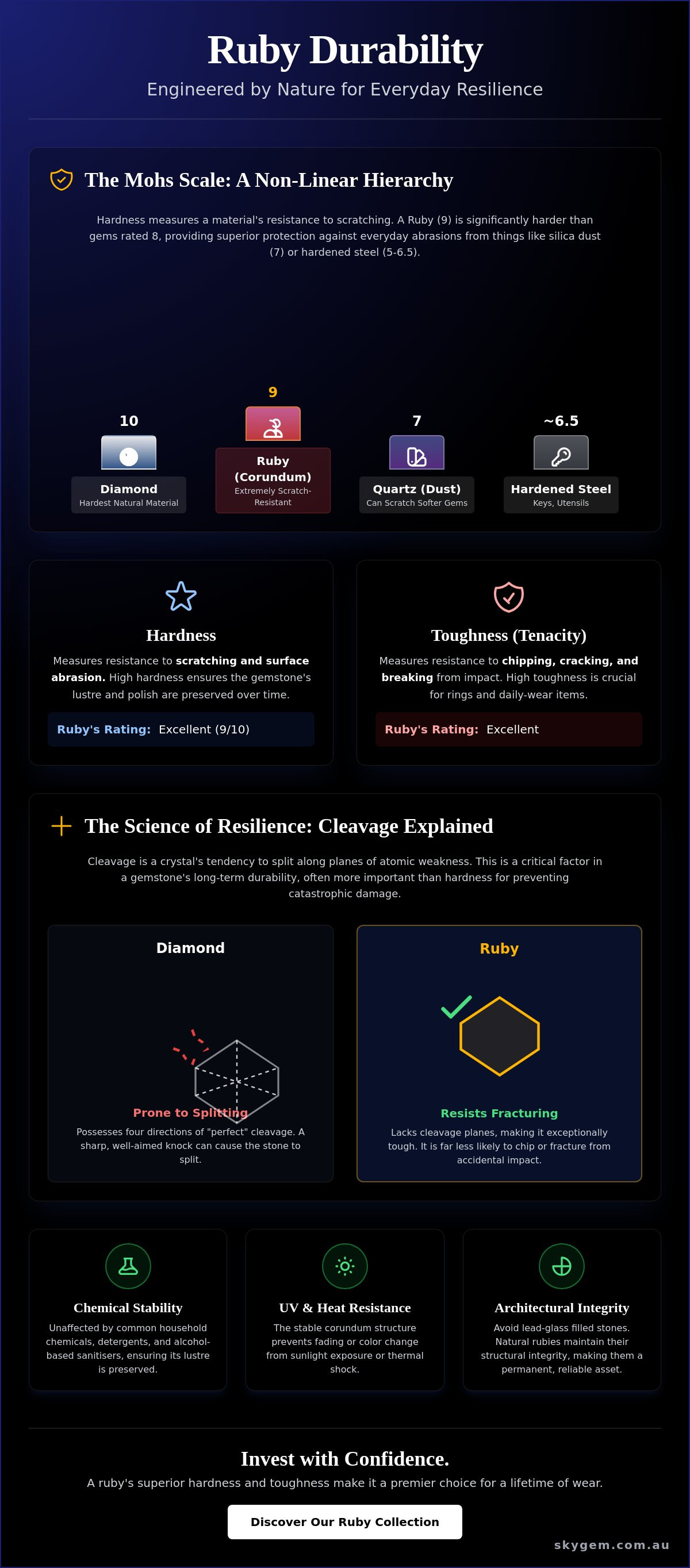
The standard metric for evaluating a gemstone's resistance to damage is the Mohs scale of mineral hardness. This scale ranks minerals from 1 to 10 based on their ability to scratch one another. As documented in the Ruby Hardness on the Mohs Scale, rubies consistently rank at a 9. This placement makes them the second hardest natural material known to man, surpassed only by diamonds. Because the scale is non-linear, a 9 is significantly harder than an 8, providing a level of protection that ensures the stone remains free from the microscopic abrasions that dull lesser gems.
Practical comparisons highlight this advantage. Common household dust often contains particles of silica (quartz), which sits at a 7 on the Mohs scale. While silica can easily scratch glass or softer stones like opal or tanzanite, it cannot penetrate the surface of a ruby. Similarly, hardened steel typically ranges between 5 and 6.5. This disparity means that everyday contact with keys, stainless steel surfaces, or kitchen utensils won't result in surface damage. The primary benefit for the wearer is a gemstone that remains exceptionally resistant to the "clouding" effect caused by accumulated surface scratches.
Hardness vs. Toughness: Why the Difference Matters
It's vital to distinguish between hardness and tenacity, often referred to as toughness. Hardness measures a material's ability to resist scratching or surface abrasion. Tenacity, however, measures the ability to resist breaking, chipping, or cracking under impact. While a 9 on the Mohs scale confirms that a ruby is difficult to scratch, its crystalline structure also provides excellent toughness. This combination is why rubies are a premier choice for engagement rings and daily accessories; they offer a balanced profile that handles both friction and the occasional accidental knock against a hard surface.
The Corundum Advantage
The density of a ruby is a direct result of its Aluminium Oxide composition and its hexagonal crystal system. This dense arrangement contributes to the stone's high specific gravity and its ability to withstand thermal shock. Because natural rubies are among the most stable minerals on Earth, they don't fade when exposed to UV light or degrade when in contact with standard household chemicals. This inherent durability ensures that the vibrant red saturation remains consistent over a lifetime. For those prioritising ruby durability for everyday wear, the corundum structure provides a future-proof solution that resists the rigours of a modern lifestyle.
The Science of Resilience: Gemstone Cleavage and Impact
Understanding the structural integrity of a gemstone requires looking beyond surface hardness. Cleavage refers to the tendency of a crystal to split along specific planes of atomic weakness. While diamonds are the benchmark for scratch resistance, they possess four directions of perfect cleavage. This means a diamond can split if it's hit at a precise angle. Rubies don't have this vulnerability. Because they lack cleavage planes, they're much harder to break or chip through sheer force. This structural advantage significantly enhances ruby durability for everyday wear, as the stone is far less prone to catastrophic fracturing during accidental impacts.
This resilience makes the ruby an exceptionally tough candidate for jewellery that faces the friction of daily life. In the Australian market, where outdoor lifestyle factors are a priority, the technical performance of corundum is a major benefit for long-term wear. Unlike stones that require delicate handling, a ruby handles the occasional knock against a hard surface with ease. It remains a stable and reliable choice for those who want a high-value gemstone without the constant anxiety of fragility.
How Ruby Handles Physical Impact
The resilience of a ruby is rooted in its interlocking crystalline structure. In gemology, we distinguish between hardness, which is scratch resistance, and toughness, which is impact resistance. Rubies exhibit high tenacity, making them a reliable choice for rings intended for active lifestyles. Whether you're working in a professional office or engaging in weekend activities, a ruby's lack of cleavage ensures it absorbs energy rather than shattering. Tenacity is a measure of a gemstone’s resistance to fracturing or crushing, and the ruby's high tenacity ensures it remains intact even under significant physical stress.
When selecting a stone for a permanent piece, it's helpful to consider the following technical traits:
- Structural Density: The tightly packed atoms in corundum provide a solid foundation that resists external pressure.
- Impact Absorption: Without cleavage planes to act as "fault lines," the stone distributes the force of a blow across its entire body.
- Surface Stability: High toughness means the facet junctions are less likely to crumble or "paper wear" over decades of use.
Comparing Ruby to Other Coloured Gems
When evaluating coloured stones, the ruby's performance is superior to many popular alternatives. Emeralds, for instance, often contain numerous internal inclusions and fractures that make them inherently brittle and susceptible to damage. You can read more from GIA on Ruby Durability regarding how clarity impacts structural integrity. Both rubies and sapphires belong to the corundum family, sharing an identical durability profile that ranks at a 9 on the Mohs scale. This puts them in a category of their own for reliability.
Both gemstones are ideal for high-impact jewellery like engagement rings or everyday bands. To ensure these stones are mounted to withstand decades of use, refer to our bespoke jewellery guide for technical insights on protective setting styles. If you're ready to find a stone that matches your lifestyle, you can explore our curated selection of loose rubies to find a specimen with the perfect balance of colour and structural clarity.
Real-World Wearability: Chemicals, Heat, and Lifestyle
Understanding ruby durability for everyday wear requires looking beyond the Mohs scale to how the stone interacts with modern environments. While a ruby's crystalline structure is exceptionally hard, its daily performance is often dictated by the substances it encounters. In an Australian context, where outdoor activity and frequent use of hand sanitisers are standard, maintaining the stone's optical performance is a matter of technical care rather than fragility. The ruby remains one of the few gemstones capable of withstanding the rigours of a busy lifestyle without losing its structural integrity.
Chemical Exposure and Stone Stability
Natural, unheated rubies are chemically inert. They resist damage from most household acids and bases, including the vinegar or citrus cleaners used in many Australian homes. However, the primary threat isn't the destruction of the gem, but the degradation of its brilliance. Lotions, perfumes, and heavy sunscreens tend to accumulate on the underside of the stone. This "clogging" creates a film that disrupts the light path, making a high-quality ruby appear dull. For detailed technical protocols, the GIA Ruby Care and Cleaning Guide confirms that while the stone is stable, the buildup of oils requires regular removal to maintain luminosity.
Chlorine and bleach present a different risk. While these chemicals won't dissolve the ruby, they can cause stress corrosion in the metal alloys of the setting. If you're swimming in a chlorinated pool or using industrial-strength cleaners, removing your ring protects the integrity of the gold prongs. Ruby durability for everyday wear is high, but the mechanical security of the stone depends on the health of the surrounding metalwork. Consistent exposure to harsh chemicals can eventually weaken the setting, risking the loss of the gemstone entirely.
Thermal Stability in Daily Life
Rubies possess excellent thermal management properties. They remain stable during rapid temperature shifts, such as moving from a 38°C afternoon in Perth to a refrigerated office environment. This stability contrasts sharply with stones like opals or pearls, which can succumb to thermal shock or dehydration. Natural rubies are forged under extreme heat and pressure; this means standard domestic heat won't alter their colour or structure. This isn't always true for glass-filled or highly treated stones, which can fail if exposed to high temperatures during repairs or even accidental contact with a hot stove. Ensuring the longevity of high-wear pieces requires professional maintenance to check for structural shifts or loose settings that might occur over years of use.
The Daily Ruby Checklist: When to Remove Your Jewellery
- Gym and Heavy Lifting: Avoid mechanical impact that could chip the facet edges or deform the band.
- Gardening: Soil contains quartz particles (Mohs 7), which won't scratch a ruby but can quickly abrade the metal setting.
- Applying Cosmetics: Put your rings on last to prevent hairspray and perfume from forming a cloudy film.
- Swimming: Chlorine can weaken 18k gold or platinum alloys over time, potentially loosening the stone.
- Kitchen Prep: Remove rings when handling heavy oils or doughs that lodge in the intricate parts of the setting.
Selecting for Longevity: Treatments and Setting Styles
Choosing a ruby for a ring requires a technical understanding of how treatments and mounting styles influence the stone's resilience. While rubies are inherently hard, certain commercial enhancements can introduce structural weaknesses that compromise ruby durability for everyday wear. A strategic approach to selection focuses on both the internal integrity of the crystal and the mechanical protection provided by the jewellery design. We view the setting not just as an aesthetic choice, but as a protective housing that ensures the gemstone survives the rigours of daily activity.
The Risk of Fracture-Filled Rubies
Many rubies in the Australian market undergo lead-glass filling to improve clarity. This process involves injecting high-lead content glass into surface-reaching fractures. While the stone looks better initially, it becomes chemically unstable. Lead glass is highly susceptible to damage from mild acids, such as lemon juice or vinegar, and can be destroyed by the heat of a jeweller's torch during routine repairs. For a piece intended to last decades, unheated or traditionally heat-treated rubies are the industry standard. These stones maintain their structural density without the risk of the filler leaching or cracking. We recommend a transparent loose gemstone selection process to verify the treatment status before the stone is set into a permanent mount.
Protective Settings for Everyday Wear
The metal mounting serves as the primary line of defence against mechanical impact. A bezel setting is the most secure option, as it surrounds the entire girdle of the ruby with a protective rim of gold or platinum. This prevents the edges from chipping when the ring accidentally strikes hard surfaces like granite benchtops or door frames. If you prefer the classic look of prongs, the geometry matters. A 6-prong setting offers a significant safety advantage over a 4-prong configuration. In a 6-prong arrangement, the loss or bending of a single claw is less likely to result in the stone falling out. This redundancy is essential for maintaining ruby durability for everyday wear in active lifestyles.
The choice of metal also dictates how well the prongs hold their shape over time. High-quality 18ct gold or platinum provides the necessary tensile strength to keep the gemstone immobile. When stones are loose in their settings, they act like a hammer against the metal, eventually wearing down the seat and increasing the risk of loss. You can explore various mounting options in our collection of engagement rings to see how different designs prioritise stone security.
Ensure your investment is protected by selecting a stone and setting engineered for life. Consult with our specialists to design a custom-made ring that balances aesthetic elegance with technical durability.
Professional Care and Maintenance for Your Ruby
Maintaining the structural integrity of a ruby requires a proactive approach to preventative care. While the ruby ranks high on the Mohs scale, the longevity of the piece depends on how well the setting supports the stone under daily stress. We view the relationship between a client and their jeweller as a technical partnership, ensuring that ruby durability for everyday wear is maintained through decades of use. Regular attention prevents minor abrasions from becoming significant structural failures. Establishing a rigorous care routine is the final step in guaranteeing ruby durability for everyday wear, turning a high-performance gemstone into a multi-generational heirloom.
Routine Home Cleaning Protocol
A consistent cleaning schedule prevents the accumulation of oils and debris that can dull the stone's optical performance. Follow this structured process every 2 to 4 weeks to keep the ruby in peak condition:
- Step 1: Submerge the piece in a solution of warm water and a few drops of mild, pH-neutral detergent for 15 minutes.
- Step 2: Use a soft-bristled brush to gently agitate the areas behind the stone where skin oils and hand creams typically collect.
- Step 3: Rinse under lukewarm running water and dry thoroughly with a lint-free microfibre cloth to avoid water spots.
Homeowners should exercise caution with ultrasonic cleaners. While rubies are generally resilient, stones with significant inclusions or surface-reaching fractures can suffer internal stress from high-frequency vibrations. If a standard soak doesn't restore the stone's brilliance, it's an indicator that a professional deep clean is required. A specialist can safely remove compacted debris that has hardened over time without risking the stone's stability.
Long-term Maintenance and Inspections
Professional inspections should occur annually to evaluate the mechanical components of the ring. During a "check and polish" service, a specialist examines the prongs and bezel for signs of thinning or displacement. Metal naturally wears down over time. In the Australian climate, fine grit and dust can act as an abrasive between the finger and the metal band. A prong that loses 30% of its mass can no longer provide the clamping force necessary to secure the gemstone. Early detection allows for retipping or rebuilding the setting before the stone is lost.
Storage is another critical factor in preserving the surface finish. Because a diamond is the only mineral harder than a ruby, storing them together can result in permanent scratches on the ruby's facets. Use individual fabric-lined compartments to isolate each piece of jewellery. For those concerned about how their active lifestyle might impact their jewellery, booking a custom design consultation provides an opportunity to engineer a setting specifically for high-impact environments. This technical foresight ensures your ruby remains a permanent asset rather than a fragile accessory.
Securing the Future of Your Bespoke Investment
Selecting a gemstone for a lifetime requires a precise balance of chemical stability and structural resilience. As a variety of corundum, rubies possess a Mohs hardness rating of 9.0, which means they're the second hardest natural mineral on Earth. This physical property ensures that ruby durability for everyday wear remains superior to almost all other coloured gemstones used in high-end jewellery. By prioritising unheated, GIA-certified stones, you avoid the long-term risks associated with glass-filling or thermal treatments that can compromise a stone's internal lattice. Our team at Skygem focuses on future-proofing your investment through bespoke design that prioritises technical performance and architectural aesthetics. We offer expert technical consultations to ensure every piece maintains its structural integrity against the rigours of the Australian lifestyle. It's a partnership aimed at creating a permanent asset that retains its brilliance for decades. We look forward to helping you engineer a piece that stands the test of time.
Explore our collection of natural, unheated rubies for your bespoke piece
Frequently Asked Questions
Can I wear my ruby ring in the shower or while washing dishes?
You can wear your ruby ring during these activities, but it's better to remove it to prevent soap scum buildup. While the gemstone itself is chemically resistant, household detergents often contain abrasive surfactants that can dull the metal setting over time. Regular exposure to hot water and soap won't damage a natural ruby, yet it necessitates more frequent maintenance to retain its original lustre.
Will a ruby scratch as easily as a sapphire?
A ruby won't scratch more easily than a sapphire because both gemstones are varieties of the mineral corundum. On the Mohs Scale of Mineral Hardness, both rubies and sapphires hold a rating of 9.0, making them the second hardest natural gemstones available. Only a diamond or another piece of corundum can cause physical surface abrasions to your ruby, ensuring high performance in daily applications.
Is a ruby more or less durable than a diamond for an engagement ring?
Rubies are slightly less hard than diamonds, though they remain an exceptional choice for long term daily use. While a diamond rates a 10 on the Mohs scale, the ruby's rating of 9 provides sufficient resistance against the 7.0 hardness of common dust particles. This high level of ruby durability for everyday wear ensures the stone resists the typical abrasions encountered in an active Australian lifestyle.
What happens if I hit my ruby ring against a hard surface?
Hitting your ruby against a hard surface like granite or steel can result in chipping or internal fractures. While rubies lack the distinct cleavage planes found in diamonds, they can still crack under high impact. If a significant strike occurs, you should inspect the stone under 10x magnification to ensure the structural integrity of the setting and the gemstone remains intact and secure.
Do rubies lose their colour or fade in the sun over time?
Natural rubies don't lose their colour or fade when exposed to UV radiation from the sun. The red hue in corundum is caused by the presence of chromium, which is stable under standard environmental conditions. Unlike organic gems or certain treated stones, a high quality ruby maintains its saturation even in the harsh Australian climate where UV indices often exceed 11 during summer months.
How often should I have my ruby jewellery professionally cleaned?
You should have your ruby jewellery professionally cleaned and inspected at least once every 12 months. This annual check allows a specialist to verify the security of the claws and remove compacted debris that home cleaning cannot reach. Maintaining this schedule prevents the 15% to 20% risk of stone loss associated with undetected wear in the metal housing of the ring over several years.
Can hand sanitiser damage my natural ruby?
Hand sanitiser won't damage a natural, untreated ruby, but it can leave a film that obscures the stone's brilliance. Most Australian sanitisers contain 60% to 80% ethanol or isopropyl alcohol, which is safe for the corundum structure. However, frequent use can dry out organic inclusions or affect certain surface treatments, so rinsing your hands with fresh water after application is a practical safeguard for your investment.
Are lab-grown rubies as durable as natural rubies?
Lab-grown rubies are just as durable as natural rubies because they share the same chemical composition and crystal structure. Both versions consist of aluminium oxide and achieve a 9.0 rating on the Mohs scale. This ensures that ruby durability for everyday wear remains consistent regardless of whether the gemstone was mined from the earth or created through technical processes like the Verneuil or flux growth methods.
Disclaimer
This article is for general informational purposes only and may include AI-assisted content. Pricing, specifications, and availability are subject to change. For accurate advice and current information, please contact SkyGem & Co. directly. Nothing in this content constitutes professional or financial advice.