
Professional Ring Resizing Melbourne: The Australian Expert Guide to a Perfect Fit (2026)

What if the perfect fit for your ring isn't a static measurement, but a precise calibration of physics and biology? For many, the frustration of a top-heavy solitaire spinning or the constant fear of a loose band slipping off becomes a daily burden. When you seek professional ring resizing experts, you're looking for more than a simple adjustment. SkyGem & Co. understands you're seeking a solution that maintains the delicate equilibrium between comfort and security.
You likely feel a sense of anxiety every time your solitaire tilts or your band leaves a mark on your skin. This guide will provide you with the technical knowledge needed to ensure your ring remains secure and comfortable for a lifetime. We examine the mechanics of different metal alloys, the specific limitations of intricate settings, and how to achieve a calibrated fit that resists rotation even during seasonal temperature shifts.
Key Takeaways
- Understand the technical precision of laser-welding and metal removal to ensure your band retains its original structural integrity.
- Learn how the density of materials like Platinum and 18K Gold dictates the resizing process and protects the security of your gemstone settings.
- Master the 'Wide Band Rule' and learn how to mitigate 'ring spin' to ensure your professional ring resizing melbourne service results in a stable, comfortable fit.
- Account for biological fluctuations and Melbourne's seasonal shifts to select a measurement that remains accurate throughout the year.
- Discover why high-value bespoke pieces require a tailored consultation that prioritises the balance and architecture of the ring over simple chart measurements.
What is Professional Ring Resizing and How Does the Process Work?
Professional ring resizing is the technical process of modifying the circumference of a precious metal band to achieve a secure, calibrated fit without compromising the piece's structural integrity. It isn't a simple stretching exercise; rather, it's a precise metallurgical procedure that requires an expert understanding of how different alloys respond to heat and tension. When you seek ring resizing melbourne specialists, you're looking for a technician who can alter the shank while preserving the original design's aesthetic and strength.
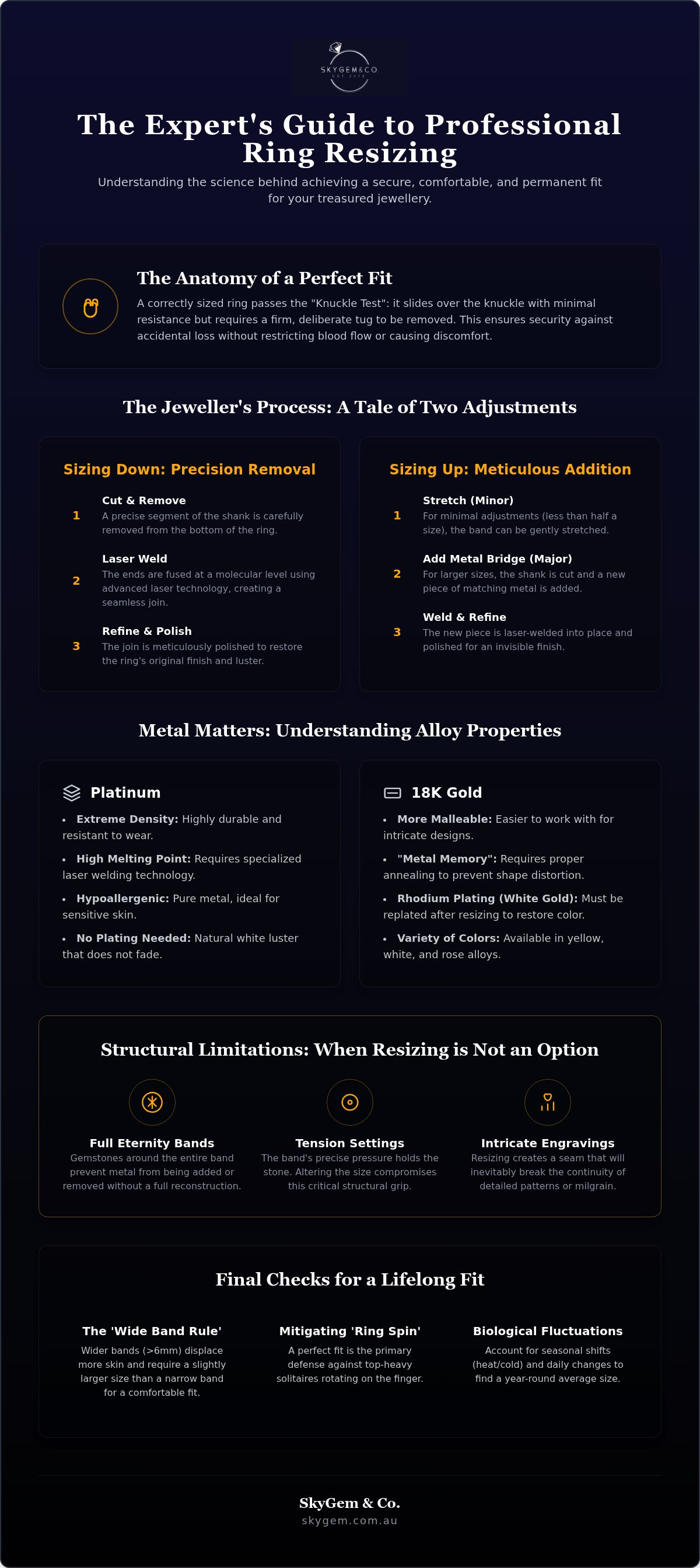
The process for sizing a ring down involves removing a precise segment of the metal from the base of the shank. A master jeweller then aligns the ends and uses laser welding to fuse the metal. This method is vastly superior to traditional soldering because laser technology creates a bond at a molecular level using the same metal as the ring itself. It avoids the "seam" often seen with older techniques and ensures the band remains a consistent colour and density. For sizing a ring up, the jeweller may stretch the metal for very minor adjustments, but for significant changes, they must insert a matching metal bridge. This addition ensures the band doesn't become dangerously thin, which would lead to warping or cracking over time.
The Anatomy of the Perfect Fit
A ring that fits correctly follows the "Knuckle Test" rule. It should slide over the knuckle with minimal effort but require a firm, deliberate tug to remove. This resistance is your primary defence against losing a high-value piece during cold weather or hand washing. While the international ring sizing standards provide the alphabetical scale used across Australia, these letters are merely a baseline for a deeper technical consultation. A poor fit is often identified by excessive rotation or, conversely, skin indentation that restricts blood flow. Our goal is to find the equilibrium where the ring stays upright without causing discomfort.
Professional Calibration vs. Retail Guesswork
High-value bespoke jewellery, such as a custom made engagement ring melbourne, requires more than a simple plastic sizer. Master jewellers use precision-engineered steel sizing rings to account for half-sizes that generic retail chains often overlook. We also consider the "comfort fit" curve on the interior of the band. This internal radius significantly alters how the metal interacts with your skin and bone. DIY methods like using string or paper are notoriously unreliable for high-end commissions because they fail to account for the width of the band or the weight of the gemstone setting.
Technical Factors: Metals, Settings, and Structural Integrity
Successful ring resizing is heavily dependent on the specific physical properties of the metal alloy used in the shank. Platinum, for instance, is prized for its extreme density and durability, yet it poses unique challenges during the adjustment process. Unlike gold, platinum has a significantly higher melting point and requires specialised laser technology to prevent visible seams or contamination at the join. Conversely, 18K gold is more malleable, but it possesses a certain "metal memory" that must be managed. If a jeweller doesn't properly anneal the metal, the band may attempt to return to its original shape, leading to an ovalised fit or structural weakness.
The most critical technical consideration in ring resizing melbourne involves the "arc" of the ring. When the circumference of a band is altered, the curvature of the entire piece changes. For a solitaire, this is relatively straightforward. However, for complex designs, this change in the arc can exert pressure on the prongs or the seat of the gemstone. If the arc is tightened too much without adjusting the setting, the prongs may splay outwards, potentially compromising the security of the centre stone. This is why a technical assessment of the ring's architecture is mandatory before any metal is removed or added.
Certain designs are inherently unresizable due to their structural reliance on a continuous band. Full eternity rings, which feature gemstones around the entire circumference, cannot be resized without removing stones and completely rebuilding the shank. Similarly, tension settings rely on the precise pressure of the band to hold the diamond in place; altering the size disrupts this physics-based grip. Intricate patterns or hand-engraved details also present limitations, as the resizing seam will inevitably break the continuity of the design.
Resizing White Gold and Platinum
When resizing white gold, the process is incomplete without rhodium plating. The heat from the laser welder and the subsequent polishing process strip away the existing rhodium finish, revealing the naturally warm undertones of the white gold alloy. We apply a fresh layer of rhodium to restore the bright, mirror-like finish. For platinum pieces, we use high-heat laser equipment to ensure the new metal bridge is seamlessly integrated. This maintains the hallmark's integrity and ensures the shank remains a single, solid unit. If you're considering a new piece, you can explore our range of platinum and gold settings to understand how these materials perform over time.
Impact on Pave and Side-Stone Settings
Changing the curvature of a band has a direct impact on side-stone security. In pave or channel settings, the small "melee" diamonds are held in place by tiny beads of metal or narrow tracks. As the band's curve is straightened or tightened, these settings can shift, causing the stones to loosen. A professional resize always includes a comprehensive post-adjustment inspection under a microscope to ensure every individual stone remains seated correctly. To understand how we engineer these settings for long-term stability, you can learn about our bespoke engagement ring process and the technical standards we apply to every custom commission.
The Physics of Fit: Balancing Band Width and Gemstone Stability
Achieving the ideal fit involves more than just a static diameter measurement; it requires a deep understanding of how band geometry interacts with human anatomy. A common misconception in ring resizing melbourne is that a single size applies universally across all jewellery styles. In reality, the width of the band is a primary variable in perceived tightness. As the surface area of the metal increases, it displaces more of the finger's soft tissue, creating a tighter sensation even if the internal diameter remains identical to a narrower ring.
The relationship between the height of a centre stone and the band's tension is equally critical. A high-set solitaire engagement ring creates a leverage point that amplifies any instability in the fit. If the band is even marginally too loose, the weight of the gemstone acts like a pendulum, causing the ring to rotate towards the palm. To mitigate this, top-heavy designs often require a more calibrated, snug fit than balanced pieces like trilogy or halo engagement rings. Tapered shanks, which are wide at the shoulders and narrow at the base, provide a hybrid solution by offering the aesthetic of a substantial piece while maintaining the comfort of a thinner band.
Calculating the Wide Band Adjustment
The "Wide Band Rule" is a technical standard used to ensure comfort for designs exceeding 5mm in width. Because wider bands trap more heat and moisture against the skin, they typically require a half to a full size increase. When we perform a technical assessment, we use a graduated scale: for every 2mm of width added beyond a standard 2.5mm shank, we generally recommend a quarter-size increase. This prevents the metal from pinching the skin and ensures the piece remains comfortable during daily activity. You can explore our collection of wide-band wedding rings to see how different profiles influence the final measurement.
Stability Solutions for Large Gemstones
For many clients, the challenge of "ring spin" is exacerbated by having knuckles that are significantly wider than the base of the finger. If we size the ring to fit the base, it won't pass the knuckle; if we size it for the knuckle, it spins freely once worn. We address this physics-based problem using internal sizing beads. These small spheres of matching metal are laser-welded to the inside of the shank, providing a "grip" that keeps the stone upright without restricting the ring's passage over the knuckle. Another effective architectural solution is the "Euro-shank," which features a slightly squared bottom. This flat base provides a counterweight and a wider footprint, effectively resisting rotation in high-set or top-heavy designs.
Preparation and Timing: Ensuring an Accurate Measurement for Life
Biological fluctuations are the primary variable in achieving a permanent fit. Your finger size isn't a fixed metric; it responds dynamically to environmental and physiological stimuli. High humidity and heat cause blood vessels to dilate, while high salt intake leads to fluid retention, both of which can increase your ring size by up to half a letter. Conversely, cold temperatures cause the tissue to contract. This volatility is why a single measurement taken in a climate-controlled retail environment often fails to reflect the reality of daily wear.
In Melbourne, the seasonal variance is particularly pronounced. A ring that feels comfortably snug in the height of January may become dangerously loose during a cold July morning. Professional ring resizing melbourne services don't just aim for a fit that works today; they aim for a fit that remains secure across the full spectrum of Australia's climate. When you invest in a ring resizing melbourne consultation, you're choosing a solution that respects these biological realities. We also account for dominant hand variations. The fingers on your dominant hand are typically larger due to increased muscle development and blood flow, meaning you cannot assume your right-hand measurement applies to your left.
Long-term physiological changes are another factor we integrate into our technical consultation. Life events such as pregnancy, significant changes in exercise routines, or age-related knuckle swelling will all influence how a ring sits over time. While we can't predict every change, we can design a fit that allows for minor fluctuations without requiring constant intervention.
The Optimal Measurement Window
To capture the most accurate data, you should measure your finger in the late afternoon when it has reached its largest stable size for the day. It's essential that your body temperature is regulated before the fitting; avoid coming in directly from a cold wind or a high-intensity workout. The ideal 'Goldilocks' window for professional sizing occurs when your hands are at a comfortable room temperature and your hydration levels are balanced.
Lifestyle and Grip Considerations
Your daily activity level dictates the necessary security of the fit. If your lifestyle involves frequent hand-washing or high-impact outdoor activities, a slightly tighter calibration is required to prevent the ring from slipping off when wet or under centrifugal force. We also distinguish between 'tapered' fingers, where the base is the widest point, and 'knuckled' fingers, where the ring must pass a prominent joint. For tapered fingers, a snug fit is non-negotiable for security, whereas knuckled fingers often benefit from the stability solutions discussed in previous sections.
If you're ready to ensure your high-value jewellery is perfectly calibrated for your lifestyle, you can consult with our master jewellers for a technical sizing assessment.
Bespoke Precision: The SkyGem & Co. Approach to Permanent Jewellery
SkyGem & Co. views ring resizing melbourne as a critical technical intervention rather than a routine retail service. While standard jewellers might rely solely on a sizing chart, we perform a comprehensive structural analysis that considers the specific balance and stone placement of your piece. High-value bespoke jewellery requires this holistic approach to ensure the adjustment doesn't compromise the original design intent. Our consultants evaluate the entire architecture of the band, looking for potential stress points in the metal before any modification begins. This methodical assessment ensures that the redistribution of weight across the shank doesn't lead to future warping or stone loss.
We believe that the long-term success of a resized ring depends on the initial engineering of the piece. By integrating future resizability into our CAD design phase, we ensure that the shank remains robust enough to withstand professional alterations without losing its structural stability. This foresight is a hallmark of our commitment to regional craftsmanship and technical excellence. Regular maintenance plays a vital role in this lifecycle; identifying minor shifts in the metal early can often prevent the need for more invasive resizing procedures later. We act as technical consultants for your jewellery, ensuring each piece remains a permanent and evolving asset.
Expert Consultations for Custom Pieces
Our technical team accounts for the precise weight and dimensions of natural GIA-certified diamonds during the sizing process. A top-heavy stone creates a different tension profile than a low-set gemstone, and we calibrate the fit to manage this specific centre of gravity. This level of precision is essential for maintaining the security of the setting while achieving the desired comfort level. We don't just look at the diameter; we look at how the stone's mass interacts with the band's arc. You can book an expert consultation for your engagement ring to begin this detailed evaluation with our master jewellers.
Long-Term Care and Restoration
Every resizing service we provide includes a thorough professional cleaning and a microscope-level inspection of all prongs to ensure maximum security. We verify that the process of altering the band hasn't introduced micro-fractures or loosened the seats of your side stones. This restoration phase is crucial for white gold pieces, where we apply a fresh layer of rhodium to ensure a uniform, high-lustre finish across the new join. SkyGem & Co. stands by our technical work with a guarantee on craftsmanship and structural stability. Visit our Melbourne boutique for a professional fitting and experience a technical approach to jewellery maintenance that prioritises performance and longevity over retail speed.
Securing Your Investment for the Decades Ahead
Achieving a perfect fit is a technical calibration that requires a deep understanding of metallurgical properties and human biology. Professional ring resizing melbourne services must account for the specific arc of the band to maintain the security of your gemstone settings while resisting rotation. Whether you're managing ring spin on a top-heavy solitaire or adjusting for Melbourne's seasonal shifts, the objective is to balance structural integrity with daily comfort. This methodical approach ensures your bespoke jewellery remains a secure and wearable asset for a lifetime.
At SkyGem & Co., we act as your technical consultants throughout the entire jewellery lifecycle. Our family-owned boutique focuses on technical precision, utilizing expert CAD design to ensure every custom piece is engineered for future resizability. We specialize in both natural GIA-certified and lab-grown diamonds, providing the high-level craftsmanship your high-value investment deserves. Design your perfect bespoke engagement ring with SkyGem & Co. today and enjoy the confidence that comes with a masterfully calibrated fit. Your journey toward a permanent, perfect fit starts with a commitment to quality over hype.
Frequently Asked Questions
How much does it cost to have a ring resized in Australia?
Resizing costs in Australia vary significantly based on metal type, design complexity, and the number of sizes required. While simple gold bands are generally more accessible, platinum pieces or rings with intricate gemstone settings require more technical labour and specialised equipment. Additional factors, such as the necessity for rhodium plating on white gold or the labour involved in resetting stones, will influence the final technical investment for your piece.
Can you resize a ring that is too big or too small by more than two sizes?
Most rings can be resized by up to three sizes, but the technical feasibility depends on the original architecture of the band. Sizing up by more than two sizes often requires adding a matching metal bridge to maintain structural integrity and prevent the shank from becoming too thin. Conversely, extreme sizing down can distort the arc of the ring, potentially compromising the security of the gemstone settings or causing stones to loosen.
How long does the professional ring resizing process typically take?
The professional ring resizing melbourne process typically takes between four and seven business days to complete. This timeframe allows for the technical modification, laser welding, and a rigorous quality control inspection. High-value bespoke pieces may require additional time for rhodium plating or microscope-level stone security checks to ensure the piece returns to you in pristine condition and meets all structural safety standards.
Is it possible to resize a full eternity diamond band?
Full eternity diamond bands are generally considered unresizable because the continuous line of stones leaves no bare metal for adjustment. Attempting to resize these designs would disrupt the precise spacing of the gemstones and weaken the entire setting architecture. For these styles, we recommend ensuring an exact initial measurement or considering a 3/4 eternity design that provides a small section of plain metal at the base for future modifications.
How tight should an engagement ring be on my knuckle?
An engagement ring should slide over your knuckle with minimal effort but require a firm, deliberate tug to remove. This resistance ensures the ring remains secure during cold weather or hand washing when fingers naturally contract. If the ring passes over the knuckle too easily, it increases the risk of accidental loss. If it's too restrictive, it can cause skin irritation and discomfort during Melbourne's warmer months.
Will resizing my ring leave a visible mark or weak spot in the metal?
A professional resize using laser welding technology leaves no visible marks or structural weak spots in the metal. Unlike traditional soldering, laser welding fuses the metal at a molecular level using an identical alloy. This creates a seamless join that maintains the original colour and density of the band. Once the piece is professionally polished and plated, the resizing point is indistinguishable from the rest of the shank.
Do wider wedding bands really need a larger size than engagement rings?
Wider wedding bands typically require a half to a full size increase compared to narrow engagement rings. Because a wider band covers more surface area on the finger, it displaces more soft tissue and creates a tighter sensation. We apply the "Wide Band Rule" to ensure that bands over 5mm in width remain comfortable without pinching the skin or restricting circulation, especially during physical activity or heat fluctuations.
Can I resize a ring made of platinum or 18K white gold?
Both platinum and 18K white gold are suitable for resizing, though they require different technical approaches. Platinum has a higher melting point and requires specialist high-heat laser equipment to ensure a seamless bridge and maintain its hallmark integrity. 18K white gold is more malleable but necessitates a fresh layer of rhodium plating after the resize to restore its bright, mirror-like finish and consistent colour across the new join.
Disclaimer
This article is for general informational purposes only and may include AI-assisted content. Pricing, specifications, and availability are subject to change. For accurate advice and current information, please contact SkyGem & Co. directly. Nothing in this content constitutes professional or financial advice.