
Peach Sapphire Engagement Rings: The 2026 Guide to a Modern Classic

What if the most sophisticated choice for a centre stone isn't a traditional white diamond, but a gemstone that captures the specific, nuanced light of a sunset? You've likely noticed that peach sapphire engagement rings have moved beyond being a niche trend to become a modern classic for 2026. It's natural to feel some hesitation when distinguishing between a standard peach tone and the highly regulated Padparadscha classification, especially when you're also weighing the structural durability of a coloured gem against the performance of a diamond.
We understand that selecting a bespoke ring requires more than just an aesthetic preference; it demands technical certainty. This guide provides the professional framework needed to evaluate stone quality, from understanding GIA nomenclature to assessing how different light sources interact with the gem's internal chemistry. You'll learn how to balance colour saturation with structural integrity, ensuring your selection remains as vibrant in decades to come as it is today. We'll also explore how specific precious metal alloys can either neutralise or amplify the stone's warmth, allowing you to design a piece that is both technically superior and deeply personal.
Key Takeaways
- Understand the technical distinction between standard peach tones and the rare Padparadscha classification by applying specific GIA colour standards.
- Discover how to select metal alloys for peach sapphire engagement rings that prevent colour-bleed and enhance the stone's natural sunset hues.
- Evaluate the long-term performance of sapphires, which rank 9 on the Mohs scale, making them a more durable choice for daily wear than softer gemstones.
- Learn to identify the ideal 50/50 balance of pink and orange light return to ensure your selected gemstone possesses maximum brilliance and depth.
- Navigate the bespoke procurement process to secure ethically sourced stones that align with both technical specifications and personal design goals.
The Rise of Peach Sapphire Engagement Rings
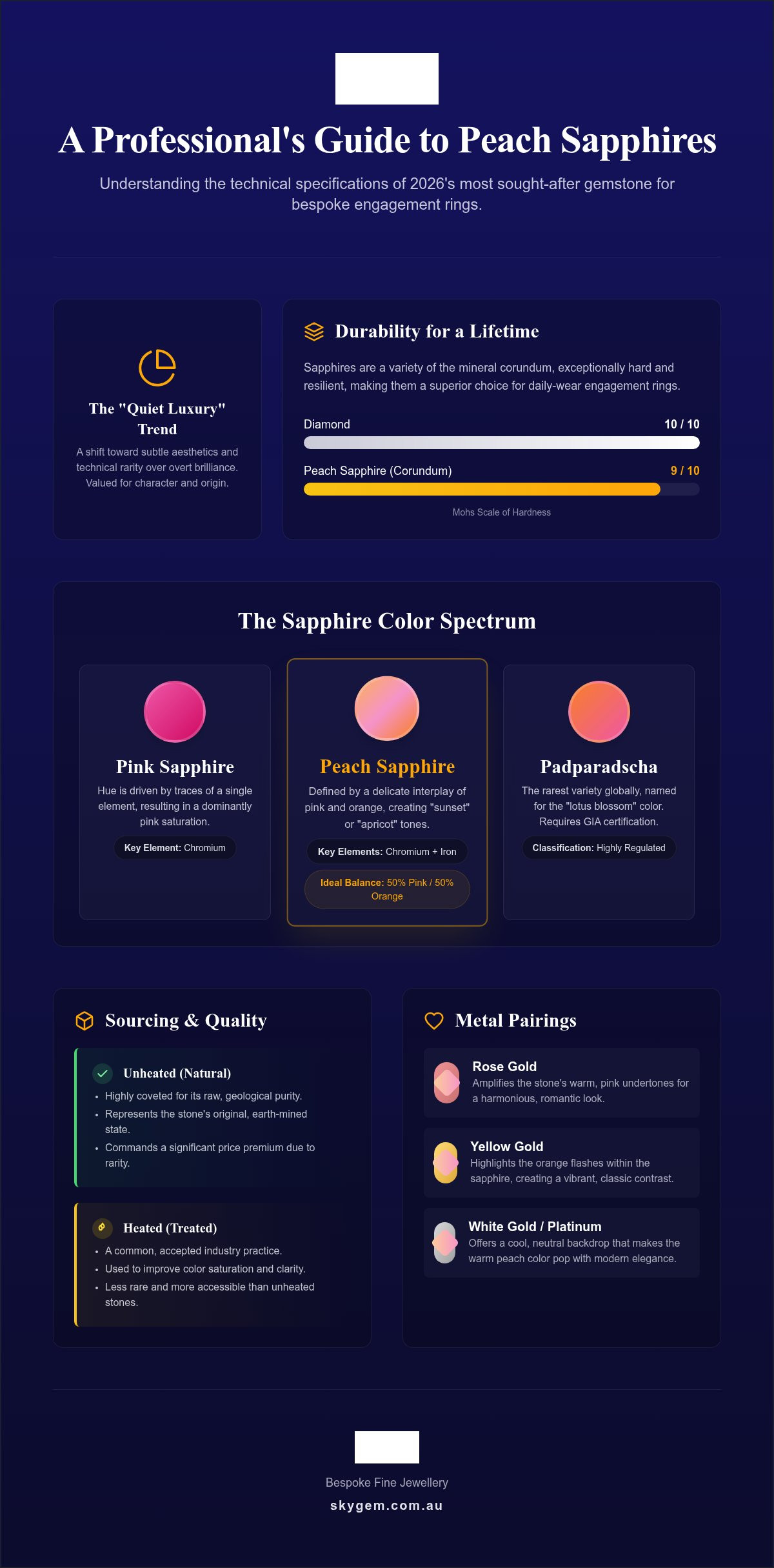
A peach sapphire is a rare variety of the mineral corundum that exhibits a delicate balance of pink and orange hues. Unlike the saturated blues and reds traditionally associated with this mineral family, peach tones offer a sophisticated neutrality that has redefined the modern engagement ring. This shift represents a broader movement in 2026 toward "quiet luxury," where the value of a piece is found in its technical rarity and subtle aesthetic rather than overt brilliance. Couples are increasingly seeking centre stones that reflect individual personality while maintaining the structural performance expected of a lifetime investment.
Recent market data indicates a significant pivot toward unheated, natural-toned stones. As consumers become more educated on gemstone treatments, the demand for "earth-grown" colours has surged. This trend is driven by a desire for transparency in the procurement process. A peach sapphire's warmth provides a softer alternative to the clinical white of a diamond, creating a piece of jewellery that feels integrated with the wearer's skin tone and personal style. It's a choice that prioritises character and origin over mass-market standards.
Peach vs. Traditional Pink Sapphires
The primary technical differentiator between these stones is the presence of a secondary orange undertone. While a pink sapphire relies on chromium for its hue, peach sapphires contain a specific combination of trace elements that absorb light in a way that produces "champagne" or "apricot" flashes. This creates a multidimensional appearance that changes depending on the light source. Modern preferences have moved away from the high-saturation "bubblegum" pinks of previous decades, favouring these earthier, more versatile peach sapphire engagement rings for their ability to complement a wider range of precious metals.
The Investment Value of Coloured Sapphires
High-quality corundum has historically maintained exceptional price stability, but peach varieties are currently seeing a unique market surge. Scarcity is a major factor here; finding "eye-clean" stones in this specific colour range is technically challenging because light-toned stones reveal internal inclusions more readily than dark blue ones. Supply constraints have also played a role. For instance, reports from 2025 noted that the supply of unheated sapphire from major origins like Madagascar was down approximately 70%. Choosing a bespoke design further protects this value, as hand-finished settings provide the structural longevity that mass-produced alternatives often lack.
The Spectrum: Peach, Pink, and the Padparadscha Standard
Selecting a peach sapphire requires a clear understanding of the technical threshold that separates standard peach hues from the prestigious Padparadscha classification. A premium peach sapphire is defined by its delicate interplay of pink and orange, but the specific ratio of these colours determines both its market value and its rarity. To achieve the ideal aesthetic, gemmologists look for a 50/50 balance of pink and orange light return. If one colour dominates too heavily, the stone is simply classified as a pink or orange sapphire, losing the unique "sunset" character that defines this category.
The chemical composition of the stone dictates its final appearance. Trace elements within the crystal lattice, specifically chromium and iron, are responsible for these warm tones. Chromium typically provides the pink saturation, while iron introduces the orange or yellow undertones. The Padparadscha standard is the rarest sapphire variety globally. Because this classification is so specific, a GIA report is necessary to confirm if a stone meets the rigorous criteria for the name, which is derived from the Sinhalese term for a lotus blossom.
Heat Treatment vs. Natural Peach Sapphires
Heat treatment is a common industry practice used to dissolve silk inclusions and stabilise colour saturation. While this is a widely accepted standard, unheated peach sapphires are highly coveted by collectors because they represent the stone's original, earth-mined state. These unheated specimens command a significant price premium because their colour is naturally achieved without human intervention. When you're evaluating precious gemstones for a bespoke project, unheated stones offer a level of technical purity that treated stones cannot match. It's a choice that prioritises the raw, geological history of the gem.
Clarity and Cut: Maximising the "Glow"
Lighter-toned peach sapphire engagement rings are less forgiving than their darker counterparts. Because the body colour is pale, internal inclusions are more visible to the naked eye; this makes "eye-clean" clarity a non-negotiable requirement for a high-quality ring. Cutting also plays a critical role in visual performance. Poorly cut stones often suffer from "windowing," a technical flaw where light passes straight through the centre of the gem. This effect makes the colour look diluted and weak. Precise, custom cutting ensures light reflects back to the viewer, which eliminates muddy undertones and maximises the characteristic sunset glow that couples find so appealing.
Designing the Ring: Metal Pairings and Setting Styles
Selecting the right metal for peach sapphire engagement rings is a technical decision that goes beyond simple aesthetics. Because these gemstones are often lighter in saturation, they are susceptible to the "colour-bleed" effect. This occurs when the metal of the setting reflects through the pavilion facets of the stone, altering its perceived face-up colour. Understanding this interaction allows you to either amplify specific undertones or create a sharp, modern contrast that highlights the gem's internal brilliance.
Pairing a peach sapphire with 18k rose gold is a popular choice for those seeking a monochromatic, seamless look. The copper content in the rose gold alloy naturally enhances the pink undertones of the stone, making the overall piece feel warm and integrated. Conversely, 18k yellow gold pairings tend to draw out the apricot and champagne highlights, which is ideal for stones with a higher concentration of iron-based orange hues. For a more clinical and high-contrast appearance, platinum or white gold provides a neutral frame that makes the peach tones "pop" against the cool, white metal.
Solitaire vs. Halo: Which Setting Suits a Peach Sapphire?
The choice of setting style determines how light interacts with the gemstone's crystal structure. A solitaire setting allows the stone's natural colour and custom cut to speak without distraction, providing maximum light entry from the sides. If you want to increase the perceived size and brilliance of the centre stone, a halo of white diamonds provides a bright boundary that makes the peach hue appear more concentrated. Trilogy designs offer a balanced alternative, where the peach centre stone is flanked by diamond or sapphire side stones to create a wider profile. To see how these different frameworks look in practice, you can explore our range of bespoke engagement rings.
Prong and Bezel Considerations
The mechanical structure of the setting also impacts the gem's performance. A four-prong setting is often preferred for peach sapphires because it leaves more of the stone's girdle exposed, allowing more ambient light to enter the crown. However, a six-prong setting provides superior security and can make the stone appear more rounded. For those with active lifestyles, a bezel setting offers a protective metal rim that prevents chipping while providing a sleek, contemporary aesthetic. A sophisticated design trick involves using rose gold claws on a platinum band; this ensures the metal touching the stone doesn't create "white spots" that might clash with the gem's warmth.
Durability, Ethics, and Sourcing Standards
A primary concern for many couples is whether peach sapphire engagement rings can withstand the rigours of daily wear compared to a traditional diamond. On the Mohs scale of mineral hardness, sapphires rank at a 9, while diamonds hold the top position at 10. While diamonds are technically harder, sapphires possess superior toughness, meaning they're less prone to chipping under direct impact. Due to its exceptional hardness and resistance to scratching, sapphire is the most durable coloured gemstone for bridal jewellery.
Technical performance is why we recommend peach sapphire engagement rings over alternative stones like morganite. While morganite offers a similar aesthetic, it ranks significantly lower on the hardness scale (7.5 to 8) and has a tendency to attract oils and skin creams. This leads to a cloudy appearance that requires frequent cleaning. Peach sapphires maintain their refractive brilliance much longer, making them the technically superior choice for a generational asset. The journey of these stones from reputable global suppliers to a hand-finished setting involves a transparent chain of custody that ensures both quality and ethical integrity.
Ethical Gemstone Sourcing in Australia
The Australian regulatory environment for jewellery is built on transparency and consumer protection. When you're sourcing a gemstone, it's vital to work with suppliers who can provide clear documentation regarding the stone's origin and any treatments it has undergone. Verifying the provenance of your sapphire is a critical step in the bespoke process. Professional consultations serve as a technical bridge, educating buyers on the ethical implications of their choices and the standards held by global mining bodies. If you're ready to explore high-quality, ethically sourced options, you can learn more about our precious gemstones.
Maintenance and Long-term Care
Even the most durable gemstones require a structured maintenance routine to ensure their longevity. Professional cleaning is recommended annually to remove deep-seated debris that at-home care can't reach. During these sessions, a technical inspection of the prongs is essential. Bespoke settings are engineered for durability, but the metal can shift over years of wear; regular checks prevent stone loss and ensure the setting remains structurally sound. Restoration and resizing services are part of a responsible ownership plan, ensuring your ring remains a functional and beautiful piece for decades. To ensure your selection is managed with professional precision, book a technical consultation for your bespoke project.
Creating Your Bespoke Peach Sapphire Engagement Ring
At SkyGem & Co., we view the creation of peach sapphire engagement rings as an intersection of technical precision and aesthetic design. We act as technical consultants throughout the process, ensuring that the ethereal beauty of the stone is supported by a framework engineered for a lifetime of wear. This methodical approach prioritises long-term success over short-term trends, resulting in a piece that functions as a permanent asset rather than a temporary fashion statement.
The journey begins with a technical consultation focused on gemstone procurement. Unlike off-the-shelf retailers, we specialise in direct procurement, sourcing loose peach sapphires that meet your specific colour saturation and clarity requirements while adhering to your budget. Once you've selected the stone, we move to bespoke CAD design. This phase involves creating a 3D rendering of your unique setting, allowing you to visualise the proportions and metal interactions before any physical manufacturing begins. The final phase is the hand-finishing and stone setting by master jewellers. They execute the design with a focus on structural longevity, ensuring prongs are perfectly seated and the metal is finished to the highest standard. To start your custom ring journey today, we recommend booking a session to discuss your specific design frameworks.
Transparency in the Design Process
Expert consultations are vital because they remove the ambiguity often associated with bespoke jewellery. By visualising the ring through high-resolution 3D models alongside the loose stone, you gain a clear understanding of the final product's scale and light performance. We don't believe in rushing the creative phase; the timeline for a custom hand-finished engagement ring typically accounts for the meticulous detail required in the casting and setting stages. This transparency ensures that you remain an active partner in the design's evolution from a concept to a finished piece.
Final Quality Assurance
Every premium gemstone we source is accompanied by GIA certification or equivalent grading reports to verify its origin and treatment status. The final quality assurance phase involves a rigorous inspection under magnification to ensure the technical precision of the setting. We check for facet alignment, prong security, and the integrity of the metal alloy to ensure it meets our strict regulatory standards. It's this commitment to granular detail that separates a bespoke project from a mass-market purchase. For a deeper understanding of our manufacturing standards, you can read our 2026 Guide to Bespoke Jewellery.
Securing Your Modern Classic for 2026 and Beyond
Selecting a peach sapphire is a technical investment in both rarity and resilience. By understanding the specific light return of the corundum family and the importance of professional colour grading, you can choose a stone that transcends fleeting trends. These gemstones provide the structural durability required for daily wear while offering a warmth that traditional diamonds cannot replicate. It's a choice that balances ethereal beauty with practical longevity.
At SkyGem & Co., we act as your technical consultants to bridge the gap between initial gemstone procurement and the final setting. Our process relies on expert technical consultations, bespoke CAD design, and hand-finished settings to ensure your project meets the highest standards. We utilise ethically sourced GIA certified stones to provide total transparency and peace of mind. We invite you to book a bespoke consultation to find your perfect peach sapphire and begin the engineering of your unique piece. Your journey toward one of our peach sapphire engagement rings is a commitment to quality that will remain a vibrant, permanent asset for generations.
Frequently Asked Questions
Are peach sapphires as durable as diamonds for an engagement ring?
Peach sapphires rank 9 on the Mohs scale, making them the most durable coloured gemstone option for bridal jewellery. While a diamond is harder at a rank of 10, sapphires possess excellent toughness, which refers to their resistance to chipping and breaking under impact. This structural integrity ensures that peach sapphire engagement rings can withstand the rigours of daily wear over several generations without losing their polished surface or sharp facet edges.
What is the difference between a peach sapphire and morganite?
Morganite is a variety of beryl, whereas peach sapphire is a variety of corundum. Sapphires are significantly harder and have a higher refractive index, resulting in superior brilliance and sparkle. Unlike morganite, which is porous and tends to attract skin oils and lotions, sapphires remain clear for longer periods. Choosing a sapphire ensures your ring maintains its sunset hue without the cloudy appearance common in softer pink gemstones like morganite.
Do peach sapphires change colour in different lighting?
These gemstones exhibit a subtle shift in appearance based on the light's Kelvin temperature. In natural daylight, the pink undertones are often more pronounced, while incandescent indoor lighting can draw out warmer apricot or champagne flashes. This characteristic is due to the stone's internal chemistry and how trace elements absorb specific wavelengths. It's a dynamic quality that adds depth to the piece, ensuring the ring looks different throughout the day.
Is a peach sapphire more expensive than a blue sapphire?
Standard peach sapphires are typically more accessible than high-saturation royal blue sapphires of similar size and clarity. However, if a stone is technically classified as a Padparadscha, its price can exceed that of traditional blue varieties due to extreme scarcity. Market value is driven by the unheated status and the precision of the pink-orange balance. For many couples, peach sapphire engagement rings offer a premium, rare aesthetic at a more competitive price point.
What metal looks best with a peach sapphire?
Metal selection is a technical decision based on how light reflects through the gemstone's pavilion. Rose gold creates a monochromatic look by amplifying pink undertones, while yellow gold highlights the stone's orange and champagne notes. For those seeking a modern aesthetic, platinum or white gold provides a cool contrast that makes the peach hue appear more vibrant. We often suggest using rose gold prongs on a white metal band to maintain the stone's warmth.
Are peach sapphires rare?
Natural peach sapphires are technically rare, particularly when they are unheated and lack significant internal inclusions. While blue sapphires are more common in the global market, the specific geological conditions required to produce a balanced peach hue occur less frequently. Recent supply chain reports from 2025 indicate a significant reduction in unheated sapphire yields from major origins. This ongoing scarcity makes high-quality peach specimens a stable choice for bespoke jewellery projects.
Can I use a peach sapphire in a lab-grown diamond setting?
You can certainly combine a natural peach sapphire centre stone with lab-grown diamond accents in a bespoke setting. Our technical design process uses CAD software to ensure the structural dimensions of the setting accommodate the specific depth and girdle thickness of your sapphire. This hybrid approach allows you to prioritise a rare, natural centre stone while benefiting from the brilliance and cost-efficiency of lab-grown diamonds for the halo or side stones.
How do I clean my peach sapphire ring at home?
To maintain the stone's brilliance, soak the ring in warm water mixed with a few drops of mild detergent. Use a soft-bristled toothbrush to gently remove debris from underneath the stone and around the prongs, as this is where oils typically accumulate. Rinse thoroughly with clean water and dry with a lint-free cloth. While at-home care is effective for surface cleaning, we recommend an annual professional inspection to ensure the setting's structural integrity.
Disclaimer
This article is for general informational purposes only and may include AI-assisted content. Pricing, specifications, and availability are subject to change. For accurate advice and current information, please contact SkyGem & Co. directly. Nothing in this content constitutes professional or financial advice.