
Oval Cut Diamond Guide 2026

What if the carat weight listed on a GIA certificate is the least reliable indicator of how large your stone will appear on the hand? While many buyers assume a higher weight equates to a more impressive presence, the true value of an oval cut diamond lies in its specific optical performance and physical spread. You likely recognise that this shape offers a unique, elongating effect, yet you may feel uncertain about how to avoid the "bow-tie" shadows that often dim the centre of these stones.
We believe that selecting a premium diamond requires a blend of technical precision and aesthetic balance. This guide provides the authoritative framework needed to evaluate stones with confidence, ensuring you achieve maximum brilliance and finger coverage in 2026. You'll learn to identify the ideal length-to-width ratios for your specific hand shape and understand the structural requirements of bespoke settings. We will examine the nuances of light return and symmetry, moving from technical specifications to the practical design choices that protect your investment for decades to come.
Key Takeaways
- Understand why the elongated shape of an oval offers up to 15% more surface area and superior finger coverage compared to round cuts of the same carat weight.
- Identify the optimal length-to-width ratio for an oval cut diamond to ensure the stone appears elegant rather than too narrow or overly rounded.
- Learn to evaluate the bow-tie effect by assessing facet symmetry and light return to minimise dark shadows in the centre of the stone.
- Explore how hidden halos and bespoke solitaire settings can be engineered to secure elongated stones while maximising their natural brilliance.
- Compare the long-term value and physical properties of GIA certified natural diamonds against lab-grown alternatives to find the best fit for your requirements.
The Aesthetic Appeal of the Oval Cut Diamond
The modern oval cut diamond represents a sophisticated evolution in lapidary science, successfully merging the brilliance of a round cut with an elongated silhouette. While the concept of elliptical stones has existed for centuries, the specific facet arrangement we recognise today was perfected in the late 1950s. This development is a pivotal moment in the history of diamond cuts, as it allowed for a stone that captures light with similar intensity to a round brilliant while offering a more distinctive, modern profile.
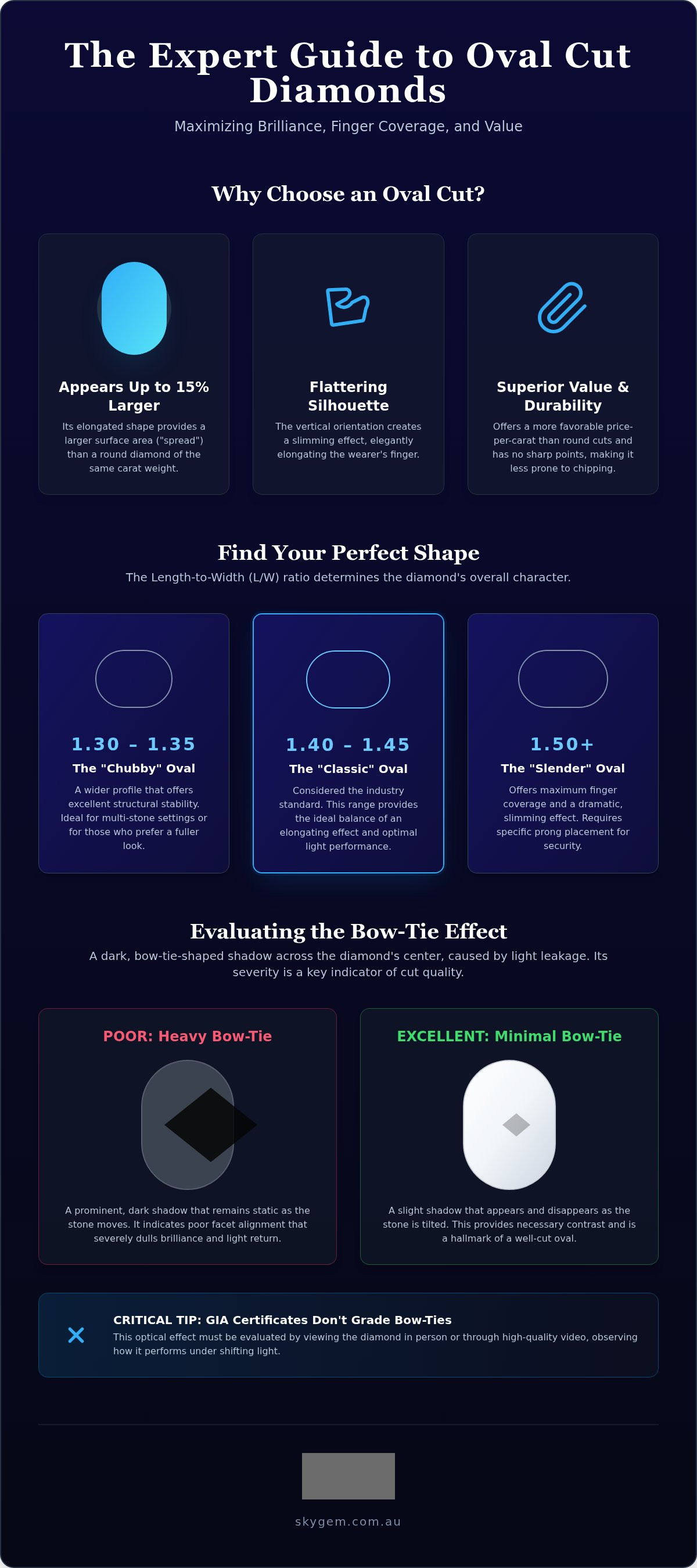
One of the most compelling technical advantages of this shape is the "illusion" of size. Due to its elongated geometry, an oval diamond typically possesses a larger surface area, or "spread," than a round diamond of the same carat weight. Research indicates that an oval can appear 10% to 15% larger than its round counterpart because less of the stone’s weight is hidden in the depth of the pavilion. This makes it an ideal choice for those seeking to maximise visual impact without increasing the total carat investment.
The Versatility of the Oval Silhouette
The oval's curved edges provide a softer aesthetic compared to the sharp angles of marquise cut natural diamonds or the asymmetrical point of pear cut natural diamonds. This lack of sharp points makes the stone less prone to chipping, offering a practical advantage for daily wear. Its balanced proportions allow it to transition seamlessly between vintage-inspired filigree settings and ultra-modern, minimalist bands. For the wearer, the vertical orientation of the stone creates a slimming effect, elegantly elongating the finger regardless of hand size or shape.
Maximising Your Budget with Elongated Cuts
Choosing an oval cut diamond often provides a more favourable price-per-carat ratio than the industry-standard round brilliant. Because round diamonds require the most significant loss of raw material during the cutting process, they carry a higher premium. By opting for an elongated cut, you can often secure a stone with a larger face-up appearance for a lower financial outlay. However, achieving this value requires a careful balance; you must ensure the stone isn't cut too shallowly to achieve spread, as this can lead to poor light performance and a dull appearance in the centre of the diamond.
Decoding Oval Diamond Quality: Ratios, Bow-Ties, and Brilliance
While the silhouette provides the initial draw, the technical performance of an oval cut diamond depends on precise faceting. Most stones follow a standardised brilliant pattern, but "crushed ice" hybrids are becoming more common in the market. These hybrids use smaller, more numerous facets to hide inclusions, though they often lack the crisp light return and high contrast of a traditional cut. According to the International Gem Society's Buying Guide, the standard oval brilliant contains 58 facets, which must be perfectly aligned to ensure light reflects back to the eye rather than leaking through the pavilion.
Understanding the Length-to-Width Ratio
The length-to-width (L/W) ratio determines the stone's footprint and overall character. It's a critical metric for ensuring the diamond complements the wearer's hand. We generally categorise these ratios into three distinct profiles:
- 1.30 to 1.35: Often called "chubby" ovals, these stones provide a wider profile. They suit multi-stone settings and offer excellent structural stability for active lifestyles.
- 1.40 to 1.45: This range is the classic industry standard. It provides the ideal balance between the elongating effect and optimal light performance.
- 1.50 and above: Slender ovals offer maximum finger coverage and a dramatic, slimming effect. While visually striking, these require specific prong placement to ensure the elongated ends are protected from impact.
Evaluating the Bow-Tie Effect in Person and Video
The bow-tie is a dark, transverse shadow across the centre of the stone. It's caused by light leakage or the viewer's own head obstructing light return. Because a GIA certificate only provides a static top-down diagram, it cannot grade the intensity or visibility of this effect. You must view the stone in motion to see how the shadow reacts to shifting light. A minimal bow-tie is actually acceptable and provides necessary contrast; however, a heavy, dark shadow indicates poor facet alignment that dulls the stone's centre.
When reviewing stones, we recommend checking them under varied light sources, including natural daylight and indoor office lighting. This ensures the brilliance remains consistent across different environments. Symmetry and polish are equally critical, as any misalignment in the "shoulders" of the oval becomes immediately apparent in elongated shapes. If you need assistance filtering through technical specifications to find a stone with minimal shadow, you may arrange a consultation with our specialists to review high-definition stone captures together.
Designing the Perfect Setting for an Oval Engagement Ring
Selecting the right setting for an oval cut diamond requires a technical approach that balances structural integrity with aesthetic minimalism. A classic solitaire remains the most popular choice for highlighting the stone's elongated silhouette. By reducing visual interference around the girdle, a solitaire allows the eye to focus entirely on the diamond’s specific length-to-width ratio and brilliance. This design choice is particularly effective for stones with high symmetry grades, as it leaves the pavilion facets unobstructed for maximum light entry.
Metal choice significantly influences the diamond's colour perception and overall performance. Platinum or white gold provides a neutral backdrop that enhances the brightness of high-colour stones (D-F). Conversely, 18ct yellow gold can mask slight warmth in lower colour grades, creating a harmonious, vintage-inspired look without compromising the stone's performance. It's a practical way to achieve a premium aesthetic while optimising your stone budget, as the metal helps the diamond appear whiter than its technical grade might suggest.
Securing the Stone: Prong Placement and Protection
Because of their elongated geometry, ovals require strategic prong placement to ensure the stone remains secure during daily wear. While a 4-prong setting offers a cleaner look, a 6-prong configuration provides superior protection for the "ends" of the diamond, which are the most vulnerable to impact. Claw prongs are often preferred over round prongs as they taper to a fine point, mirroring the elegant curves of the stone while covering less of its surface area.
Through bespoke CAD design, we tailor the basket to the exact dimensions of the specific stone. This technical precision ensures a flush fit that prevents the "tilting" or loosening often seen in mass-produced, off-the-shelf settings. It's about creating a permanent home for the diamond that respects its unique physical properties and protects the girdle from potential chipping.
The Rise of the Hidden Halo and Pavé Bands
For those seeking additional brilliance without the traditional bulk of a top-facing halo, the hidden halo has emerged as a premier design solution. This feature places a delicate row of diamonds just beneath the centre stone's girdle, visible only from the side profile. It adds a "secret" sparkle that doesn't distract from the primary oval cut diamond or interfere with its perceived size.
Proportion is paramount when selecting a band. A band that is too wide can visually shrink the centre stone, while one that is too thin may lack the durability required for long-term viability. We typically recommend a band width of 1.8mm to 2.0mm to maintain the illusion of stone size while ensuring structural stability. Integrating bespoke engagement rings principles ensures that every component, from the pavé setting to the bridge height, is engineered to complement the unique proportions of your selected diamond. This holistic approach ensures the ring remains a stable, high-performance asset rather than a one-off purchase.
Natural vs. Lab-Grown Oval Diamonds: A Comparison
In 2026, the choice between natural and lab-grown stones is a primary consideration for any oval cut diamond purchase. Physically, chemically, and optically, these two categories are identical. Both register as a 10 on the Mohs hardness scale and exhibit the same refractive index. To the naked eye, even an expert cannot distinguish between them without specialised spectroscopic equipment. The distinction lies not in performance, but in origin, rarity, and the resulting market value.
The value proposition of lab-grown diamonds has shifted significantly. Data from 2026 shows that lab-grown diamonds now account for 51% of centre stones in newly appraised engagement rings. This adoption is driven by a substantial price delta; a high-quality 1-carat lab-grown oval typically costs between $900 and $1,200, while a natural stone of comparable quality averages approximately $3,530. This 81% price difference allows you to prioritise visual impact and technical specifications that might otherwise be out of reach.
Choosing Lab-Grown Ovals for Maximum Impact
Opting for lab-grown oval diamonds allows you to reallocate your budget toward superior colour and clarity grades. While natural inventories are limited by geological rarity, lab-grown production can be precisely controlled. This results in a broader availability of "slender" ovals with L/W ratios exceeding 1.50, which are often difficult to source in natural form. For those focused on modern aesthetics and maximum finger coverage, lab-grown stones provide a high-performance alternative that meets the same rigorous durability standards as earth-mined diamonds.
The Timelessness of Natural GIA Certified Ovals
For many, the appeal of oval cut natural diamonds remains rooted in their inherent rarity and historical value. Unlike lab-grown stones, which typically retain only 10% to 30% of their original purchase price on the resale market, natural diamonds are finite assets. Every natural stone we source comes with a GIA certificate and a matching laser inscription on the girdle, providing a permanent record of its provenance and quality.
This choice often reflects a preference for heritage and long-term viability. While lab-grown diamonds offer immediate visual impact, a natural oval cut diamond represents a billion-year geological journey. It remains a preferred choice for those viewing their jewellery as a legacy piece. Whether you prioritise the innovative efficiency of lab-grown technology or the enduring prestige of natural stones, our role is to act as a technical consultant to ensure your selection aligns with your long-term project goals.
The Bespoke Journey: Crafting Your Oval Ring with SkyGem & Co.
Selecting a premium oval cut diamond is only the first phase of a high-level design project. While mass-produced retail often relies on pre-fabricated settings that force a stone into a generic frame, our boutique approach prioritises precision engineering. We act as technical consultants throughout the lifecycle of the build, ensuring the final asset is both aesthetically balanced and structurally sound. This methodical process respects your professional time, moving from high-level conceptual benefits to granular technical details with ease.
Sourcing the Finest Oval Diamonds Nationally
Our gemmologists perform a rigorous vetting process that goes beyond standard GIA certification data. We evaluate every potential stone for light performance, specifically looking for minimal bow-tie shadows and optimal facet symmetry. By accessing a global network of reputable suppliers, we provide a curated selection of both natural and lab-grown ovals that meet our internal performance metrics. Transparency is a core pillar of our partnership; we provide the education necessary for you to understand the quantitative data behind your diamond's brilliance. You'll know exactly why a specific stone was selected for its superior light return and face-up spread.
From Design Concept to Final Masterpiece
The creation of bespoke engagement rings requires a methodical transition from digital precision to physical craftsmanship. We utilise advanced CAD (Computer-Aided Design) to model the setting around the specific dimensions of your elongated stone. This ensures the basket and prongs are engineered to microns, providing a level of security that generic settings cannot replicate. Following the digital phase, our master jewellers hand-finish every piece. This manual process hardens the metal through compression, ensuring the setting is far more durable than standard cast jewellery found in global retail chains.
This technical approach extends to the long-term viability of the ring. A hand-finished setting is more resistant to the rigours of daily wear than mass-produced alternatives. We view each project as a permanent asset, which is why we emphasise ongoing professional maintenance. Regular checks ensure the structural integrity of the prongs remains intact, protecting your investment for decades. By choosing a bespoke path, you aren't just buying a product; you're investing in a piece of regional design engineered for performance and longevity.
Securing Your Investment in a Premium Oval Cut Diamond
Selecting a premium oval cut diamond requires more than a cursory glance at a grading certificate. It involves a rigorous technical evaluation of light performance, ratio balance, and the specific structural integrity of the final setting. By understanding how facet alignment impacts the bow-tie effect and how bespoke CAD design protects elongated stones, you transition from a standard purchase to a well-engineered design project.
Every selection, whether it involves the innovative value of lab-grown technology or the rare heritage of GIA certified natural diamonds, should be grounded in transparency and performance metrics. We take immense pride in our regional Australian craftsmanship, ensuring every hand-finished setting provides the stability and quiet confidence required for lifelong durability. Our commitment to technical precision ensures that your ring remains a permanent asset rather than a temporary purchase. We invite you to collaborate with us to refine your vision into a finished masterpiece that values quality over hype.
We look forward to acting as your dedicated technical consultant in creating a piece that perfectly balances aesthetic elegance with enduring engineering.
Frequently Asked Questions
Do oval diamonds have more sparkle than round diamonds?
Round brilliant diamonds remain the industry standard for light return because their perfect symmetry allows for maximum internal reflection. While an oval cut diamond is designed to mimic this brilliance, its elongated shape creates a different light pattern. You'll experience high levels of sparkle in a well-cut oval, but it will typically exhibit more splintered light effects rather than the bold flashes of fire seen in a round cut.
What is the most popular length-to-width ratio for an oval diamond?
The most popular length-to-width ratio for a balanced aesthetic typically falls between 1.40 and 1.45. This range provides the classic silhouette that most find appealing. Stones with a ratio below 1.30 can appear too wide, while ratios exceeding 1.50 result in a very slender, elongated appearance. Choosing the correct ratio depends on your hand shape and whether you prefer a traditional or more dramatic profile.
Will an oval diamond show more yellow colour than other cuts?
Elongated shapes like the oval tend to concentrate body colour at their tapered ends. This means a lower colour grade may be more noticeable in an oval than in a round brilliant of the same grade. If you're sensitive to warmth, we recommend selecting a stone in the D to F range. Alternatively, setting the diamond in 18ct yellow gold can help mask these slight tints for a cohesive appearance.
Is a 1 carat oval diamond bigger than a 1 carat round diamond?
A 1-carat oval cut diamond will almost always appear larger than a 1-carat round diamond to the naked eye. This is due to the elongated shape and the fact that more of the stone's weight is distributed across the surface rather than in the depth. Research indicates that ovals can offer up to 15% more surface area, providing superior finger coverage and a more substantial presence for the same weight.
How can I tell if an oval diamond has a bad bow-tie?
You can identify a problematic bow-tie by looking for a persistent dark shadow across the centre of the stone when viewed from above. While most ovals have a slight bow-tie due to their facet structure, it shouldn't be a black, opaque void that kills the diamond's brilliance. We recommend viewing high-definition videos or inspecting the stone in person under natural light to ensure the shadow doesn't detract from the performance.
Are oval diamonds more prone to chipping or breaking?
Oval diamonds are quite durable because they lack the sharp, vulnerable points found in marquise or pear cuts. The rounded edges make them less likely to snag on clothing or chip during daily activities. However, the structural integrity of the ring still depends on the setting. We utilise bespoke CAD design to ensure the stone is held securely, protecting the girdle from impact while maintaining a refined aesthetic.
Which setting is best for a 2 carat oval diamond?
For a 2-carat stone, a 6-prong solitaire or a hidden halo setting offers the best balance of security and style. Larger ovals require additional support to prevent the stone from tilting or loosening over time. A 6-prong configuration provides extra protection for the elongated ends of the stone. Our hand-finished settings are engineered to accommodate these larger dimensions, ensuring the ring remains a permanent and stable asset for the wearer.
Can I use an oval diamond in a trilogy or halo setting?
Ovals are exceptionally versatile and work well in both trilogy and halo configurations. In a trilogy ring, ovals are often flanked by pear or round side stones to create a graduated, elegant look. A halo setting can further enhance the perceived size of the stone, though many modern buyers now prefer a hidden halo for a more subtle sparkle. We specialise in customising these designs to ensure the proportions remain perfectly balanced.