
Natural vs Lab Created Alexandrite: The Definitive 2026 Comparison Guide

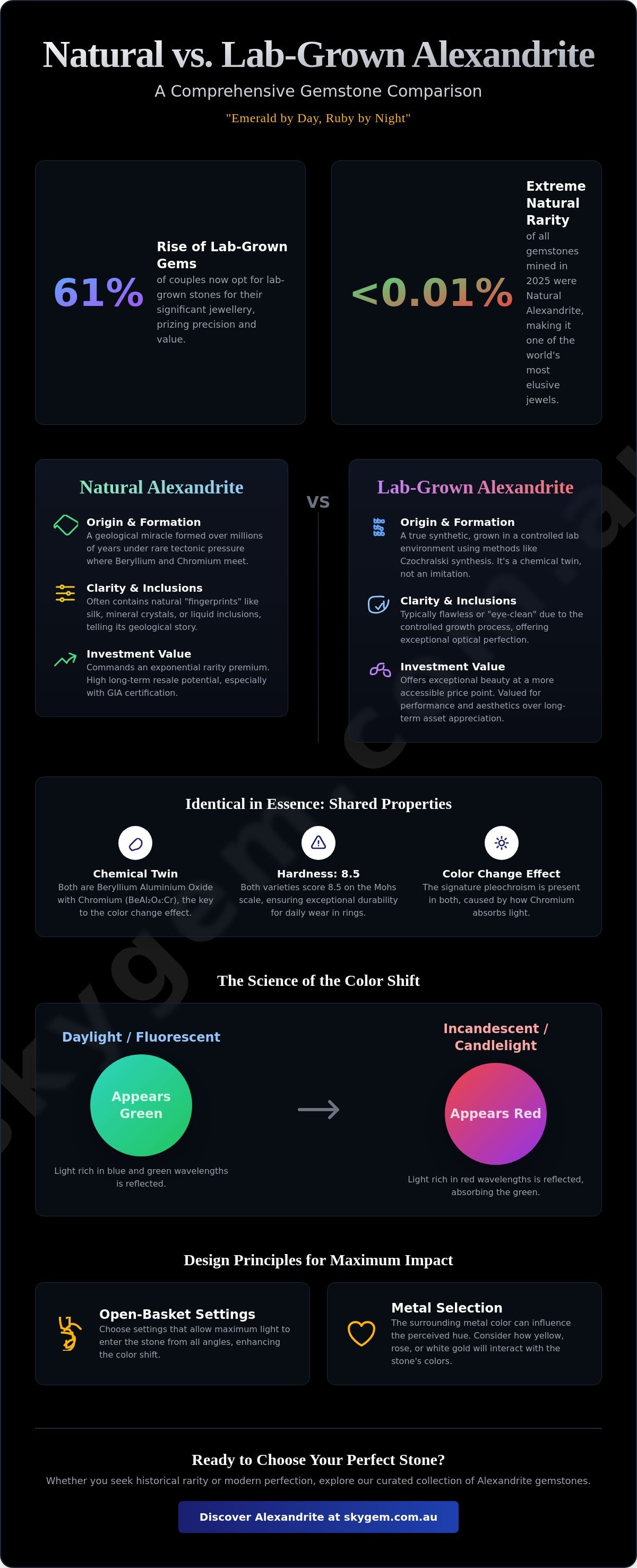
With 61% of couples now opting for lab-grown stones for their most significant jewellery, the debate regarding natural vs lab created alexandrite has shifted from a question of authenticity to a nuanced evaluation of technical performance and investment value. You likely recognise the prestige of a geological miracle, yet you may feel uncertain about why natural specimens command such a premium or whether a lab-grown alternative is truly a chemical twin. It's a valid concern, particularly as natural alexandrite remains so exceptionally rare that it accounted for less than 0.01% of gemstones mined in 2025.
This guide clarifies the technical, aesthetic, and value differences between earth-mined and laboratory-grown alexandrite to help you choose the perfect gemstone for your bespoke jewellery. We'll examine the chemical identity of lab gems and provide the metrics needed to spot high-quality colour change. You'll gain the confidence to select a stone that functions as a lasting heirloom, whether you prioritise historical rarity or modern technical precision.
Key Takeaways
- Understand the specific role of Chromium in triggering the rare "emerald by day, ruby by night" pleochroism effect.
- Evaluate the technical distinctions of natural vs lab created alexandrite, comparing the geological rarity of "forbidden" elements against the precision of the Czochralski synthesis method.
- Learn why both varieties maintain a Mohs hardness of 8.5, ensuring the durability required for daily wear in bespoke engagement rings.
- Identify the factors that drive the exponential rarity premium of natural stones and how GIA certification impacts long-term resale potential.
- Master the design principles for setting alexandrite, focusing on how specific metals and open-basket settings optimise light interaction for maximum colour shift.
The Chameleon of Gemstones: What Defines Alexandrite?
Alexandrite is often described as a geological miracle because it requires specific environmental conditions that rarely occur in nature. It's a variety of the mineral chrysoberyl, yet it's distinguished by a dramatic ability to change colour based on the light source. This phenomenon, famously called "emerald by day, ruby by night," occurs because of the presence of chromium ions within the crystal structure. While many collectors weigh the merits of natural vs lab created alexandrite, the underlying chemical identity remains centred on this chromium-induced light absorption. Standard chrysoberyl lacks this specific trace element, resulting in stones that are typically yellow or green without any colour-shifting properties.
The rarity of this gemstone cannot be overstated. It's one of the world's most elusive precious stones, largely because the elements required for its formation—beryllium and chromium—rarely meet in the Earth's crust. Beryllium is common in continental crust, while chromium is typically found in the mantle. Their convergence requires rare tectonic events. Data from 2025 indicates that less than 0.01% of all gemstones mined were alexandrite, highlighting the extreme scarcity of earth-mined specimens compared to other high-value gems like sapphires or emeralds.
The History and Rarity Factor
The story of this gemstone began in 1834 in the Ural Mountains of Russia. These original deposits set an international benchmark for quality, producing stones with a vivid bluish-green to raspberry-red shift that remains the standard for "fine" specimens today. Because the Russian mines are now largely exhausted, modern supplies are primarily sourced from Brazil, Sri Lanka, and East Africa. Each location produces stones with slightly different profiles. For instance, Sri Lankan stones often exhibit a brownish-red hue in incandescent light, whereas Brazilian stones are prized for their clarity. For those seeking alexandrite for a bespoke project, understanding these regional nuances is essential for selecting a stone that matches specific aesthetic goals.
The Science of Colour Shift
The science of the colour shift lies in how the stone absorbs light across the visible spectrum. Under daylight or fluorescent light, which is rich in blue and green wavelengths, the stone appears teal or emerald green. Conversely, incandescent light contains more red wavelengths, which causes the stone to reflect the deep reds or purples we associate with the "ruby" side of its personality. Understanding Alexandrite gemstone properties helps explain why the intensity of this shift is the primary driver of value in both natural vs lab created alexandrite comparisons. Pleochroism is the ability of a gemstone to show different colours when viewed from different angles. This optical property adds a layer of visual complexity, ensuring the gem remains dynamic regardless of the wearer's movement or the environment's lighting conditions.
Geological Formation vs. Laboratory Synthesis: How They Are Made
The fundamental distinction in the natural vs lab created alexandrite comparison is not one of chemistry; it's a matter of origin. Both stones are technically beryllium-aluminium oxides, yet their paths to formation are worlds apart. Natural alexandrite is the result of a geological accident where beryllium and chromium meet. These elements are usually separated in the Earth's crust; beryllium typically resides in continental rocks while chromium is found in the mantle. Their convergence requires rare, high-pressure tectonic events that occur only in a few places on the planet. In contrast, lab-grown alexandrite is a synthetic gemstone, not a simulant. While a simulant merely imitates the look using different materials, a synthetic stone is a chemical twin grown in a controlled environment.
When selecting a stone for custom made engagement rings, the choice between these two formation methods determines both the visual character and the long-term rarity of the piece. Laboratory growth provides a level of optical perfection that nature rarely achieves, while earth-mined stones carry the prestige of a million-year-old history.
Natural Formation: A Geological Miracle
Natural crystals develop over millions of years within metamorphic rocks. This slow, turbulent growth often leaves behind a diagnostic footprint of inclusions. You'll frequently find "silk" (fine rutile needles), liquid-filled fingerprints, or mineral crystals trapped inside the stone. These features are not necessarily flaws; they're proof of earth-mined origin. Because the required chemical conditions are so rare, finding high-quality natural stones over 1.00 carat is a significant challenge. Most natural specimens are small, making any stone of substantial size a true investment piece. According to GIA on Alexandrite quality, these internal characteristics are vital for gemologists to distinguish between natural and synthetic origins.
The Lab-Grown Process: Technical Precision
The Czochralski or "pulled" method is the 2026 industry standard for high-performance alexandrite. This process involves melting the raw elements in a crucible and slowly pulling a rotating seed crystal from the liquid. This technical precision allows for a stone that's typically eye-clean and exhibits a full 100% colour change. While flux growth is another method used, it's often slower and more expensive, sometimes resulting in flux inclusions that mimic natural "veils." Pulled alexandrite remains the preferred choice for its clarity and consistent performance. For modern consumers, the laboratory process offers an ethical alternative with a smaller environmental footprint than traditional mining, providing a sustainable way to enjoy this rare colour-change phenomenon.
Natural vs Lab Created Alexandrite: Performance Comparison
Assessing the visual identity of natural vs lab created alexandrite requires an understanding of how light interacts with the crystal lattice. To the naked eye, a high-quality lab-grown stone is often indistinguishable from a top-tier natural specimen. Both exhibit the characteristic shift from a cool teal or bluish-green in daylight to a warm purple or raspberry red under incandescent light. However, the primary difference lies in the "crispness" of this transition. Lab-grown stones, produced under controlled conditions, typically offer a vivid and complete colour change, whereas many natural stones may appear slightly "muddy" or retain brownish-green undertones that mask the secondary colour.
Clarity expectations also differ significantly between the two origins. Natural alexandrite frequently contains "birthmarks"—internal inclusions such as silk or small crystals—which can disrupt the path of light and soften the colour shift. In contrast, lab-grown stones are almost universally eye-clean. This lack of internal obstruction allows for maximum saturation, resulting in the deep teal-to-purple shifts that collectors prize. Both varieties share a Mohs hardness of 8.5, making them exceptionally durable. This technical specification ensures that whether you choose a natural or synthetic stone, it'll withstand the rigours of daily wear without the risk of easy scratching or chipping.
Grading the Colour Change
Professional gemologists use a percentage metric to grade the strength of the colour shift. A "100% colour change" means the stone transitions entirely from one hue to the other without any overlapping "bleed" of the previous colour. While lab-grown stones consistently achieve this 100% mark, modern natural gems often fall in the 50% to 80% range. According to the Gemological Institute of America (GIA), the value of the stone is dictated primarily by this intensity. Lower-quality natural stones may exhibit a brownish-grey tone in the transition phase, a factor rarely present in the technically precise laboratory versions which favour a cleaner, more dramatic red.
Longevity and Daily Wear
For those designing bespoke engagement rings, alexandrite is the premier alternative to diamond regarding longevity. Its 8.5 hardness rating is surpassed only by sapphires, rubies, and diamonds. This physical resilience means both natural and lab-grown stones are resistant to household chemicals and heat. They're also safe for ultrasonic cleaning, provided the natural stone doesn't have significant surface-reaching fractures. Because the chemical structure is identical, the lab-grown version isn't a "soft" imitation; it's a high-performance asset that maintains its lustre and structural integrity over decades of continuous use.
Investment Value and Heirloom Potential
The market for natural vs lab created alexandrite is bifurcated by the concept of the "Rarity Premium." In the world of earth-mined gemstones, price scales exponentially with carat weight. Because high-clarity natural alexandrite is so difficult to find in larger sizes, a three-carat stone isn't simply three times the price of a one-carat stone; it can be ten times more expensive. This exponential growth reflects the stone's status as a finite geological asset. For collectors and those seeking a heritage piece, natural alexandrite acts as a tangible store of value that historically maintains its position in the global auction market.
Lab-grown alexandrite serves a different function. It's a "lifestyle" choice that prioritises design and optical performance over speculative value. While it lacks the resale potential of its natural counterpart, it allows for the creation of bold, high-impact jewellery that would be prohibitively expensive or geologically impossible to source from a mine. It's a design-led purchase, offering the technical precision of a 100% colour-change gemstone for daily wear without the financial weight of an investment-grade asset.
The Significance of GIA and IGI Reports
Purchasing natural alexandrite without a reputable laboratory report is a significant risk. A certificate from the Gemological Institute of America (GIA) or the International Gemological Institute (IGI) provides an objective analysis of the stone's origin and any potential treatments. These reports are essential for distinguishing between a true synthetic alexandrite and a "simulant." Many stones marketed as alexandrite are actually colour-change sapphires or even treated glass. A technical report confirms the chemical species, ensuring you're paying for a true chrysoberyl variety rather than an imitation. This documentation is the cornerstone of your stone's future resale value and provenance.
Choosing for Your Purpose
Selecting the right stone depends on the intended lifecycle of the jewellery piece. Natural alexandrite is the logical choice for heritage items where the goal is to preserve wealth and history across generations. These stones are rare, finite, and carry a prestige that lab-grown alternatives cannot replicate. Conversely, lab-created stones are ideal for modern engagement rings and fashion-forward pieces. They provide the same 8.5 Mohs hardness and chemical stability, allowing for a premium aesthetic at a practical price point. If you're ready to explore these options for your next project, you can browse our curated selection of natural and lab-created alexandrite gemstones to compare their visual characteristics in person.
Designing with Alexandrite: The SkyGem & Co. Approach
Designing with alexandrite is a technical challenge because the stone's appearance is entirely dependent on its environment. When evaluating natural vs lab created alexandrite, the choice of metal is paramount. White metals like platinum or 18K white gold provide a neutral backdrop that emphasises the cool teal and bluish-green hues of the stone's daylight persona. Conversely, yellow or rose gold can warm the overall appearance, sometimes enhancing the purplish-red shift but potentially "muddying" the green phase if the stone's saturation isn't optimal. We guide you through these variables to ensure the metal choice complements the specific chromium profile of your stone.
The architecture of the setting must prioritise light entry. An open basket or trellis setting is essential to allow light to strike the pavilion facets from multiple angles, triggering the colour change that defines this mineral. Without this exposure, the stone may appear dark or lose its vibrant pleochroism. When pairing these centre stones with accents, many clients choose lab grown diamonds for their exceptional brilliance and ethical alignment, though natural diamonds remain a popular choice for those building a purely earth-mined heirloom. Our commitment to sourcing ethical, high-performance alexandrite gemstones ensures that every stone, regardless of origin, meets rigorous standards for colour shift and structural integrity.
Crafting Your Unique Piece
Integrating alexandrite into solitaire engagement rings requires a balance of protection and visibility. While alexandrite is hard, measuring 8.5 on the Mohs scale, the technical precision required for setting involves ensuring the prongs don't obscure the stone's "colour-change windows." During our consultation process, we analyse how specific stones interact with your skin tone. Some individuals find the deep raspberry reds of lab-created stones more flattering, while others prefer the softer, more varied transitions of natural specimens. This personalised approach ensures the final design functions as a cohesive aesthetic unit.
Expert Advice and Transparency
At SkyGem & Co., we act as technical consultants for your project. We prioritise education, providing access to our curated collection of precious gemstones so you can observe the natural vs lab created alexandrite difference under varied light sources. Our focus remains on long-term viability and technical craftsmanship to ensure your bespoke piece remains a permanent asset. We don't believe in high-pressure sales; instead, we provide the data and visual evidence you need to make an informed decision for your heirloom jewellery.
Securing Your Legacy with Precision Design
Choosing between natural vs lab created alexandrite involves balancing geological rarity with modern technical performance. While natural stones act as a finite store of value with a unique historical provenance, lab-grown varieties provide a high-clarity, 100% colour-change alternative that is ideal for daily wear. Both options offer the resilience of an 8.5 Mohs hardness, ensuring your jewellery remains a permanent asset for decades to come. Our approach focuses on technical precision and ethical transparency, providing you with the data needed to make an informed selection for your bespoke project.
We invite you to consult with our experts to explore how specific light absorption spectra and metal choices will influence your stone's appearance. With our focus on GIA and IGI certified stones and bespoke design expertise, we ensure every ethically sourced option meets our rigorous standards for quality and longevity. Explore Our Curated Alexandrite Collection and begin the journey of crafting a piece that reflects your unique vision and values.
Frequently Asked Questions
Is lab-created alexandrite a real alexandrite?
Yes, lab-created alexandrite is a real alexandrite in terms of its chemical and physical composition. It's a synthetic chrysoberyl that possesses the same 8.5 Mohs hardness and refractive index as earth-mined specimens. Unlike simulants that only look similar, these are laboratory-grown twins created through technical processes like the Czochralski method. This ensures the stone remains a permanent asset with identical performance metrics to its natural counterpart.
Does lab-grown alexandrite change colour as well as natural?
Lab-grown alexandrite frequently exhibits a more distinct and vivid colour change than modern natural stones. While natural specimens often show a 50% to 80% shift with occasional "muddy" undertones, technically precise laboratory growth allows for a full 100% transition. You'll typically see a crisp move from a cool teal to a raspberry red. This consistency makes it a reliable choice for those prioritising the "emerald by day, ruby by night" effect.
Why is natural alexandrite so expensive compared to other gems?
Exceptional geological rarity is the primary driver of natural alexandrite's cost. The specific environmental conditions where beryllium and chromium meet are so infrequent that less than 0.01% of all gemstones mined in 2025 were alexandrite. As size increases, the rarity premium escalates exponentially. This makes high-quality natural stones over one carat some of the most expensive precious assets in the global jewellery market.
Can a jeweller tell the difference between natural and lab alexandrite?
An experienced gemologist can distinguish between the two using specialised magnification and diagnostic tools. Natural stones typically feature inclusions such as rutile needles, known as "silk," or liquid-filled fingerprints. In the natural vs lab created alexandrite debate, microscopic evidence like curved growth lines or flux remnants in lab stones provides the definitive proof of origin. Professional certification from the GIA or IGI is the standard for verifying these results.
Does lab-created alexandrite fade over time?
No, the colour in lab-created alexandrite is permanent and won't fade or shift over time. Its optical properties are a result of chromium ions within the crystal lattice, just like natural stones. This chemical stability ensures the gem is resistant to sunlight, domestic chemicals, and heat. You can expect the colour-change performance to remain as vibrant decades from now as it is on the day of purchase.
Is alexandrite durable enough for an engagement ring?
Alexandrite is one of the most durable gemstones available, making it an excellent candidate for an engagement ring. With a Mohs hardness of 8.5, it's significantly tougher than emeralds or opals. It resists scratching and chipping during daily activities, providing a practical alternative to diamonds for long-term wear. This structural integrity is identical whether you're comparing natural vs lab created alexandrite varieties.
What is the best metal for an alexandrite ring?
Platinum and 18K white gold are the most effective metals for showcasing the stone's unique pleochroism. These cool-toned metals provide a neutral frame that doesn't compete with the teal or bluish-green phases of the gem. While yellow gold can enhance the warm red or purple shift, it occasionally introduces a yellowish tint into the green side of the stone's personality. White metals ensure the most technically accurate colour representation.
How do I know if my alexandrite is a simulant or a true synthetic?
Verification through a reputable laboratory report is the only certain method. A true synthetic alexandrite is a chrysoberyl variety, whereas common simulants are often colour-change sapphires or treated glass. Reports from the GIA or IGI will explicitly state the species and origin. If a stone lacks professional documentation or is marketed at a price point inconsistent with high-quality synthetic chrysoberyl, it is likely a simulant rather than a true laboratory-grown gem.
Disclaimer
This article is for general informational purposes only and may include AI-assisted content. Pricing, specifications, and availability are subject to change. For accurate advice and current information, please contact SkyGem & Co. directly. Nothing in this content constitutes professional or financial advice.