
Natural Sapphires Buying Guide: Selecting Premium Gemstones for Bespoke Jewellery

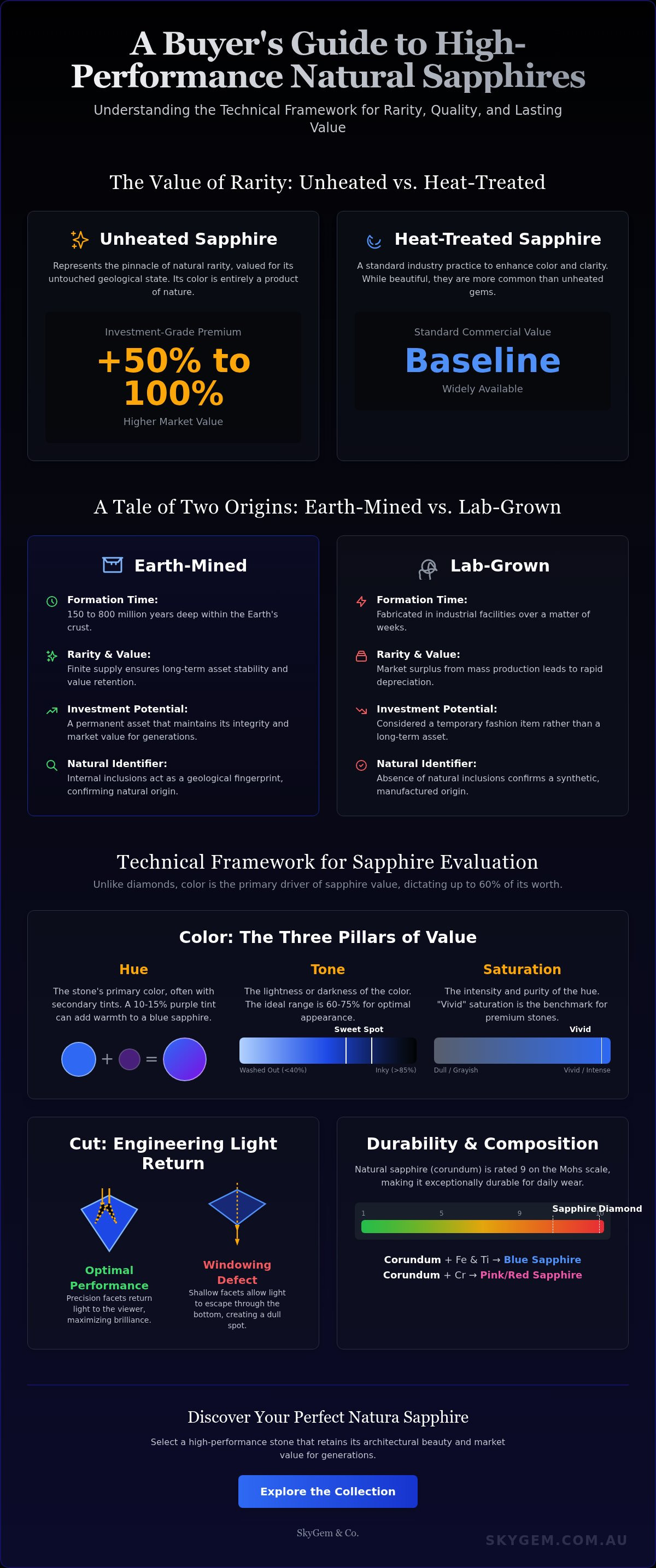
An unheated royal blue sapphire often commands a price premium of 50% to 100% over its heat-treated counterparts, yet most buyers can't distinguish between them without a specialist laboratory report. You've likely felt the frustration of comparing two stones that look identical to the naked eye while facing a price discrepancy of several thousand A$. It's a common hurdle when you're sourcing premium natural sapphires that must serve as both a personal heirloom and a stable long-term asset.
This guide provides the technical framework you need to evaluate gemstone performance with precision, ensuring you don't overpay for low-grade or synthetic alternatives. We'll examine the ROI of unheated gems versus heat-treated stones, the impact of trace elements on colour saturation, and how to select a hue that complements your preferred metal for a bespoke Australian-led design. By the end, you'll have the confidence to select a high-performance stone that retains its architectural beauty and market value for generations.
Key Takeaways
- Understand the technical superiority of earth-mined corundum and why its Mohs hardness of 9 is essential for the longevity of daily-wear jewellery.
- Learn to identify high-performance cutting techniques that ensure optimal light return while preventing common aesthetic defects like windowing.
- Navigate the complexities of heat treatments and origin to distinguish between standard commercial gems and investment-grade unheated sapphires.
- Discover how to select a gemstone from the natura sapphires collection that aligns with the structural and aesthetic requirements of a bespoke engagement ring.
- Master the principles of metal pairing to enhance the natural saturation of your stone, ensuring a sophisticated and durable finish for your custom-designed piece.
Defining Natural Sapphires: Why Earth-Mined Gems Remain the Gold Standard
Natural sapphires represent one of nature's most sophisticated geological achievements, formed deep within the earth's crust over periods spanning 150 million to 800 million years. These gemstones are a variety of the mineral corundum, which crystallises under extreme pressure and intense thermal conditions. For those seeking natura sapphires for bespoke jewellery, the primary appeal lies in this authentic geological heritage. Unlike mass-produced alternatives, each stone serves as a physical record of the earth's history. From a technical perspective, natural sapphires offer a Mohs hardness rating of 9, making them the second hardest natural mineral on the planet. This durability ensures that a sapphire can withstand the rigours of daily wear in the Australian climate without the risk of surface abrasions or structural degradation common in softer materials.
The Chemical Composition of Brilliance
The visual performance of a sapphire is dictated by its internal chemistry. Pure corundum is colourless; the vivid blues, yellows, and teals we observe are the result of specific trace elements trapped during the crystallisation process. Iron and titanium combine to produce the classic blue hue, while chromium introduces pink or red tones. A unique characteristic of high-quality stones is pleochroism, a phenomenon where the crystal displays different colours depending on the angle of light entry. This requires precise orientation during the cutting process to maximise the primary face-up colour. Rubies and sapphires are chemically identical corundum minerals distinguished solely by the concentration of chromium that produces a red hue.
Natural vs. Lab-Grown: The Performance Gap
The distinction between earth-mined gems and lab-grown stones is defined by rarity and long-term asset stability. Lab-grown sapphires are fabricated in industrial facilities over a matter of weeks, resulting in a market surplus that leads to rapid depreciation. Conversely, natural stones retain value due to their finite supply and the increasing difficulty of sourcing premium rough material. Many buyers mistakenly seek "perfect" stones, yet internal inclusions are essential indicators of a gem's natural origin. These microscopic features act as a geological fingerprint, confirming the stone wasn't manufactured in a controlled laboratory environment. When considering the difference in value structures, it's helpful to look at how lab-grown diamonds compare to their natural counterparts, as the same principles of industrial scalability versus geological scarcity apply here. Choosing a natural stone is a commitment to a permanent asset that maintains its integrity over generations.
The Technical Framework for Evaluating Sapphire Quality
Evaluating high-end gemstones requires a departure from the rigid grading systems used for white diamonds. While the 4Cs remain the foundational metric, the hierarchy shifts significantly when assessing natura sapphires. Colour becomes the primary driver of worth, often dictating up to 60 percent of the total sapphire value. A technical understanding of how light interacts with the corundum crystal lattice is essential for any collector or bespoke jewellery designer seeking a long-term asset.
Colour: The Three Pillars of Hue, Tone, and Saturation
Professional grading breaks colour down into three distinct components. Hue refers to the basic colour, such as blue, pink, or yellow. Most stones exhibit secondary hues; for instance, a blue sapphire might show a 10 to 15 percent purple tint, which often adds warmth and depth to the stone's appearance. Tone describes the lightness or darkness. The industry sweet spot typically sits between 60 percent and 75 percent tone. Stones exceeding 85 percent tone often appear "inky" or black in low-light environments, while those below 40 percent may look washed out. Saturation measures the intensity. Vivid saturation is the benchmark for premium specimens, ensuring the stone remains vibrant from every angle.
Cut and Symmetry: Engineering Light Return
A precision cut is not merely about the external shape but about managing internal light performance. Windowing occurs when the pavilion facets are cut too shallow, allowing light to pass straight through the centre of the stone rather than reflecting back to the eye. This results in a "dead" spot where the underlying setting or finger is visible through the gem. Conversely, extinction refers to dark, lifeless areas caused by facets that are too steep. A well-engineered cut ensures maximum brilliance across the entire face of the stone. This technical balance is vital for stones destined for high-performance Australian-designed rings where light return is paramount.
Clarity and Inclusions: The Silk Factor
Sapphires are classified as Type II gemstones, meaning they naturally contain some inclusions. While "loupe-clean" stones are exceptionally rare, "eye-clean" is the standard for high-quality bespoke jewellery. One unique feature is "silk," which consists of fine rutile needles. When distributed evenly, silk scatters light to create a velvety appearance that can actually increase the stone's desirability and value. Buyers should focus on identifying structural threats rather than minor internal markers. Avoid surface-reaching fractures or large crystals located directly under the table facet. Use this checklist for a thorough evaluation:
- Inspect the stone under 10x magnification to identify any feathers that reach the surface.
- Check for "windowing" by placing the stone over a white background with printed text; if you can read the text through the stone, the cut is too shallow.
- Observe the stone in both natural daylight and incandescent light to monitor for unwanted colour shifts.
Carat weight must be balanced against physical dimensions. A 2-carat stone with an overly deep cut may have a smaller face-up appearance than a well-proportioned 1.5-carat stone. Always prioritise the millimetre measurements to ensure the stone meets the architectural requirements of your custom setting. If you're looking for a stone that balances these technical specifications perfectly, explore our curated selection of natura sapphires to find a specimen that meets professional standards.
Heat Treatment and Origin: Navigating the Technicalities of Sapphire Value
Over 90% of the sapphires currently in the global supply chain have undergone thermal enhancement. This isn't a sign of a manufactured stone; rather, it's an industry-standard practice used to optimise the natural potential of the gem. By applying controlled heat, producers can dissolve microscopic rutile inclusions and improve the overall saturation of the stone. For collectors seeking the pinnacle of rarity, unheated stones represent the top tier of the market. These gems are often classified as investment grade because they possess exceptional colour and clarity exactly as they were extracted from the earth.
The Science of Heat Treatment
Standard heat treatment mimics the intense geological pressure and temperature found in the Earth's crust. Technicians heat the stones to temperatures between 800°C and 1800°C to finish the process nature started millions of years ago. This enhancement is permanent, stable, and doesn't require special care. It's vital to distinguish this from unstable treatments that we strictly avoid, such as beryllium diffusion or lead-glass filling. These aggressive methods introduce foreign elements into the crystal lattice, which significantly compromises the stone's structural integrity and resale value. We focus on natura sapphires that have either received standard heat or remain entirely unheated, ensuring your selection retains its value over decades of wear.
Global Origins and Market Value
The geographic source of a sapphire acts as a pedigree that dictates its price per carat. Traditional origins like Kashmir, Burma, and Sri Lanka carry historical prestige, with premiums reaching thousands of A$ per carat for specific shades of blue. Recently, there's been a surge in demand for Australian Sapphires. These stones, particularly those from Central Queensland and New South Wales, are celebrated for their rich teals and deep "Royal Blue" hues, offering a unique aesthetic for bespoke jewellery that reflects our local landscape.
When evaluating these options, referring to GIA's guide to sapphire quality factors helps clarify how trace elements like iron and titanium influence both colour and origin. A certified origin from a laboratory like GIA or GRS can increase the value of natura sapphires by 20% to 50% compared to stones of unknown provenance. This transparency is essential for clients who view their jewellery as both a personal statement and a portable asset. Choosing a stone with a documented history provides the technical assurance required for high-level custom design projects.
How to Choose the Right Sapphire for Your Engagement Ring Design
Selecting a sapphire for a bespoke engagement ring involves more than just picking a colour. It's about technical synergy between the stone's geometry and the metal's properties. When you invest in natura sapphires, you're choosing a material with a Mohs hardness of 9, making it exceptionally durable for daily wear in Australia’s active environment. However, the way you house that stone determines both its longevity and its brilliance.
Matching Stone Shape to Setting Style
Classic silhouettes like ovals and cushions remain the industry standard for Solitaire Engagement Rings because they offer the best weight retention from the raw crystal. These rounded edges allow for a soft, timeless look that focuses entirely on the stone's internal fire. For clients seeking an architectural edge, geometric cuts such as hexagons or tapered baguettes provide a sharp, modern aesthetic. We've seen a 25% increase in requests for 'Toi et Moi' styles, where a vibrant sapphire is paired with a high-clarity diamond. This creates a high-contrast visual that highlights the sapphire’s specific saturation levels through side-by-side comparison.
Metal Choice and Colour Enhancement
Metal selection acts as a sophisticated colour filter for your gemstone. 18K White Gold and Platinum are the preferred choices for cooling down the deep, velvety tones of royal blue natura sapphires. The neutral backdrop prevents yellow tints from bleeding into the stone's secondary hues. Conversely, Rose Gold provides a copper-based warmth that enhances the delicate undertones of pink or peach varieties. We often recommend a technical hybrid approach for yellow gold rings: using 'hidden' platinum prongs. This ensures the gemstone is held by a denser, more secure metal that resists thinning, while the rest of the band maintains your preferred gold aesthetic.
The choice between a trilogy and a solitaire setting often depends on the sapphire's proportions. A trilogy design uses side stones to add brilliance to a darker main stone, effectively 'opening up' the colour. Protecting your investment is the final, crucial step. While traditional prongs allow maximum light entry, a bezel setting offers a 360-degree protective rim. This is a practical solution for those who want to ensure their sapphire remains chip-free over decades of wear. Whether you prefer the minimalist profile of a four-prong setting or the robust security of a full bezel, the structural design must reflect your lifestyle requirements.
Ready to find the perfect centrepiece for your custom design? Explore our collection of premium sapphires.
Standout Gems: The Natura Sapphires Collection at SkyGem & Co.
SkyGem & Co. curates the Natura Sapphires collection as a response to the demand for earth-mined stones that exhibit superior light performance. We don't just stock gems. We select them based on rigorous technical benchmarks. Every stone in this selection meets our high-performance standard, which focuses on precision cutting and optical symmetry. This ensures that the sapphire doesn't just sit in the setting but actively interacts with light to produce maximum brilliance.
Our commitment to engineering excellence extends to the certification and ethics of every gem. We prioritise GIA-certified stones to provide you with an objective, third-party analysis of the stone's characteristics. Our ethical sourcing protocols ensure that every sapphire is traceable and mined under fair conditions. We maintain a strict eye-clean clarity standard. This means that no inclusions are visible to the naked eye, ensuring the structural integrity and aesthetic purity of your bespoke jewellery piece.
Collection Highlights: Choosing Your Centre Stone
The Deep Blue Oval remains a cornerstone of the collection for those seeking timeless elegance. These stones are selected for their high saturation and lack of secondary grey masks, providing a vivid hue that remains bright even in low-light environments. For a more modern, Australian-inspired aesthetic, our Teal Sapphires offer a unique blend of blue and green. These stones have become a preferred choice for contemporary engagement rings in Melbourne due to their distinct personality and versatility.
If you prefer a softer, romantic alternative to traditional diamonds, the Peach and Champagne sapphires in our collection are ideal. These stones provide a sophisticated lustre and a high refractive index. They offer a durable alternative for daily wear, ranking 9 on the Mohs scale, which is essential for longevity in engagement rings.
The SkyGem Consultation Advantage
We operate as more than just a retailer; we are your technical consultants in the procurement process. If your specific requirements for a sapphire aren't met by our current inventory, we initiate a bespoke procurement phase. We leverage a global network to source stones that meet your exact specifications for carat weight, dimensions, and colour profile. Our team ensures that every sapphire is perfectly calibrated for its intended setting, whether you're looking for a custom made engagement ring or a standalone statement piece.
Our technical expertise allows us to advise on how a sapphire's cut will affect its final appearance once set in gold or platinum. This level of detail prevents common issues like "windowing" where light leaks through the back of the stone. You can browse the Natura Sapphires Collection online to view our current high-performance inventory and begin your selection process.
Securing Your Investment in Earth-Mined Excellence
Selecting a premium gemstone requires a precise understanding of geological rarity and international grading benchmarks. By prioritising GIA-certified stones, you ensure that critical data regarding origin and thermal treatment is verified by the Gemological Institute of America. This technical rigour is essential for maintaining the long-term asset value of your jewellery. Our natura sapphires are curated to meet these exacting standards, providing a reliable foundation for bespoke projects that demand both durability and aesthetic depth.
SkyGem & Co. acts as your technical consultant throughout the procurement process. We combine GIA-certified natural gemstones with bespoke craftsmanship in Australia to deliver pieces that exceed local regulatory expectations. Our team provides expert technical consultations to clarify the structural and optical performance of every stone in our inventory. This methodical approach ensures your final design is a permanent asset, engineered for performance and longevity in the Australian landscape. We're committed to helping you navigate the complexities of gemstone selection with transparency and precision.
Explore the Natura Sapphires Collection: Ethical, Earth-Mined Brilliance
We're ready to assist you in finding a sapphire that perfectly matches your technical requirements and your unique design vision.
Frequently Asked Questions
Are natural sapphires better than lab-grown ones for an engagement ring?
Natural sapphires offer superior long term value and rarity compared to lab grown alternatives. While synthetic stones share the same chemical composition, they lack the geological history and investment potential of earth mined gems. In the Australian market, natural stones retain approximately 50% to 70% of their resale value, whereas synthetic versions often hold negligible secondary market interest. Choosing a natural stone ensures your bespoke piece remains a unique asset with inherent historical value.
What is the most expensive colour of natural sapphire?
Cornflower Blue and Royal Blue are the most valuable traditional colours, but the Padparadscha sapphire remains the most expensive per carat. This rare pink orange variety can reach prices exceeding A$20,000 per carat for high quality specimens over two carats. Market demand for intense, vivid saturations drives these premiums. Collectors often prioritise stones from historical origins like Ceylon or Madagascar due to their proven record of price appreciation in international auctions.
How can I tell if a natural sapphire has been heat-treated?
Identifying heat treatment requires professional gemological equipment to detect internal microscopic inclusions like dissolved rutile silk or discoid fractures. Approximately 95% of natural sapphires on the global market undergo thermal enhancement to improve clarity and colour. You should always request a laboratory report from a reputable body like GIA or the Gemmological Association of Australia. These documents specify if a stone is unheated, a status that typically commands a 30% to 50% price premium.
Do natural sapphires chip or scratch easily?
Natural sapphires are exceptionally durable, ranking 9 on the Mohs scale of mineral hardness. This makes them the second hardest natural gemstone used in jewellery, surpassed only by diamonds. They resist surface scratching from everyday contact with most household materials. However, they can still chip if they sustain a direct impact against a hard surface like granite or steel. Proper bezel or claw settings provide the necessary structural protection for daily wear in active environments.
Is a GIA certificate necessary for a natural sapphire?
A GIA certificate or a report from a comparable authority like the GAA is essential for verifying authenticity and treatment status. These reports provide an objective technical audit of the stone's dimensions, weight, and origin. Without independent certification, buyers risk purchasing treated stones at untreated prices. For any investment grade natural sapphires valued over A$3,000, a detailed laboratory report serves as a critical document for insurance and future valuation purposes.
What is a 'Parti' sapphire, and is it considered natural?
A Parti sapphire is a 100% natural gemstone that displays two or more distinct colours within a single crystal, often showing combinations of yellow, green, and blue. These stones are predominantly found in Australian deposits, particularly in the Queensland and New South Wales gem fields. Because no two stones share the exact same colour zoning, they're highly sought after for bespoke Australian jewellery. They represent a unique geological phenomenon where chemical conditions shifted during crystal growth.
How do I clean and maintain my natural sapphire ring?
You can maintain the brilliance of your sapphire by cleaning it with warm, soapy water and a soft bristled brush every two to four weeks. Use a mild detergent and avoid harsh chemicals like bleach or abrasive pastes that might damage the metal setting. While sapphires are heat stable, avoid extreme thermal shock. We recommend an annual professional inspection by a qualified jeweller to ensure the structural integrity of the claws and the security of the stone.
Can I use a natural sapphire in a custom-designed ring?
Natural sapphires are ideal for custom designed rings because their physical properties allow for various cutting styles, from traditional ovals to modern geometric shields. Their structural stability supports intricate metalwork and complex settings. When commissioning a bespoke piece, the gemstone's specific dimensions dictate the engineering of the mount. This ensures a precise fit that maximises light performance and protects the stone's girdle, resulting in a durable and balanced architectural design.
Disclaimer
This article is for general informational purposes only and may include AI-assisted content. Pricing, specifications, and availability are subject to change. For accurate advice and current information, please contact SkyGem & Co. directly. Nothing in this content constitutes professional or financial advice.