
Natural Ruby Ring Value Australia: The 2026 Investor’s & Buyer’s Guide

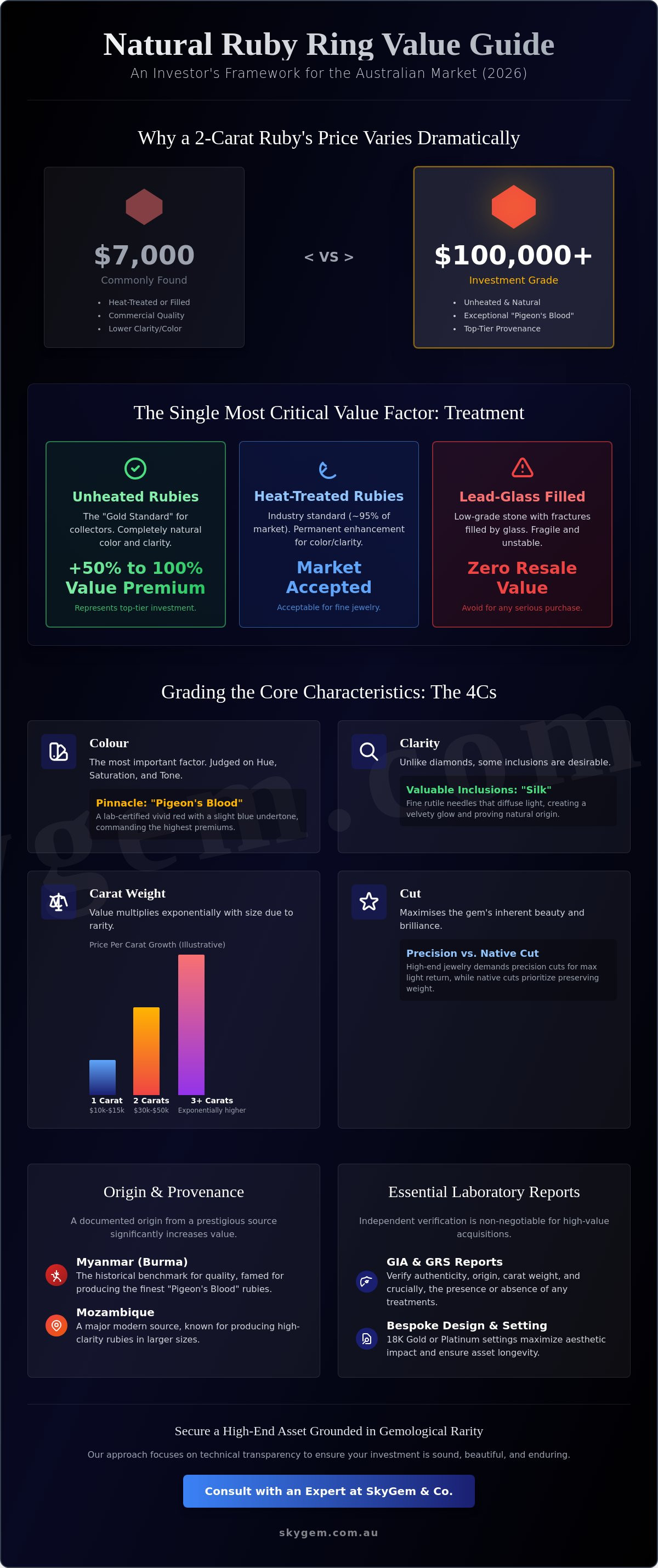
Why does one 2-carat ruby ring command $7,000 while another, seemingly identical stone, sells for over $100,000? It's a disparity that often leaves Australian buyers feeling hesitant, particularly when faced with the fear of overpaying for a treated gemstone or misinterpreting international laboratory reports. You deserve a piece that maintains its worth, yet the technical complexities of gemstone grading can feel like a significant barrier to a confident purchase. This guide clarifies the specific factors driving natural ruby ring value australia in 2026, from the rare "Pigeon Blood" hue to the substantial premium placed on unheated origins. We'll break down the technical metrics of the four Cs, explain how to navigate local GST and import regulations, and provide a framework for selecting a bespoke jeweller who prioritises technical transparency. By understanding the intersection of gemological rarity and market data, you can secure a high-end asset that aligns with both your aesthetic preferences and your long-term financial goals. Our approach focuses on providing the granular detail required for a sophisticated acquisition, ensuring your investment is grounded in practical performance and regulatory standards.
Key Takeaways
- Master the technical grading of colour and clarity, specifically the "Pigeon's Blood" benchmark and the role of natural silk inclusions in determining gemstone quality.
- Distinguish between common heat-treated stones and the rare unheated varieties that represent the gold standard for Australian collectors and investors.
- Analyse how provenance from Myanmar and Mozambique dictates natural ruby ring value australia, allowing for a strategic approach to origin-based premiums.
- Identify the essential laboratory reports from GIA and GRS required to verify stone authenticity and ensure technical compliance during high-end acquisitions.
- Learn how bespoke design choices, such as 18K gold or platinum settings, integrate with the ruby’s characteristics to maximise both aesthetic impact and asset longevity.
Understanding the Primary Determinants of Natural Ruby Value
Evaluating the natural ruby ring value australia requires a departure from traditional diamond grading frameworks. While diamond valuation prioritises the absence of colour and internal flaws, ruby assessment is driven by the depth and purity of its crimson hue. Understanding Ruby gemstone properties is the first step for any serious collector or investor. The "Pigeon’s Blood" standard represents the pinnacle of this hierarchy. It describes a vivid red with a soft blue undertone and high fluorescence. In the Australian market, stones meeting this specific laboratory-certified criteria command the highest premiums, often exceeding the price of high-grade colourless diamonds of comparable size.
Clarity in rubies involves a distinct technical assessment. Unlike the strict requirement for diamonds to be flawless, rubies often contain "silk," which consists of fine rutile needles. This silk can actually enhance value by diffusing light across the stone, creating a soft, velvety glow that synthetic alternatives cannot replicate. When these inclusions are well-distributed, they prove the stone's natural origin. However, if inclusions impede transparency or reach the surface, the value decreases. The goal is to find a balance where the stone appears eye-clean while retaining its natural character.
Carat weight functions as an exponential multiplier rather than a linear one. High-quality natural rubies over 2 carats are geologically rare. Their price per carat can triple or quadruple compared to a 1-carat stone. For instance, while a fine 1-carat ruby might be valued between $10,000 and $15,000, a 2-carat stone of identical quality could command $30,000 to $50,000. This scarcity makes larger, high-clarity stones particularly attractive for long-term wealth preservation.
The 4Cs of Rubies: Colour, Clarity, Cut, and Carat
Hue, saturation, and tone are the primary technical metrics that dictate the visual impact and market price of a ruby. Eye-clean stones are exceptionally rare, making any ruby that lacks visible inclusions under 10x magnification a top-tier asset. While native cuts are often used at the source to preserve weight, precision cuts are preferred for high-end bespoke jewellery to ensure maximum light return and brilliance.
The Rarity Factor: Why Natural Rubies Command a Premium
Rubies are geologically scarcer than almost any other precious gemstone because of the specific conditions required for chromium to enter the crystal lattice. For an investment-grade threshold in Australia, buyers should focus on stones that are unheated and possess a documented origin. These natural stones retain value far more effectively than lab-grown or heavily treated counterparts, serving as a stable asset within a luxury portfolio.
Heat Treatment vs. Unheated Rubies: The Value Premium
Thermal enhancement is an industry standard, with approximately 95% of rubies on the global market undergoing heat treatment to improve their colour saturation and clarity. This process involves heating the stone to high temperatures to dissolve rutile inclusions, resulting in a more vibrant appearance. While heated stones are widely accepted in the trade, the distinction between a treated stone and an unheated one is the most critical factor affecting natural ruby ring value australia. Unheated rubies are nature's rare exceptions. They possess exceptional colour and clarity without any human intervention, making them the gold standard for serious Australian collectors and investors.
The financial disparity between these two categories is significant. A fine quality unheated ruby typically commands a price premium of 50% to 100% over a heated stone of the same weight and colour. In some high-end instances, this gap can be even wider. Buyers should be particularly cautious of "lead-glass filled" or "composite" rubies. These are low-grade stones with significant fractures filled with high-refractive glass to mimic high-quality gems. These stones are fragile and don't hold their value over time. They have virtually no resale value and are unsuitable for investment purposes. Their durability is also compromised, as common household chemicals or professional cleaning can damage the glass filler.
Identifying Natural Enhancements
Traditional heat treatment is permanent and stable, but other methods like beryllium diffusion are more invasive. Diffusion involves adding chemical elements during the heating process to artificially change the stone's hue. According to GIA's guide to ruby value, full disclosure of these treatments is mandatory for any ethical transaction. We prioritise absolute transparency in our technical disclosures, ensuring you understand exactly what you're purchasing. You can view our range of ethically sourced, fully disclosed natural rubies to see the difference quality makes.
The Financial Case for Unheated Rubies
By 2026, the supply of unheated material has become increasingly constrained. As production from traditional sources like Myanmar slows, unheated stones are transitioning into "legacy" assets that offer high portability and value retention. For a stone to be classified as investment-grade, the laboratory report must explicitly state "No indications of heating." This specific remark is the definitive proof required to secure a premium at future valuations. If you're seeking a piece that combines technical rarity with enduring beauty, you might browse our unheated ruby collection to find a stone that meets these rigorous standards.
Origin and Provenance: Impact on Australian Market Prices
Provenance acts as a critical value multiplier in the assessment of natural ruby ring value australia. While the "Four Cs" establish the technical baseline, origin provides the historical and geological context that collectors use to justify significant premiums. A stone's chemical signature, often linked to its geographical source, dictates its visual performance under different lighting conditions. For the sophisticated buyer, understanding where a ruby was mined is just as important as its carat weight or clarity grade.
Burmese rubies, specifically those from the Mogok region, remain the most prestigious origin in the global market. These stones typically possess high chromium content and low iron, which allows for strong red fluorescence. This effect creates an "inner glow" that persists even in low-light environments. Because of political instability and historical trade restrictions, the supply of new Burmese material is extremely limited. This scarcity, combined with their unique aesthetic, ensures they command the highest price per carat. For a detailed breakdown of these premiums, our ruby price guide provides current market benchmarks based on recent auction data and wholesale trends.
Mozambique has emerged as the most significant alternative for high-end buyers in Australia. Since the discovery of the Montepuez deposit around 2009, this region has produced rubies with exceptional clarity and substantial size. Unlike the included nature of many Burmese stones, Mozambique rubies often feature an "open" crystal structure that allows for superior light return. They represent an excellent strategic choice for those seeking a large, vibrant centre stone for a bespoke engagement ring without the extreme Burmese premium. Madagascar also provides value-focused alternatives, though these stones often exhibit darker tones that require expert cutting to maximise brilliance.
The Burmese Ruby: Historical Dominance
The unique fluorescence of Burmese stones is a result of their marble-hosted geological origin. This lack of iron prevents the "quenching" of red light, giving the stone its legendary glow. Current trade embargoes and limited production mean that existing Burmese rubies are increasingly viewed as legacy assets with high resale potential in the Australian market.
New Frontiers: Mozambique and Madagascar
Mozambique rubies offer a modern technical advantage, often appearing cleaner to the naked eye than their Burmese counterparts. This high transparency makes them ideal for larger carat weights where inclusions would be more apparent. In the Australian jewellery landscape, the focus has shifted toward these origins because they offer better value for money while maintaining the vibrant red saturation required for investment-grade natural rubies.
Understanding these nuances is essential when reviewing GIA's guide to ruby quality factors. Australian consumers increasingly prioritise ethical sourcing alongside technical specifications. Traceability is no longer an optional luxury; it's a requirement for ensuring the long-term integrity of a high-end acquisition. By selecting stones with documented provenance, you ensure your investment is grounded in both geological rarity and ethical compliance.
The Role of Certification and Professional Appraisal
Establishing a definitive natural ruby ring value australia requires independent, third-party verification. Without a technical report from a recognised gemological laboratory, a ruby's value remains subjective and speculative. The Gemological Institute of America (GIA) serves as the global baseline for ruby verification, providing an unbiased assessment of the stone's dimensions, treatment status, and natural origin. For those seeking the highest market premiums, a certificate from GemResearch Swisslab (GRS) is often the preferred authority. GRS is specifically renowned for its strict "Pigeon's Blood" colour grading, a designation that can significantly increase a stone's liquidity and resale price.
Certification acts as a critical safeguard against undisclosed synthetics or invasive treatments like glass-filling and beryllium diffusion. These enhancements are often difficult to detect with a standard jeweller's loupe but are instantly identified through the advanced spectroscopic analysis used in top-tier labs. A verified report ensures that the premium you pay for an unheated stone is supported by hard data. This technical transparency is essential for maintaining the long-term integrity of your jewellery portfolio.
Reputable Laboratories in the Australian Context
For high-value natural rubies, buyers should insist on reports from the "Big Four" laboratories: GIA, GRS, SSEF, or Gübelin. Local "in-house" certificates or store-issued "valuation certificates" often lack the technical rigor and international recognition required for investment-grade assets. While these local documents are useful for basic identification, they don't provide the same level of security as an independent laboratory report. This is particularly true when selecting complex pieces like engagement rings melbourne, where the centre stone's certification dictates the entire project's valuation.
Insurance and Resale Security
A comprehensive laboratory report is the foundation of a professional jewellery appraisal. In Australia, a standard appraisal for insurance purposes typically starts from $85 to $165 per item, while a more complex gemologist valuation begins around $185. These documents translate the technical findings of a lab report into a "replacement value" for your insurance policy. Having a verified natural ruby makes your asset far more liquid; should you ever choose to sell, the certificate provides immediate proof of quality to prospective buyers. Ensure your lab report includes these four essential data points:
- Origin: Confirmation of the geographical source (e.g., Burma or Mozambique).
- Treatment: A definitive "No Heat" or "Heated" remark.
- Colour Grade: Specific terminology like "Vivid Red" or "Pigeon's Blood".
- Dimensions: Accurate millimetre and carat weight measurements.
Securing a stone with the correct documentation is the only way to future-proof your purchase. To ensure your investment is fully protected, view our collection of certified natural rubies, each accompanied by reputable international laboratory reports.
Bespoke Design: Maximising the Value of a Ruby Ring
The architectural framework of a ring does more than just secure a gemstone; it acts as a technical component that dictates the stone's visual performance. When evaluating natural ruby ring value australia, the craftsmanship of the setting is a significant variable that mass-produced alternatives often overlook. A bespoke approach allows for the adjustment of metal thickness and prong placement to account for the specific proportions of a natural ruby. This precision is vital because natural stones rarely conform to the standardised "calibrated" sizes used in commercial jewellery. By tailoring the mount to the stone, we ensure optimal light-return and structural integrity.
Setting styles like the solitaire and the halo play distinct roles in value preservation. A solitaire design places the full focus on the centre stone's quality, making it the preferred choice for top-tier unheated rubies. A halo setting, while adding visual size, also provides a protective perimeter of diamonds that shields the ruby from lateral impacts. Because rubies, while hard, can be brittle, the technical execution of the setting must prioritise long-term durability to prevent chipping or loss of the stone over time.
Metal Selection and Colour Enhancement
The choice of alloy serves as a tool for colour correction and enhancement. While platinum is the standard for technical purity and durability, 18K yellow gold is frequently used strategically. Yellow gold prongs can "warm up" a ruby's hue, subtly counteracting purplish secondary tones to achieve a more vivid red appearance. This technique is particularly effective for stones that sit just below the "Pigeon's Blood" threshold. Conversely, platinum is often preferred for trilogy ruby settings to provide a high-contrast backdrop that allows the red saturation to stand out. If you're considering a unique design, our custom made engagement rings process integrates these technical considerations from the initial CAD design through to the final hand-setting.
The SkyGem & Co. Approach to Ruby Curation
We view the creation of a ruby ring as a technical partnership. Our curation process begins with a granular analysis of the loose stone's dimensions and fluorescence. This data informs the bespoke manufacturing process, ensuring the setting is engineered to the micron. This level of detail is what separates a commercial product from a permanent asset. We invite you to explore our precious gemstones collection to find a stone that serves as the foundation for your next project. By focusing on engineering excellence and architectural aesthetics, we help you secure a piece that maintains its value and beauty for generations. Our goal is to provide a solution-oriented approach that prioritises the long-term success of your acquisition.
Securing Your Investment in Natural Rubies
Securing a natural ruby in the current Australian market requires a methodical approach to technical data and provenance. By prioritising unheated stones with GIA or GRS certification, you ensure that your acquisition is grounded in verifiable rarity. We've explored how the intersection of "Pigeon's Blood" colour grading and Burmese or Mozambique origin dictates the long-term natural ruby ring value australia. These factors, combined with a bespoke setting engineered to the stone’s specific dimensions, transform a standard purchase into a permanent legacy asset. It's about moving beyond simple aesthetic appeal to understand the underlying metrics of gemstone performance and market liquidity.
As specialists in unheated rare rubies, we provide the technical expertise required to navigate these complex markets. We invite you to visit our bespoke design boutique in the Royal Arcade for a consultation or explore our curated collection of Natural Ruby Rings online. Every piece in our inventory features GIA or GRS certified gemstones, ensuring full transparency and compliance with international standards. Taking the time to understand these variables ensures your choice remains as enduring and valuable as the stone itself.
Frequently Asked Questions
Is a natural ruby ring a good investment in Australia?
Yes, provided the stone is unheated and possesses a documented provenance from a reputable source. High-quality natural rubies have historically demonstrated strong value retention and appreciation, often outperforming other gemstone categories in the luxury market. In Australia, the scarcity of investment-grade material ensures that top-tier specimens remain highly liquid assets for collectors and sophisticated investors.
What is the price per carat for a high-quality natural ruby in 2026?
Fine quality heated rubies generally range from $5,000 to $12,000 per carat for 1.0 to 2.0 carat stones. Unheated Burmese rubies of comparable quality can command upwards of $20,000 per carat, reflecting their extreme geological rarity. It's important to note that pricing follows an exponential curve; a 2-carat stone will often cost significantly more than twice the price of a 1-carat stone.
How can I tell if my ruby is natural or lab-grown?
Definitive identification requires advanced spectroscopic analysis and microscopic examination by a qualified gemologist. Natural rubies typically contain specific internal characteristics, such as "silk" rutile needles or mineral crystals, while lab-grown stones often exhibit curved growth striae or flux inclusions. Because modern synthetic production is highly sophisticated, a laboratory report from GIA or GRS is the only reliable way to confirm natural origin.
Why are Burmese rubies more expensive than those from other countries?
Burmese stones possess a unique geological signature characterised by high chromium content and low iron. This chemical composition allows the stone to exhibit strong red fluorescence, creating a signature "inner glow" that persists even in low light. This aesthetic superiority, combined with historical prestige and current supply constraints in the Mogok region, drives the significant price premium over stones from other origins.
Does the setting of the ring affect the overall value of the ruby?
While the gemstone represents the primary value of the piece, a bespoke setting is critical for protecting the asset's integrity. A poorly constructed mount can lead to stone damage or loss, which would drastically reduce the natural ruby ring value australia. High-quality craftsmanship using 18K gold or platinum ensures the stone is securely held while maximising its visual performance and brilliance.
Should I buy a ruby with a GIA or GRS certificate?
Both laboratories are internationally recognised authorities, but they offer different grading specialities. GIA provides a conservative and highly reliable baseline for identifying treatments and origin. GRS is often preferred by high-end collectors for its specific "Pigeon's Blood" colour designation. For any significant purchase, having at least one of these reports is essential for verifying the technical specifications of the gemstone.
What is the difference between a "natural" ruby and a "genuine" ruby?
"Natural" indicates the stone was formed by geological processes within the earth, whereas "genuine" is a broader term that can include stones with invasive treatments. A genuine ruby might be lead-glass filled or beryllium diffused, which significantly compromises its long-term value and durability. Always prioritise technical reports that specify "natural" origin and provide a clear disclosure of any thermal enhancements or lack thereof.
How do I care for a natural ruby ring to maintain its value?
Maintain your ruby's brilliance by cleaning it regularly with a soft brush and mild detergent to remove surface oils. Although rubies are exceptionally hard, they should be stored separately from diamonds to prevent scratches. Annual professional inspections are recommended to ensure the prongs remain secure. Avoiding harsh chemicals and thermal shock protects the stone's structural integrity, ensuring it remains a viable legacy asset for the future.
Disclaimer
This article is for general informational purposes only and may include AI-assisted content. Pricing, specifications, and availability are subject to change. For accurate advice and current information, please contact SkyGem & Co. directly. Nothing in this content constitutes professional or financial advice.