
Men's Wedding Rings: The 2026 Guide to Premium Metals and Craftsmanship

Is the most resilient metal for your daily wear actually the one you have been advised to purchase? While a high percentage of Australian grooms prioritize longevity, the technical specifications of men's wedding rings are frequently obscured by retail jargon rather than engineering reality. You likely recognize that a ring isn't just a symbolic gesture; it's a permanent piece of precision hardware that must withstand forty years of mechanical friction while retaining its original profile. Choosing the correct alloy involves more than a simple aesthetic preference, as it requires a firm grasp of Vickers hardness and the specific density of premium metals.
We agree that the search for a band often feels like an impossible trade-off between structural integrity and refined style. This 2026 guide provides the technical framework you need to master these nuances and select a high-performance ring built for lifelong durability. We'll examine the metallurgical differences between platinum and 18ct gold, the ergonomic benefits of Comfort Fit engineering, and the subtle design details that ensure your choice remains a timeless asset rather than a passing trend.
Key Takeaways
- Understand why modern men's wedding rings are now viewed as precision-engineered structural assets rather than generic accessories, ensuring lifelong structural integrity.
- Compare the metallurgical performance of 18K gold alloys against Platinum 950 to select a material that offers optimal hypoallergenic properties and density for your specific lifestyle.
- Identify the technical advantages of 'Comfort Fit' interior geometries and how specific edge profiles reduce skin friction for superior daily wearability in the Australian climate.
- Evaluate advanced diamond setting techniques, such as channel and flush sets, to achieve a sophisticated balance between contemporary aesthetics and maximum stone security.
- Learn to future-proof your investment by selecting a high-performance band that integrates local craftsmanship with rigorous technical standards.
The Architecture of Men's Wedding Rings: Defining Your Foundation
Selecting a wedding ring is often viewed as a purely aesthetic choice, yet for the modern man, it represents a significant structural investment. While the history and cultural significance of wedding rings establishes the emotional foundation, the physical reality requires a focus on engineering. We've moved beyond the era of generic, mass-produced bands. Today, men's wedding rings are precision-engineered assets designed to withstand decades of mechanical stress.
Your daily environment dictates the necessary tensile strength and Vickers hardness of the metal. A ring worn in a demanding manual profession faces different abrasive forces than one in a corporate office. SkyGem & Co. approaches design through this technical lens, balancing architectural aesthetics with long-term wearability. This ensures the piece remains a permanent fixture rather than a high-maintenance liability. We treat every band as a bespoke project, focusing on the intersection of metallurgical integrity and comfort. In the Australian market, 18ct gold and platinum remain the benchmarks for durability, providing a reliable foundation for daily wear.
Width and Proportion: Finding the Right Scale
Standard widths for men's bands typically range from 4mm to 8mm. This isn't just a matter of taste; it's about scale and ergonomics. A 4mm band often suits slender fingers or those with smaller knuckles. Conversely, an 8mm band provides the necessary visual weight for larger hands or longer fingers. If the band is too narrow for the hand's build, it lacks presence. If it's too wide, it can impede joint mobility. Choosing the right proportion ensures the ring integrates seamlessly with your hand's natural mechanics and reflects your personal build.
Customisation vs. Off-the-Shelf Solutions
Mass-cast rings often suffer from porosity, which compromises their structural integrity over time. Hand-finished solutions offer superior density and durability. This technical superiority is a hallmark of bespoke jewellery design. It allows for precise adjustments to accommodate unique hand shapes or prominent knuckles. Personalisation can go beyond fit. Integrating personal elements like the Roman Numeral Men's Wedding Ring for a unique touch transforms a standard band into a unique chronological record. This approach ensures your men's wedding rings are custom-engineered reflections of your personal history and lifestyle requirements.
Comparing Precious Metals: Metallurgical Performance and Durability
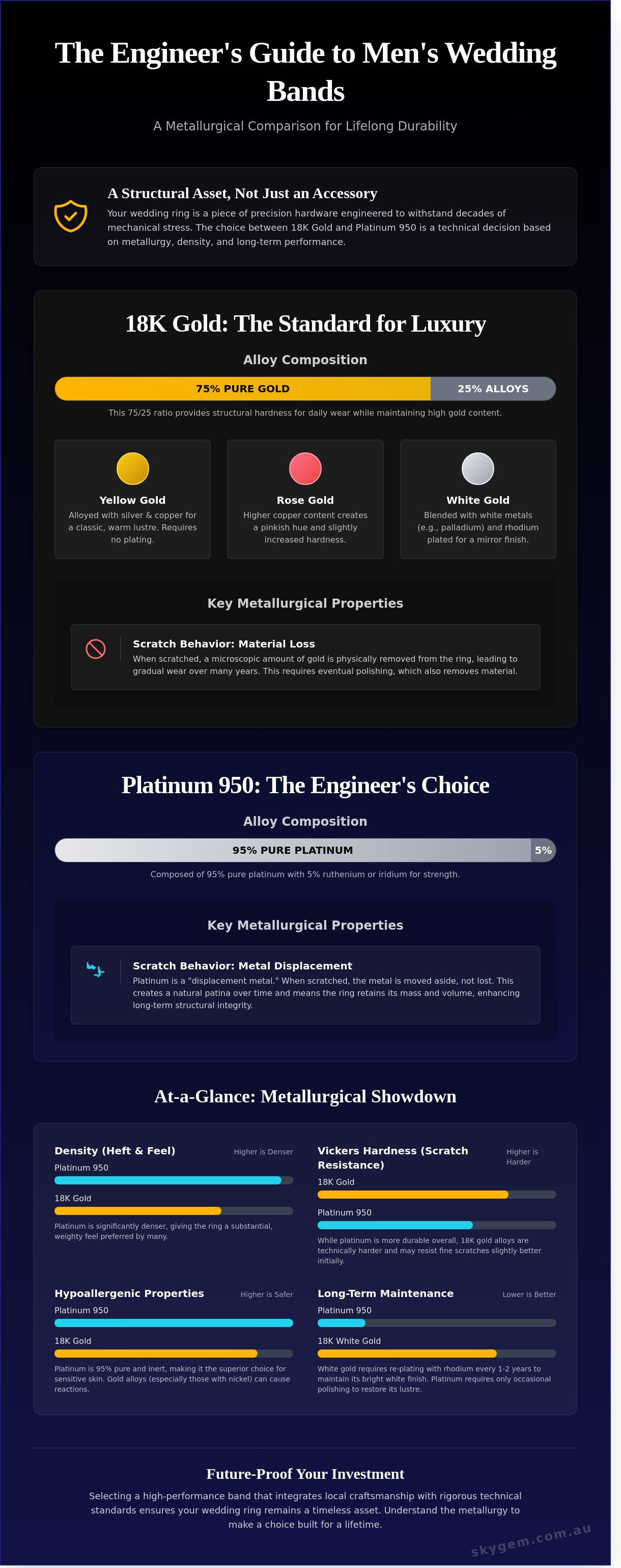
Selecting a wedding band requires an analytical look at material science. The metal's density and alloy composition determine how a piece survives decades of daily wear. For most men's wedding rings, the technical choice settles between 18K gold and Platinum 950. Each offers distinct mechanical advantages and maintenance profiles that impact long-term ownership.
18K Gold Purity: The Industry Standard for Luxury
18K gold is the benchmark for high-end men's wedding rings in Australia. It consists of 75% pure gold and 25% alloy metals. This specific ratio provides the necessary structural hardness for daily use while maintaining the prestige of high gold content. Pure 24K gold is too malleable for a ring; it would deform under the pressure of a firm handshake. You can find deeper insights into these alloy structures in the definitive guide to gold jewellery.
The aesthetic performance of gold depends on its alloy partners:
- Yellow Gold: Uses a balance of silver and copper to retain a traditional, warm lustre. It's classic and requires no chemical coatings.
- Rose Gold: Increases the copper proportion to achieve a pinkish hue. This alloy is technically slightly harder than yellow gold due to the copper content.
- White Gold: Blends gold with white metals like palladium. It's finished with rhodium plating to achieve a bright, mirror-like surface.
Platinum: The Engineer's Choice
Platinum 950 is composed of 95% pure platinum and 5% ruthenium or iridium. It's a "displacement metal," which is a critical distinction for durability. When platinum is scratched, the metal doesn't flake away. Instead, it shifts to the side. This means the band doesn't lose volume or thin out over thirty years of wear. It's the ideal selection for men with high-activity lifestyles or those working in trade environments where equipment contact is frequent.
The density of platinum provides a substantial weight on the finger. It's roughly 40% heavier than 18K gold. This "heft" is a primary indicator of luxury and provides a secure feeling for the wearer. While the initial investment for platinum is higher than gold, its long-term structural integrity and hypoallergenic properties offer a superior price-to-durability ratio. It won't cause skin irritation, making it a safe technical choice for those with metal sensitivities.
Maintenance requirements differ between these two categories. White gold stays bright through periodic rhodium plating, usually required every 12 to 24 months. Platinum develops a matte "patina" over time. Many owners value this look as it showcases the ring's history. If you prefer a high-shine finish, platinum can be repolished without losing actual metal weight. Choosing the right metal involves balancing these technical traits against your daily routine. If you're ready to compare these textures in person, viewing a curated collection of men's wedding rings is a practical next step.
Profile and Edge Geometry: The Science of Comfort
Selecting men's wedding rings involves more than choosing a metal; it requires an understanding of ring ergonomics. The profile, or the cross-sectional shape of the band, dictates how the piece interacts with your skin and adjacent fingers throughout the day. A standard flat interior can create a suction effect or trap moisture, leading to skin irritation. To solve this, the 'Comfort Fit' interior uses a precision-engineered domed inner surface. This curved geometry reduces the contact area between the metal and the finger by approximately 20%, allowing for natural airflow and easier movement over the knuckle during temperature fluctuations.
Edge geometry is equally vital for long-term wearability. While a pipe-cut ring offers a sharp, modernist silhouette, its 90-degree edges can press into the fingers during a firm handshake or while gripping tools. Conversely, a low-dome profile provides a softer transition that feels more natural. Thickness also plays a functional role in hand mechanics. Most high-quality bands range between 1.6mm and 2.2mm in depth. If a ring exceeds 2.5mm, it often interferes with the natural closure of the hand; it's a small measurement that makes a significant difference in daily comfort.
Bevelled and Stepped Edges: Adding Architectural Depth
Architectural details like those found in the Men's Double Stepped Edge Wedding Ring create a multi-dimensional aesthetic without increasing the ring's overall width. These steps act as visual anchors, breaking up the surface area of the metal. For those who prefer a streamlined look, the Men's Flat Beveled Edge Classic Wedding Band is a superior choice. The angled bevels reduce the visual bulk at the edges, making the band appear thinner on the finger than a standard flat cut. Railed edges serve a protective function; they create a raised border that shields the central design or finish from direct impact, ensuring the ring's longevity in demanding environments.
Concave and Grooved Designs
Modern engineering allows for unique light-catching surfaces, such as those seen in the Men's Concave Bevelled Edge Wedding Band. Unlike traditional convex domes, a concave profile curves inward, creating a play of shadows and highlights that shifts as the hand moves. Texture is another tool for the modern groom. The Men's Brick Grove Wedding Band utilises a repetitive geometric pattern to establish a rugged, masculine aesthetic. Beyond the visual impact, these grooves are highly practical. They effectively mask micro-scratches and the inevitable wear and tear of daily life, maintaining the ring's character over decades of use. This makes them an ideal selection for men who value a low-maintenance yet distinctive piece of men's wedding rings.
Diamond Integration and Decorative Finishes
The Australian jewellery market has seen a distinct shift in the last 24 months, with a 15% increase in the adoption of men's diamond wedding bands. Modern grooms no longer view stones as purely ornamental but as architectural elements that enhance the structural profile of the ring. Choosing the right diamond for men's wedding rings requires a balance between light performance and daily durability. Square-edged cuts, such as the Princess or Baguette, align with the wider surface area of masculine bands, creating a seamless, integrated aesthetic rather than a protruding focal point. This geometric alignment ensures the ring maintains a low profile, which is essential for comfort and functionality in professional Australian environments.
Securing the Stones: Channel and Solid Settings
Engineering stone security is paramount for active lifestyles. The Channel-Set Square Diamond Men's Wedding Ring utilizes parallel metal walls to lock diamonds in place, protecting the girdle of each stone from impact. This technical approach ensures the gems sit flush with the metal surface, preventing snagging on clothing or equipment. In contrast, solid settings, like those found in the Square Diamonds Solid Men’s Wedding Ring, involve embedding the stone directly into the band's thickness. This requires a minimum metal depth of 1.8mm to ensure structural integrity and stone stability. By removing the need for traditional claws, these settings offer a sleek, snag-free finish that appeals to professionals who require high-performance jewellery that meets local safety standards.
Surface Textures and Milgrain Detailing
Surface textures define the ring's character and its response to light. The Men's Low Dome Milgrain Carved Edge Wedding Band exemplifies how vintage techniques provide a sophisticated frame for the finger. Milgrain adds a beaded texture that masks minor scratches over time, making it a practical choice for long-term wear. For those in corporate environments, a brushed or matte finish reduces glare and offers a contemporary, understated look. In contrast, high-polish finishes maximize the reflective properties of 18K gold or platinum, creating a bold statement. Selecting a finish should depend on your daily tactile environment. High-friction professions may wear down high-polish surfaces faster, whereas textured or hammered finishes maintain their visual profile for much longer without requiring frequent servicing. This focus on future-proofing ensures your investment remains a permanent asset.
The SkyGem & Co. Collection: Precision-Crafted Excellence
SkyGem & Co. approaches the curation of men's wedding rings with the same engineering precision applied to high-end architectural projects. Our collection reflects a commitment to structural integrity and refined aesthetics; each piece is designed to serve as a durable, lifelong asset. We move beyond mass-produced standards by utilizing a hand-finished manufacturing process that prioritizes metal density and surface finish. This technical focus results in bands that resist the daily rigours of the Australian landscape while maintaining their geometric profile over decades of wear. Precision is our standard. Every curve is measured to ensure the highest levels of quality and performance.
For those who prefer a streamlined profile, the Unisex Low Dome Classic Wedding Band offers a sophisticated, minimalist solution. It features a low-profile arc that minimizes bulk between the fingers, making it an ideal choice for professionals who value ergonomic comfort. The design focuses on the purity of the metal and is available in various widths to suit specific hand proportions and aesthetic preferences. It's a versatile foundation for any jewelry collection.
Standout Products for the Modern Groom
Our range includes specialized designs for individuals seeking a distinct visual identity. The Men's Trapezoid Rail Wedding Band utilizes sharp, geometric lines to create a bold architectural statement. It's a choice for those who appreciate structural depth and modern styling. Conversely, the Rail Flat Round Edge Men's Diamond Wedding Ring integrates high-grade stones into a flat-profile band, balancing luxury with a practical, snag-free edge. Pricing within the collection is transparent, reflecting the volume of precious metal and the complexity of the setting. Options typically range from A$975 for classic bands to over A$5,000 for intricate diamond-set designs, ensuring value is aligned with technical craftsmanship and material quality.
Finalising Your Selection
Selecting the correct size requires a technical understanding of band width. Wide bands displace more skin and often require a slightly larger measurement than thin bands to ensure proper circulation and comfort. We recommend a professional fitting to account for these variables before a final purchase. Once you've identified a profile that aligns with your aesthetic, you can transition to a bespoke consultation to discuss specific metal alloys or custom modifications. This collaborative process ensures your ring meets every technical and personal requirement. We view ourselves as your technical partner in this selection process.
Engineering Your Permanent Legacy
Selecting a wedding band requires a balance of structural integrity and ergonomic comfort. High-performance metals offer superior metallurgical durability, ensuring your piece withstands the rigours of daily life. Understanding the relationship between profile geometry and wearability ensures your choice remains a practical, lifelong asset that doesn't compromise on comfort.
SkyGem & Co. approaches every piece with the precision of a technical consultant. Our men's wedding rings benefit from bespoke CAD design services that allow for sub-millimetre customisation. Each band is hand-finished in the heart of the jewellery district and features ethically sourced GIA certified diamonds to meet the highest industry benchmarks. This commitment to Australian-led design provides a level of reliability that mass-produced alternatives can't match.
Discover your perfect handcrafted wedding band in our Men's Collection
We look forward to helping you commission a ring that stands as a testament to both engineering excellence and your personal journey.
Frequently Asked Questions
What is the most durable metal for a man's wedding ring?
Tungsten carbide is the most durable metal for men's wedding rings, ranking 9 on the Mohs scale of mineral hardness. This material maintains its finish in high-impact environments common in Australian trade industries. While gold and platinum require periodic polishing to remove scuffs, tungsten remains scratch-resistant for decades. It's an ideal choice for those seeking a permanent, low-maintenance solution that resists deformation under extreme pressure.
What is a 'Comfort Fit' wedding band and why does it matter?
A comfort fit wedding band features a domed interior profile rather than a traditional flat inner surface. This ergonomic design reduces the surface area in contact with the skin, which minimises friction and allows the ring to glide over the knuckle more easily. It's particularly beneficial for men with active lifestyles or those prone to finger swelling in the Australian heat. The rounded edges prevent the metal from pinching the skin during daily tasks.
How wide should a man's wedding ring be?
Most men select a width between 6mm and 8mm for their wedding band to ensure a balanced aesthetic. A 6mm band suits approximately 70 percent of Australian men with average hand sizes. If your ring size is 10 or larger, an 8mm width provides better visual proportions. Choosing the correct width ensures the ring feels substantial on the hand without impeding joint mobility or interfering with professional equipment.
Can men's wedding rings with diamonds be resized?
Resizing men's wedding rings with diamonds depends entirely on the specific setting style and metal type. If the diamonds are set in a full 360-degree eternity pattern, resizing is technically impossible without compromising the structural integrity of the stone mounts. However, rings with diamonds across the top half can often be adjusted by one or two sizes. It's essential to consult a specialist to evaluate the channel or tension setting before attempting any structural modification.
Is Platinum better than White Gold for a wedding band?
Platinum offers superior long-term value because it's a naturally white, high-density metal that doesn't require rhodium plating. White gold is a gold alloy that needs re-plating every 12 to 24 months to maintain its bright finish. While platinum carries a higher initial cost, its 95 percent purity level makes it hypoallergenic and more resistant to thinning over decades of wear. It's a robust investment for those seeking a heavy, premium feel.
How do I choose between a matte and a polished finish?
Choose a matte finish if you prefer a modern, understated look that hides surface micro-scratches from daily labour. Polished finishes offer a traditional, high-reflectivity aesthetic but show scuffs and fingerprints more clearly. Data from jewellery workshops suggests that 40 percent of men now opt for brushed or satin textures. These matte options ensure the ring maintains a consistent appearance between professional maintenance sessions and doesn't require constant cleaning to look its best.
What is the difference between a beveled edge and a stepped edge?
A beveled edge features a slanted surface that connects the top of the ring to the sides at a 45-degree angle. In contrast, a stepped edge incorporates a sharp, 90-degree drop between two different levels of the band. Beveled edges provide a smoother feel and a more aerodynamic look that won't catch on clothing. Stepped edges create a distinct architectural silhouette that highlights the contrast between different metal textures or colours.
Should my wedding band match my partner's ring metal?
You don't need to match your partner's ring metal, as individual lifestyle requirements should dictate your material choice. While 25 percent of couples choose matching sets for symbolic unity, many prioritise personal comfort and durability. If one partner works in a manual industry and the other in a corporate environment, selecting different metals like tungsten and 18k gold ensures both rings remain functional. Focus on a design that reflects your personal style rather than strict uniformity.
Disclaimer
This article is for general informational purposes only and may include AI-assisted content. Pricing, specifications, and availability are subject to change. For accurate advice and current information, please contact SkyGem & Co. directly. Nothing in this content constitutes professional or financial advice.