
Men's Diamond Wedding Bands: A Guide to Style, Security, and Craftsmanship

A wedding band is often the most significant piece of jewellery a man will ever own, yet many traditional designs prioritise aesthetic flair at the expense of the structural engineering required for decades of wear. Selecting from the available range of men's diamond wedding bands requires more than an eye for style; it demands an understanding of how technical precision ensures long-term viability. You likely want a ring that signals sophistication without appearing fragile or excessively flashy, especially if your daily environment involves physical rigour.
We understand the concern that a diamond-set piece might feel too delicate or that poor craftsmanship could lead to the loss of a stone. This guide provides the technical clarity needed to balance refined aesthetics with industrial-grade durability. We'll analyse the most secure setting methods, compare the performance of various precious metals, and explore how bespoke design can tailor a band to your specific lifestyle requirements. By focusing on the intersection of craftsmanship and material science, you can select a band that serves as a reliable and permanent asset.
Key Takeaways
- Learn why specific setting styles, such as channel or flush settings, are essential for securing diamonds against the rigours of an active lifestyle.
- Understand how the density and hardness of different precious metals impact the long-term durability of men's diamond wedding bands.
- Determine the ideal band width and profile to balance a sophisticated aesthetic with the practical requirements of your daily environment.
- Explore the bespoke design process to achieve a superior level of structural integrity and metal thickness compared to mass-produced alternatives.
- Gain clarity on the latest grading standards for natural and lab-grown diamonds to make an informed decision based on performance and value.
Beyond the Plain Band: The Evolution of Men's Diamond Wedding Bands
The traditional wedding ring has undergone a significant transformation. For decades, the standard for men was a simple, unadorned gold band. However, the modern market for men's diamond wedding bands has expanded as grooms seek a balance between symbolic tradition and personal expression. This shift isn't merely about aesthetics; it's a move toward treating the wedding band as a high-performance piece of fine jewellery that reflects individual success and technical appreciation. Modern men are increasingly comfortable with design elements that were once reserved for women's jewellery, provided they are executed with a focus on structural integrity and refined proportions.
Tracing the history of the wedding ring reveals that while the circle has always represented eternity, the materials used have evolved to match the era's technological capabilities. Today, diamonds are integrated into men's bands not just for their brilliance, but for their physical properties. As the hardest natural substance on Earth, a diamond serves as a fitting metaphor for the endurance of a lifelong commitment. By utilising industrial and architectural design principles, modern jewellers have reframed the diamond band as a piece of precision-engineered equipment. This approach addresses traditional concerns regarding masculinity by focusing on the diamond as a symbol of resilience rather than mere ornamentation.
The Symbolism of Diamonds in Men's Jewellery
Diamonds represent more than luxury; they embody structural resilience. In the context of men's wedding bands, a single, flush-set diamond can communicate strength without overwhelming the ring's profile. This approach aligns with the quiet luxury movement, where value is found in the quality of materials and the precision of the setting rather than overt display. For many, choosing natural diamonds or lab-grown diamonds is a way to elevate a classic band while maintaining a grounded, professional appearance that suits a corporate or industrial environment.
Modern Design Trends for 2026
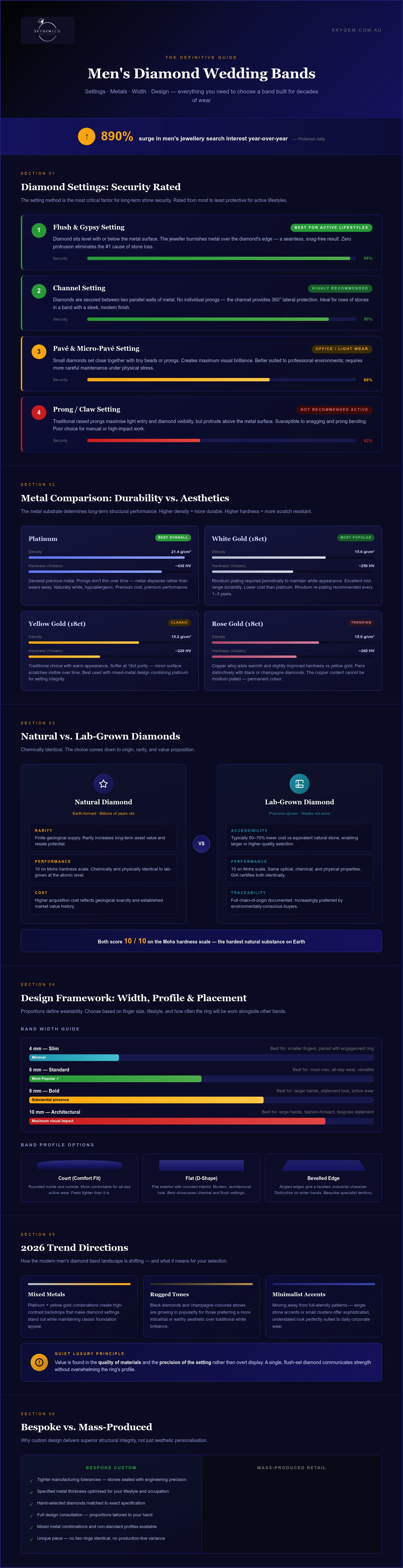
The landscape of men's jewellery is rapidly shifting. Pinterest data from 2026 indicates that search interest for men's jewellery has surged by 890% year-over-year, reflecting a broader acceptance of diverse styles. Modern trends favour subtle diamond accents that provide a touch of refinement without appearing delicate.
- Mixed Metals: Combining platinum with yellow gold creates a high-contrast backdrop that makes diamond settings stand out while maintaining a classic foundation.
- Rugged Tones: Black diamonds and champagne coloured stones are increasingly popular for those who prefer a more industrial or earthy aesthetic.
- Minimalist Accents: Moving away from full eternity patterns, many men now opt for single stone accents or small clusters that offer a sophisticated, understated look suitable for daily wear.
Technical Diamond Settings: Ensuring Security for Active Lifestyles
Setting styles refer to the mechanical method used to secure a diamond within the metal substrate of the band. For men's diamond wedding bands, selecting the right setting is the most critical factor in ensuring the piece survives decades of daily wear. High-performance rings require a specific relationship between metal volume and stone protection; if the metal is too thin or the setting is too exposed, the risk of stone loss increases significantly. According to the GIA guide to men's wedding bands, choosing a setting that suits your lifestyle is as important as the diamond itself. Bespoke manufacturing allows for tighter tolerances than mass-produced retail rings, ensuring that each stone is seated with engineering precision rather than relying on a generic cast.
Flush and Gypsy Settings: The Ultimate in Protection
Flush and gypsy settings represent the pinnacle of security for individuals with active or manual occupations. In these designs, the diamond sits perfectly level with or slightly below the metal surface. This configuration eliminates snagging on clothing or equipment, which is a common cause of prong failure in other styles. The technical process involves burnishing, where the jeweller uses a specialised tool to rub the metal over the edge of the diamond, creating a seamless and incredibly secure bond. Because the diamond is encased within the band, it's protected from the impacts of heavy lifting or contact with hard surfaces, making it a reliable choice for long-term viability.
Channel and Pavé Settings: Maximising Brilliance
For those who prefer more visual impact, channel and pavé settings offer increased brilliance while maintaining a high degree of safety. Channel settings secure a row of diamonds between two continuous walls of precious metal, which protects the vulnerable girdle of each stone from lateral impacts. This creates a smooth surface that feels comfortable against adjacent fingers and won't catch on fabrics. Pavé settings use small metal beads to create a continuous surface of light. While visually striking, multi-stone bands require periodic maintenance to ensure that the small metal grains haven't worn down over time. If you work in a high-impact environment, you might book a technical consultation to determine which setting style aligns best with your specific durability needs and lifestyle requirements.
The choice between these settings often comes down to the balance between light performance and the rigours of your daily routine. While a flush setting offers the most protection, a channel setting provides a more traditional jewellery aesthetic without compromising the structural integrity of the band. Regardless of the style chosen, the volume of metal surrounding the stone remains the primary indicator of how well the ring will perform over the next fifty years.
Material Selection: Comparing Metals and Diamond Origins
The performance of men's diamond wedding bands depends heavily on the physical properties of the chosen metal. While aesthetic preference is important, the metal acts as the structural foundation that ensures stone retention over time. Different alloys offer varying levels of hardness and density, which directly impact how well a setting resists deformation. Selecting a metal isn't just about colour; it's about matching the material's mechanical capabilities to the user's lifestyle and the specific requirements of diamond security.
Platinum vs. 18ct Gold: A Technical Comparison
Platinum is frequently regarded as the superior choice for diamond-set wedding rings due to its exceptional density and "memory." When platinum is scratched, the metal is displaced rather than lost, meaning the prongs or walls holding the diamonds remain structurally intact longer than gold. 18ct gold, however, remains the industry standard for its balance of lustre and durability. While 18ct White Gold requires periodic rhodium plating to maintain its bright finish, Platinum is naturally white and requires less frequent surface maintenance. For men in high-impact environments, the weight and resilience of Platinum provide a sense of stability that lighter alloys don't match.
The Choice of Diamond: Natural or Lab-Grown?
Deciding between natural diamonds and lab grown diamonds involves balancing investment value against project budget. Both options share identical physical, chemical, and optical properties, meaning they perform exactly the same within a setting. However, their market trajectories differ significantly. As of 2026, natural diamonds generally retain 50% to 60% of their purchase price at resale, whereas lab-grown stones typically retain 10% to 30%. For those prioritising rarity and long-term asset value, natural stones are the logical choice. Conversely, lab-grown diamonds allow for larger or more numerous stones within the same budget, which is particularly advantageous for elaborate multi-stone designs.
Metal colour also plays a technical role in diamond selection. White metals like Platinum and White Gold demand diamonds with higher colour grades to avoid a yellowish tint. In contrast, 18ct Yellow Gold or Rose Gold can accommodate stones with slightly lower colour grades, as the warmth of the metal masks subtle tints in the diamond. This synergy between metal and stone allows for a more efficient allocation of budget without compromising the visual impact of the band. Your choice should reflect a balance between the technical requirements of the setting and your personal perspective on investment and ethics.
Design Framework: Width, Profile, and Diamond Placement
Designing men's diamond wedding bands requires a structural approach where dimensions are dictated by both ergonomics and the physical space required for secure stone settings. Unlike plain bands, which can be as narrow as 2mm or 4mm, diamond-set versions typically range from 6mm to 8mm in width. This additional metal volume provides the necessary depth to house the pavilion of the diamond without compromising the ring's structural integrity. Choosing a profile; whether flat, domed, or bevelled; is equally important for daily wearability. A comfort-fit interior, which features a slightly curved inner surface, is essential for these wider, heavier bands. This design reduces the surface area in contact with the skin, allowing for better airflow and preventing the skin irritation often associated with wide, flat-interior rings.
Proportions and Aesthetics
Achieving visual balance involves more than just selecting a stone. Many expert designers apply the "Rule of Thirds," where the diamond channel or row occupies the central third of the band's total width. This creates a framed effect that looks intentional and architecturally sound. The choice of finish also influences how the diamonds are perceived. A matte or brushed finish provides a non-reflective backdrop that allows the diamond's fire to stand out by contrast. Polished finishes, conversely, create a continuous play of light across the entire surface, which can sometimes make the diamonds blend into the metal. Integrating mixed finishes, such as a brushed centre with polished bevelled edges, can add a layer of sophistication to the final design.
Future-Proofing Your Purchase
Planning for the long term is vital because men's diamond wedding bands are significantly more complex to resize than plain metal bands. When stones are set into the metal, they create rigid points that do not flex during the resizing process. If a ring is stretched or compressed, the settings can warp, which often leads to stone loss or damage. To mitigate this risk, many men opt for "top-only" placement, where diamonds are set across the upper half or third of the band. This leaves a solid section of metal at the base of the ring, allowing for easier adjustments as your finger size changes over the years. Internal engraving is a popular way to personalise a band, but it must be positioned carefully to avoid the "azures" or drill holes behind the diamonds. Compromising these areas can weaken the stone's seat and make cleaning the diamonds more difficult, eventually dulling their brilliance.
The Bespoke Advantage: Crafting a Unique Men's Diamond Band
Off-the-shelf men's diamond wedding bands are frequently manufactured to meet a specific retail price point, which often results in a strategic reduction of metal thickness. Thin walls and narrow settings are prone to warping under physical pressure, which directly endangers the security of the diamonds. By adopting the technical principles used for bespoke engagement rings, we prioritise structural density and engineering precision. This approach ensures that the band is a permanent asset designed for long-term viability rather than a mass-produced commodity. A bespoke band allows for the metal volume to be calibrated specifically to the size of the stones, providing a level of protection that generic rings cannot match.
The use of Computer-Aided Design (CAD) technology allows for the visualisation of the exact diamond placement and depth before the casting process begins. This technical foresight is crucial for ensuring that the internal architecture of the ring correctly supports each stone's pavilion. Working with a consultant also enables you to select individual stones for a consistent layout. By hand-selecting diamonds with matching colour, clarity, and cut proportions, you achieve a level of visual continuity that is often lacking in pre-set retail pieces.
The Custom Design Process
The transition from an initial concept to a finished piece involves moving from hand-sketches to high-resolution 3D renderings. This stage allows for precise adjustments to the band's profile, width, and ergonomic fit. Once the design is finalised, expert jewellers perform the hand-finishing and stone setting. This process requires significantly more skill than automated factory settings, as each stone is seated according to its unique dimensions. This custom engagement rings technology also facilitates the aesthetic synchronisation of the groom's band with their partner's jewellery, ensuring a cohesive design language across both pieces.
Quality Assurance and Longevity
Reliability in fine jewellery is built on transparency and ongoing maintenance. Every diamond integrated into a bespoke band should be accompanied by independent certification, providing quantitative proof of its performance metrics. Beyond the initial creation, the longevity of the ring depends on a professional partnership. Regular inspections and professional cleaning are essential for identifying potential wear in the metal before it leads to stone loss. We act as your technical consultant, providing the expertise required to maintain the ring's structural integrity and aesthetic value for a lifetime of daily wear.
Investing in Structural Excellence and Refined Design
Choosing from the diverse range of men's diamond wedding bands is a decision that merges personal style with rigorous technical requirements. We've analysed how selecting the correct setting, such as a flush or channel mount, provides the mechanical security necessary for an active lifestyle. By prioritising metal volume and density, particularly with high-performance materials like Platinum, you ensure your ring remains a permanent asset that resists the rigours of daily wear.
Our bespoke process utilises high-precision CAD design to visualise every detail before manufacturing begins. This methodical approach ensures that your band features hand-finished craftsmanship and incorporates either GIA certified natural diamonds or premium lab-grown stones tailored to your exact specifications. This level of technical oversight guarantees a piece that's both aesthetically sophisticated and structurally sound for decades to come.
We look forward to acting as your technical partner in creating a wedding band that reflects your commitment through superior engineering and timeless design.
Frequently Asked Questions
Are diamonds in men's wedding bands likely to fall out?
No, provided the setting is engineered correctly for your lifestyle. Flush or channel settings are specifically designed to protect the stone's girdle and prevent snagging. High-quality bespoke manufacturing uses thicker metal walls and tighter tolerances than mass-produced retail pieces. Regular professional inspections every twelve to eighteen months further mitigate the risk by identifying any metal fatigue or prong wear before the stone becomes loose. This proactive maintenance ensures the long-term viability of men's diamond wedding bands.
Which metal is best for a man's diamond wedding ring?
Platinum is technically superior for stone security due to its high density and "memory" for holding diamonds in place. Unlike gold, platinum displaces rather than loses metal when scratched, maintaining the structural integrity of the setting over decades. However, 18ct white or yellow gold remains a durable and popular choice. White gold requires rhodium plating to maintain its finish, whereas platinum's natural white colour is permanent. This reduces long-term surface maintenance requirements for your fine jewellery.
Can a men's diamond wedding band be resized?
Resizing is possible but depends heavily on the diamond placement. Bands with a "top-only" diamond configuration are easier to adjust because they have a solid metal section at the base. Full eternity bands, where diamonds encircle the entire ring, are extremely difficult to resize without compromising the settings. Stretching or compressing the metal can warp the stone seats, potentially leading to stone loss. It's essential to confirm your size accurately during the initial CAD design phase.
What is the difference between natural and lab-grown diamonds for a wedding band?
Natural and lab-grown diamonds are chemically identical, offering the same brilliance and durability. The primary difference lies in their origin and market value. Natural diamonds are finite resources that generally retain a higher percentage of their purchase price at resale. As of late 2025, the GIA has simplified lab-grown grading to "Premium" or "Standard" ratings. This makes men's diamond wedding bands using lab-grown stones a budget-accessible alternative for larger, high-performance designs that prioritise visual impact.
How do I clean a men's diamond ring at home?
You can maintain the brilliance of your ring by soaking it in a solution of warm water and a few drops of mild dish soap. Use a soft-bristled toothbrush to gently clean around the diamond settings, paying close attention to the "azures" or holes behind the stones where oils and debris accumulate. Rinse the ring thoroughly under warm running water and dry it with a lint-free cloth. Don't use abrasive chemicals or ultrasonic cleaners at home.
Will a diamond wedding band look too feminine?
Modern design principles focus on industrial and architectural aesthetics to ensure diamond bands remain masculine. By utilising wider band profiles, brushed finishes, and flush-set diamonds, the ring appears as a piece of precision-engineered equipment rather than delicate jewellery. Subtle accents or single-stone designs offer a "quiet luxury" feel that complements professional attire. The key is balancing the stone's brilliance with the structural weight and geometric lines of the band to create a grounded, premium aesthetic.
What are the most popular diamond shapes for men's rings?
Round brilliant diamonds are the most popular choice due to their superior light performance and versatility in flush settings. Square princess cuts and rectangular baguette diamonds are also highly favoured for their clean, geometric lines that align well with wider band profiles. Baguette diamonds, in particular, provide an understated, architectural look that feels modern and masculine. Each shape requires a specific setting depth, which our designers factor into the initial CAD phase to ensure long-term security.
How much should I expect to spend on a men's diamond wedding band?
Your investment depends on several technical factors, including the choice of metal, total diamond carat weight, and whether you select natural or lab-grown stones. Platinum bands with natural diamonds represent the higher end of the spectrum due to material density and stone rarity. Conversely, 18ct gold bands with lab-grown accents offer a more accessible entry point. We focus on transparency and education, helping you allocate your budget toward the technical features that matter most for your lifestyle.