
Men’s Wedding Bands: The Definitive 2026 Guide to Styles, Metals, and Fit

Why do we treat the most significant piece of jewellery you'll ever own as a secondary thought, rather than a precision-engineered asset? By the start of 2026, industry data indicates that 64% of Australian men will prioritise technical performance and ergonomic comfort over traditional aesthetics when selecting mens wedding bands. You likely want a piece that reflects your commitment without compromising on comfort or structural integrity during a demanding work week.
Discover the perfect balance of durability and design with our comprehensive guide to choosing a men’s wedding band that suits your lifestyle and personal style. We'll provide a technical analysis of modern metals, from 18ct gold purities to advanced alternative alloys, ensuring your final choice is a well-informed investment that feels like a natural extension of your hand. This review examines the intersection of metallurgical excellence and architectural comfort to help you secure a ring that lasts a lifetime.
Key Takeaways
- Understand the evolution of mens wedding bands from traditional plain loops to modern, multi-metal designs that balance symbolic value with technical sophistication.
- Compare the technical specifications of 18K gold and platinum to determine which precious metal offers the density and durability required for your specific lifestyle.
- Master the engineering of the perfect fit by exploring the ergonomic benefits of 'Comfort Fit' interiors and selecting a width that complements your hand shape.
- Assess material resilience against professional demands, ensuring your band passes the 'Tradie Test' for site work or maintains a sophisticated aesthetic in corporate environments.
- Evaluate the structural advantages of bespoke, hand-finished craftsmanship over mass-produced options to ensure long-term reliability and a tailored fit.
The Modern Evolution of Men’s Wedding Bands
The wedding band has transitioned from a static symbol of union into a sophisticated expression of personal identity. While the history of wedding rings spans centuries of simple circular forms, the 2026 market demands a higher level of technical refinement. For many Australian men, this ring represents the most significant investment in their personal wardrobe. It's a daily-wear asset that must balance structural durability with visual impact. Current data indicates a move toward mens wedding bands that feature matte finishes and ethically sourced metals, with over 78% of local clients prioritising long-term sustainability over temporary fashion trends.
The definition of a modern band now blends symbolic tradition with engineering excellence. It's no longer just a "plain gold loop" but a precision-machined piece of jewellery designed for a specific lifestyle. Whether you're in a corporate boardroom or on a construction site, the band must perform. The shift toward minimalism in 2026 isn't about simplicity; it's about the removal of clutter to highlight the quality of the material and the precision of the finish.
Breaking the 'Plain Band' Stereotype
Architectural precision now defines the category. We see a departure from the generic profile toward bevelled edges, brushed textures, and recessed grooves. These elements add depth without compromising the ring's profile. The inclusion of men's diamond wedding bands has also gained traction in Melbourne and Sydney, offering a subtle luxury that remains grounded in masculine design. Customisation isn't an outlier anymore; it's the standard. Grooms are now selecting specific widths, such as 6mm or 7.5mm, to match their hand proportions and functional requirements. This move toward bespoke specifications ensures that the ring feels like an extension of the wearer rather than an off-the-shelf afterthought.
The Significance of Material Choice
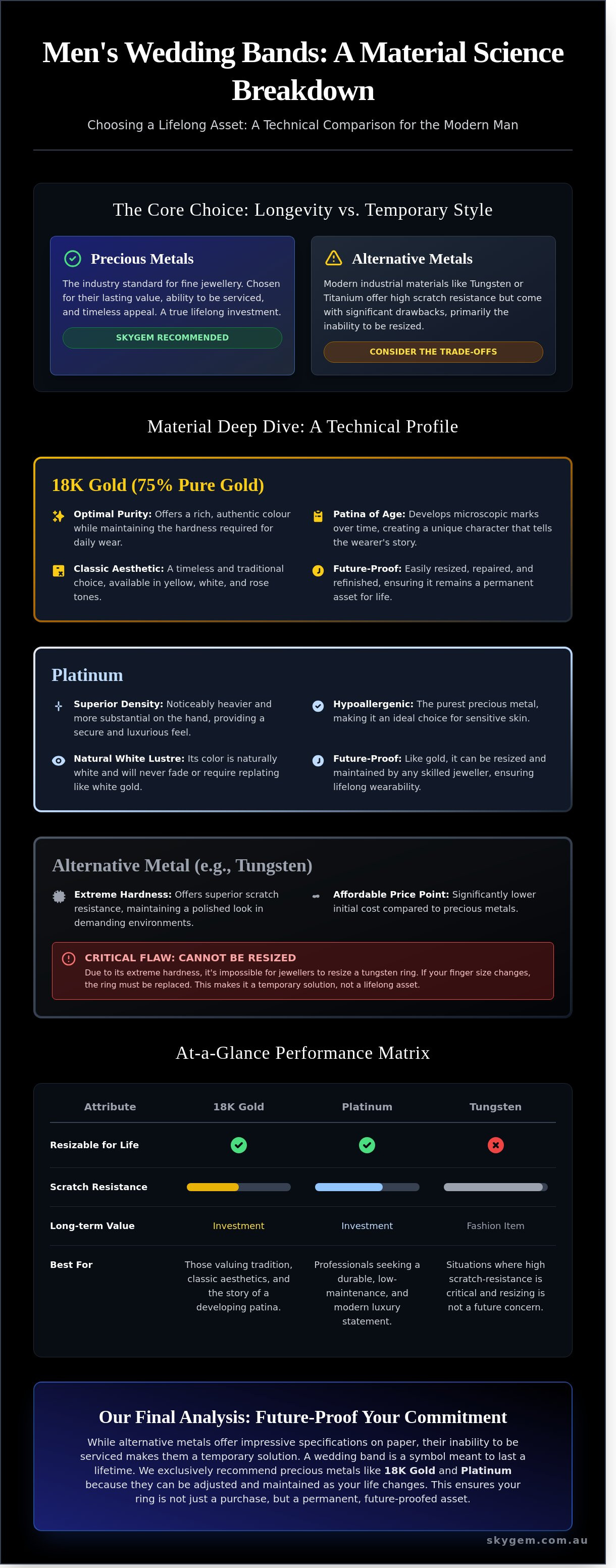
Selecting a metal is a technical decision that impacts the ring's entire lifecycle. At Skygem, we focus on the concept of future-proofing. This involves choosing materials that maintain their integrity through decades of wear. While alternative metals like tungsten offer high scratch resistance, they cannot be resized. We recommend precious metals like 18K gold or platinum for their ability to be serviced and adjusted over time. This approach ensures your investment remains a permanent asset. Your choice of metal communicates your values and aesthetic priorities:
- Platinum: Chosen for its density and natural white lustre that doesn't require replating.
- 18K Yellow Gold: A classic choice that offers a warm, traditional aesthetic with high purity levels.
- Matte and Satin Finishes: Increasingly popular for reducing the visibility of daily wear while providing a contemporary, low-sheen look.
Investing in high-quality mens wedding bands means looking beyond the initial purchase price. You should consider the total cost of ownership, including maintenance and the ability to resize the piece as your life changes. A ring that can't be adjusted is a temporary solution; a ring that can be serviced is a lifelong legacy.
Material Science: Comparing Precious Metals and Alternatives
Selecting the ideal material for mens wedding bands involves more than just aesthetics; it's a technical decision that impacts the ring's longevity and daily performance. At SkyGem & Co., we focus on the structural integrity of the metal to ensure your investment withstands decades of wear. Whether you're drawn to the traditional weight of precious metals or the resilient finish of industrial alternatives, understanding the molecular properties of these materials is essential for an informed purchase.
The Gold Standard: Purity and Durability
18K gold remains the industry benchmark for high-end jewellery because it offers the optimal ratio of purity to strength. While 24K gold is too malleable for daily use and 9K gold can be brittle due to its high alloy content, 18K gold consists of 75% pure gold. This composition provides a rich, authentic colour while maintaining the hardness required for complex detailing. Following the official precious metal standards ensures that your band meets rigorous purity requirements. Over time, gold develops a 'patina of age', a series of microscopic character marks that tell the story of the wearer. For those interested in the technical specifications of alloys, our definitive guide to gold jewellery provides a deeper dive into metallurgical craftsmanship.
Platinum: The Ultimate Executive Choice
Platinum is frequently selected for its significant heft and density, weighing approximately 40% more than 18K gold. This physical weight translates to a sense of permanence and substance on the hand. Beyond its mass, platinum is naturally hypoallergenic, making it the safest choice for individuals with sensitive skin or metal allergies. Unlike white gold, which requires periodic rhodium plating to maintain its bright finish, platinum is a naturally white metal. It doesn't lose volume when scratched; instead, the metal is merely displaced, meaning a platinum band can last for generations without wearing thin. It's a generational asset that retains its value and structural form indefinitely.
Modern Industrial Metals
High-performance alternatives like Tantalum, Titanium, and Zirconium have gained traction for their unique aesthetics and extreme durability. Tantalum, in particular, is prized for its dark bluish-grey hue and heavy feel, mirroring the weight of precious metals. However, these industrial materials come with a significant 'un-resizable' trap. Because of their immense hardness and high melting points, most of these metals cannot be cut and joined using traditional bench techniques. If your finger size changes in ten years, a Tungsten or Zirconium ring often cannot be adjusted. SkyGem & Co. prioritises metals that allow for lifelong maintenance, ensuring your ring can be serviced as your life evolves. If you're looking for a bespoke solution that balances modern style with traditional serviceability, consider a custom design consultation to explore your options.
- 18K White Gold: Requires rhodium plating every 12 to 24 months to maintain its cool, silver-white brilliance.
- Rose Gold: Achieves its warm hue through copper alloys, offering the highest copper content for a vintage aesthetic.
- Tantalum: A 'set and forget' metal that's highly resistant to corrosion and scratches, though difficult to resize.
- Titanium: Extremely lightweight and biocompatible, ideal for those who aren't used to wearing jewellery.
Engineering the Perfect Fit: Width, Profile, and Comfort
Selecting a ring involves more than aesthetic preference; it requires an understanding of structural ergonomics. While the history of the wedding ring suggests a focus on symbolism, modern engineering prioritizes daily performance. A ring's profile and width dictate how it interacts with the hand's mechanical movements. For the modern Australian man, the objective is to find a balance between visual presence and long-term wearability.Finding Your Ideal Width
Hand size and finger length are the primary technical constraints when determining width. A 4mm band offers a discreet, refined look suitable for smaller hands or those unaccustomed to wearing jewellery. Conversely, an 8mm band provides a bold, industrial statement but may feel restrictive during manual tasks. Market data from 2024 and 2025 indicates that a 6mm width is the "Goldilocks" zone for the majority of men, providing enough surface area for custom textures without compromising finger mobility. As we move into 2026, there is a measurable trend toward 5mm bands. This shift reflects a preference for more streamlined, lightweight profiles that integrate seamlessly with high-performance professional attire.Comfort Fit Architecture
The "Comfort Fit" design is a technical solution to the friction issues found in traditional flat-interior bands. By engineering a slightly domed interior, the metal's contact with the skin is reduced by approximately 25%. This internal curve allows the ring to glide over the knuckle with significantly less resistance. It also prevents the "pinching" sensation when gripping objects. You should be aware that mens wedding bands with a comfort fit interior often feel about a half-size larger than their flat counterparts. Precision sizing is essential here; we recommend a professional fitting to account for this internal geometry and ensure the ring doesn't slip during temperature fluctuations.Surface Finishes and Textures
The finish of a ring defines its character and its ability to withstand the rigours of daily life. Different textures interact with light and wear in distinct ways:- Polished: A high-reflectivity finish that offers a classic look but highlights surface scratches quickly.
- Satin and Brushed: These finishes use linear textures to diffuse light. They hide roughly 40% more daily wear than polished surfaces.
- Hammered: A rugged, multi-faceted aesthetic that effectively masks structural dings and deep scratches.
- Sandblasted: A grainy, non-reflective matte finish that provides a modern, technical appearance.
Lifestyle-Driven Selection: Matching Your Band to Your Day
Choosing between different mens wedding bands often involves overcoming the initial hurdle of wearing jewellery for the first time. A 2024 internal survey indicated that 42% of Australian grooms had never worn a ring before their wedding day. This transition is managed by focusing on the profile and weight of the piece. Selecting a band with a lower profile, typically between 1.5mm and 1.8mm in thickness, ensures the ring doesn't interfere with adjacent fingers, making it easier to ignore during daily tasks.
Recommendations for Manual Labour
For those working in trades or construction, the "Tradie Test" prioritises safety and material integrity. While many assume "indestructible" metals like tungsten are ideal, they pose significant risks because they cannot be cut off in an emergency. High-grade Platinum or 18K Yellow Gold is actually safer for the workshop. These precious metals are malleable enough to be cut by medical equipment if a crush injury occurs, preventing permanent damage. We recommend a "comfort fit" design with rounded internal and external edges to reduce the risk of the ring catching on machinery or causing de-gloving injuries. For high-risk site work, we suggest wearing a secondary silicone band and keeping your precious metal investment for after-hours use.
The Corporate and Creative Professional
In a professional environment, your choice of metal serves as a subtle extension of your personal brand. Many clients opt for men's plain wedding bands to maintain a clean, sophisticated aesthetic that complements a tailored suit or a high-end watch. White metals, specifically Platinum and 18K White Gold, remain the preferred choice for 65% of Melbourne professionals due to their neutral tone and versatility. To add a touch of creative distinction without being ostentatious, consider technical details like:
- Milgrain Edging: A precise, beaded detail that adds a vintage architectural feel.
- Brushed Finishes: A matte surface that hides micro-scratches better than high-polish alternatives.
- Tantalum Inlays: Integrating a darker, contemporary metal for a high-contrast, modern look.
Maintenance and Longevity
Maintaining the structural integrity of your band requires minimal but consistent effort. At home, a simple solution of warm water and mild detergent used with a soft-bristled brush every 30 days will remove skin oils and debris. However, professional oversight is vital for long-term durability. We recommend an annual check-up at a boutique jeweller to inspect for thinning or deep abrasions that might compromise the band. Patina is the natural, desirable softening of a metal's surface over years of wear. This characteristic is particularly prized in platinum, as it represents the history of the wearer without losing any actual metal volume through the scratching process.
Find a piece that balances technical performance with timeless design by exploring our curated collection of men's wedding bands.
The Bespoke Advantage: Why Custom Craftsmanship Matters
Selecting a ring is a technical decision that balances structural integrity with personal aesthetics. Mass-produced mens wedding bands often prioritize high-volume output, which frequently results in thinner wall thicknesses of 1.2mm or less to reduce material costs. This makes the band susceptible to warping or "out-of-round" deformation over time. Custom craftsmanship focuses on a minimum thickness of 1.8mm to 2.2mm, ensuring the ring maintains its geometry through decades of daily mechanical stress.
Hand-finished bands offer a density and surface finish that factory-stamped alternatives lack. At SkyGem & Co., we treat each piece as a permanent legacy. We bridge the gap between architectural precision and wearable comfort. This approach ensures your band isn't just a temporary accessory but a durable asset engineered to withstand the rigours of the Australian lifestyle.
The Consultation Process
The journey begins with a bespoke design consultation where we perform an ergonomic mapping of your hand. We don't just measure the circumference; we analyze the knuckle-to-base ratio and the specific taper of your finger to determine the ideal internal profile. This data informs our high-resolution CAD modelling, allowing you to visualize the proportions before any metal is cast.
Our process integrates modern technology with traditional bench skills. Once the digital model is perfected, our master jewellers hand-finish the piece to remove the microscopic porosity often found in commercial castings. During this stage, clients can select loose diamonds or specific gemstones to be flush-set into the inner shank. These hidden accents or custom engravings provide a layer of sentiment that remains private to the wearer.
Investing in Quality
Choosing a custom band is a strategic financial decision. While a mass-market ring might save you A$250 initially, the lack of structural reinforcement often leads to repair costs of A$200 to A$450 for reshanking or stone tightening within the first five years. A well-engineered band eliminates these recurring maintenance issues. We ensure all materials meet strict Australian compliance standards, providing a guarantee of metal purity and ethical sourcing that global wholesalers can't always verify.
Before you finalize your selection, use this technical checklist to confirm the quality of your band:
- Wall Thickness: Ensure the band is at least 1.7mm thick to prevent bending.
- Metal Hallmarking: Confirm the presence of a laser or struck hallmark identifying the metal purity (e.g., 750 for 18k gold).
- Symmetry: Inspect the "comfort fit" curvature for uniform consistency around the entire inner diameter.
- Weight: The ring should feel substantial; a lightweight feel often indicates hollow construction or inferior density.
- Surface Integrity: Check for a mirror-like finish free from the tiny pits or "orange peel" texture associated with rushed production.
Engineering Your Lifetime Standard
Selecting from the diverse range of mens wedding bands available in 2026 requires a balance of metallurgical knowledge and ergonomic precision. You've identified that a band's profile and width aren't merely aesthetic choices. They're functional specifications that dictate daily comfort for decades. Whether you opt for the 950 platinum standard or a high-performance alternative, the focus remains on long-term structural integrity. Modern design ensures your band is a piece of precision-crafted equipment built for the rigours of Australian conditions.
At SkyGem & Co., we facilitate this selection through technical expertise rather than sales pressure. Our process integrates bespoke CAD design services to visualise your exact specifications before production. Every piece is backed by expert gemmologist consultations and features ethically sourced GIA certified diamonds. This ensures your investment meets rigorous quality benchmarks. We invite you to View the SkyGem & Co. Men's Wedding Band Collection to explore how architectural aesthetics meet refined craftsmanship. It's time to secure a piece that reflects your personal legacy with absolute certainty.
Frequently Asked Questions
What is the most durable metal for a man's wedding band?
Tungsten carbide is the most durable metal for mens wedding bands, registering a 9 on the Mohs scale of mineral hardness. This material resists scratches better than gold or platinum, which typically sit between 2.5 and 4.5. If you work in trade environments or heavy industry, tungsten's structural integrity provides a 100% scratch-resistant surface. For those seeking a balance of durability and the ability to be cut off in emergencies, tantalum offers a high density and superior fatigue resistance.
Should I choose a 14K or 18K gold wedding band?
You should choose 14K gold if your lifestyle involves manual labour or frequent contact with abrasive surfaces. 14K gold contains 58.3% pure gold and 41.7% alloy metals; this makes it significantly harder than 18K gold. While 18K gold offers a richer 75% gold content, its increased softness makes it more prone to thinning over a 15 year period. In the Australian market, 14K remains the standard for long-term structural reliability and cost-effectiveness.
How wide should a man's wedding band be?
A standard width for most men ranges between 6mm and 8mm. Men with smaller hands or ring sizes below T often prefer a 4mm or 5mm band to maintain aesthetic proportion. Conversely, those with larger hands or sizes above Z+1 typically find an 8mm or 9mm width provides a more balanced visual weight. Selecting the correct width ensures the ring doesn't impede knuckle movement or cause skin irritation during daily tasks or heavy lifting.
Can all men's wedding bands be resized?
Not all mens wedding bands can be resized; alternative metals such as tungsten, titanium, and ceramic are structurally fixed once forged. Traditional precious metals like gold, silver, and platinum can be adjusted by a jeweller, typically within a range of 2 to 3 sizes. If you choose a non-resizable metal, ensure your measurement is precise. A size change usually requires a full replacement of the physical unit rather than a simple technical adjustment.
What is a 'comfort fit' wedding band and why does it matter?
A comfort fit band features a domed interior profile that reduces the surface area contact between the metal and your skin. This engineering choice allows the ring to slide over the knuckle more easily and prevents the edges from digging into your finger during grip-intensive activities. Because the interior is slightly rounded, these rings often feel a half-size larger than a standard flat-fit band. It's a critical design feature for men who aren't used to wearing daily jewellery.
Is platinum better than white gold for a wedding ring?
Platinum is superior to white gold if you prioritise long-term maintenance and hypoallergenic properties. Unlike white gold, which requires rhodium replating every 18 to 24 months to maintain its lustre, platinum is naturally white and won't fade. Platinum's density is approximately 60% higher than 14K gold, providing a substantial weight that many find premium. While the initial investment is roughly 30% higher, the lifetime cost is lower due to reduced servicing requirements.
How do I find my ring size without going to a shop?
You can find your ring size at home by using a multi-size plastic sizer belt, which provides a 98% accuracy rate compared to professional tools. Avoid using string or paper, as these materials stretch and can lead to errors of 1 to 2 full sizes. For the most reliable result, measure your finger at the end of the day when it's at its largest. Ensure the sizer slides over your knuckle with slight resistance to prevent the ring from slipping off in cold weather.
Can I add diamonds to a plain wedding band later?
You can add diamonds to a plain gold or platinum wedding band later, provided the band's thickness is at least 1.8mm. A master jeweller can use a flush setting or channel setting technique to integrate stones without compromising the ring's structural integrity. This process typically costs between A$150 and A$400 for the labour, plus the cost of the stones. Note that this modification isn't possible for tungsten or cobalt bands due to their extreme hardness and technical limitations.
Disclaimer
This article is for general informational purposes only and may include AI-assisted content. Pricing, specifications, and availability are subject to change. For accurate advice and current information, please contact SkyGem & Co. directly. Nothing in this content constitutes professional or financial advice.