
Lab Grown vs Natural Diamonds: The Comprehensive 2026 Comparison Guide

By the start of 2026, lab-grown diamonds secured their place as the centre stone in more than 45% of engagement rings. This shift marks a significant transition in the jewellery industry, moving the lab grown vs natural diamonds conversation away from "real versus imitation" toward a more nuanced debate over technical origin and long term value. You likely feel the pressure of this choice, balancing a desire for tradition against the practical advantages of modern engineering. It's common to feel concerned about future resale potential or overwhelmed by complex terminology like CVD and HPHT.
We understand that an engagement ring is both a significant emotional symbol and a substantial technical acquisition. This guide provides a rigorous analysis of the current market, offering a framework to align your purchase with your specific budget and values. We'll examine the physical properties of each stone, the updated GIA certification standards for 2026, and the financial realities of the secondary market. By the end of this technical breakdown, you'll have the clarity required to select a diamond that meets your standards for both performance and aesthetic design.
Key Takeaways
- Establish the chemical equivalence and physical durability shared by both diamond types to dispel common myths regarding "imitation" stones.
- Compare initial acquisition costs against long-term resale potential to determine which diamond type aligns with your personal financial objectives.
- Navigate the updated 2026 GIA certification tiers for lab grown vs natural diamonds to ensure your selection meets professional grading standards.
- Assess the environmental and ethical impact of modern sourcing methods, from traditional geological mining to advanced laboratory reactor production.
- Discover how bespoke CAD design and expert metal pairings provide a technically sound and aesthetic foundation for your specific stone dimensions.
The Fundamental Truth: Are Lab-Grown Diamonds "Real"?
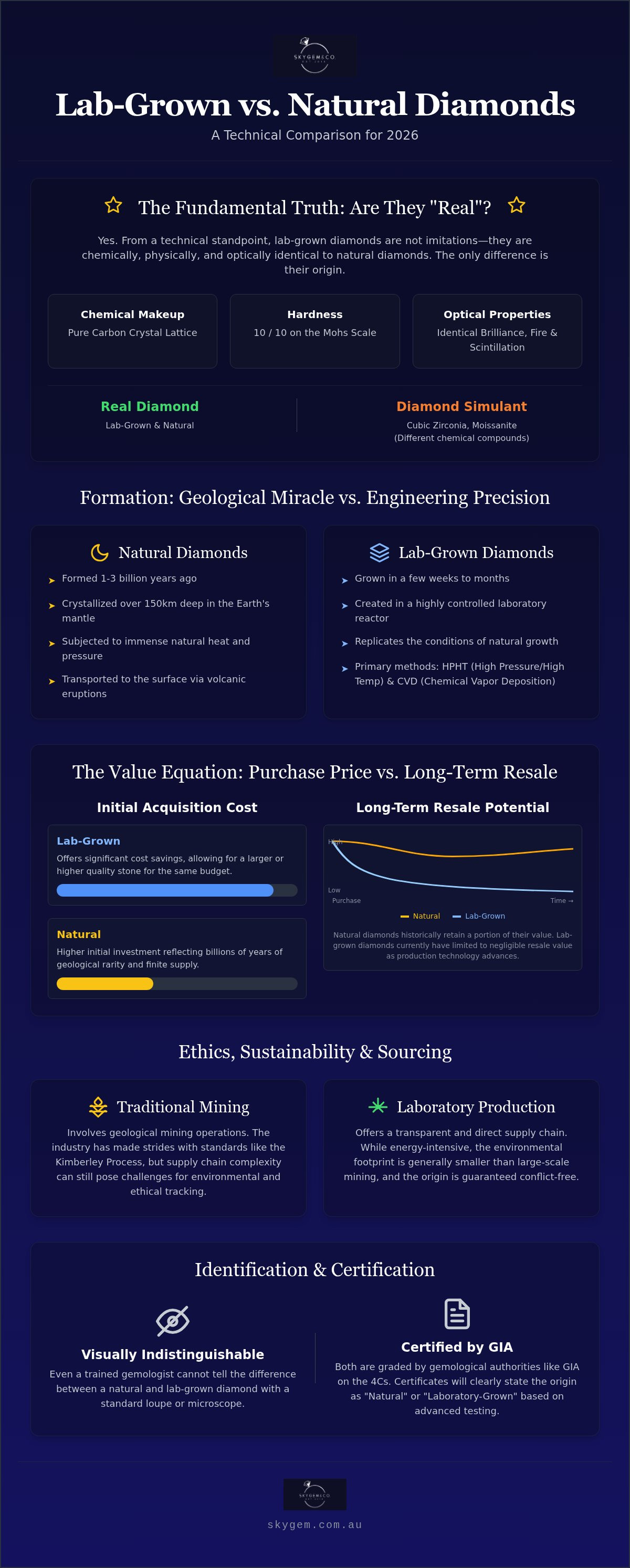
The debate surrounding lab grown vs natural diamonds often begins with a question of authenticity. From a technical and chemical standpoint, lab-grown stones aren't merely similar to their earth-mined counterparts; they're identical. Both are composed of pure carbon atoms arranged in a rigid crystal lattice structure. This specific arrangement results in a material that reaches 10 on the Mohs scale of mineral hardness, providing the same durability and scratch resistance required for a lifetime of daily wear.
Beyond their structural integrity, these stones exhibit the exact same optical properties. This includes the refractive index, which determines how light bends as it enters the stone, and the specific levels of fire and scintillation that define a diamond's sparkle. Whether you choose natural white diamonds or their laboratory equivalents, the substance remains the same. The only physical distinction lies in the environment of formation, not the chemical makeup of the crystal itself.
The "Ice Analogy": Understanding Origin vs. Substance
To simplify the technical complexity, industry experts often use the "ice analogy." Consider the difference between ice formed on a glacier and ice produced in a modern freezer. One takes centuries to crystallise under environmental pressure, while the other is created in a controlled setting over a shorter timeframe. Despite the disparate origins, both are H2O. They share the same melting point, density, and cooling properties.
This distinction is vital because it separates lab-grown diamonds from "simulants" such as Cubic Zirconia or Moissanite. Simulants are entirely different chemical compounds that only mimic the appearance of a diamond. By contrast, the Synthetic Diamond Manufacturing Processes used today result in a genuine diamond crystal. One is a product of geological history, while the other is a triumph of technical precision. Both are considered "real" diamonds by every major gemological authority.
Can the Naked Eye Tell the Difference?
Even the most seasoned jewellers cannot distinguish between these two origins using only their eyes or a standard jeweller's loupe. Because they're the same material, both types are assessed using the traditional 4Cs: Cut, Colour, Clarity, and Carat. You'll find lab grown white diamonds with the same internal inclusions and colour variations as those found in nature. They react to light in the same way, producing the same brilliance that consumers expect from high-end jewellery.
While they appear identical in a setting, they aren't indistinguishable to science. Identifying the origin requires advanced spectroscopic equipment that detects trace elements or specific growth patterns unique to laboratory environments. Professional gemological tools are required for identification because the physical properties are so perfectly matched that visual inspection is insufficient.
Technical Formation: HPHT vs. CVD vs. Geological Growth
The technical divergence in the lab grown vs natural diamonds comparison is found in the specific environmental conditions required for carbon crystallisation. While the end product is chemically identical, the processes involved range from ancient geological upheaval to modern vacuum chamber precision. Understanding these formation methods is essential for any client seeking to balance the allure of geological history with the advantages of contemporary engineering. The method of growth doesn't just dictate the origin; it influences the internal structure and purity of the final crystal.
Natural Diamonds: The Geological Miracle
Natural diamonds represent a finite geological resource, formed between one and three billion years ago. These stones crystallised at depths exceeding 150 kilometres within the Earth's mantle, where they were subjected to intense heat and extreme pressure. They were eventually transported to the surface through rare volcanic eruptions known as kimberlite pipes. This billion year journey is what establishes the inherent rarity of Natural GIA Certified Diamonds. Because these conditions cannot be replicated by nature on a human timescale, each earth mined stone carries a legacy of deep time that remains a primary driver for many collectors.
The Science of Lab Growth: Precision Engineering
Laboratory environments utilise two primary methods to achieve the same carbon bonding: High Pressure High Temperature (HPHT) and Chemical Vapor Deposition (CVD). HPHT essentially mimics the Earth’s mantle by placing a carbon source and a diamond "seed" into a press that generates massive mechanical force and heat. This method is often used to produce stones with high colour grades, though it can sometimes introduce metallic inclusions from the flux used in the process.
CVD has become the modern standard for producing high purity stones. In this process, a diamond seed is placed in a vacuum chamber filled with carbon rich gas. A microwave beam creates a plasma cloud of carbon gas, causing carbon atoms to precipitate and layer onto the seed. This controlled environment allows for the growth of Type IIa stones, which are the most chemically pure diamonds. Many of our Lab-Grown White Diamonds fall into this elite category, offering exceptional clarity.
As detailed by the GIA on Diamond Origins, both methods result in a crystal that is physically indistinguishable from one found in the earth. If you're considering how these technical specifications translate to a finished piece, you might explore our bespoke engagement rings to see how different origins influence final design choices.
The Value Equation: Purchase Price vs. Long-Term Resale
When evaluating lab grown vs natural diamonds, the most immediate distinction is the capital required for acquisition. As of 2026, laboratory-grown stones typically enter the market at a price point 60% to 80% lower than natural diamonds of equivalent specifications. This price delta is driven by technological efficiency rather than material inferiority. However, a professional evaluation must account for the asset’s performance over time. While the initial saving is substantial, the secondary market treats these two categories with different levels of liquidity.
Natural diamonds benefit from a "scarcity premium" rooted in their finite geological supply. This rarity supports a more stable resale environment, where stones often retain 50% to 60% of their initial value. Conversely, lab-grown diamonds are often viewed as a "sunk cost" in financial planning. While they retain a lower percentage of value, typically between 20% and 40%, it's essential to consider the absolute dollar loss. Losing 50% of a high-value natural stone often results in a larger total financial deficit than losing the entire value of a more affordable lab-grown equivalent. As detailed in this analysis of Comparing Diamond Value and Ethics, the choice often depends on whether the buyer prioritises immediate visual scale or long-term capital retention.
Consider the following financial distinctions:
- Acquisition Cost: Lab-grown diamonds offer a 60% to 80% reduction in initial capital outlay compared to natural stones.
- Asset Liquidity: Natural diamonds maintain a secondary market value between 50% and 60%, whereas lab-grown stones typically retain 20% to 40%.
- Absolute Risk: The lower entry price of lab diamonds limits the total dollar amount at risk, even if the percentage of value retained is lower.
Maximising Your Budget for Visual Impact
For many clients, the primary objective is to achieve the greatest aesthetic impact within a fixed budget. Choosing a lab-grown stone allows for significantly higher Carat weight or superior Clarity grades that might otherwise be cost-prohibitive. This is particularly advantageous for Solitaire Engagement Rings, where the central stone is the focal point of the design. By reallocating funds from the rarity premium into the physical dimensions of the stone, you can secure a visually commanding piece. You can explore these options further in our guide to Lab-Grown vs Natural Diamonds: The 2026 Comprehensive Australian Buying Guide.
Natural Diamonds as a Tangible Asset
Clients who view their purchase as a multi-generational family heirloom often gravitate toward natural stones. The price stability of GIA-certified natural diamonds is reinforced by a global infrastructure of collectors and wholesalers. While lab-grown technology continues to evolve, natural diamonds remain a tangible asset with a proven track record of value preservation. This choice reflects a preference for geological exclusivity over technical accessibility, ensuring the ring maintains its status as a finite piece of Earth's history.
Ethics, Sustainability, and Certification Standards
The ethical framework of the lab grown vs natural diamonds choice has evolved significantly over the last two decades. Today, the natural diamond industry operates under the Kimberley Process, a multilateral trade regime established in 2003 to prevent "conflict diamonds" from entering the mainstream market. This ensures that earth-mined stones are ethically tracked from the point of extraction to the final retail setting. Conversely, laboratory-grown stones offer a different ethical profile, removing the necessity for large-scale geological excavation. Aligning your purchase with your personal values requires a clear understanding of these distinct supply chains.
Transparency remains the foundation of premium jewellery. We act as technical consultants to ensure every stone, regardless of origin, meets rigorous international standards. This commitment involves providing direct access to independent grading data, which eliminates ambiguity for the consumer. Whether you prioritise the legacy of a natural stone or the technical innovation of a lab-grown crystal, the lab grown vs natural diamonds decision should be supported by verifiable documentation rather than marketing claims.
The Importance of GIA Certification
The Gemological Institute of America (GIA) represents the gold standard for Australian buyers seeking technical precision. A GIA report provides an objective assessment of a stone’s quality, but the reporting format differs depending on the origin. A "Natural Diamond" report uses the traditional grading nomenclature, whereas a "Laboratory-Grown Diamond" report clearly identifies the stone's technical origin. To ensure authenticity, you'll want to check for a microscopic laser inscription on the girdle of the stone. This serial number matches the digital certificate, providing a permanent link between the diamond and its specific grading data.
Environmental Considerations: A Balanced View
Evaluating the environmental footprint of your choice requires a balanced perspective on resource management. Diamond mining involves significant land-use impact and geological disruption, though modern regulations have improved reclamation efforts. In contrast, laboratory reactors require substantial electricity to maintain the plasma clouds or mechanical presses required for carbon bonding. Buyers should look for "Conflict-Free" or "Sustainably Grown" labels to verify that their stone was produced under responsible conditions. Transparency in the supply chain is a hallmark of premium jewellery, allowing you to choose a stone that reflects both your aesthetic standards and your ethical priorities.
To view our current inventory of independently verified stones, you can explore our GIA-certified natural diamonds or our laboratory-grown alternatives.
Bespoke Design: Integrating Your Choice into a Custom Setting
Once the lab grown vs natural diamonds technical evaluation is complete, the focus shifts to the structural integration of the stone into a finished piece. The origin of the diamond doesn't change the engineering requirements of the setting; both require a foundation that balances durability with light performance. Our approach involves acting as technical consultants, using Computer-Aided Design (CAD) to tailor every setting to the specific micron-level dimensions of your chosen stone. This precision ensures that the prongs or bezel provide maximum security without obstructing the path of light through the crystal lattice.
Material selection is the next critical phase. Platinum is often recommended for its superior density and natural white lustre, making it an ideal pairing for stones with high colour grades. Alternatively, 18K Gold provides a classic aesthetic and can be alloyed into white, yellow, or rose variations to complement the specific hue of your diamond. Whether you've selected a trilogy, halo, or solitaire style, the metal must be chosen to enhance the stone's physical properties while ensuring long-term structural integrity.
Solitaire and Halo: Enhancing Diamond Sparkle
A Custom Made Engagement Ring is engineered to maximise the refractive index and scintillation of the diamond. For those choosing lab-grown stones, Halo Engagement Rings are a popular choice to achieve a grander visual scale. The lower cost-per-carat of lab diamonds allows for a larger centre stone, which is then amplified by a perimeter of smaller diamonds. This combination creates a high-performance aesthetic that remains within a practical budget. You can learn more about this process in our professional overview of bespoke engagement rings.
The Final Decision: A Framework for Buyers
Navigating the lab grown vs natural diamonds choice requires a clear alignment between your financial objectives and personal values. We recommend using the following framework to refine your selection:
- Priority Assessment: Determine if your primary goal is visual impact (Carat and Clarity) or geological rarity.
- Budget Allocation: Decide if you prefer to invest in a finite earth-mined asset or a modern laboratory-grown stone that offers more scale for the same capital.
- Ethical Framework: Choose the supply chain transparency and sourcing method that best fits your personal ethical standards.
While technical data provides a solid foundation, there's no substitute for seeing these stones in person. Viewing the fire and scintillation of both types side-by-side often provides the final clarity needed for a confident purchase. We invite you to book a consultation with SkyGem & Co. to explore our curated selection of GIA-certified stones and begin the CAD design process for your unique setting.
Securing Your Legacy with Technical Precision
The choice between lab grown vs natural diamonds ultimately rests on how you define value for your specific project. Whether you prioritise the ancient geological history of an earth-mined stone or the technical precision of a laboratory-grown crystal, both options provide the same physical performance and aesthetic brilliance. It's essential to remember that independent GIA certification remains the benchmark for quality, ensuring transparency in every acquisition. By utilising expert bespoke CAD design, we ensure that your chosen stone is integrated into a setting with micron-level accuracy, regardless of its origin.
This technical approach transforms a high-end diamond into a permanent asset that reflects your personal standards. We're here to act as your technical partner, helping you refine your selection through our boutique consultation service to match your specific budget and long-term values. You can move forward with absolute confidence, knowing your choice is backed by professional expertise and guaranteed quality. Explore our curated selection of Lab-Grown and Natural Diamonds to begin the design of your bespoke engagement ring.
Frequently Asked Questions
Is a lab-grown diamond a "fake" diamond?
No, lab-grown diamonds aren't fake or simulants like Cubic Zirconia. They consist of pure carbon crystals grown in a laboratory that replicates the Earth's natural pressure and heat. Because they share the same atomic structure and 10 Mohs hardness rating as earth-mined stones, they're classified as real diamonds by gemological authorities. The only technical difference is the origin of the crystal, not the substance itself.
Do lab-grown diamonds get cloudy over time?
Lab-grown diamonds don't get cloudy, change colour, or lose their brilliance over time. Since they're made of the same durable carbon lattice as natural stones, their optical properties are permanent. Any perceived cloudiness is usually the result of surface dirt or oils, which can be removed through standard professional cleaning. They maintain their refractive index and scintillation for a lifetime, just like stones formed deep within the earth.
Will a jeweller know my diamond is lab-grown?
A jeweller cannot distinguish between these stones using only their eyes or a standard loupe. However, professional gemologists use advanced spectroscopic equipment to identify growth patterns unique to laboratory environments. Additionally, most lab-grown diamonds have a microscopic laser inscription on the girdle that identifies their origin. This ensures transparency and prevents confusion during the lab grown vs natural diamonds identification process at any reputable jewellery boutique.
Why are natural diamonds so much more expensive?
The price premium for natural diamonds is driven by their finite geological supply and the immense resources required for extraction. Natural stones formed billions of years ago and are no longer being produced by the earth on a human timescale. This inherent rarity creates a scarcity premium that supports higher market prices. Lab-grown stones are more affordable because their production is limited only by technology and electricity, not by geological availability.
Can I insure a lab-grown diamond engagement ring?
Yes, you can insure a lab-grown diamond engagement ring just as you would a natural one. Most major insurance providers offer coverage based on a professional appraisal and the stone's grading report. While the replacement cost will be lower than a natural equivalent due to the lower initial purchase price, the insurance protects your financial acquisition against loss, theft, or damage. We recommend keeping your GIA certificate and purchase receipt for the valuation process.
Do lab-grown diamonds have GIA certificates?
Yes, the Gemological Institute of America (GIA) provides full grading reports for lab-grown stones. As of late 2025, GIA updated its reporting standards to clearly differentiate between natural and laboratory-grown origins. These certificates provide an objective assessment of the 4Cs, ensuring you receive a stone that meets specific performance metrics. Every GIA-certified lab diamond also carries a laser inscription on the girdle that matches the digital or physical report.
What is the resale value of a lab-grown diamond compared to a natural one?
Natural diamonds generally retain a higher percentage of their value, typically between 50% and 60% on the secondary market. In contrast, 2026 market data shows lab-grown diamonds retain between 20% and 40% of their original purchase price. While the percentage is lower for lab stones, the absolute dollar amount lost is often less because the initial acquisition cost was significantly lower. Neither diamond type should be considered a high-yield financial investment.
Which diamond type is more eco-friendly?
Both diamond types have environmental impacts that require careful consideration. Natural diamond mining involves significant land disruption and geological excavation, though modern regulations have improved reclamation efforts. Lab-grown diamonds avoid land-use issues but require substantial electricity to power vacuum chambers and reactors. When comparing lab grown vs natural diamonds, look for Sustainably Grown or Conflict-Free labels to ensure your stone meets your specific environmental and ethical standards.
Disclaimer
This article is for general informational purposes only and may include AI-assisted content. Pricing, specifications, and availability are subject to change. For accurate advice and current information, please contact SkyGem & Co. directly. Nothing in this content constitutes professional or financial advice.