
Lab Grown vs Natural Diamonds: The 2026 Definitive Comparison Guide

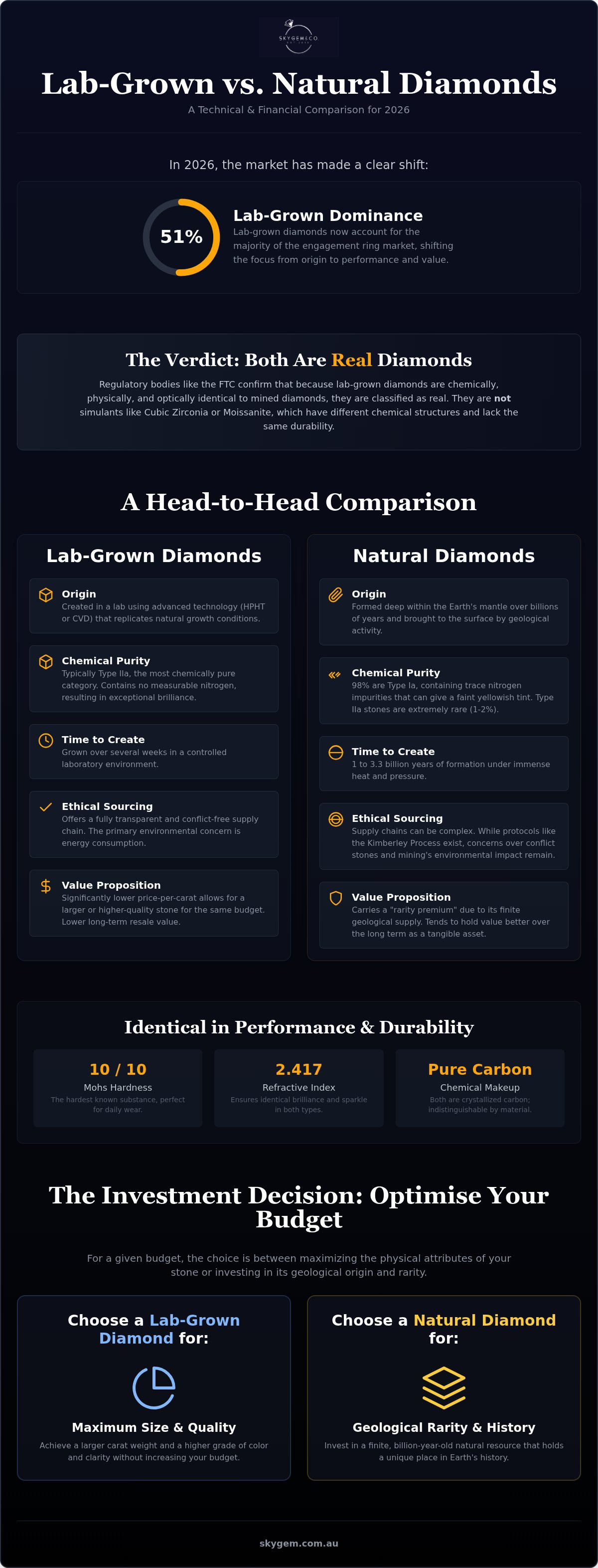
In 2026, the most sought-after stone for a bespoke engagement ring is no longer exclusively the one formed in the Earth's mantle over a billion years. With lab-grown diamonds now accounting for 51% of the engagement ring market, the choice between lab grown vs natural diamonds has shifted from a technical debate to a strategic decision between industrial innovation and geological rarity.
You've likely encountered conflicting terminology regarding synthetic versus simulant stones, leading to valid concerns about authenticity and future resale value. It's natural to feel a sense of pressure when trying to reconcile the desire for a high-performance, high-clarity gem with the complexities of ethical sourcing and long-term financial stability.
This guide provides a detailed technical comparison of the scientific, financial, and ethical differences between these two diamond types to ensure you make an informed investment in your fine jewellery. We'll examine the updated GIA grading protocols, the 2026 market data on price-to-quality ratios, and the specific physical properties that define the longevity of both lab-grown and natural assets.
Key Takeaways
- Understand why lab-grown stones are chemically and physically identical to mined diamonds, earning them the official classification of "real" by regulatory bodies.
- Evaluate technical performance metrics, including a Mohs hardness of 10 and identical refractive indices, ensuring both options provide the same lifelong brilliance and durability.
- Compare the long-term financial implications of lab grown vs natural diamonds, specifically regarding the "rarity premium" and secondary market value as of 2026.
- Navigate the ethical landscape by weighing the benefit of a transparent, conflict-free supply chain against the energy-intensive nature of laboratory production.
- Learn how to optimise your budget for bespoke jewellery by choosing between a larger carat weight or higher geological rarity for your specific ring design.
Are Lab-Grown Diamonds Real?
To understand the fundamental nature of these stones, one must look past the origin and focus on the molecular structure. Lab-grown diamonds aren't just lookalikes; they're carbon in its most crystallised form. They share the same chemical, physical, and optical properties as diamonds extracted from the Earth. Because of this molecular identity, the Federal Trade Commission (FTC) updated its jewellery guides to confirm that a diamond is a diamond, regardless of whether it grew in the ground or a laboratory.
It's vital to distinguish between a Synthetic diamond and a simulant. Simulants like cubic zirconia or moissanite only mimic the appearance of a diamond. They possess entirely different chemical structures and lower hardness ratings, which means they lack the longevity required for an heirloom piece. In contrast, when comparing lab grown vs natural diamonds, you're looking at the same material: pure carbon arranged in a cubic crystal structure. Both stones rank 10 on the Mohs scale, meaning they're the hardest known natural substance on the planet.
The Two Primary Growth Methods: HPHT vs CVD
Modern technology allows us to replicate the extreme conditions of the Earth's mantle within a controlled environment. The High Pressure High Temperature (HPHT) method uses a specialised press to subject carbon to the crushing force and intense heat required for crystallisation. This process effectively mimics the geological forces that create natural diamonds over billions of years.
The alternative method is Chemical Vapour Deposition (CVD). This involves placing a diamond "seed" in a vacuum chamber filled with carbon-rich gases like methane. When these gases are heated into a plasma state, the carbon atoms break away and settle onto the seed. CVD is a layer-by-layer atomic growth process that builds the stone over several weeks, allowing for incredible precision in the final crystal structure.
Chemical Purity and Type IIa Classification
One technical advantage of lab stones is their extreme purity. Approximately 98% of natural diamonds contain nitrogen impurities, classifying them as Type Ia. These impurities often give natural stones a faint yellowish tint. However, many lab-grown white diamonds are produced as Type IIa.
This is the rarest and most chemically pure category, representing only 1 to 2% of all natural stones found in the Earth. Type IIa diamonds contain no measurable nitrogen or boron impurities, which ensures superior light transmission. This lack of atomic interference allows light to pass through the stone with minimal disruption, resulting in exceptional fire and brilliance. For a bespoke ring, this level of purity ensures the stone performs at its peak regardless of the lighting environment.
Physical, Optical, and Chemical Comparison
When evaluating lab grown vs natural diamonds, the technical specifications are indistinguishable across almost every performance metric. Both stones possess a refractive index of 2.417 and a dispersion of 0.044, which dictates how light is bent and separated into a spectrum of colours. This ensures that the fire and brilliance of a lab-grown stone is identical to that of a mined counterpart. Because both materials share the same thermal conductivity, they will both pass a standard diamond tester pen, which identifies stones by how quickly they dissipate heat.
Durability is another area of total parity. On the Mohs scale of mineral hardness, both stones score a 10. This makes them highly resistant to scratching and ideal for pieces intended for lifelong daily wear, such as bespoke engagement rings. While the chemical makeup is identical, a 10x loupe may reveal different types of inclusions. Natural stones often contain crystals of other minerals or feathers formed over millennia, whereas lab diamonds might show metallic inclusions from the HPHT flux or unique graining patterns from the CVD process.
Can the Naked Eye Identify the Real One?
There is a common misconception that lab-grown diamonds are "too perfect" to be real. In reality, lab stones exhibit a full range of clarity grades and often include internal flaws similar to those found in nature. Without microscopic laser inscriptions on the girdle, visual identification is impossible for humans. Even seasoned jewellers cannot rely on visual inspection alone; they must use advanced UV spectroscopy or photoluminescence imaging to detect the specific growth signatures that separate industrial innovation from geological history.
The 4Cs in 2026: Cut, Colour, Clarity, and Carat
The universal grading standards of the 4Cs apply equally to both stone types. Cut remains the most critical factor for performance, as a poorly cut diamond will appear dull regardless of its origin. In 2026, the availability of larger carat weights has shifted significantly. While a 2-carat natural diamond of high colour and clarity remains a rare find, lab growth technology has made stones of this size and quality accessible for a much wider range of budgets. If you're currently weighing your options, our expert gemological consultations can help you compare specific stones side-by-side to see how these metrics translate to real-world beauty.
Market Value, Rarity, and Long-Term Investment
The financial landscape of the jewellery industry has undergone a significant transformation by 2026. While the physical properties of these stones are identical, the market treats them with distinct economic logic. Natural diamonds continue to command a "rarity premium" because their supply is governed by geological constraints that cannot be accelerated. In contrast, lab-grown diamonds follow a pricing trajectory similar to consumer technology. Increased manufacturing efficiency and higher production volumes have reduced the cost of lab stones by 80% to 90% compared to mined counterparts of equivalent quality.
Deciding between lab grown vs natural diamonds requires a clear distinction between a luxury consumption choice and a long-term financial asset. A natural diamond is often viewed as a family heirloom with a predictable store of value. Market data from the first half of 2026 indicates that natural diamonds generally retain 25% to 50% of their retail value on the secondary market. Lab-grown diamonds provide a significantly higher budget-to-quality ratio at the point of sale, but they typically retain only 10% to 30% of their original price due to the continuous influx of new industrial supply.
The Economics of Rarity
The value proposition of Natural White Diamonds is rooted in their finite nature. As of June 2026, lab-grown stones have captured 51% of the engagement ring market, which has created a clear bifurcation in the industry. Natural stones are increasingly positioned as rare geological artifacts. Lab-grown stones are valued for their high performance and immediate affordability. This saturation in the lab-grown sector means that while you can acquire a larger stone for your budget today, it is unlikely to serve as a financial hedge in the future.
GIA and IGI Certification Standards
Independent verification remains the primary safeguard for both buyers and collectors. The Gemological Institute of America (GIA) and the International Gemological Institute (IGI) provide rigorous grading that ensures transparency. As of October 1, 2025, the GIA implemented a specific grading scale for lab-grown stones, classifying them as "Premium" or "Standard" instead of using the traditional D-Z colour scale. This distinction, combined with mandatory laser inscriptions on the girdle, ensures that lab-grown origins are always disclosed. These inscriptions are microscopic and do not affect the stone's brilliance, but they provide essential security for the integrity of the natural diamond market.
Sustainability and Ethical Considerations
The ethical landscape of the jewellery industry is often reduced to a binary choice, yet a technical audit of lab grown vs natural diamonds reveals a more complex reality. For many consumers, the primary driver toward lab-grown stones is the "conflict-free" assurance. Because these gems are produced in controlled laboratory environments, the risks associated with historical mining practices are eliminated. However, a comprehensive assessment must also account for the industrial energy consumption required to sustain the HPHT and CVD processes.
Modern natural diamond mining operates under the stringent regulations of the Kimberley Process, which was established to prevent "conflict diamonds" from entering the mainstream market. Beyond regulation, the natural diamond sector plays a critical role in the socio-economic development of mining nations. In countries like Botswana, diamond revenues fund essential infrastructure, healthcare, and education systems. Choosing a natural stone can therefore be viewed as an investment in the economic stability of these regional communities.
Environmental Footprint: Mined vs Man-Made
Comparing the environmental impact involves weighing land displacement against carbon emissions. Traditional mining requires significant earth moving and habitat disruption, which remains its most visible footprint. Conversely, the production of lab-grown diamonds is an energy-intensive industrial process. As of 2026, the rise of "Green Certified" laboratories has shifted the conversation. Many leading facilities now utilise 100% renewable energy sources, such as solar or wind power, to mitigate their carbon output. For a deeper look at these technical standards, consult our Lab Grown Diamonds Guide.
Ethical Sourcing Transparency
Transparency is the new benchmark for luxury. In 2026, blockchain technology is increasingly used to track natural diamonds from the point of extraction to the final setting, providing a verifiable digital audit trail. Lab-grown diamonds offer a different form of peace of mind through fully traceable, single-origin production. Ethical luxury is best defined as a calculated balance between human impact and environmental footprint. Whether you prioritise carbon neutrality or supporting regional mining economies, your choice should reflect a verified understanding of the supply chain. If you are ready to select a stone that aligns with your values, you can browse our ethically sourced engagement rings today.
Choosing the Right Diamond for Your Bespoke Ring
Selecting the centre stone is the pivotal moment where technical performance meets aesthetic vision. When deciding between lab grown vs natural diamonds for a custom project, your choice dictates the structural parameters of the design. A lab-grown diamond allows for a significant increase in carat weight without exceeding a standard budget, which often leads to more ambitious designs, such as intricate trilogy settings or expansive emerald cuts. Conversely, a natural diamond choice often prioritises geological rarity, leading many clients to select minimalist solitaire settings that showcase the stone’s unique provenance and specific chemical characteristics.
Design implications also vary based on how you allocate your budget. A solitaire setting is the ultimate test of a diamond's quality, as it leaves the stone's cut and clarity fully exposed. If you choose a natural stone with a smaller carat weight but higher clarity, a solitaire design ensures that the geological purity is the focal point. In contrast, a halo engagement ring can be used to amplify the perceived size of a natural stone or to add a layer of complex brilliance to a large lab-grown centrepiece. Regardless of the stone type, the final aesthetic is a result of balancing the 4Cs with the architectural requirements of the ring.
Technical consultation with a master jeweller is essential, particularly for stones exceeding two carats. Our team acts as a technical consultant throughout the bespoke process, using precision CAD (Computer-Aided Design) to ensure every prong and gallery is engineered to the exact millimetre of your chosen stone. This level of precision is vital for ensuring the longevity of the piece, as it prevents the structural fatigue that can occur in mass-produced settings.
Bespoke Design and Stone Selection
SkyGem & Co. facilitates the bespoke engagement ring journey by providing a solution-oriented approach to stone sourcing. We match specific metal types to the hue of your diamond to enhance its natural performance. For example, 18K white gold or platinum is typically recommended for Type IIa lab stones to maintain their colourless appearance, while 18K yellow gold can provide a warm contrast for natural stones with a slight tint. Our design process ensures the setting provides maximum security, especially for high-value natural stones that require reinforced structural integrity.
The Final Decision Matrix
The choice between lab grown vs natural diamonds ultimately rests on your long-term priorities for the jewellery. We recommend a natural diamond for clients who value traditional sentiment, a geological store of value, and the unique history of a stone formed over a billion years. A lab-grown diamond is the preferred choice for those prioritising budget efficiency, maximum carat size for the investment, and a transparent industrial origin. For those seeking a truly unique piece, our Custom Made Engagement Rings service provides the technical framework to bring either choice to life with expert precision.
Defining Your Legacy in Fine Jewellery
The decision between lab grown vs natural diamonds is a personal choice between geological rarity and industrial precision. We've explored how both stones offer identical physical performance and 10/10 hardness, ensuring your investment stands the test of time. While natural stones maintain a distinct position as a finite store of value, lab-grown alternatives provide an accessible path to higher carat weights and transparent production. Your final choice should reflect your priorities, whether you value the billion-year history of a mined gem or the technological brilliance of a laboratory-grown crystal.
As a family-owned independent boutique, SkyGem & Co. acts as your technical consultant to help you navigate these complexities with confidence. We specialise in sourcing GIA certified stones for both categories, ensuring every gem meets the highest global standards for colour and clarity. Our expert CAD design services allow us to integrate your chosen stone into a bespoke setting that's as structurally sound as it is aesthetically refined.
Ready to begin your custom design journey? Book a Bespoke Consultation with SkyGem & Co. to explore our collection of premium stones. We look forward to helping you craft a piece that perfectly reflects your values and vision.
Frequently Asked Questions
Is a lab-grown diamond a 'fake' diamond?
No, lab-grown diamonds are not fake. They're composed of the same crystallised carbon as mined diamonds, sharing identical chemical and optical properties. Unlike "simulants" such as cubic zirconia or moissanite, which only mimic the appearance of a diamond, lab-grown stones are classified as real diamonds by the Federal Trade Commission. They possess the same Mohs hardness of 10, ensuring they remain a permanent, high-performance asset for your jewellery.
Do lab-grown diamonds get cloudy over time?
Lab-grown diamonds don't get cloudy or change colour over time. Because they're physically identical to natural diamonds, they possess the same extreme durability and chemical stability. Cloudiness is typically an issue with low-quality simulants that are porous or susceptible to surface scratching. A lab diamond's crystalline structure is permanent, meaning its brilliance and fire will remain unchanged for generations with standard maintenance and professional cleaning.
Can a jeweller tell the difference between lab and natural diamonds?
A jeweller cannot distinguish between these stones using only the naked eye or a standard 10x loupe. While both materials look identical, professionals use specialised spectroscopy equipment to detect unique growth signatures. Advanced machines identify the specific UV fluorescence or crystal growth patterns that separate geological formations from industrial processes. Additionally, most modern stones include microscopic laser inscriptions on the girdle that explicitly state their origin for total transparency.
Why are natural diamonds more expensive than lab-grown ones?
The price disparity in lab grown vs natural diamonds is driven by the economics of extraction and rarity. Natural diamonds are finite geological assets that require immense capital to extract from deep within the Earth's mantle. Lab-grown diamonds are industrial products whose costs decrease as reactor technology scales and improves. While a natural diamond commands a premium for its scarcity, lab diamonds offer a higher budget-to-quality ratio for those prioritising size.
Do lab-grown diamonds have any resale value in 2026?
Yes, lab-grown diamonds have resale value, but it's significantly lower than that of natural stones. In 2026, lab-grown stones are treated more like depreciating luxury goods rather than rare commodities. Their value on the secondary market is impacted by the continuous influx of new industrial supply. Natural diamonds generally retain a higher percentage of their retail value, making them a more stable choice for those viewing their purchase as a financial heirloom.
What is the best diamond for an engagement ring?
The "best" choice depends on your specific priorities for the piece. If you value geological rarity, traditional sentiment, and long-term value retention, a GIA-certified natural diamond is the superior option. If your goal is to maximise carat size and clarity within a specific budget, a lab-grown diamond provides exceptional performance. When comparing lab grown vs natural diamonds, both provide the hardness required for daily wear, making them equally suitable for bespoke designs.
Are lab-grown diamonds GIA certified?
Yes, the Gemological Institute of America (GIA) provides full certification for lab-grown diamonds. These reports provide an unbiased technical audit of the stone's 4Cs and confirm its origin, ensuring total transparency for the consumer. The GIA's digital "Report Check" service allows you to verify the stone's specifications against their global database. This certification is essential for protecting your investment and ensuring the stone's quality aligns with its technical grading.
How do I know if my diamond is natural or lab-grown?
The most reliable way to verify a diamond's origin is to examine its grading report and laser inscription. Reputable stones from the GIA or IGI have a microscopic serial number etched onto the girdle. You can cross-reference this number with the grading laboratory's online database to confirm if the stone is natural or lab-grown. Without a certificate, you'll need a professional gemological consultation using advanced UV spectroscopy to verify the stone's growth history.