
Lab Diamond Solitaire Engagement Rings: The 2026 Technical & Style Guide

Did you know that the GIA no longer uses the traditional 4Cs to grade lab-grown stones? This technical shift, which became official in late 2025, has introduced a new layer of complexity for those seeking lab diamond solitaire engagement rings in a crowded digital marketplace. It's natural to feel concerned that a lab-grown choice might lack the prestige or structural integrity of a traditional piece. You shouldn't have to settle for a mass-produced setting just because you've chosen a modern diamond. High-performance engineering and hand-finished elegance can, and should, exist in the same piece.
This guide provides the technical clarity you need to select a stone that exceeds standard retail quality. You'll learn how to navigate the dominance of IGI certification and why the synergy between a high-carat diamond and a bespoke setting is vital for longevity. We'll preview the current landscape of diamond performance metrics, the importance of regional craftsmanship, and the specific design choices that ensure your solitaire remains a permanent, high-value asset for generations to come.
Key Takeaways
- Understand why lab diamond solitaire engagement rings are chemically and physically identical to mined diamonds, offering a modern classic that balances technical innovation with heritage design.
- Learn to evaluate quality beyond the standard 4Cs by focusing on craftsmanship and navigating the 2026 certification landscape, including the specific roles of GIA and IGI reports.
- Identify the structural advantages of hand-finished settings over porous, mass-produced cast metal to ensure the long-term durability and elegance of your investment.
- Discover how specific diamond shapes influence the visual scale and performance of your solitaire, allowing you to maximize the impact and perceived size of high-carat stones.
- Gain insight into the bespoke design journey, where a technical consultant helps you source a high-performance loose stone and engineer a precision-fit, hand-forged setting.
The Evolution of Lab Diamond Solitaire Engagement Rings
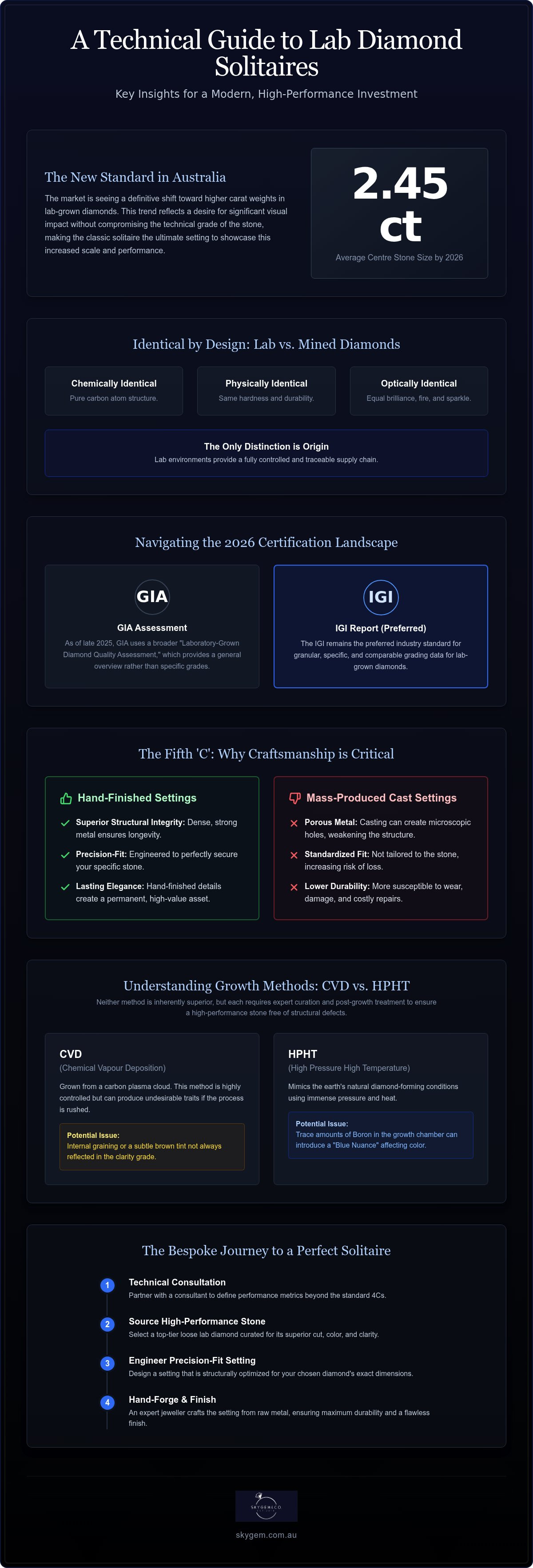
The concept of lab diamond solitaire engagement rings represents a significant intersection of heritage design and modern technical innovation. While the solitaire silhouette has remained a staple of fine jewellery for centuries, the integration of laboratory-grown stones has redefined the category. These diamonds are not merely substitutes; they're chemically, physically, and optically identical to their mined counterparts. The Evolution of Lab Diamond Solitaire Engagement Rings has reached a point where the distinction lies only in the origin of the carbon source, not the quality of the crystalline structure. This ensures that the technical performance of the stone remains the primary focus of the design.
In the Australian market, there's a distinct shift toward higher carat weights. By 2026, the average centre stone size in lab-grown rings has increased to 2.45 carats, a substantial jump from previous years. This trend reflects a desire for visual impact without compromising on the technical grade of the stone. For those exploring lab grown diamonds in Australia, the solitaire provides the purest canvas to showcase this increased scale. Choosing lab diamond solitaire engagement rings allows for a design that prioritises the diamond's performance over decorative distraction, resulting in a piece that feels both premium and practical.
Why the Solitaire Style Remains Supreme
A solitaire setting functions as a precision-engineered stage for a high-performance diamond. By removing side stones or complex halos, all visual attention is directed to the central stone’s light return and fire. This style is inherently timeless; it doesn't succumb to the cyclical nature of fashion trends that often date more ornate rings. From a practical perspective, the solitaire’s streamlined profile offers unmatched versatility for future stacking. It allows for a seamless fit with various wedding band styles, ensuring the set remains elegant as your personal style evolves over decades.
The Environmental and Ethical Landscape in 2026
Modern consumers increasingly view transparency as a non-negotiable metric of luxury. Laboratory environments offer a controlled, traceable supply chain that traditional mining often lacks. The ecological footprint is significantly reduced, as these stones are created using sophisticated technology rather than large-scale earth displacement. While some still debate the "realness" of these stones, the scientific facts are absolute. The Federal Trade Commission (FTC) legally classifies them as diamonds, and major bodies like the IGI provide full-scale certification. This data-driven approach ensures that your choice is grounded in both ethical responsibility and technical excellence.
Evaluating Lab Diamond Quality: Beyond the Standard 4Cs
While the standard 4Cs provide a necessary framework, they often fail to capture the nuanced technical profile of high-performance stones. For lab diamond solitaire engagement rings, the true differentiator is the "Fifth C": Craftsmanship. This encompasses not just the final polish but the entire growth and cutting lifecycle. In the 2026 market, relying solely on a grading report is insufficient. As of late 2025, the GIA transitioned to a broader Laboratory-Grown Diamond Quality Assessment, whereas the IGI remains the preferred choice for granular, comparable data. Understanding industry-recognized diamond terminology is essential for interpreting these reports accurately.
The precision of the cut is the single most important factor in determining the visual brilliance and light return of a solitaire diamond. A poorly executed cut can make even a high-colour stone appear dull. Selecting a stone requires a technical eye to ensure the angles and proportions align for maximum fire.
CVD vs. HPHT: Which Growth Method is Superior?
Lab diamonds are typically grown via two methods: Chemical Vapour Deposition (CVD) or High Pressure High Temperature (HPHT). CVD growth involves a carbon plasma cloud. If the growth process is rushed, it can result in internal grain lines or a subtle brown tint that isn't always reflected in a clarity grade. Conversely, HPHT growth mimics the earth's natural conditions but can introduce a "Blue Nuance" if boron is present in the growth chamber. Neither method is inherently superior, but each requires expert curation to ensure the stone is free from these structural defects. If you're unsure which stone meets your requirements, you can book a technical consultation to review loose stones in person.
Spotting "Milky" or "Hazy" Lab Diamonds
A common pitfall in the digital marketplace is the "milky" diamond. This phenomenon occurs when high-strain or rapid growth creates a microscopic cloudiness throughout the crystal lattice. Even stones with high clarity grades like VVS1 can suffer from a lack of transparency, which severely limits scintillation and fire. This is particularly noticeable in lab diamond solitaire engagement rings where there are no side stones to mask the lack of light performance. You shouldn't purchase a diamond based on a certificate alone, as these reports don't always track the transparency of the material. A professional inspection is the only way to guarantee a stone possesses the crisp appearance required for a premium solitaire.
Hand-Finished vs. Mass-Produced Solitaire Settings
Many buyers focus exclusively on the stone, assuming the band is a standard commodity. This oversight ignores the technical reality of metalwork. Mass-produced settings are typically created through high-volume casting, which often results in microscopic porosity. This structural weakness is one of the "hidden costs" of choosing a pre-made ring; while the initial price is lower, the risk of metal fatigue or prong failure is significantly higher. In contrast, lab diamond solitaire engagement rings from a bespoke maker utilize hand-finished or hand-forged components. This process increases metal density, ensuring the ring maintains its circular form and structural integrity over decades of daily wear.
SkyGem & Co. approaches the setting as a technical consultant, ensuring the engineering supports the aesthetic. When a ring is hand-finished, the metal is compressed and polished to a level of durability that cast settings cannot replicate. This is a vital consideration for a piece intended to be a permanent asset. A precision-engineered custom-made engagement ring in Melbourne provides the security required for high-carat stones, preventing the heartbreak of a lost diamond due to a snapped prong.
The Anatomy of a Premium Solitaire Setting
A premium setting is defined by three critical components:
- The Shank: A precision-engineered shank must have sufficient width and depth. Mass-cast rings often shave off fractions of a millimetre to save on material, but this leads to "thinning" and warping.
- The Gallery: A bespoke gallery is designed specifically for the dimensions of your loose diamond. This allows optimal light to enter the pavilion, maximising the scintillation we discussed in the previous section.
- The Claws: The security of the prongs is paramount. Whether you prefer round, claw, or petal styles, a hand-finished setting ensures each prong is perfectly tensioned against the stone for maximum safety.
Platinum vs. 18ct Gold in Solitaire Design
Platinum is the technical gold standard for securing high-performance lab diamond solitaire engagement rings. It's a dense, naturally white metal that doesn't wear away over time; instead, it develops a "patina" that can be polished back to a mirror finish. 18ct White Gold is a popular alternative, though it requires periodic rhodium plating to maintain its bright appearance. You can explore the technical nuances of these alloys in our Gold Jewellery Guide. Choosing the right material is a decision about long-term viability, ensuring the setting remains as reliable as the stone it holds.
Choosing the Perfect Diamond Shape for Your Solitaire
The geometric silhouette of the centre stone is the primary driver of a ring's aesthetic character and visual scale. When selecting lab diamond solitaire engagement rings, the shape you choose dictates how the light interacts with the crystal lattice and how the piece sits on the hand. While the Round Brilliant remains the most frequent choice for its unparalleled light return, fancy shapes offer a way to maximise finger coverage or achieve a specific architectural look. Each shape carries unique technical requirements for the setting, particularly when protecting vulnerable points or managing light leakage.
The Brilliant Round: The Gold Standard of Fire
A Round Brilliant cut is engineered for maximum scintillation, featuring 57 or 58 facets designed to reflect light back through the table. For those seeking lab grown round diamonds, technical precision in the cut is non-negotiable. To achieve an "Ideal" or "Excellent" grade, the stone must adhere to strict proportional ranges, such as a table percentage between 54% and 57%. In a solitaire setting, these proportions ensure the diamond doesn't appear "dark" in the centre. Symmetry and polish are the final technical markers; they ensure every facet aligns perfectly to eliminate light scatter, which is vital for a stone that stands alone without side diamonds to mask imperfections.
Fancy Shapes: Oval, Emerald, and Radiant Cuts
Fancy shapes allow for a more personalised profile but require a technical eye during the sourcing process. Ovals and Pears are prone to the "bow-tie effect," a dark shadow across the centre caused by misaligned facets. During a consultation, we look for stones where this effect is minimised to ensure consistent brilliance. Emerald cuts, being step-cuts, have large, open tables that act like windows into the stone. Because they don't have the "crushed ice" sparkle of brilliant cuts, clarity is paramount; even minor inclusions are easily visible. Radiant cuts offer a middle ground, combining the elegant rectangular silhouette of an Emerald cut with a facet pattern that mimics the sparkle of a Round.
Aesthetics: Proportions and Finger Coverage
The "Length-to-Width Ratio" is a critical metric that defines whether a stone looks short and wide or long and slender. For an Oval, a ratio of 1.35 to 1.50 is typically preferred for a balanced look. Elongated shapes provide greater finger coverage, often making a 2-carat stone appear significantly larger than a Round of the same weight. To avoid a top-heavy appearance, the band thickness must be calibrated to the diamond's dimensions. A bespoke setting can "lift" the diamond slightly, allowing more light to enter the pavilion while ensuring the stone sits flush enough for practical daily wear. This synergy between stone geometry and setting height is what separates a professional design from a standard retail mount.
The Bespoke Journey: Crafting Your Lab Diamond Solitaire
The creation of lab diamond solitaire engagement rings is a methodical process that prioritises technical precision over high-volume retail speed. At SkyGem & Co., we act as your technical consultant, guiding you through a structured journey that transforms a high-performance loose stone into a permanent family asset. This bespoke approach ensures that every specification, from the metal density to the claw alignment, is engineered for longevity and aesthetic balance. By moving away from mass production, we ensure your ring is a unique reflection of precise engineering and refined design.
Step 1: The Expert Diamond Consultation
The journey begins with sourcing a selection of loose lab diamonds tailored to your specific technical requirements and budget. While a certificate provides a baseline, it cannot convey the "life" or specific scintillation pattern of a stone. During a consultation for custom made engagement rings in Melbourne, we compare stones side-by-side. This allows you to observe how different growth methods and cut proportions perform in various lighting environments, ensuring the chosen diamond possesses the crisp transparency required for a high-carat solitaire.
Step 2: Design, CAD, and Manufacturing
Once the diamond is selected, we translate the vision into a high-resolution 3D model using Computer-Aided Design (CAD). This stage is critical for ensuring a perfect fit between the stone's unique pavilion depth and the gallery of the ring. CAD allows for microscopic adjustments to ensure the claws are perfectly symmetrical and the shank thickness meets our structural standards for long-term wear. Following approval, the ring is cast and then undergoes rigorous hand-finishing. This final step is where the metal achieves its premium lustre and the prongs are meticulously tensioned to secure the stone.
Ensuring Longevity: Care and Maintenance
A bespoke solitaire is designed to last generations, but its structural health depends on regular professional maintenance. Over time, daily wear can impact the tension of the prongs or the finish of the metal. We recommend periodic inspections to check for prong tightening and to perform professional ultrasonic cleaning, which removes the microscopic build-up that can dull a diamond's fire. This commitment to lifelong jewellery health ensures that your investment remains as secure and brilliant as the day it was first polished.
Book a consultation to start your bespoke solitaire journey
Engineering a Modern Legacy
Selecting lab diamond solitaire engagement rings in 2026 requires a shift from passive shopping to rigorous technical evaluation. You've learned that the brilliance of a stone is inseparable from the precision of its growth method and the density of its hand-finished setting. By focusing on the "Fifth C" of craftsmanship and prioritizing structural integrity over mass-produced convenience, you ensure your piece remains a permanent and evolving asset.
Expert consultations and specialized GIA or IGI certification provide the data necessary for a confident investment. Whether you choose a high-performance Round Brilliant or an elongated fancy shape, the synergy between a bespoke CAD design and a hand-forged mount is what guarantees lifelong durability. It's a boutique approach that transforms a standard purchase into a precision-engineered partnership focused on quality over hype.
We look forward to helping you source a stone that exceeds standard retail expectations and crafting a setting that reflects the highest standards of regional design.
Frequently Asked Questions
Are lab-grown solitaire rings as durable as natural diamond rings?
Yes, lab-grown diamonds possess the exact same hardness as mined diamonds, scoring a 10 on the Mohs scale. This makes them highly resistant to scratching and suitable for daily wear. The overall durability of the piece often depends more on the setting. We prioritize hand-finished mounts over mass-produced cast metal to ensure the metal density supports the stone for generations.
Do lab diamonds come with GIA or IGI certificates?
Lab diamonds are graded by both the GIA and IGI. While the GIA transitioned to broader quality assessment categories in late 2025, the IGI remains a popular choice for those seeking granular data on the traditional 4Cs. Every stone we source for our lab diamond solitaire engagement rings includes a full laboratory report to verify its technical properties and origin.
Can I tell the difference between a lab-grown and a natural diamond solitaire?
It's impossible to distinguish between the two with the naked eye. Lab diamonds are chemically, physically, and optically identical to natural stones. They exhibit the same fire, scintillation, and brilliance. Even an experienced jeweller requires specialized laboratory equipment, such as a spectrometer, to identify the specific growth patterns within the carbon lattice that indicate a laboratory origin.
What is the best metal for a lab diamond solitaire engagement ring?
Platinum is the technically superior choice for securing high-carat diamonds because of its extreme density and durability. It doesn't wear away over time; it simply displaces, making it ideal for protecting the prongs. 18ct gold is also an excellent option for those who prefer the warmth of yellow or rose hues, provided the setting is engineered with sufficient structural integrity.
How much should I spend on a lab diamond solitaire in 2026?
Your budget should reflect a balance between the diamond's technical performance and the quality of the craftsmanship. Industry data shows that lab diamond prices declined by roughly 74% between 2020 and 2026, which allows you to prioritize a higher cut grade and a bespoke setting. We suggest focusing your investment on a stone with excellent light return rather than just maximum carat weight.
Can I customise the setting of a lab diamond ring at SkyGem & Co.?
Yes, we specialize in the end-to-end creation of bespoke pieces. Our process involves using CAD technology to design a mount specifically for your chosen loose diamond. This ensures a precision fit that mass-produced settings can't offer. Customizing your lab diamond solitaire engagement rings allows you to select specific claw styles and band widths that match your personal aesthetic and durability requirements.
Do lab-grown diamonds lose their sparkle or change colour over time?
No, lab diamonds are permanent and stable. They don't fade, cloud, or undergo colour shifts because their crystalline structure is identical to that of natural diamonds. If a ring appears to lose its brilliance, it's typically due to a buildup of oils or lotions on the surface. A professional ultrasonic cleaning will immediately restore the stone to its original light performance.
What happens if my lab diamond solitaire needs resizing or repair?
We provide full professional maintenance services, including resizing, prong tightening, and metal restoration. Because our rings are hand-finished rather than mass-cast, they're designed for long-term repairability. We recommend a structural check-up every twelve months to ensure the claws remain secure. These services are part of our commitment to the ongoing health and viability of your fine jewellery.