
How to Budget for an Engagement Ring in Australia

The traditional three-month salary rule is a relic of 20th-century marketing that has no place in a modern, informed financial strategy. In 2026, determining how to budget for an engagement ring in Australia is a technical consulting exercise rather than a social obligation. You likely feel the pressure of choosing between natural and lab-grown diamonds while trying to avoid the marketing fluff that often inflates retail prices. It's a complex decision where technical precision must meet personal aesthetic goals and long-term financial stability.
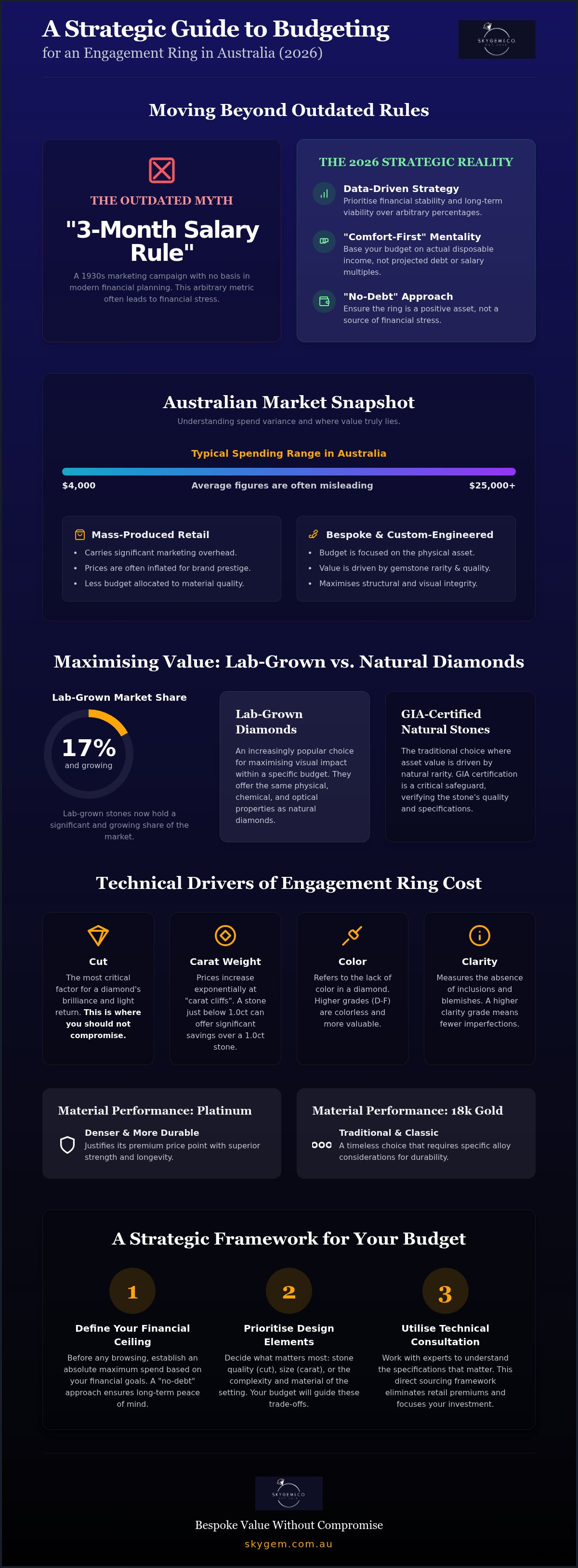
We understand that this investment requires a balance of quiet confidence and practical data. This guide provides a strategic framework to master the financial aspects of your purchase, ensuring you don't overpay for brand prestige at the expense of material quality. We will preview the current market shifts, including the 17% market share now held by lab-grown stones, and identify the specific performance metrics that matter most. This methodical approach ensures you invest in a high-quality ring that serves as a lasting asset for your future together.
Key Takeaways
- Transition from outdated marketing myths to a data-driven strategy that prioritises financial stability and long-term project viability over arbitrary salary percentages.
- Identify the core technical cost drivers, including the 4Cs and material specifications, to understand how platinum and 18k gold selections impact the total investment.
- Evaluate the comparative performance metrics of lab-grown diamonds and GIA-certified natural stones to maximise visual impact while adhering to your specific value requirements.
- Master how to budget for an engagement ring australia by defining an absolute financial ceiling and prioritising specific design elements like stone quality and setting complexity.
- Utilise technical consultations and direct sourcing frameworks to eliminate retail premiums and ensure your bespoke ring achieves maximum value and structural integrity.
Moving Beyond the 'Three-Month Salary' Myth in 2026
The concept of spending three months' salary on a diamond is an artificial benchmark with no basis in modern financial planning. This specific ratio originated as a 1930s marketing campaign designed to increase diamond consumption during a period of economic recovery. When exploring the history of engagement rings, it's clear that societal expectations have often been shaped by industry influence rather than individual fiscal health. In 2026, Australian buyers are increasingly rejecting these arbitrary metrics in favour of protecting home equity and maintaining liquid savings.
Understanding how to budget for an engagement ring australia requires a "comfort-first" mentality. This means your allocation should derive from actual disposable income rather than projected debt or rigid percentages. We've observed a significant shift toward value-based budgeting. This approach prioritises technical precision and material quality over sheer size. A smaller, expertly cut diamond often provides better light return and long-term aesthetic satisfaction than a larger stone with compromised clarity or colour. Investing in technical specifications ensures the ring maintains its structural and visual integrity for decades.
The Reality of Average Spend in Australia
Current market data indicates a broad variance in Australian spending, typically ranging from $4,000 to well over $25,000. Relying on an "average" figure is often misleading because it fails to account for the specific technical requirements of bespoke, high-quality jewellery. A mass-produced retail piece carries significant marketing overhead. Conversely, a custom-engineered ring focuses the budget on the physical asset. When you view the purchase as a project with specific performance goals, you can distinguish between inflated retail pricing and the actual value of the materials. Asset value is driven by the rarity and quality of the gemstone rather than the label on the box.
Setting Your Personal Financial Boundaries
Before you step into a boutique, it's vital to align your jewellery investment with your broader 2026 financial objectives. Whether you're prioritising a mortgage deposit or international travel, the acquisition shouldn't compromise your stability. Adopting a "no-debt" approach is the most reliable way to ensure the ring remains a positive asset rather than a source of financial stress. You can use SkyGem & Co.'s engagement ring guide to better understand how different styles and configurations influence the total cost of the project. This technical foresight prevents budget creep during the design phase and ensures your investment is focused on high-performance materials.
Technical Drivers of Engagement Ring Costs
Determining how to budget for an engagement ring australia involves more than just selecting a stone. It requires an understanding of the technical specifications that dictate market price and long-term durability. The primary cost drivers remain the 4Cs, which are the fundamental diamond quality factors established by the GIA. These metrics provide a technical price floor, ensuring that your investment is backed by an objective, globally recognised standard. GIA certification acts as a critical safeguard, verifying that the asset's specifications meet the performance standards you're paying for.
Metal performance also plays a pivotal role in the financial framework. Platinum and 18k gold offer distinct physical properties that impact both the initial cost and the long-term maintenance schedule. Platinum is denser and more durable, which justifies its premium price point in the Australian market. Gold, while more traditional, requires specific alloy considerations to ensure longevity. Choosing the right material is a balance of aesthetic preference and structural requirement, and understanding these metrics allows you to allocate funds where they contribute most to the ring's integrity.
The Impact of Diamond Specification on Budget
Cut quality is the most critical technical driver of a diamond's visual performance. It's the one area where you shouldn't compromise, as a superior cut is responsible for the stone's brilliance and light return. Investors should be aware of the "carat cliff," where prices increase exponentially at 0.5ct, 1.0ct, and 1.5ct milestones. Selecting a stone slightly below these benchmarks can result in significant savings without a discernible loss in visual scale. Additionally, identifying the "eye-clean" sweet spot in clarity and colour allows you to save approximately 15-20% on the stone price while maintaining a premium appearance to the naked eye.
Bespoke Engineering vs. Mass Production
Mass-produced rings are often cast in large batches, which can lead to hidden structural defects like metal porosity. These rings may be cheaper upfront, but poor stone-setting often results in costly long-term maintenance or the risk of stone loss. In contrast, bespoke engineering utilises high-precision CAD design to create a setting specific to your gemstone's unique geometry. This process allows for budget optimisation by focusing on structural integrity where it matters most. You can read more about the technical benefits of bespoke engagement rings to see how this approach protects your investment. By understanding these technical drivers, you can more effectively manage how to budget for an engagement ring australia while ensuring the final product meets your performance expectations.
To begin your project with a focus on technical precision, you might consider browsing our custom made engagement ring services to see how we balance cost and quality.
Maximising Value: Lab-Grown Diamonds vs. Natural Gemstones
Once you understand the technical drivers of cost, the next strategic step in how to budget for an engagement ring australia is selecting the origin of your gemstone. In 2026, the choice between lab-grown and natural diamonds is primarily a decision between aesthetic scale and long-term asset retention. Natural, GIA-certified diamonds represent a finite resource with a historical track record of value preservation. Industry data suggests these stones typically retain 20-60% of their retail price, making them the preferred choice for those prioritising investment stability. However, the premium for natural stones remains high. Buyers must weigh the prestige of a mined stone against the efficiency of modern alternatives.
We see many couples moving toward a value-based framework where the focus is on the lived experience of the jewellery. If your goal is to maximise the physical dimensions of the stone without exceeding a set financial ceiling, lab-grown options provide a clear path. This shift isn't just about cost; it's about technical precision. Both options offer the same brilliance and durability, but they serve different financial functions within your broader portfolio. Deciding which path to take requires an honest assessment of whether you value the rarity of the material or the visual impact of the design.
The 2026 Lab-Grown Diamond Market
Lab-grown diamonds now account for approximately 17% of the total diamond jewellery market, reflecting a major shift in consumer confidence. These stones are physically, chemically, and optically identical to natural diamonds. They aren't "fakes" or "simulants"; they're real diamonds grown in a controlled environment. For buyers looking to maximise visual impact, choosing lab-grown white diamonds allows you to achieve a 2-carat look on a 1-carat budget. Market reports indicate that lab-grown stones are often 60-85% cheaper than natural counterparts of similar quality. This allows couples to redirect funds toward higher metal specifications or more intricate custom engineering.
Alternative Gemstones: Australian Sapphires and Beyond
For those seeking high-character aesthetics, coloured gemstones provide a robust and budget-friendly alternative. Australian sapphires, particularly teal and peach varieties, have become a sophisticated choice for modern projects. When budgeting, the Mohs scale of mineral hardness is a critical performance metric. Sapphires rate at a 9, which ensures they're durable enough for daily wear. This technical resilience ensures your investment maintains its visual integrity over time. Exploring a curated selection of precious gemstones reveals that high-quality sapphires often provide a larger footprint and more unique colour profiles than diamonds at a similar price point. This allows for a bespoke design that feels personal and premium while remaining within strict financial boundaries.
How To Budget For An Engagement Ring?
Establishing a structured framework is the most effective way to manage how to budget for an engagement ring australia. The first step involves defining an absolute ceiling. This is a non-negotiable figure that ensures the project remains within your financial comfort zone and prevents emotional budget creep. Once this limit is set, you must prioritise the "Big Three": stone size, stone quality, or setting complexity. Achieving excellence in all three areas requires a substantial investment, so most successful projects focus on two pillars while making strategic compromises on the third. This methodical approach mirrors the decision-making process of any large-scale technical design project.
Allocating 10-15% of your total budget for the setting is a necessary technical requirement. This ensures the structural integrity of the ring and the security of the centre stone. A high-quality setting is not merely an aesthetic choice; it's a protective housing for your gemstone asset. Beyond the initial purchase, you must account for the total cost of ownership. This includes ongoing maintenance, potential resizing, and professional cleaning to preserve the ring's performance over time. Viewing the ring as a permanent and evolving asset requires planning for these lifecycle costs from the outset.
Prioritising the 4Cs Based on Your Partner's Style
Aligning the 4Cs with a specific aesthetic allows for smarter fund allocation. If your partner values maximum sparkle, you should prioritise cut quality over carat weight. A superior cut ensures optimal light return, which can make a smaller stone appear more brilliant than a larger, poorly cut alternative. Conversely, if they prefer a vintage look, you might prioritise setting detail and warmer colour grades. A technical consultant can help you reallocate funds within the 4Cs, ensuring you don't overpay for specifications that aren't visible to the naked eye.
Accounting for Hidden Costs
Financial planning must extend beyond the boutique floor. Specialised jewellery insurance is a critical recurring cost, and you should expect to pay approximately 1-2% of the ring's value annually. For a $10,000 ring, this equates to $100 to $200 per year. Another vital consideration is the "wedding band factor." It's essential to ensure the engagement ring's profile allows for a flush-fitting band later. Failure to account for this can lead to expensive custom modifications or accelerated wear on the metal. You can learn more about matching your budget with wedding rings to ensure a cohesive long-term design.
To begin refining your technical specifications with an expert partner, we recommend exploring our engagement rings to see how different configurations impact your total investment.
The SkyGem & Co. Approach: Bespoke Value Without Compromise
The final phase in mastering how to budget for an engagement ring australia is selecting a partner who operates with technical transparency. At SkyGem & Co., we've refined our procurement process to eliminate the unnecessary retail premiums associated with mass-market franchises. By providing direct access to a global inventory of loose stones, we ensure your capital is invested in the physical quality of the materials rather than a retailer's marketing overhead. This approach allows us to act as your technical consultant, guiding you through the selection of natural white diamonds or lab-grown alternatives with a focus on long-term viability and aesthetic performance.
A boutique experience in Australia provides a level of budget control that's impossible to achieve in a mass-production environment. We treat each ring as a unique engineering project where your financial boundaries dictate the design parameters. This partnership ensures that every design choice, from the prong style to the metal alloy, is made with a full understanding of its impact on the total cost. Our role is to provide the data-driven insights you need to manage the complexities of the 2026 market with quiet confidence.
Education as a Budgeting Tool
We believe that technical education is the most powerful tool for cost optimisation. Rather than relying on vague sales pitches, we provide comprehensive GIA reports and performance data for every stone in our collection. Our digital Ring Builders allow you to visualise your budget in real-time, testing different configurations of carat, colour, and clarity to see how they influence the final price point. This transparency ensures your decision is grounded in fact, adhering to the high standards of Australian jewellery excellence and regulatory precision. It's a methodical process designed to respect both your time and your investment.
Next Steps: Your Consultation
When you're ready to transition from research to execution, we invite you to a technical consultation. To make the most of this session, we suggest preparing a few key items:
- A defined budget range based on your "Absolute Ceiling" as discussed in our framework.
- Visual inspiration or specific design elements that align with your partner's aesthetic.
- Technical questions regarding specific stone performance or metal durability.
Our consultants work strictly within your established limits to create a piece that exceeds your expectations without compromising your financial stability. We focus on quality over quantity, ensuring your ring remains a permanent asset that retains its value. Book a technical consultation with SkyGem & Co. to start your bespoke journey.
Executing Your Strategic Diamond Investment
Mastering how to budget for an engagement ring australia is a process of balancing personal values with precise market data. You've seen that the outdated three-month rule has been replaced by a strategic framework that prioritises financial stability and technical specification. By focusing on the "Big Three" and understanding the total cost of ownership, you ensure that your investment is both beautiful and fiscally responsible. This methodical approach allows you to secure a high-performance asset that reflects your unique partnership.
Whether you select GIA Certified Natural Diamonds for their historical value or ethically sourced lab-grown options for their impressive scale, the key is informed decision-making. Our expert technical consultations act as your project management resource, helping you navigate the 2026 landscape with clarity. We're here to ensure your bespoke piece meets the highest standards of regional design and structural integrity. Design your bespoke engagement ring with Australia's technical experts and begin your journey with a partner who values performance over hype. Your future starts with a well-engineered decision.
Frequently Asked Questions
Is the 3-month salary rule still used in Australia?
No, the three-month salary rule is an outdated marketing construct rather than a modern financial standard. In 2026, Australian buyers focus on personal financial health and long-term goals like property acquisition. You should establish a budget based on your actual disposable income and savings. This ensures the purchase remains a positive asset for your future together rather than a source of financial strain.
How much should I spend on an engagement ring if I make $100k a year?
There is no single figure for a $100,000 income, as it depends on your specific financial obligations and savings goals. Most experts suggest a "comfort-first" approach that avoids high-interest debt. When determining how to budget for an engagement ring australia, you must evaluate your liquid assets and monthly surplus. This allows you to invest in a piece with high technical performance while maintaining your broader financial stability.
Are lab-grown diamonds a good investment for my budget?
Lab-grown diamonds are an excellent choice for maximising aesthetic scale, though they function differently as a financial asset. They cost significantly less than natural stones, allowing for a larger or higher-quality diamond within your existing budget. While natural diamonds retain a higher percentage of their resale value, lab-grown stones provide immediate value through their identical physical and optical properties at a much lower entry point.
What is the average cost of a bespoke engagement ring in Australia?
Market data for 2026 indicates that the average spend for an engagement ring in Australia typically falls between $5,000 and $12,000. However, "average" can be misleading for bespoke projects. The final cost is driven by technical specifications such as stone origin, the 4Cs, and the complexity of the custom setting. Working with a consultant helps you navigate these variables to achieve the best result for your specific allocation.
Can I get a high-quality engagement ring for under $5,000?
You can certainly acquire a high-quality ring for under $5,000 by making strategic technical compromises. Opting for a lab-grown diamond or a durable alternative like an Australian sapphire can provide a premium look at this price point. The key is to prioritise cut quality and a hand-finished setting. This ensures the ring remains structurally sound and visually impressive despite a more conservative total budget.
Do I need to pay for the engagement ring all at once?
Most reputable jewellers provide flexible payment structures, though the terms vary significantly. Options like Latitude Gem Visa or Zip often provide interest-free periods, but you must be aware of the high interest rates, sometimes exceeding 25%, that apply if the balance isn't cleared. A no-debt approach is usually the most stable way to manage how to budget for an engagement ring australia to avoid recurring monthly fees.
How does the choice of metal affect my overall ring budget?
Metal choice is a significant technical driver of the setting's cost and durability. Platinum is denser and more expensive than 18k gold, requiring a larger initial investment. However, its superior wear resistance often reduces long-term maintenance costs. Gold is a traditional and versatile alternative, but it may require more frequent polishing or rhodium plating to maintain its visual performance over the ring's lifecycle.
Should I buy the diamond or the setting first?
The diamond and setting should be selected as part of a unified technical design. The stone's specific dimensions and geometry dictate the structural requirements of the setting to ensure maximum security and light return. Attempting to buy a stone without considering the final setting can lead to engineering challenges or higher costs during the custom design phase. A holistic approach ensures the best visual and structural outcome.