
How to Budget for an Engagement Ring in 2026: A Technical Value Guide

Did you know that while gold prices climbed to $4,700 per ounce in early 2026, the cost of high-quality lab-grown diamonds fell by nearly 70% over the last five years? This divergence in the market means that traditional spending guidelines are no longer a reliable metric for value. You probably feel the pressure of balancing a desire for a premium, bespoke result with the anxiety of overpaying for a brand name. Understanding how to budget for an engagement ring 2026 requires a technical perspective that prioritizes material performance and structural integrity over retail hype.
We're here to act as your technical consultants, helping you navigate the complexities of modern gemstone pricing and bespoke manufacturing. In this guide, you'll learn how to establish a realistic budget by identifying specific areas where you can compromise on technical specifications without sacrificing aesthetic impact. We'll provide a clear framework for allocating your funds across metal, stone, and craftsmanship. This overview covers everything from the price gap between natural and lab-grown diamonds to the efficiencies of custom design, giving you the data-driven confidence to invest in a piece that offers both immediate beauty and long-term viability.
Key Takeaways
- Transition from outdated marketing constructs to a value-based budgeting model that aligns your financial parameters with technical gemstone performance.
- Learn how to budget for an engagement ring 2026 by identifying "price cliffs" and technical specifications that offer significant cost reductions without impacting visual brilliance.
- Understand the structural advantages of bespoke engineering, where custom settings are designed to optimize light return and strategically conceal stone inclusions.
- Establish a clear investment hierarchy by prioritizing a "hero" element, whether you value the rarity of a natural Australian sapphire or the scale of a lab-grown diamond.
- Utilize a loose stone procurement strategy to maintain transparency and ensure your funds are allocated toward high-performance materials rather than brand-name premiums.
Beyond the Two-Month Rule: Modern Engagement Ring Budgeting in 2026
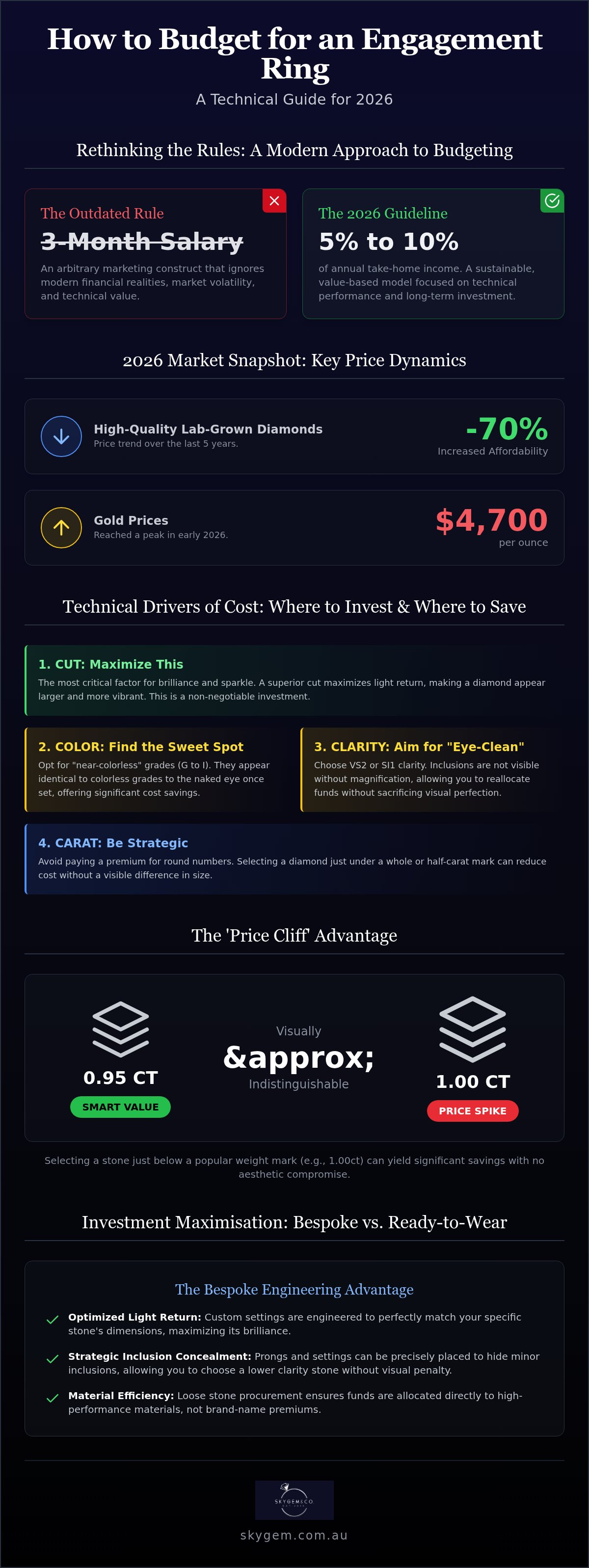
The "three-month salary" rule, once a staple of mid-20th-century marketing, has effectively been retired by the informed buyers of 2026. This arbitrary percentage fails to account for the technical nuances of the modern market, where stone origin and manufacturing precision dictate value more than the sticker price. When considering how to budget for an engagement ring 2026, the focus has shifted toward Value-Based Budgeting. This approach aligns your personal financial comfort with specific gemstone performance metrics rather than following a rigid, outdated formula. Recent data indicates that financial advisors now suggest a more sustainable range of 5% to 10% of annual take-home income, reflecting a broader shift toward long-term fiscal health.
Understanding the history of engagement rings reveals how historical marketing campaigns shaped these spending habits. Today, the "Total Cost of Ownership" (TCO) is a more critical metric for a successful investment. This includes the initial procurement of high-performance materials, the precision engineering involved in custom made engagement rings in Melbourne, and the ongoing requirements for maintenance and insurance. Consumers are increasingly prioritising technical transparency and bespoke craftsmanship over arbitrary price tags or brand-name premiums.
Why Salary-Based Rules Fail the Modern Buyer
Flat percentage rules are impractical in an era defined by complex debt-to-income ratios and diverse lifestyle goals. A ring's true value isn't found in its cost relative to a paycheck, but in its structural durability and the efficiency of its design. Technical education serves as the most effective tool to prevent overspending. By understanding how light return and material properties interact, you can make informed decisions that prioritise visual impact over nominal carat weight. This shift ensures your capital is spent on tangible quality rather than perceived status.
The 2026 Australian Market Landscape
The local market is currently influenced by significant fluctuations in raw material costs. With gold prices reaching $4,700 per ounce in May 2026, the cost of settings has increased by approximately 40% to 50% since early 2025. This volatility has led many to explore alternative stones like Australian sapphires, which offer a premium, durable option with a distinct regional origin. While precious metals like platinum and 18K gold remain the industry standard for stability and longevity, the strategic selection of gemstones allows for a more flexible allocation of funds within a bespoke project.
The Technical Drivers of Cost: Where to Invest and Where to Save
To master how to budget for an engagement ring 2026, you must look past the carat weight to the finer technical specifications. While retail marketing often fixates on size, the true drivers of cost and visual performance are found within The GIA's 4Cs of diamond quality. Strategic buyers can achieve significant savings by prioritising Cut above all else. A superior cut ensures maximum light return, which often makes a stone appear larger and more brilliant than a poorly cut stone of higher carat weight.
The "Price Cliff" phenomenon is a critical technical consideration for any budget. Diamond prices often spike at whole numbers like 1.00ct or 1.50ct. By selecting a stone that weighs 0.90ct to 0.99ct, you can often secure a diamond that's visually indistinguishable from a full carat but costs significantly less. Similarly, opting for "eye-clean" clarity (VS2 or SI1) and "near-colourless" grades (G to I) allows you to reallocate funds toward a higher quality setting or a more durable metal without compromising the ring's overall beauty.
Metal selection also impacts the final project cost. While platinum is prized for its density and natural white hue, 18K white gold offers a similar aesthetic at a lower price point. This remains true even with gold prices reaching historic highs of $4,700 per ounce in 2026. Choosing 18K gold allows for greater budget flexibility when selecting the center stone. You can explore these options further through our online diamond procurement portal to see how these variables interact in real-time.
Lab-Grown vs Natural Diamonds: A 2026 Pricing Analysis
In 2026, the technical identity of lab-grown diamonds is identical to their mined counterparts, yet they offer 70% to 90% more value per carat. They're an ideal choice for those who want to maximise scale and brilliance within a fixed budget. However, natural GIA certified diamonds continue to be the standard for rarity and long-term asset value. Choosing between them depends on whether you prioritise the immediate visual impact of a larger stone or the inherent rarity of a natural resource.
Maximising Value with Coloured Gemstones
For those seeking a bespoke aesthetic, Australian sapphires provide a durable and vibrant alternative. Teal and peach sapphires have gained significant traction in 2026, offering a unique colour profile that often feels more exclusive than traditional white diamonds. When budgeting for precious gemstones, be aware of the "unheated" premium. Natural, unheated rubies and sapphires command higher prices due to their rarity; they represent the pinnacle of gemstone purity for the discerning collector.
Bespoke Design vs Ready-to-Wear: Which Path Maximises Your Investment?
Choosing between a pre-set ring and a custom-engineered piece is a pivotal decision when determining how to budget for an engagement ring 2026. Ready-to-Wear (RTW) refers to rings that are pre-set and ready for immediate acquisition. In contrast, Bespoke design involves engineering a setting specifically for a selected loose stone. While RTW offers convenience, bespoke design provides a technical advantage that can actually lower your total expenditure. This is achieved through the principle of "designing to the stone."
One of the most effective budget-saving strategies in bespoke design is the ability to strategically place setting elements to enhance the stone's appearance. If a diamond has a minor inclusion near the girdle, a bespoke setting can be engineered to place a prong precisely over that characteristic. This allows you to invest in a stone with a lower clarity grade, which carries a smaller price tag, while achieving a visually perfect result once the ring is assembled. This level of precision is rarely possible with mass-produced settings that are built to generic stone dimensions.
Mass-market retail often carries a significant "Retail Markup" to cover extensive inventory overhead and global brand marketing. Boutique manufacturing typically operates on a "Manufacturing Fee" plus the raw cost of materials. This transparent structure ensures that your investment is directed toward the physical asset rather than the retailer's operational costs. Additionally, bespoke settings offer superior structural integrity. Because they are individually cast or fabricated for a specific project, they avoid the common issues of metal porosity and thin bands often found in mass-produced, cast rings.
The Myth of the 'Custom Premium'
Many buyers assume that custom work always carries a price premium. In reality, custom engagement rings can often be more cost-effective by eliminating unnecessary gold weight and using loose stones sourced at wholesale rates. Modern CAD (Computer-Aided Design) technology allows for precise budgeting before a single gram of gold is cast. This technical foresight helps in how to budget for an engagement ring 2026 by identifying potential cost-saving opportunities early in the design phase. Expert consultations during this process also prevent expensive design mistakes that could lead to structural failure later.
Ready-to-Wear: When Speed Trumps Customisation
Sometimes, the project timeline requires a faster turnaround than a bespoke build allows. Ready-to-ship engagement rings are the optimal financial choice when you need a high-quality result on a compressed schedule. However, it's vital to vet these pieces with the same technical rigour as a custom project. Always verify that the setting isn't being used to obscure a stone of inferior quality. Insisting on GIA certification, even for pre-set RTW collections, provides an essential layer of security for your investment.
A Step-by-Step Framework for a 2026 Engagement Ring Budget
Establishing a precise financial roadmap is essential for navigating the technical complexities of the modern jewellery market. When determining how to budget for an engagement ring 2026, you should move beyond emotional spending toward a structured procurement process. This framework ensures that every dollar is allocated to maximise both aesthetic impact and structural longevity. By treating the purchase as a technical project, you can avoid the common pitfalls of retail inflation and brand-name premiums.
Follow these five steps to define your investment parameters:
- Step 1: Determine a hard ceiling. Based on current 2026 financial goals, most experts recommend an allocation of 5% to 10% of your annual take-home income. This serves as your project's maximum budgetary limit.
- Step 2: Prioritise the 'Hero' element. Decide whether your primary value driver is the physical scale of a lab-grown diamond, the rarity of a natural Australian sapphire, or the intricate engineering of a bespoke setting.
- Step 3: Apply the 70/30 allocation rule. As a general benchmark, allocate 70% to 80% of your funds to the centre stone and 20% to 30% to the setting and manufacturing fees.
- Step 4: Factor in the extras. Account for essential secondary costs such as professional insurance, future maintenance, and potential resizing requirements.
- Step 5: Consult a technical expert. Use a professional consultation to refine your specifications, ensuring your stone selection and setting design are perfectly matched within your financial range.
Allocating Funds: The Stone vs. The Setting
While it is tempting to maximize stone size, the setting's structural integrity should never be compromised. A well-engineered setting protects your investment from daily wear and tear. To optimize your spend, consider specific "savings hacks" like selecting a 1.4ct stone instead of a 1.5ct stone. This allows you to avoid the significant price jump associated with the 1.5-carat weight bracket while maintaining a nearly identical visual profile. For those seeking the most budget-efficient path, Solitaire engagement rings offer a timeless aesthetic that directs the majority of your capital toward the centre stone's quality.
Hidden Costs to Anticipate
Long-term viability requires planning for costs beyond the initial purchase. Professional jewellery insurance is a non-negotiable requirement for any piece valued over $5,000, providing protection against loss or structural damage. You should also anticipate the costs of ongoing maintenance, such as periodic prong tightening or rhodium plating for 18K white gold. Additionally, remember that wedding bands should be considered as a separate, secondary budget item to ensure your total bridal jewellery set remains financially sustainable. To begin refining your project specifications, you can book a technical consultation with our design team.
Navigating Your Purchase with SkyGem & Co.: Expert Consultations
The transition from theoretical planning to physical procurement requires a partner who prioritises technical precision over sales quotas. At SkyGem & Co., our philosophy is built on a foundation of transparency and technical education. We operate as your project consultants rather than traditional retailers, ensuring that every design decision is backed by data and material science. Understanding how to budget for an engagement ring 2026 is only the first step; the second is executing that budget with a specialist who understands the intersection of performance metrics and aesthetic design.
Our "loose stone" procurement process is a cornerstone of this transparent approach. By viewing and selecting a diamond or gemstone before it is placed in a setting, you gain a clear, unobstructed view of its technical characteristics. This method ensures you only pay for the quality you can physically verify, eliminating the risk of "hidden" inclusions that pre-set rings might obscure. This level of granular detail is essential for maintaining the integrity of your investment, especially when navigating the high-volatility 2026 market.
Choosing a boutique consultation over a high-pressure retail environment allows for a more methodical decision-making process. We respect your professional time and your financial parameters, moving from high-level conceptual benefits to granular technical details with ease. This partnership approach ensures the long-term success of your project, resulting in a piece that functions as a permanent and evolving asset rather than a one-off purchase.
The SkyGem & Co. Bespoke Process
Our bespoke workflow integrates the latest CAD technology with traditional craftsmanship to maximise your "sparkle per dollar." We utilise GIA certified diamonds and ethically sourced gemstones, ensuring every component meets rigorous regulatory standards. Our designers work within your specific budget to optimize the ratio between stone quality and metal longevity. This commitment to regional expertise and user-focused design serves as a recurring signature of reliability in every piece we manufacture.
Ready to Begin Your Journey?
The path to a high-quality, bespoke result begins with inspiration and technical alignment. We encourage you to browse our engagement ring collection to identify the styles and materials that resonate with your vision. Once you have established your initial preferences, the next step is to refine those requirements with a specialist who can translate your goals into a structural reality. We invite you to book a bespoke consultation with SkyGem & Co. to discuss your technical requirements and begin the precision engineering of your engagement ring.
Securing Long-Term Value in Your 2026 Engagement Ring Project
Successful ring procurement in 2026 requires a departure from outdated marketing myths in favour of a technical, value-driven framework. By prioritising high-performance cut quality and understanding the structural benefits of bespoke engineering, you ensure your investment translates into a piece of enduring stability. Whether you select the rarity of a natural diamond or the scale of a lab-grown stone, aligning your financial parameters with specific material specifications is the most effective way to achieve a premium result.
Knowing how to budget for an engagement ring 2026 empowers you to make informed compromises that don't sacrifice visual brilliance. Our team at SkyGem & Co. acts as your technical consultant throughout this process. We leverage GIA Certified Diamonds and specialise in the unique aesthetic of Australian and Teal Sapphires to create rings that meet the highest regulatory standards. Through our bespoke CAD design services, we provide the precision required to bring your vision to life within your established range. We look forward to partnering with you on this significant project.
Design your bespoke engagement ring with SkyGem & Co.
Frequently Asked Questions
Is $10,000 a good budget for an engagement ring in 2026?
A $10,000 budget is a robust and versatile threshold that allows for significant technical flexibility. In the current market, this amount comfortably covers a high-quality 1-carat natural diamond with a bespoke setting or an exceptionally large lab-grown diamond with intricate design elements. This budget level ensures you don't have to compromise on the structural integrity of the metal or the cut quality of the centre stone.
How much should I spend on a lab-grown diamond ring compared to natural?
You should expect to allocate significantly less capital for a lab-grown diamond ring to achieve the same visual impact as a natural one. Because lab-grown stones cost a fraction of their mined counterparts, you can often secure a 2-carat stone for less than the price of a 1-carat natural diamond. This allows you to redirect your budget toward premium metals or more complex bespoke engineering without increasing your total expenditure.
Does the 'three months' salary' rule still apply in Australia?
The "three-month salary" rule is an obsolete marketing construct that is no longer recommended by financial or technical experts. Modern Australian buyers prefer a value-based approach when considering how to budget for an engagement ring 2026. Most current guidelines suggest an allocation of 5% to 10% of your annual take-home income, which ensures the purchase remains a sustainable investment rather than a source of financial strain.
Can I get a high-quality bespoke ring for under $5,000?
Securing a high-quality bespoke ring for under $5,000 is entirely achievable through strategic material selection. By opting for a lab-grown diamond or a durable coloured gemstone like an Australian sapphire, you can maintain high technical standards within a tighter budget. Choosing a solitaire setting also helps keep costs down by focusing your investment on the centre stone's performance rather than auxiliary diamond accents.
Should I buy the diamond or the setting first when budgeting?
You should establish the budget for your centre stone first, as it typically represents 70% to 80% of the total project cost. Once the technical specifications and price of the stone are confirmed, the remaining funds can be allocated to the setting. This sequence ensures that the stone's dimensions and light performance are the primary drivers of the ring's design, leading to a more cohesive and structurally sound result.
What are the most cost-effective alternatives to diamonds in 2026?
Australian sapphires, particularly the teal and peach varieties, are the most technically viable and cost-effective alternatives to diamonds. These gemstones offer a high level of hardness, making them suitable for daily wear while providing a unique aesthetic that diamonds cannot replicate. Their varied colour profiles allow for a truly bespoke look that often carries a lower raw material cost than traditional white diamonds.
How much does a custom engagement ring design fee typically cost?
Custom design fees are usually integrated into the overall manufacturing and labour costs of a bespoke project. This fee covers the technical CAD design process, which allows for a digital preview of the ring's structural specifications before casting. By working with a boutique manufacturer, you ensure that these costs are transparent and directly related to the precision engineering of your specific piece rather than arbitrary retail markups.
Is platinum worth the extra cost over 18K white gold for a budget-conscious buyer?
Platinum is a premium choice due to its natural whiteness and density, but 18K white gold is often the more practical option for those managing a strict budget. While platinum doesn't require rhodium plating, its higher material cost can consume funds that might be better spent on stone quality. For many buyers, the aesthetic similarity of the two metals makes white gold a more efficient allocation of capital.
Disclaimer
This article is for general informational purposes only and may include AI-assisted content. Pricing, specifications, and availability are subject to change. For accurate advice and current information, please contact SkyGem & Co. directly. Nothing in this content constitutes professional or financial advice.