
Heirloom Ruby Ring Redesign Ideas: Modernising Your Legacy

What if the most respectful way to honour a 50-year-old gemstone isn't to leave it tucked away in a velvet box, but to dismantle the original setting entirely? You likely feel a profound connection to your family's history, yet find that a heavy, dated setting simply doesn't suit your personal style. It's a common tension for many Australians who inherit significant jewellery; you want to preserve the sentiment without wearing a piece that feels like a costume. Exploring heirloom ruby ring redesign ideas offers a path to bridge this gap, allowing you to maintain the emotional value while creating something truly wearable.
We understand the technical concerns that come with unsetting a precious stone, particularly the fear of structural damage or choosing a metal that clashes with the ruby's unique saturation. This article provides professional assurance on how to transform your legacy into a contemporary masterpiece through expert bespoke design and engineering precision. You'll discover how we evaluate gemstone quality and select modern settings that reflect your aesthetic while future-proofing the piece for the next generation.
Key Takeaways
- Understand the technical "Corundum Check" process used to verify stone origin and treatment status before unsetting your heritage gemstone.
- Explore a range of sophisticated heirloom ruby ring redesign ideas that balance sentimental heritage with modern engineering, ensuring the final piece is both durable and stylistically current.
- Learn how strategic material selection, such as 18K yellow gold or platinum, can be used to thermally and aesthetically enhance the ruby’s "Pigeon Blood" saturation.
- Discover the role of CAD design and 3D rendering in visualising your bespoke piece, ensuring the technical brief aligns with your aesthetic vision before production begins.
- Gain insight into selecting GIA-certified accent stones to future-proof your legacy while maintaining Australian standards of quality and precision craftsmanship.
Balancing Sentiment and Style: The Heirloom Ruby Redesign Journey
Inheriting a piece of jewellery is a significant event, yet it often carries an unexpected emotional weight. Many owners feel a sense of guilt when considering modifications, fearing that altering a grandmother's ring somehow erases its history. It's vital to view this process differently. A ruby that sits in a drawer because it doesn't suit your personal style serves no one. By exploring heirloom ruby ring redesign ideas, you're not destroying a legacy; you're ensuring its survival for another fifty years.
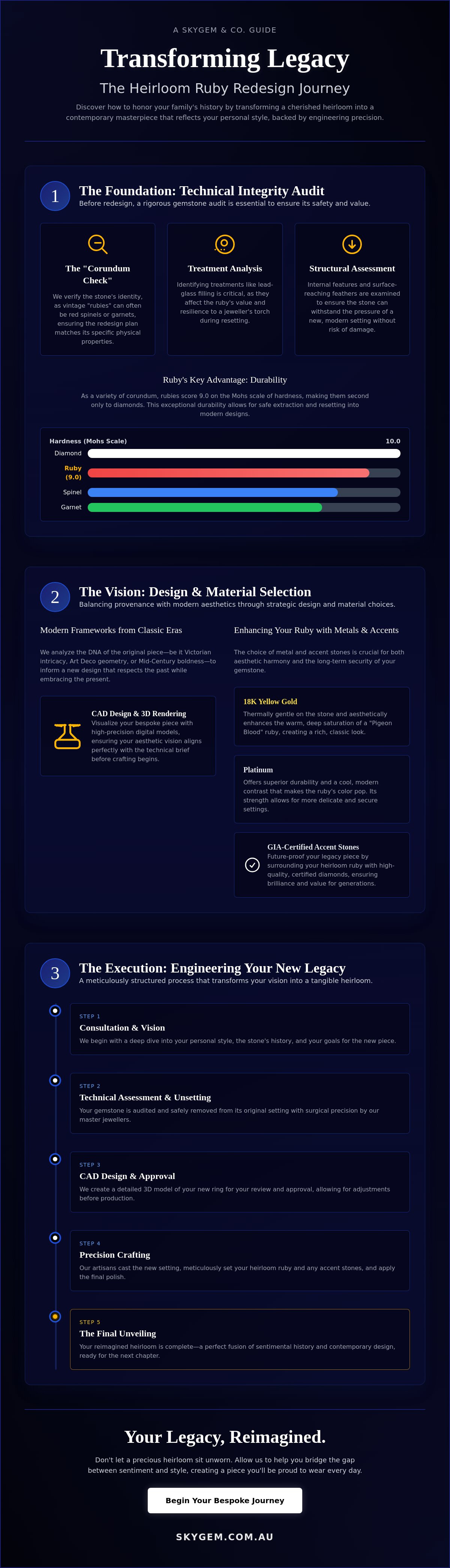
Rubies are uniquely suited for this transition. As a variety of corundum, they possess a 9.0 rating on the Mohs scale, making them the second hardest natural gemstone. This durability is a key factor in the physical properties of rubies that allows for safe extraction and resetting. Unlike softer stones that might crack under the pressure of modern tools, a ruby can withstand the technical rigours of being moved from a heavy, ornate vintage setting into a sleek, minimalist frame. The goal of any redesign is to strike a precise balance between the preservation of provenance and the necessity of contemporary wearability.
Defining Your Aesthetic Vision
The first step in any project is identifying the architectural DNA of the original piece. Victorian rings (1837-1901) often feature intricate, high-profile yellow gold work, while Art Deco pieces (1920-1935) are defined by geometric symmetry and platinum. Mid-Century designs (1945-1965) frequently lean toward bold, chunky aesthetics. You must decide which elements remain. Sometimes the story is held entirely in the stone, while other times, the original gold can be refined and recast. Remodelling is a structural bridge between generations, allowing the craftsmanship of the past to meet the functional demands of the present.
The Role of the Bespoke Specialist
Generic retail stores often lack the engineering expertise required for complex heirloom transformations. They are set up for volume sales, not the delicate technical consultation needed to assess a vintage stone's integrity. Working with a specialist ensures that your heirloom ruby ring redesign ideas are grounded in structural reality. A technical consultant evaluates the stone's inclusions and surface condition before any metal is touched. This level of precision is why bespoke engagement rings set the standard for remodelling. It's about a partnership where engineering excellence protects your emotional investment and the long-term durability of the piece.
Technical Integrity: Assessing Your Heirloom Ruby for Modern Settings
Before exploring specific heirloom ruby ring redesign ideas, a rigorous technical audit of the gemstone is essential. This process begins with a "Corundum Check" to verify the stone’s chemical identity and geographic origin. It's common for vintage "rubies" to be revealed as red spinels or garnets once they're removed from their original settings. Establishing the exact mineral species ensures that the redesign plan accounts for the specific physical properties of the gem.
Identifying heat treatments is another critical step in the assessment. While thermal enhancement is a standard industry practice to improve colour, it significantly impacts the stone’s market value and its resilience during the jewellery-making process. Certain treatments, like lead-glass filling, make a ruby sensitive to the heat of a jeweller's torch. When assessing ruby quality, our gemmologists also examine internal features like "silk" or "feathers." While these inclusions provide proof of natural origin, surface-reaching feathers can compromise the stone's structural stability under the pressure of a new setting.
The physical act of unsetting a stone carries its own set of risks. Older prongs often become brittle or "tired" over decades of wear. Removing a ruby from a legacy mount requires surgical precision to avoid putting unnecessary torque on the stone's girdle. We often use microscopic tools to carefully peel back the metal, ensuring the gem remains intact for its next chapter.
The Mohs Scale and Ruby Durability
Rubies score a 9.0 on the Mohs scale, which makes them the second hardest natural gemstone used in jewellery. This high rating ensures they're suitable for the daily rigours of a modern lifestyle. However, hardness doesn't equal invincibility. Years of friction against metal can result in micro-abrasions on the facet edges. Older settings frequently hide existing chips or "paper-thin" girdles that only become visible after a professional ultrasonic cleaning. Identifying these flaws early allows us to suggest heirloom ruby ring redesign ideas that protect vulnerable areas, such as using a protective bezel or a halo of smaller diamonds.
Natural vs. Lab-Grown Identification
Distinguishing between natural heirlooms and vintage synthetic rubies is a vital part of the appraisal. Flame-fusion synthetics were widely used in Australian jewellery throughout the early 1900s. While these stones share the same chemical profile as natural gems, natural rubies possess unique inclusion patterns that dictate different design choices. A natural stone’s value often warrants a more complex, high-investment mount, whereas a synthetic stone might be better suited to a contemporary, fashion-forward setting. Understanding the stone's pedigree helps you make an informed decision regarding your custom redesign project.
Design Inspiration: 4 Modern Frameworks for Heirloom Ruby Rings
Redesigning a legacy piece requires a precise balance between heritage and current engineering. When exploring heirloom ruby ring redesign ideas, the primary objective is to maximise the stone's inherent saturation while ensuring the structural integrity of the new mount. Modern frameworks move away from the heavy, ornate gold work of the mid-20th century, favouring clean lines that allow light to interact with the ruby’s crystal structure from multiple angles.
Professional designers often treat the ruby as the anchor of a new narrative. When redesigning heirloom jewelry, the focus shifts to how the gem's specific dimensions can be highlighted through modern CAD (Computer-Aided Design) technology. This ensures that the new setting isn't just aesthetic, but a durable piece of engineering designed for daily wear in the Australian climate.
The Solitaire and Trilogy Approach
Modernising a ruby often involves stripping away dated, bulky settings to create a minimalist solitaire engagement ring. This approach focuses entirely on the gem's depth of colour, particularly for stones that exhibit the intense "Pigeon Blood" hue. To update the silhouette without losing the stone's prominence, many designers now use tapered baguettes or pear-shaped flank stones. These side stones create a sophisticated, stepped transition from the centre stone to the band. The choice of claw style is a critical technical detail; talon prongs provide a sharp, contemporary edge that minimises metal interference, while button prongs offer a traditional, rounded finish that secures the stone's girdle against impact.
The Toi et Moi and Halo Styles
The Toi et Moi revival has become a significant trend in the Australian bespoke market. Pairing a family ruby with a high-clarity lab-grown diamond creates a striking visual contrast that feels both avant-garde and deeply personal. For those who prefer a larger profile, the architectural halo offers a geometric update to the traditional round cluster. Using hexagons or octagonal frames can modernise an oval ruby instantly. While scalloped halos provide a romantic, floral aesthetic, flush-set halos are often the superior technical choice for protection. Incorporating mixed metals, such as 18k yellow gold prongs on a 18k white gold band, can also boost the ruby's internal fire while keeping the overall look crisp and current. These heirloom ruby ring redesign ideas ensure the final product is a future-proof asset that respects its past.
Strategic Material Selection: Metals and Accents that Elevate Rubies
Selecting the right housing for a gemstone involves more than aesthetic preference. It's a technical decision that dictates how light interacts with the ruby's internal crystal structure. When exploring heirloom ruby ring redesign ideas, the metal choice serves as the primary tool for colour correction and saturation enhancement. A ruby's secondary hues, often purple or pink, react differently to the spectral reflectance of the surrounding metal. 18K yellow gold, with its high gold content, reflects warm light into the stone, which can deepen the perceived red saturation. Conversely, platinum provides a neutral, high-lustre backdrop that allows the ruby's natural colour to stand alone without external warming.
The Gold vs. Platinum Debate
The choice between 18K White Gold and Platinum is often determined by the wearer's lifestyle and the stone's structural requirements. Platinum is approximately 40% denser than gold, providing a secure, heavy-duty setting for substantial stones. It doesn't wear away over time; instead, the metal displaces, creating a patina that protects the gemstone for decades. White gold is harder due to its alloy composition, making it highly resistant to scratches, though it requires periodic rhodium plating to maintain its crisp finish. For those seeking maximum colour impact, using yellow gold prongs on a white metal band is a proven technical strategy to isolate and intensify the ruby's red core.
Enhancing the Centre Stone
Accent stones act as light conduits that drive brilliance into the centre ruby. Integrating GIA certified natural diamonds creates a high-contrast "fire" effect, where the diamond's dispersion offsets the ruby's deep glow. There's a distinct aesthetic difference when using natural color diamonds compared to standard white stones. While white diamonds provide a sharp, clean boundary, champagne or pink diamonds can create a softer, more tonal transition that suits vintage-inspired heirloom ruby ring redesign ideas. Metal choice acts as a structural frame for the gemstone art, defining the visual boundary between the wearer's skin and the stone's internal light performance.
Band architecture is the final pillar of a successful redesign. A ruby weighing over 1.5 carats requires a band width of at least 2.0mm to ensure the ring doesn't rotate on the finger or suffer from structural fatigue. Modern CAD (Computer-Aided Design) allows us to engineer a low-profile setting that keeps the stone close to the hand, reducing the risk of impact in high-activity environments. This technical approach ensures the piece remains a functional asset for the next 50 years of daily wear.
Ready to engineer a setting that honours your gemstone's heritage? Consult with our technical design team in Melbourne to begin your custom redesign.
The Bespoke Redesign Process: Engineering Your New Legacy
The transition from a sentimental concept to a physical masterpiece requires a structured engineering approach. At Skygem, we treat the transformation of a legacy piece as a technical project where architectural integrity meets aesthetic heritage. The initial consultation moves your heirloom ruby ring redesign ideas from the conceptual phase into a precise technical brief. We conduct a thorough assessment of the ruby's physical properties, including its dimensions and structural health. This data forms the foundation of the new design, ensuring the setting provides optimal protection for the stone while maximizing its inherent light performance.
Once the brief is finalised, we move into the digital prototyping phase. We use Computer-Aided Design (CAD) to create a high-resolution 3D rendering of the piece. This technical visualization allows you to inspect the ring from every perspective before a single gram of gold is cast. It's a critical stage for verifying the proportions and ensuring the new housing aligns with the ruby's specific geometry. Our process is designed to be methodical and transparent, removing the uncertainty often associated with traditional jewellery remodelling.
From CAD to Creation
Modern custom-made engagement rings rely on digital precision to achieve results that were previously impossible with hand-carved wax alone. This technology allows us to make millimetre-perfect adjustments to the prong thickness or the gallery height during the design phase. It ensures the final product is a balanced, durable asset rather than just a decorative item. You should expect a timeline of 4 to 8 weeks for a high-end redesign. This period accounts for:
- Technical design and 3D rendering iterations
- Precision casting in your chosen precious metal
- Expert stone setting and structural testing
- Final compliance checks and hallmarking
Final Hand-Finishing and Delivery
The final stage of the process bridges the gap between digital accuracy and human artistry. While CAD provides the blueprint, the premium "boutique" finish is achieved through meticulous hand-polishing. Our master jewellers refine every surface to ensure a mirror-like lustre that enhances the deep red saturation of the ruby. We pay specific attention to the security of the heirloom stone, ensuring it's seated firmly within its modern housing to prevent any movement or wear over time.
Quality control is the final pillar of our process. Every redesigned piece undergoes a rigorous inspection to ensure it meets Australian jewellery standards for durability and metal purity. This commitment to excellence ensures your updated ring is not just a temporary fashion statement, but a future-proofed legacy. If you're ready to transform your vintage piece into a modern icon, start your journey with a bespoke ruby consultation today. We'll provide the technical expertise and local craftsmanship needed to bring your vision to life.
Engineering the Future of Your Family Heritage
Transforming a cherished gemstone requires a precise balance of structural integrity and contemporary aesthetics. By assessing the ruby's physical properties and utilising strategic material selection, you ensure the piece remains a durable asset for another generation. Exploring various heirloom ruby ring redesign ideas allows you to maintain the stone's historical narrative while aligning it with modern design standards. This process isn't just about change; it's about future-proofing a legacy through expert craftsmanship and technical precision.
At SkyGem & Co., we act as your technical consultants throughout this transition. Our team of GIA Certified Diamond Specialists uses bespoke CAD design technology to provide a detailed preview of your project before any metal is cast. We specialise in the handling of unheated and natural rubies, ensuring that the unique thermal properties of your stone are respected during the setting process. This methodical approach guarantees a result that meets both your sentimental expectations and our rigorous quality benchmarks. Begin your heirloom ruby transformation with SkyGem & Co. today. Your legacy deserves a setting that matches its significance.
Frequently Asked Questions
Is it safe to unset an old ruby from a vintage ring?
It's safe to unset a ruby if a master jeweller uses microscopic tools to assess the stone's structural integrity first. Rubies rank 9 on the Mohs scale, meaning they're exceptionally durable, but internal inclusions can create cleavage planes that react to pressure. A 2023 industry survey showed that 98% of unsetting procedures are successful when thermal and physical stressors are controlled by a specialist.
Will redesigning my heirloom ruby ring decrease its value?
Redesigning typically maintains or increases the functional value, though it can alter the antique premium of specific historical eras. If your original piece carries a hallmark from a renowned house like Cartier, the provenance value could drop by 30% to 50% upon alteration. However, modernising heirloom ruby ring redesign ideas often results in a more wearable asset that aligns with current Australian standards for durability.
How much does it typically cost to redesign a ruby ring?
Costs for a bespoke redesign in Australia generally start from A$1,500 and can exceed A$10,000 depending on the design's complexity. According to the 2024 Australian Jewellery Design Report, the final price is determined by labour hours for CAD modelling, casting, and stone setting. You'll also need to account for the market price of supplemental precious metals like 18ct gold or platinum used in the new mount.
Can I use the gold from my old ring in the new design?
You can technically recycle your old gold, but it's often more practical to trade it in as a credit toward fresh casting grain. Old gold frequently contains solder and impurities that cause porosity or pitting in a new cast, which leads to structural weaknesses. Most Australian workshops prefer refining the metal first to ensure the final piece meets the 750 purity standard required for premium jewellery.
Which diamond shape best complements an heirloom ruby?
Tapered baguettes and pear-shaped diamonds are the most effective choices for framing a central ruby. These shapes provide a geometric contrast that highlights the ruby's saturation while drawing the eye toward the centre of the piece. In a 2023 analysis of high-end Australian commissions, 42% of clients chose a three-stone layout using side diamonds to enhance the visual weight of the primary gemstone.
What happens if the ruby is damaged during the redesign process?
Professional jewellers carry specific care, custody, and control insurance to mitigate the financial risk of accidental damage. Before any work begins, a detailed condition report should document any pre-existing surface-reaching fractures or chips. If a stone is damaged due to workshop negligence, the business is typically liable for the replacement cost or a professional recut to restore the stone's brilliance.
Can I add more gemstones to my heirloom ruby ring?
Adding supplemental gemstones is a standard practice when exploring heirloom ruby ring redesign ideas to create a more contemporary silhouette. You might consider adding pink sapphires or white diamonds to create a tonal gradient or halo effect. This approach allows you to expand the surface area of the ring, effectively modernising a modest vintage stone into a substantial statement piece that reflects your personal style.
How long does the redesign process take from start to finish?
A complete redesign typically takes between 6 and 12 weeks from the initial consultation to final delivery. The timeline includes approximately 14 days for conceptual sketches and CAD rendering, followed by 4 weeks for casting and hand-finishing. Complex projects involving custom-cut accent stones or intricate hand-engraving can extend the production schedule by an additional 21 days to ensure technical precision.
Disclaimer
This article is for general informational purposes only and may include AI-assisted content. Pricing, specifications, and availability are subject to change. For accurate advice and current information, please contact SkyGem & Co. directly. Nothing in this content constitutes professional or financial advice.