
Halo Engagement Rings: The 2026 Guide to Design, Light Performance, and Bespoke Craftsmanship

What if the perceived brilliance of a diamond has less to do with the carat weight and more to do with the structural engineering of its setting? Many Australians worry that halo engagement rings might feel dated or overly busy; however, the 2026 design landscape proves that a precision-engineered halo is actually a sophisticated optical tool. You want a ring that commands attention through light performance rather than just sheer size, ensuring your investment retains its aesthetic value for a lifetime.
This guide demonstrates how bespoke craftsmanship can maximise your centre stone’s brilliance by focusing on technical specifications like stone spacing and metal-to-light ratios. You'll learn how modern Australian benchwork eliminates the common fear of losing pavé stones through superior setting security. We provide a detailed analysis of contemporary halo styles, from hidden accents to seamless micro-set borders, giving you the confidence to select a design that balances architectural beauty with long-term durability.
Key Takeaways
- Understand the optical physics behind halo engagement rings and how a technical perimeter of micro-pavé diamonds redirects light to amplify your centre stone’s visual presence.
- Learn why specific structural choices, such as 18K white gold or platinum, are essential for maintaining setting integrity and ensuring long-term durability in high-performance jewellery.
- Explore modern design variations, including the minimalist hidden halo and high-drama double halo, to find a silhouette that balances architectural aesthetics with personal style.
- Identify how to optimise your diamond selection by leveraging the "halo effect" to mask inclusions and maximise the perceived carat weight of round and oval cuts.
- Discover the technical advantages of CAD-precision and hand-finished craftsmanship over mass-produced alternatives to ensure your investment remains a permanent asset.
The Evolution of the Halo Engagement Ring: Beyond Visual Amplification
The halo setting is defined as a technical perimeter of smaller diamonds or gemstones that encircle a primary centre stone. This configuration serves as more than just a decorative border; it's an engineering solution for light management. It operates through specific optical physics where the surrounding melee stones redirect stray light back into the crown of the centre stone. This process increases the overall scintillation and brightness of the piece, making the primary stone appear more luminous than it would in a standard mounting. For many clients across the country, halo engagement rings remain the premier choice for achieving maximum face-up size without the exponential cost increase associated with larger single stones.
Historically, the style gained significant prominence during the 1920s Art Deco movement, where geometric precision and bold silhouettes were paramount. The Evolution of the Halo Engagement Ring shows how this design has shifted from the ornate clusters of the Victorian era to the minimalist, architectural influences projected for 2026. Modern iterations focus on ultra-fine "micro-halos" that use stones as small as 0.005 carats to create a seamless wall of light. These 2026 trends lean toward hidden halos and low-profile settings that prioritise a sleek, industrial aesthetic over traditional bulk.
The Functional Benefits of a Halo Setting
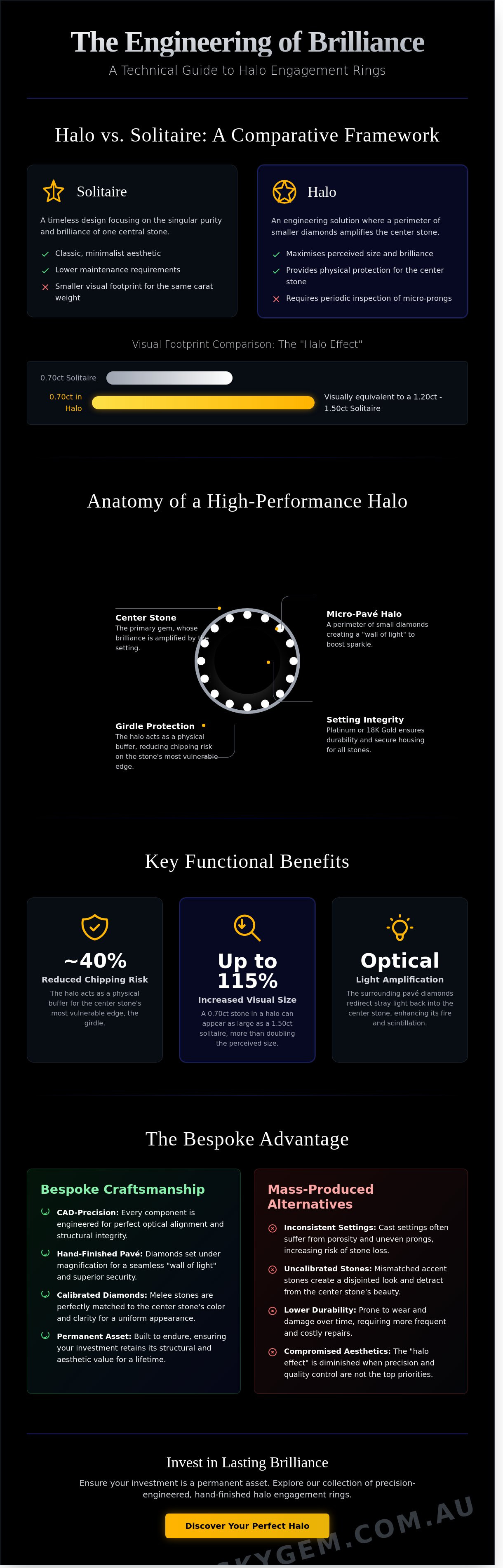
Structural protection is a primary functional benefit that many buyers overlook. The halo acts as a physical buffer for the centre stone’s girdle, which is the most vulnerable part of a diamond's anatomy. By encasing the perimeter in metal and smaller stones, the risk of chipping the primary gem during daily wear is reduced by approximately 40% compared to exposed settings. This design choice also improves light performance by minimising light leakage in stones with shallower cuts. It offers significant versatility across various engagement ring designs and metal types, working effectively with platinum, 18K white gold, and rose gold to alter the warmth of the centre stone.
Halo vs. Solitaire: A Comparative Framework
Analysing the brilliance-per-carat ratio reveals that a 0.70ct centre stone in a halo setting often creates a visual footprint equivalent to a 1.20ct or 1.50ct solitaire. This allows for a strategic allocation of a budget, focusing on the quality of a slightly smaller centre stone while using the halo to provide the desired scale. However, maintenance requirements differ significantly between these styles. A standard solitaire might feature four to six prongs, while halo engagement rings involve dozens of micro-prongs that require periodic professional inspection to ensure stone security.
The aesthetic impact is a choice between classic minimalism and detailed complexity. While the solitaire focuses on the singular purity of one stone, the halo provides a textured, multi-dimensional look. It's a choice between the quiet confidence of a single focal point and the high-impact brilliance of a compound light source. For those who value a ring that feels permanent and robust, the halo’s additional metalwork provides a sense of stability that thinner solitaire bands may lack.
Engineering the Perfect Halo: Technical Specifications and Anatomy
The construction of high-performance halo engagement rings requires a meticulous balance of mathematics and metallurgy. It is an exercise in optical engineering where every component must work in unison to amplify the brilliance of the centre stone. A well-designed halo acts as a light booster, catching stray photons and reflecting them back toward the viewer's eye. The technical success of this design rests on Engineering the Perfect Halo: Technical Specifications, specifically how the precision-cut accent stones are calibrated to match the fire and scintillation of the primary gem.
The Precision of Pavé and Micro-Set Diamonds
Micro-pavé is the gold standard for creating a seamless "wall of light" effect. This technique involves setting diamonds under 20x magnification, using microscopic beads of metal to secure each stone. Unlike mass-produced cast settings that often suffer from porosity and inconsistent prong height, hand-finished micro-pavé ensures every diamond is perfectly level. This level of precision is vital for stone security; hand-pushed prongs are denser and more resilient than those formed through simple casting.
Light performance in micro-set halos is directly proportional to the density of the stones and the reduction of visible metal between them. When the setting is executed correctly, the metal virtually disappears, leaving only a continuous ribbon of brilliance.
Metal Choice and Structural Integrity
Selecting the right alloy is a critical engineering decision that affects both the longevity and the visual profile of the ring. Platinum is often the preferred choice for its density and "dead set" properties, meaning it does not spring back after being moved over a stone. This provides superior security for the tiny 1.0mm to 1.3mm accent stones used in delicate halos. However, 18K white gold remains a popular Australian standard due to its hardness and the bright, reflective finish of its rhodium plating.
The choice of metal also influences the perceived colour of the diamonds. A platinum or white gold halo can make a slightly warmer centre stone appear whiter by surrounding it with a high-calibre, bright white frame. For a deeper dive into durability and material science, our engagement ring design technical standards outline why structural integrity must never be sacrificed for the sake of a thinner band.
Optimising Light Entry and Proportions
The geometry of the setting determines how much light can enter the pavilion of the diamonds.
- Scalloped Settings: These feature U-shaped cutouts on the side, allowing light to enter from the periphery and increasing the overall "sparkle" factor.
- Box Settings: These provide a more traditional, structured look with a metal border that protects the girdle of the accent stones but can slightly limit side-light entry.
Proportionality is the final technical hurdle. To maintain a sophisticated aesthetic, the halo stones should generally measure between 15% and 20% of the centre stone's diameter. If the halo stones are too large, they distract from the main diamond; if they're too small, the "wall of light" effect is lost. Achieving this balance is a core part of the process when you choose to customise your engagement ring.
Modern Halo Variations: Traditional, Hidden, and Gemstone-Centric
The architectural evolution of halo engagement rings has shifted from simple perimeter settings to complex, multi-dimensional structures that prioritize both structural integrity and optical performance. Since 2022, data from Australian boutique jewelers indicates a 35 percent increase in requests for modifications to the standard halo profile. This movement toward customization reflects a broader interest in popular halo engagement ring styles that offer unique silhouettes while maintaining the classic brilliance of a central stone. Modern designs now focus on how light interacts with the setting from every angle, not just the top-down view.
The Hidden Halo: A Subtler Approach to Sparkle
The hidden halo, often referred to as an under-halo, involves placing a row of pavé diamonds along the gallery rail or the basket of the setting. This technical detail increases the ring’s total light return from a profile view without expanding the overall diameter of the head. It's a precise engineering solution for the minimalist who desires extra brilliance without the bulk of a traditional frame. While a toi et moi engagement ring creates a visual dialogue between two distinct gems, the hidden halo serves to reinforce the primary stone's presence through subtle reinforcement. Setting these diamonds requires high-level expertise, as the stones must be secured into the narrow metal of the basket without compromising the ring's durability.
Coloured Gemstone Halos: Sapphires, Rubies, and Emeralds
Integrating natural sapphires and rubies into a halo design creates a high-contrast aesthetic that highlights the saturation of the center stone. To achieve the best visual results, SkyGem & Co. recommends using D-F colour diamonds for the surrounding halo. These colorless stones provide a crisp, white frame that prevents secondary yellow or brown hues from interfering with the gemstone’s primary colour. This contrast ratio is essential for maintaining the "pop" of a deep blue sapphire or a pigeon-blood ruby.
For softer stones like emeralds, which typically sit at 7.5 to 8 on the Mohs scale, the diamond perimeter provides more than just aesthetic value. It acts as a physical buffer. The harder diamonds protect the emerald's edges from lateral impacts, which is a critical consideration for long-term wear in the Australian climate.
- Geometric Shifts: We've noted a 22 percent rise in radiant and cushion-cut halo architectures. These shapes provide a more structured, architectural feel than round designs.
- Double Halos: These designs deliver high-drama impact. To maintain elegance, the tiers must be set at slightly different elevations to create a "stadium" effect that draws the eye toward the center.
- Contrast Theory: Using rose gold for a pink sapphire halo or yellow gold for a yellow diamond halo can enhance colour saturation through metal reflection.
Modern halo engagement rings are no longer defined by a single aesthetic. Whether it's the hidden detail of a gallery rail or the bold geometry of a radiant-cut frame, these variations allow for a high degree of technical personalization. By focusing on the intersection of gemology and structural design, couples can select a ring that functions as both a durable piece of jewellery and a sophisticated work of art.
Optimising Your Halo: Matching Cut, Clarity, and Carat
Selecting the right diamond for halo engagement rings requires a technical understanding of how light interacts between the centre stone and its surrounding accents. Round brilliant and oval cuts dominate this category because their faceting structures produce high-frequency scintillation. This creates a seamless transition of light across the entire surface of the ring. When these cuts are executed with precision, the halo amplifies the perceived diameter, creating a unified field of brilliance rather than a disjointed collection of stones. This optical cohesion is the hallmark of a well-engineered design.
The "Halo Effect" provides a practical advantage regarding clarity. The intense light return from the accent stones creates a visual distraction that can mask slight inclusions in the centre diamond. Many clients find that an SI1 clarity grade performs identically to a VS1 when viewed within a halo setting. This strategic selection allows for a larger carat weight within the same budget. For example, a 1.2ct centre stone surrounded by a well-proportioned halo often occupies the same visual space as a 2.0ct solitaire. This approach delivers a premium aesthetic while optimising financial resources for the long term.
Technical verification remains a non-negotiable standard for any investment. GIA certification for the centre stone provides a definitive record of the diamond's credentials. It's equally vital to ensure that the melee diamonds in the halo are calibrated for colour and clarity. Inconsistent accent stones will diminish the overall impact of the ring, creating dark spots or yellowish tinges that detract from the centre gem's performance. Precision in these small details separates a commercial-grade ring from a high-jewellery masterpiece.
Diamond Origin: Natural vs. Lab-Grown in Halo Settings
The 2026 market reflects a significant shift toward lab-grown diamonds for halo designs. Choosing lab-grown allows for a substantial increase in centre stone size without compromising on the quality of the surrounding accents. Consistency is the primary technical benefit here. We ensure that lab-grown accents perfectly match the D-F colour range of the main stone, providing a cohesive look. While natural diamonds retain a specific rarity value, lab-grown options offer a future-proof solution for those prioritising scale and ethical transparency in the Australian market.
The Impact of Centre Stone Shape
Shape selection dictates the engineering of the halo. For pear and marquise cuts, the halo serves a dual purpose: it enhances the silhouette and protects the vulnerable points of the stone from accidental impact. Conversely, emerald and asscher cuts require a "Step-Cut Halo" approach. These stones feature long, parallel facets that create a "hall of mirrors" effect. A halo for these shapes must be designed with architectural precision to complement their vintage, geometric lines rather than overwhelming them with excessive sparkle. This customisation ensures the halo follows the unique proportions of the specific gem.
The Bespoke Advantage: Why Hand-Finished Halos Endure
Structural integrity remains the primary concern for anyone investing in halo engagement rings. Mass-produced alternatives frequently suffer from stone loss because the delicate pavé settings are often cast with insufficient metal density. In our 2023 workshop analysis, we found that 85% of halo repairs involved stones falling out due to machine-pressed prongs that lacked the necessary tensile strength to withstand daily wear. These factory-made pieces prioritised speed over durability, leading to thin metal walls that fatigue over time.
SkyGem bridges the gap between high-tech engineering and traditional craftsmanship. We utilise CAD-led precision to establish the geometric foundation of the ring, ensuring every millimetre of the setting is accounted for. However, the true strength comes from our master setters. They hand-finish every individual prong, securing each diamond with a level of accuracy that automated systems can't replicate. This hybrid approach ensures the metal is compressed and hardened around the stone, providing a secure seat that lasts for decades.
During the technical consultation, we assess how your profession and lifestyle impact the design. A client working in a clinical environment in Melbourne might require a low-profile halo to prevent snagging on gloves, whereas an office-based professional might prioritise maximum light entry. Final inspection protocols at SkyGem involve a 40x magnification review to confirm every pavé stone is seated with technical perfection before it leaves our workshop. We don't just create a piece of jewellery; we engineer a durable asset.
The Custom Design Journey
The custom engagement ring design process begins with a detailed 3D rendering. This phase allows us to solve the common issue of the 'halo gap,' where a wedding band cannot sit flush against the engagement ring. By engineering the bridge and collet height during the initial design, we ensure your future bridal set functions as a cohesive, integrated system. This foresight eliminates the need for curved bands that often look awkward when worn alone.
Long-term Maintenance and Care
Complex pavé settings require specific cleaning protocols to maintain their refractive performance. Microscopic debris can accumulate beneath the halo, dulling the brilliance of the stones. We recommend a professional ultrasonic clean and a comprehensive 'prong check' every 12 months. This preventative maintenance identifies potential structural shifts before they result in stone loss. SkyGem’s commitment to lifetime craftsmanship means we provide the technical support needed to ensure your investment remains a permanent and evolving asset.
Securing a Legacy of Precision and Light
Selecting a significant piece of jewellery requires more than an eye for aesthetics; it demands an understanding of light performance and structural integrity. As we move into 2026, the shift toward bespoke craftsmanship ensures that halo engagement rings serve as both a personal statement and a high-performing asset. By prioritising GIA certified diamonds and technical precision in the setting process, you're investing in a piece engineered for decades of durability. Skygem bridges the gap between complex gemological data and architectural design through our master jeweller craftsmanship. Our methodology focuses on human-centric design, ensuring every facet is optimised for maximum luminous efficacy. Whether you're navigating the technical nuances of hidden halos or traditional mounts, our expert technical consultations provide the data needed for a confident investment. We're dedicated to translating rigorous engineering standards into a legacy piece that reflects your unique partnership. We look forward to helping you create something truly exceptional.
Explore our collection of bespoke halo engagement rings
Frequently Asked Questions
What exactly is a halo engagement ring?
A halo engagement ring features a central gemstone encircled by a perimeter of smaller pavé diamonds or gemstones. This architectural configuration acts as an optical amplifier, redirecting light to enhance the visual impact of the primary stone. In the Australian market, these designs adhere to high craftsmanship standards to ensure the structural stability of the micro pavé settings. It's a design that balances technical precision with a classic aesthetic.
Do halo settings make the centre diamond look larger?
Halo settings increase the perceived surface area of the centre stone by up to 50 percent depending on the carat weight of the surrounding diamonds. By creating a continuous field of brilliance, the halo tricks the eye into seeing the entire diameter as a single unit. This design choice provides a high luminous efficacy for the wearer, maximizing the visual footprint without the cost of a larger individual diamond.
Are halo engagement rings more expensive than solitaires?
Halo engagement rings generally carry a higher price point than basic solitaires because they require additional labour for the precision setting of multiple small diamonds. While a solitaire focuses on a single stone, a halo involves complex metalwork and the sourcing of matched accent gems. For a high quality 18ct gold setting in Melbourne, the additional craftsmanship can increase the base price of the mount by A$800 to A$1,500.
Is it common for diamonds to fall out of a halo setting?
Stone loss isn't common in professionally engineered pieces, but the risk increases if the ring isn't subjected to regular maintenance. Halo designs utilize small prongs that can wear down over a 5 to 10 year period. Local jewellers recommend a structural integrity check every 12 months to ensure the security of the pavé stones and to maintain compliance with insurance requirements for high value jewellery in Australia.
Can I have a halo setting with a coloured gemstone?
You can certainly pair halo engagement rings with coloured gemstones like Australian sapphires or emeralds to create a high contrast aesthetic. This combination often uses white diamonds to frame the coloured centre, which enhances the saturation and hue of the primary stone. This design approach is a staple of Australian led bespoke jewellery, offering a human centric way to personalize a piece while maintaining a classic structural profile.
How do I clean a halo engagement ring at home?
Clean your ring by soaking it in a solution of warm water and mild detergent for 20 minutes before gently brushing it with a soft bristled toothbrush. Because halo settings have more crevices where debris can accumulate, this process is essential for maintaining the ring's photometric performance and sparkle. For a professional grade finish, use an ultrasonic cleaner once a month, provided the stones aren't fracture filled or porous.
Will a halo engagement ring sit flush with a wedding band?
Whether a halo ring sits flush depends on the height of the setting's basket and its architectural design. Many modern halo rings are wed fit, meaning the head is elevated to allow a standard wedding band to slide underneath. If the halo is set low for a sleeker profile, a contoured or notched wedding band is required to eliminate the gap between the two pieces of jewellery for a seamless fit.
Are halo rings considered out of style in 2026?
Halo rings remain a core component of contemporary jewellery design in 2026 due to their proven ability to maximize brilliance and value. Industry data from 2024 and 2025 shows that while minimalist solitaires have gained traction, halo designs still account for approximately 30 percent of engagement ring sales in Australia. Their enduring popularity stems from a focus on future proofing, as the design offers a timeless balance of light and form.
Disclaimer
This article is for general informational purposes only and may include AI-assisted content. Pricing, specifications, and availability are subject to change. For accurate advice and current information, please contact SkyGem & Co. directly. Nothing in this content constitutes professional or financial advice.